Exclusive | Facewall Intelligent's edge-side large model will be launched on Samsung smartphones
By Deng Yongyi
Edited by Zhang Yuxin, Yang Xuan
Intelligent Emergence has exclusively learned that Edge-side large model company MiniMax Intelligence has reached a cooperation with Samsung Mobile. Its self-developed MiniCPM series of edge-side models will be launched on Samsung smartphones, covering several flagship models.
On the same day, the cyberspace administration authorities announced that seven mobile-side generative AI services, including "Apple Intelligence", had completed the filing process.
The announcement shows that a total of seven services have completed the filing: Apple Intelligence, Huawei Xiaoyi AI Large Model, OPPO Andes GPT, vivo Blueheart Edge Large Model, Xiaomi Surge AI, Samsung Galaxy AI, and Nubia Doubao Mobile Large Model.
Since the wave of large models arrived, edge-side AI has been in a period of technical exploration and early development. The simultaneous approval of seven mobile-side AI services on the same day marks an important industry milestone: edge-side AI is no longer a conceptual demonstration, and has entered the stage of large-scale implementation.
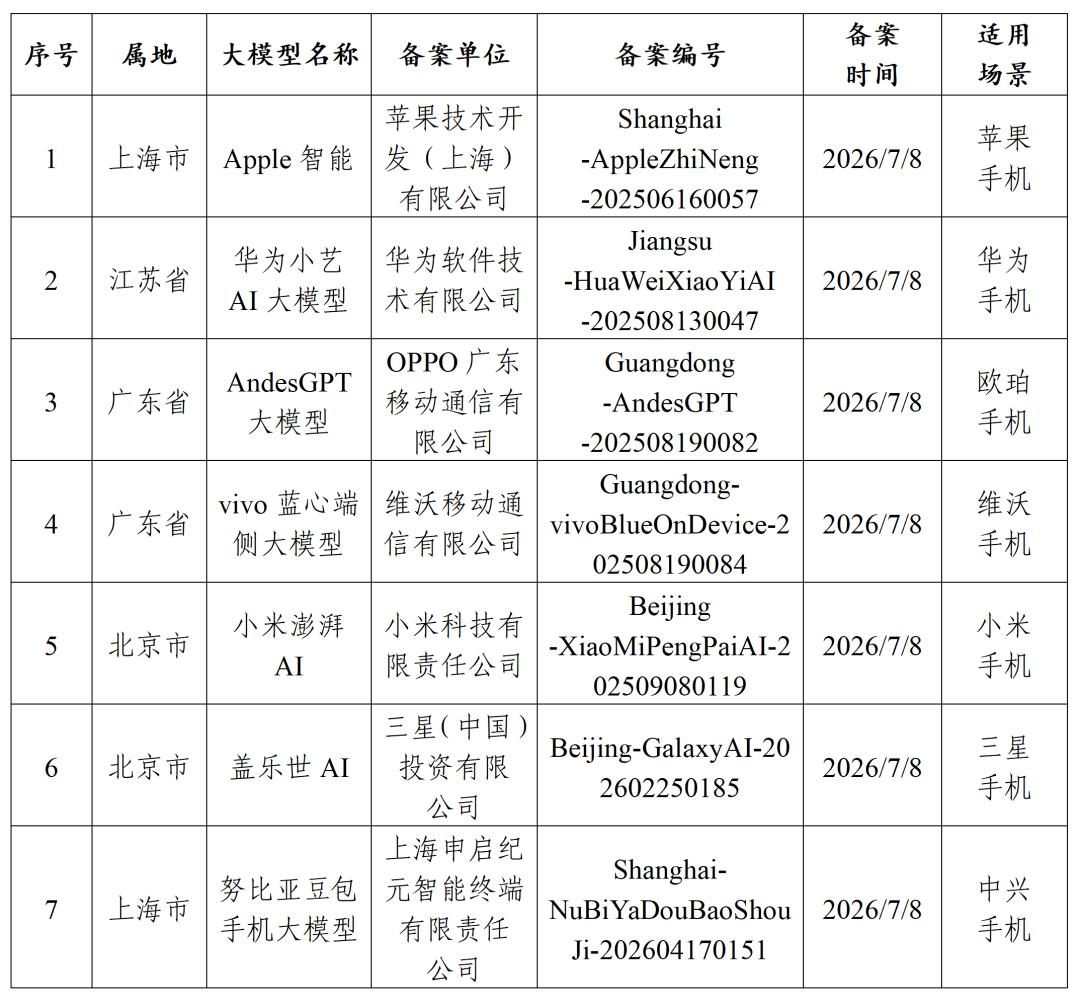
△ Source: Cyberspace Administration of China
On the same day, Alibaba confirmed to the media that Alibaba's Qwen will be integrated into Apple Intelligence as an AI capability, covering domestic devices running iOS, iPadOS, macOS and visionOS. Users can experience Qwen's capabilities such as text and image understanding, and content generation on Apple devices without switching apps. Following the announcement, Alibaba's stock price rose by more than 5%.
Previously, the edge-side AI capabilities of domestic mobile manufacturers were mostly supported by self-developed models — Huawei had Xiaoyi, OPPO had AndesGPT, vivo had Blueheart, and Xiaomi had Surge AI. Now, Alibaba's Qwen is deployed on Apple Intelligence, and MiniMax Intelligence's models are pre-installed on Samsung smartphones. This shows that AI model companies are becoming important suppliers of mobile AI capabilities. Mobile manufacturers no longer need to develop every capability on their own, and a market-based division of labor for edge-side models is taking shape.
The Startup That First Bet on Edge AI
MiniMax Intelligence was founded in Beijing in August 2022, incubated from the Natural Language Processing Lab of Tsinghua University. Its co-founder and CEO Li Dahai was formerly a partner and CTO of Zhihu; co-founder and chief scientist Liu Zhiyuan is currently a professor in the Department of Computer Science at Tsinghua University; co-founder and CTO Zeng Guoyang, at the age of 22, served as the core engineering lead in training CPM-1, China's first large language model.
According to reports from Investment Media, in the first half of 2026, MiniMax Intelligence has raised a total of over 50 billion yuan in financing, with its valuation exceeding 200 billion yuan, making it the highest-valued unicorn in China's edge AI sector.
MiniMax Intelligence is also one of the earliest domestic startups to bet on edge AI. In the second half of 2023, when the industry was still chasing the parameter scale of cloud-based large models, MiniMax Intelligence decided to go all-in on the edge-side path. This choice was not mainstream at the time — all large model companies were competing on parameters and computing power, and edge-side models were regarded as a niche "downsizing" route.
MiniMax Intelligence's judgment is based on a core methodology: knowledge density. In 2024, MiniMax Intelligence and the Tsinghua University team proposed the "Large Model Densing Law", which states that the maximum capability density of open-source large models roughly doubles every 3.5 months, and the parameter scale required for equivalent intelligence decreases exponentially.
This judgment has been gradually verified in subsequent model releases. In May 2026, MiniMax, together with Tsinghua University and OpenBMB, open-sourced the new generation of edge-side text base model MiniCPM5-1B, with only 1 billion parameters, scoring 17.9 points in the Artificial Analysis Intelligence Index, outperforming many open-source base models with larger parameter scales. Another model, MiniCPM-V 4.6, has only 1.3B parameters and can run smoothly on mobile phones with 6GB of memory, supporting mainstream operating systems such as iOS, Android, and HarmonyOS.
At present, the cumulative downloads of the MiniCPM series open-source models on platforms such as GitHub and Hugging Face have exceeded 38 million times.
In a recent exclusive interview with 36Kr, Zeng Guoyang explained the underlying logic of edge models: "The edge side is a hard constraint — if the model is too large to run, it just can't run, no amount of subsidies can help; if the power consumption is too high, the device overheats, and you can't subsidize an ice pack to cool it down." In his view, developing edge-side models is no less difficult than building large cloud models: "Achieving high efficiency is extremely challenging, it's not that the bigger the model, the simpler the work."
The implementation of edge-side models is not just about making models more efficient, but also about connecting the full chain of algorithms, chip adaptation, power consumption optimization, and end-device deployment.
MiniMax Intelligence has completed full adaptation for mainstream chip platforms including Qualcomm, MediaTek, Intel, Rockchip, NVIDIA, and AMD. In terms of domestic chips, MiniMax Intelligence has participated in the software stack construction for domestic chips such as Huawei Ascend and Cambricon, and released China's first ternary quantization large model BitCPM-CANN, which can save about 6 times the video memory during the inference phase.
MiniMax Intelligence has also established a diverse matrix of edge-side models. For example, the newly released MiniCPM-o4.5 is a full-duplex multimodal large model, which achieves simultaneous multimodal interaction of voice, video, and text with 9B parameters.
For edge-side models to run on mobile phones, issues such as power consumption, heat dissipation, memory usage, and response latency must be resolved, and every link is indispensable. "Edge-side models are not only judged by benchmark performance, but also by response time and hardware cost. It is difficult to achieve success in just one single dimension," Zeng Guoyang said in the interview.
In the automotive sector, MiniMax Intelligence has initially verified its large-scale implementation capabilities. Its self-developed edge-side intelligent agent SuperMate is expected to be deployed in more than 300,000 mass-produced vehicles by the end of 2026, covering brands such as Geely, SAIC Volkswagen, GAC, and Mazda, completing the full chain of model adaptation, hardware compatibility, supply chain management, and terminal delivery.
Samsung is one of the Android phone manufacturers with the largest global shipment volume. Its edge-side AI capabilities previously mainly relied on self-developed Galaxy AI and cooperation with Google. According to South Korean media reports, Samsung is in deep cooperation with Google to integrate Gemini into its device ecosystem, including the Galaxy Unpacked 2026 series products to be released in London on July 22. The specific role of MiniMax Intelligence's edge-side models in Samsung's system remains to be further confirmed.
Cover Source | AI Generated

👇🏻 Scan the code to join the "Intelligent Surge AI Exchange Group" 👇🏻

Welcome to exchange ideas
This article is from the WeChat public account "Intelligent Emergence", written by Deng Yongyi, and published with authorization from 36Kr.