Why doesn't Anthropic develop hardware?
The Pixel 11 is almost here.
Google has officially announced that it will host the new edition of the Made by Google launch event in New York on August 12 local time. According to current information, the Pixel 11, Pixel 11 Pro, Pixel 11 Pro XL, and the foldable Pixel 11 Pro Fold are expected to make their debut together.

Beyond smartphones, Google already oversees Android, Chrome, Pixel Watch, audio accessories, and smart home devices. This past May, it unveiled the Googlebook, a new generation AI laptop designed around Gemini Intelligence, with the first batch of products scheduled to launch this fall.
From smartphones and computers to browsers, wearables, and smart home systems, Google already owns a full hardware and software ecosystem that covers both work and daily life.
On the other side, OpenAI is also building its hardware portfolio entirely from scratch.
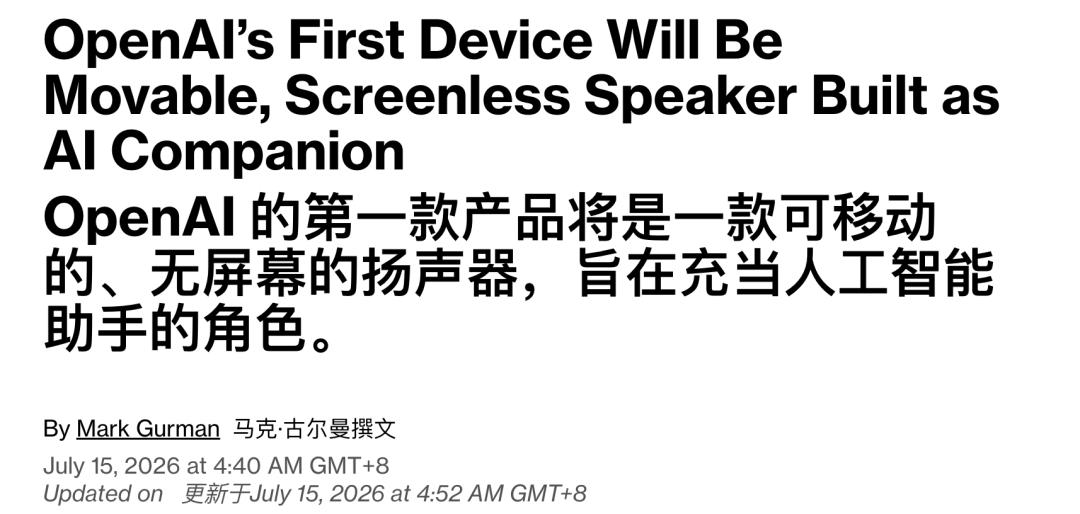
In 2025, it integrated io, the hardware company founded by Jony Ive, into its organization to push forward its own AI device roadmap. Now, the form of its first product has begun to take shape: as reported by Bloomberg, OpenAI is developing a portable, screen-less smart speaker designed to perceive home environments, offer proactive assistance, and act as a long-term presence closer to a "human-like AI companion" — similar to the familiar Xiao Ai, but upgraded with GPT capabilities.
One party already has a mature hardware ecosystem, while the other is preparing to build new endpoints completely from the ground up. With different backgrounds, both companies are setting their sights on the next critical access point in the AI era.
Among the "Big Three", only Anthropic appears remarkably quiet.
It has no Claude smartphone, no smart glasses, and has not publicly showcased any new device designed to reshape human-computer interaction. Even though Claude has become one of the most critical foundational models, Anthropic's core products still run on computers, browsers, and cloud platforms manufactured by other companies.
As more and more AI companies compete for the endpoints where users interact with AI, Anthropic is betting on a different future:
In the AI era, what is truly worth controlling may not be the device sitting beside the user, but the foundational model itself, and the tools that enable the model to operate effectively in real workflows.
Those adapting existing systems prioritize convenience, those building new paradigms prioritize completeness
Both Google and OpenAI are developing hardware, but their starting points are exactly opposite.
For Google, hardware is a card it has already held in its hand for a long time.
Search, Chrome, Android, Workspace, and Cloud form Google's sprawling internet empire; Pixel phones, watches, audio devices, smart home products, and the upcoming Googlebook extend this ecosystem all the way to the devices users interact with daily.
The Googlebook announced this past May is a particularly representative example. As we covered in previous articles, AI is driving a renewed surge in the value of productivity-focused hardware. As AI Agents evolve, computers also require stronger local performance, deeper system permissions, and smoother cross-app collaboration to help AI integrate more seamlessly into users' daily work.
What Google is working to do is rebuild its existing product ecosystem — originally built around the internet — into a new ecosystem that operates around AI.
This represents the AI transformation journey of a long-established tech giant.
Its advantage lies in its extensive existing assets: the model does not need to find users from scratch, and can directly integrate into phones, computers, browsers, email, office software, and cloud services. But this is also where its challenges lie: every existing product is tied to a mature product logic, revenue structure, and entrenched user habits.
As another legacy tech giant, Apple faces the exact same dilemma.
It owns smartphones, computers, operating systems, chips, an app store, and a massive base of high-value users, which theoretically gives it control over the distribution access that is hardest to secure in the AI era. However, Apple has long failed to build sufficiently competitive capabilities at the foundational model layer.
Eventually, Apple chose to leverage Google's strengths. This past January, the two companies announced a multi-year partnership, under which the next-generation Apple foundational model will be built on Gemini and Google's cloud infrastructure, powering the new version of Siri and additional Apple Intelligence features.
Apple's most valuable asset has thus revealed a clear gap: endpoints, systems, and users are all ready, but the intelligent layer that can truly power next-generation interaction still needs to be supplemented externally.
Meta, by comparison, is a case study in disjointed transformation.
It once had an almost enviable set of assets: global user bases and social connections brought by Facebook, Instagram, and WhatsApp, the model influence built by Llama, massive computing power investment, and a long-standing dedicated hardware team.
From Quest headsets and Ray-Ban smart glasses to Orion AR devices and myoelectric wristbands, Meta has barely missed any direction that could potentially become the next-generation access point. But these investments have never coalesced into a single core product line capable of redefining the entire company. It has dabbled widely in hardware, but ended up with little tangible success to show for it.
By contrast, Google at least has a clear vision for where to play its existing assets.
On the other side of legacy tech companies, OpenAI — a native AI company — has to start completely from scratch when it comes to hardware.
It originated from foundational models and ChatGPT, with no in-house smartphones, operating systems, app stores, low-level browser infrastructure, or consumer electronics supply chains. While ChatGPT has a massive user base, these users still access it through devices controlled by Apple, Google, and Microsoft. In other words, OpenAI owns the models and applications, but does not own the endpoints that carry them.
Therefore, the most fundamental logic behind OpenAI's hardware initiative is first and foremost to fill a gap in its capabilities.
In 2025, OpenAI integrated Jony Ive's io team into the company to formally build its in-house device development capabilities. On July 15, citing sources familiar with the matter, Bloomberg reported that the first device co-developed by OpenAI and Jony Ive's team would likely be a portable, screen-less smart speaker, envisioned as a "human-like AI companion" that can perceive home environments and offer proactive assistance.
According to reports, this product will help users control smart home devices, play media content, answer a wide range of queries, process messages, and leverage the full suite of capabilities available in ChatGPT.
This past May, analyst Ming-Chi Kuo revealed that OpenAI is accelerating development of a product directly targeted at the smartphone market, with mass production planned as early as 2027. At the end of June, OpenAI's developer account publicly teased the Codex hardware developed in partnership with custom keyboard manufacturer Work Louder, setting July 15 as the reveal date. As of press time, full product details have not been officially announced.
From the screen-less AI companion designed for home use, to the reported smartphone under development, and the publicly teased Codex controller, it is clear OpenAI does not intend to build just one piece of hardware. It is simultaneously exploring new device form factors, the mature smartphone market, and physical access points tailored for specific work scenarios.
But hardware is only one part of this broader expansion.
From search and browsers to programming, office work, enterprise services, and app platforms, OpenAI is continuously expanding outward from its core model business. ChatGPT itself is increasingly moving away from its original chatbot identity, gradually evolving into a unified access point designed to aggregate all forms of digital activity.
On July 9, OpenAI began consolidating its previously fragmented product lines back into ChatGPT: the Codex App was formally integrated into the new desktop version, and ChatGPT Work extended Codex's long-task execution capabilities from programming to documents, websites, and presentations. At the same time, the Atlas browser will cease operations on August 9, with its browsing capabilities fully migrated into ChatGPT.
This aligns with the desktop "Super App" direction previously reported by media outlets: search, browsing, programming, and general work functions will no longer exist as independent access points, and will eventually become built-in capability modules within ChatGPT.
OpenAI's expansion path closely mirrors the growth trajectory of super platforms during the internet era: acquire users first, then secure access points; once the access point is established, gradually bring search, browsing, content creation, tool invocation, and task execution into a single unified ecosystem.
However, any discussion of OpenAI's full-scale expansion cannot avoid mentioning Sam Altman himself. In fact, this entire strategy carries his very distinct personal imprint.
Altman grew up through internet entrepreneurship and the Y Combinator ecosystem. He is accustomed to thinking from the perspective of a sufficiently large end state, identifying which missing pieces are required to reach that end state, and then filling them in one by one. Beyond OpenAI, his long-term investments and advocacy span chips, energy, identity authentication, and life sciences; he has also sought unprecedentedly massive capital to reshape global AI chip and computing power supply.
As a result, OpenAI's current expansion is far more than just "building a few more products". Altman appears to believe that if AI eventually becomes a foundational platform, OpenAI cannot only own the models. It must also control applications, users, endpoints, computing power, and even the chips and energy infrastructure that underpin that computing power.
This "internet platform" mindset is exactly what has drawn long-standing criticism: the super platforms of the internet era could rely on near-zero software replication costs and powerful network effects to continuously layer new services on top of their existing user bases, but AI is a business where every invocation generates real, tangible costs.
Altman may be building the true operating system of the AI era, or he may simply be transporting the proven internet playbook of "seize access points first, then expand comprehensively" into an era with a completely different cost structure and industrial dynamics.
Anthropic: Hardware is not the top priority
While OpenAI chooses to extend its foundational model outward continuously, eventually filling every access point a company can possibly own, Anthropic — which also started from foundational models — has made almost the exact opposite choice.
Claude is certainly adding capabilities for search, design, office work, and mobile access. But even as Claude's user base continues to grow, Anthropic has shown no interest in turning it into an all-encompassing super access point.
Its product portfolio is expanding, but its core focus remains unwavering: keep investing in foundational models, and deploy those models directly into real-world work scenarios.
This is what differentiates Anthropic from many other AI application companies. It does not take an off-the-shelf model and then hunt for a handful of vertical scenarios that can be easily monetized. Behind Claude Code, Cowork, and Claude Science lies a shared prerequisite: the foundational model itself must be powerful enough to process massive volumes of context, plan multi-stage tasks, invoke external tools, and iterate continuously after encountering errors.
The Model Control Protocol (MCP) launched by Anthropic in 2024 provides an open connection framework for these models to integrate into real work environments. Through MCP, Claude can connect to code repositories, databases, Google Drive, Slack, and internal enterprise systems via various connectors, read context scattered across disparate tools, and execute operations once authorized.
Anthropic has not attempted to lock all data and software inside Claude's own closed ecosystem, and later handed MCP over to vendor-neutral open governance. It appears to believe that as long as the model's core capabilities are strong enough, and it has pathways to access all kinds of work environments, Claude does not need to own every single application to become the central intelligent layer in workflows.
Anthropic's focus on real work scenarios first manifests as continuous, heavy reinvestment in foundational models.
Writing a smooth paragraph of text is not difficult, but to understand an entire code repository, modify files, run tests, and iterate based on error feedback, the model must get dozens of consecutive steps right. The same holds true for scientific research, finance, law, and enterprise processes: work often spans multiple software tools and data sources, and all outputs must be verifiable, traceable, and deliverable.
A single error in any step can invalidate the entire workflow.
The value of Claude Code does not come solely from its user interface, permission system, or integration with development tools. Its viability first stems from the fact that Claude itself is capable of understanding large codebases, maintaining long-running task states, and troubleshooting issues after failed tests. The same logic applies to Cowork and Claude Science: the product provides a working environment, but it is ultimately model capabilities that determine how far these offerings can go.
Model development and application building are not separate activities — they are deeply intertwined. Real work scenarios themselves are the place to test models, expose their flaws, and define the direction for the next round of capability improvements.
The programming use case is particularly well-suited to fulfill this role. It has clear objectives and relatively objective feedback: whether the program runs, whether tests pass, and whether modifications break existing functionality. Deficiencies in the model's planning, tool invocation, and self-correction capabilities cannot be hidden behind a fluent natural language output in such tasks.
Cat Wu, Claude Code's product lead, mentioned on Lenny's Podcast that the team intentionally pushes product development right up to the current edge of the model's capabilities.
For example, the Claude Code team experimented with code review features very early on, and had a working product prototype, but the model's accuracy at the time was not high enough to make it a reliable feature. Instead of waiting for the model to mature and starting development from scratch later, the team kept the prototype. Once the next-generation model crossed the required capability threshold, the product could immediately be retested and launched.
We have also covered this history of Claude Code in our previously shared articles.
At Anthropic, model research and product development do not follow a sequential pipeline where research is completed first and then handed off to product teams. The two teams operate in parallel: the product team explores capabilities the model may soon support, while the research team continuously raises the ceiling of what the model can accomplish in real tasks. Every time the model makes progress, previously unworkable features can rapidly turn into finished products; once the product is deployed in real work, it exposes new failure cases, feeding those insights back into model improvement.
Cat Wu noted that some feature development cycles at Anthropic have been shortened from months to weeks, days, and in some cases just a single day. This is certainly enabled by leaner processes and AI-assisted development, but more importantly, it comes from Anthropic placing research, product teams, and end-user work scenarios in extremely close proximity.
The company itself is part of this iterative loop. Anthropic employees directly use Claude Code and Cowork to build internal tools, connecting workflows that were previously scattered across different software and data sources.
As a result, the hardware that Google and OpenAI are betting heavily on does not occupy an important place in Anthropic's roadmap — the problems it aims to solve do not require a dedicated Claude phone to be viable.
Developers, researchers, and enterprise employees already have computers, smartphones, browsers, and a wide range of professional software. What Anthropic needs to do is not build another device, but enable Claude to traverse these existing devices and software to access the context, tools, and permissions required to complete tasks.
In other words, Anthropic does not need to own the endpoints in users' hands to access the work that happens behind those endpoints.
This gives Anthropic and OpenAI completely distinct corporate identities. OpenAI is constantly expanding its boundaries: moving from models to applications, then to browsers, hardware, chips, and energy, attempting to fill every single gap a super platform could possibly need. Anthropic, by contrast, is far more focused. It does not reject new features and scenarios, but every expansion it makes must serve the same core priority: make the model more powerful, and enable the model to work deeper and more effectively.
Internet companies traditionally need to control access points because users, content, and transactions all aggregate around them. But AI companies do not necessarily need to follow that same path. Models are inherently designed to run across devices, software, and platforms. As long as the model is powerful enough, and can connect to a sufficiently wide range of tools, it does not need to own every single screen.
From this perspective, Anthropic's strategy may actually represent the optimal path for a native AI company:
Instead of remaking itself into another Google, Apple, or Meta, or rebuilding an entire internet empire from scratch, it concentrates all its resources on the capabilities that are uniquely proprietary to an AI company.
The core assets of a native AI company are not smartphones, operating systems, or a single fixed access point. They