Under the current architecture, even self-evolving AI cannot replace human judgment.
By mid-2026, the timeline for AI "R&D automation" has become remarkably aggressive.
In a report disclosed by Anthropic in June, Claude had already taken over more than 80% of internal code writing tasks. The Mythos model achieved a 52x speedup on a training code optimization task, far exceeding the 4x improvement that even a skilled human researcher could barely deliver after several hours of work.
In China, MiniMax's M3 model completed the full pipeline of "data synthesis, training, evaluation, and iteration" in just 12 hours without any human intervention. Facewall Intelligence's MiniCPM5 even used an Agent closed loop to enable the model to write a pre-training framework with 10% higher computing power utilization than the native Megatron.
All these facts prove that the industry is genuinely pushing the boundaries of Recursive Self-Improvement (RSI).
RSI refers to the scenario where models substantially participate in the complete R&D chain that "makes themselves stronger". They define goals, build environments, write code, run experiments, and feed verified successful improvements back into the underlying model.
Back in 1965, mathematician I.J. Good proposed the concept of an "intelligence explosion". In subsequent systematic deductions of superintelligence evolution paths by scholars such as Nick Bostrom, one of the most influential contemporary philosophers and our guest in the previous issue, RSI has always been the most critical link leading to ultimate intelligence.
However, over the past decade, this was nothing more than a thought experiment, because the underlying model capabilities were simply insufficient to support such an evolutionary closed loop.
But now, with the maturity of models, the technical foundation is nearly fully in place.
If AI truly crosses the threshold of self-evolution, how will research itself change? How will human capability structures transform? Why would organizations still need to exist?
Standing at the threshold of RSI, all these questions urgently need answers.
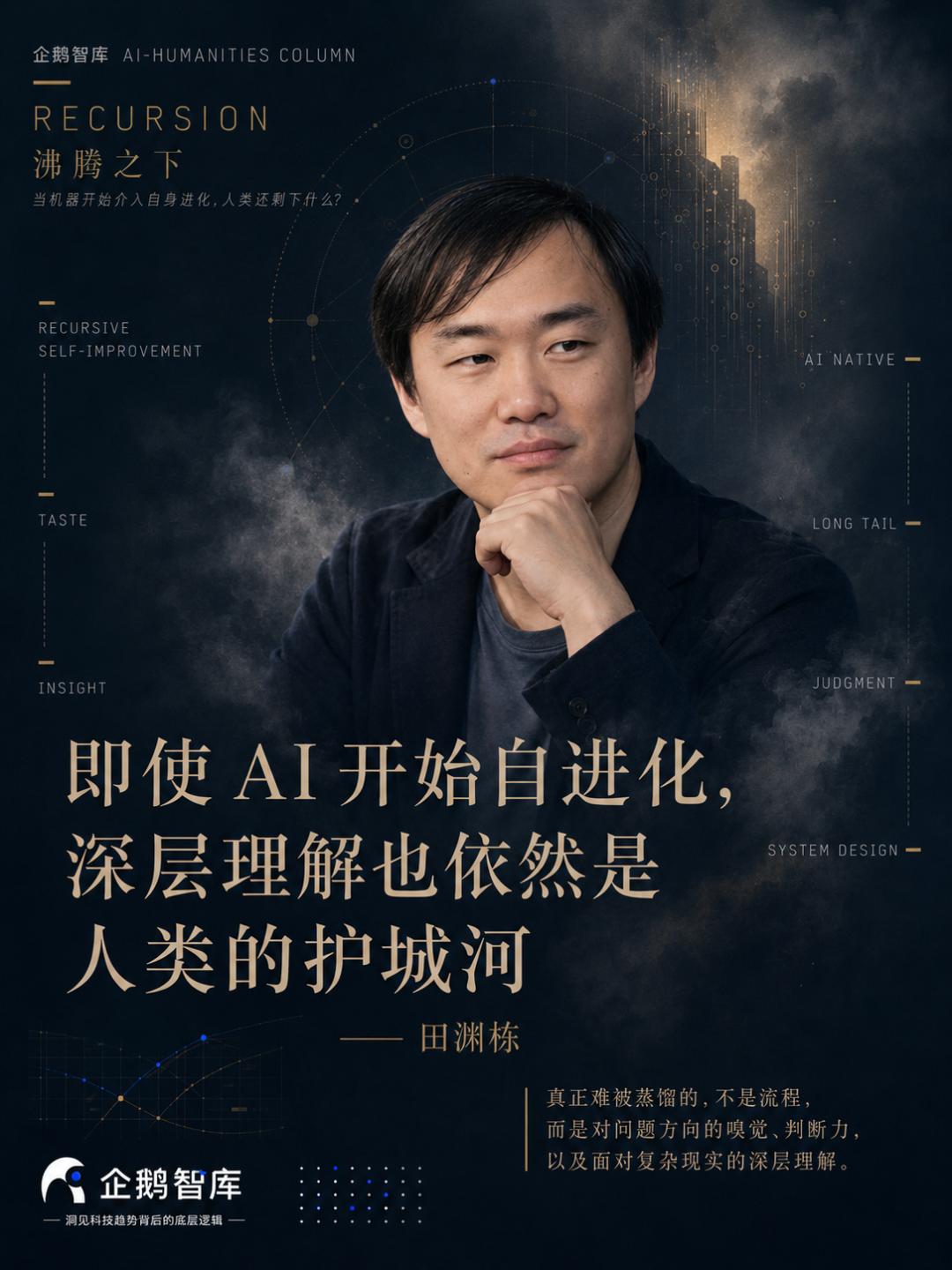
Dr. Tian Yuandong is likely one of the most suitable people to answer these questions.
He previously conducted cutting-edge AI research at Meta FAIR for a long time, and proposed a ladder explanation for Grokking (the sudden improvement of model performance). He also produced research achievements in fields such as reinforcement learning, Self-Play, model self-optimization, and open-ended exploration.
In 2026, he joined Recursive AI as a co-founder. As its name suggests, this company aims to build a self-evolving AI system.
He is not only an expert in self-evolution, but also a witness to organizational changes in the Silicon Valley wave.
On the eve of this transformation, we had a long conversation with him. We tried to clear the fog of AI automation, directly address the real current bottlenecks of self-evolving systems, and explore how individuals and organizations can reposition themselves when the path to workplace success shifts from "leading a team of a hundred people" to "controlling a group of Coding Agents".
Standing on the cliff of the transition between old and new paradigms, the answers he gave surprisingly carry a certain existential undertone.
In Tian Yuandong's view, trying to race against machines in parameter tuning and execution efficiency is a doomed losing battle. When RSI completely reshapes the division of intellectual labor in the future, humanity's last moat lies in those "deep understandings" that cannot be structured and externalized.
This includes a keen sense of problem direction, the Taste that determines where superintelligence should go, and the irreplaceability of the subject when facing real complex situations.
The following is our conversation.
01 What is the threshold for self-evolving AI?
Beneath the Surface: Self-evolving AI is now a very popular cutting-edge technical issue. But many companies are actually already working on automated AI R&D, especially the post-training part, where agent-led data synthesis, training, evaluation, and iteration are already relatively mature. What is the core difference between the self-evolving AI that Recursive AI aims to build and these already implemented automated AI R&D practices?
Tian Yuandong: These automated R&D efforts are just the first step. Our subsequent goal is to enable AI to discover new algorithms, new patterns, new architectures, and new data mixes, and even find architectures that are completely different from the current Transformer architecture, so as to discover the next-generation training paradigm.
This is our highest goal.
Beneath the Surface: So this is a more open process?
Tian Yuandong: Exactly. The simplest recursive form is hyperparameter tuning, but the hyperparameter space is not very large. Now that large models are very powerful, we can use a much larger search space.
Note: The term "automated AI R&D" here mainly refers to delegating links such as data generation, training, evaluation, and parameter tuning in existing R&D workflows to agents; while "self-evolving AI" emphasizes more on whether the system can discover new algorithms, architectures or training paradigms, and feed the results back into the improvement of the model itself. The difference between the two does not lie in the degree of automation, but in whether a closed loop of "improving itself" is formed.
Beneath the Surface: I have a somewhat immature understanding: can AI self-evolution be regarded as an automated scientific discovery process? First identify the problem, then define the goal and reward, then explore solutions, then construct the environment and required data, and finally verify the results and retain the improvements. These improvements can be in external form or parameter form. Do you think this understanding is correct?
Tian Yuandong: The high-level understanding is roughly correct. It is equivalent to automating the research process of researchers. After automation, AI finds new insights and ideas, then puts them back into the original AI to make it stronger. After AI becomes stronger, it can continue to automate. That's roughly the logic.
The difference between it and AI Scientist is that the goal of AI Scientist may be something outside AI, such as material design or drug design. These tasks do not involve modifying AI itself, and there is no path for self-production and self-enhancement.
We prefer to find self-producing applications. If we discover a new pre-training architecture, we can put it back into pre-training to make the model stronger. This is a feature that many AI Scientist directions do not have.
Note: AI Scientist usually refers to using AI to automate scientific research workflows, such as proposing hypotheses, designing experiments, writing papers, or solving external scientific problems like materials and drugs. Recursive AI focuses on a more recursive version: the research object is not an external scientific problem, but how AI itself can continue to become stronger.
Beneath the Surface: For the automated systems that have been industrially deployed now, which parts do they roughly cover? Which part does Recursive AI want to advance? For example, part of pre-training is automated, and there are also automated workflows for parameter tuning. Which parts are relatively mature and which are not?
Tian Yuandong: It's hard to say which parts are mature and which are not. Even for parameter tuning, you can achieve very good results. If you have a deeper understanding of the parameter space, the model or the parameter-tuning AI may discover some better parameter combinations.
So it's not that parameter tuning is always the lowest-level work. The most important thing is whether the model has a better understanding of the problem. With a better understanding, parameter tuning will also have more profound significance.
The specific action space is not the only factor that measures the strength of self-evolution.
Beneath the Surface: What matters more is how powerful the exploration space is?
Tian Yuandong: Right, the exploration space, and whether you can make amazing discoveries within that exploration space.
Many experienced large model researchers will form very important insights into the problem after observing a large number of signals. Writing down these insights can greatly improve efficiency. Insights can be very simple, ranging from tuning parameters to modifying just two lines of code.
The specific action is not important. What matters is how deep your understanding of the problem is.
Note: "Exploration space" can be understood as the range of schemes that the system allows itself to try. Parameter tuning, code modification, data ratio adjustment, and architecture changes are just action spaces at different levels; what truly determines the self-evolution capability is whether the system can form effective insights in these spaces, rather than whether the action itself looks advanced.
Beneath the Surface: AI is a very good pattern learner, which can summarize probabilities and patterns from existing content. To some extent, even natural scientific discoveries are recursive and inductive.
Experienced researchers discover rules after observing many examples, then summarize and improve them. Logically, this should be what AI is good at. But you also mentioned in other interviews that AI's own innovation capability is still limited. Isn't there a contradiction here?
Tian Yuandong: Innovation exists at different levels. For relatively simple innovations, AI is already very strong, even surpassing humans.
For example, transferring concepts to other scenarios and applying existing concepts to perform repetitive tasks — AI already does these very well.
But at more complex and abstract levels of innovation, AI has not yet reached human level.
The two are different.
Beneath the Surface: What is the general pattern of more complex innovations? For example, some discoveries are recursive, while others may be accidental. Is AI unable to grasp such contingencies or more advanced new discoveries?
Tian Yuandong: We can look at some examples, such as how Galois discovered group theory, and how Einstein discovered the theory of relativity and even the general theory of relativity. These are conceptual breakthroughs formed on the basis of a large number of experiments.
Conceptual breakthroughs can solve many previously unsolvable problems. With such concepts, the perspective from which you ask questions and your understanding of the problem will be completely refreshed.
Currently, AI cannot conduct such research yet.
Beneath the Surface: Is it because it does not yet have good conceptual induction and summarization capabilities?
Tian Yuandong: Yes, or to put it another way, it lacks the ability to instantly understand new structures. It mostly matches patterns derived from past experiences.
Of course, even if it's just pattern matching, AI is already very useful in practice. In many scenarios, simple pattern matching can also achieve very good results.
If the highest-level direction cannot be achieved for the time being, there will still be many application deployment scenarios.
Beneath the Surface: With the current autoregressive architecture of AI, is it possible for it to emerge with more advanced semantic summarization or updated pattern understanding?
Tian Yuandong: With current large models and training algorithms, I think it's not easy (to achieve the understanding of new structures). But if we find new algorithms, it might be possible.
We are still in the process of exploration now.
Note: "Conceptual breakthrough" does not mean making better matches in existing patterns, but changing the way the problem itself is expressed. Tian Yuandong used group theory and the theory of relativity as examples to illustrate that truly advanced scientific discoveries often come from new abstract frameworks, not just inducing local laws from a large number of samples.
02 How to cross the threshold of self-evolving AI?
If the first part discusses "what counts as self-evolution", this part discusses a more engineering-oriented problem: how to make the system truly cross this threshold? The bottleneck here is not just computing power or the model itself, but a series of specific engineering steps.
These include verification signals, human insights, feedback speed, and how the system organizes different evolution paths into a sustainable closed loop.
Beneath the Surface: A very practical problem is that training a frontier-scale model once may take weeks or months and is extremely expensive. In this case, how can the research team determine whether a training route is correct?
Tian Yuandong: Right now, it still relies on experienced researchers to look at specific metrics. A model goes from pre-training, to RL, then to RLHF, and finally is released. We hope the final model has excellent metrics, but the relationship between the final parameter metrics and the initial pre-training decisions is not yet very clear.
So we still have to rely on experience and past knowledge to find good solutions and identify intermediate metrics to measure the process.
In this way, everyone can be confident that previous judgments were correct. If this process can be automated, things will be better later on.
Beneath the Surface: Currently, the main bottlenecks driving AI research — are they GPUs, cluster stability, or things like reward signals and verification signals that cannot keep up?
Tian Yuandong: I think reward signals and human insights are more important.
Clusters are of course also important. You need a minimum cluster size to get started; it's very difficult to do things with too few cards. But after the cluster reaches a certain scale, the biggest problem is how to let everyone maximize the display of their knowledge and discover new insights.
Note: A reward signal refers to the feedback signal used to judge "how well you are doing" during training or search. In tasks like programming problems and math problems, feedback is often clear; but in research routes, organizational decisions, and long-term product judgments, feedback is slow and ambiguous, making it more difficult for self-evolving systems to form a closed loop.
Beneath the Surface: In your previous research on self-optimization, you often let the model generate its own feedback signals, such as self-play, Agent as a judge, and meta-rewarding. Do you think the model or Agent itself can become a general cross-task reward signal source?
Tian Yuandong: Models can provide some signals. Because generation is always more difficult than judgment, and judgment is simpler than generation.
A model spends a lot of effort generating a lot of data, but judging the quality of that data is relatively simpler. Through this asymmetry, we can always find some problems in the generated results and then let the model improve.
But the main problem is that models may only be able to discover relatively superficial signals. For some more advanced and complex big problems, the model may not be able to find the relevant signals. This is where humans are needed. Humans have relatively high appreciation capabilities and can find important signals that models cannot detect.
Beneath the Surface: So for universal reward or universal verifier, there are still two paths at the moment: one is based on the model itself as a verifier, and the other is the mode where humans write rules (Rubric)?
Tian Yuandong: Right, the two will eventually combine. The entire loop is often an adversarial training process: run first, find problems after running, then add patches, and run again after patching.
Note: A verifier is used to judge whether a result is correct or good enough; a rubric is a scoring standard written by humans. Model self-evaluation can cover a large number of samples, but it easily stays at a superficial level; human rubrics can better inject high-level judgments, but they are costly and have limited coverage.
Beneath the Surface: I noticed that the Recursive AI team has done a lot of research on self-evolution before. For example, Jeff Clune participated in the Darwin Goedel Machine, which combines Darwinian evolution and meta-learning; AI Scientist is more focused on tree search; your own research focuses on self-play; there are also other paths like double-layer agents and meta-learning. They don't seem to be completely unified.
Is there a more unified logic behind these self-evolution methods?
Tian Yuandong: In the end, it will definitely be a comprehensive model. There is no very clear mathematical theory on the path of evolution, nor is there a scheme that is definitely better than others.
I can always cite examples to show that one scheme works better in some cases and worse in others. Right now, we are mostly still in the process of exploration.
Beneath the Surface: There may currently be two paths for self-evolution. One is more parameter-focused self-evolution; the other is traditional RL, which learns new knowledge through the environment and then accumulates it, including external accumulation like skill evolve. What do you think of these two models?
Tian Yuandong: Reinforcement learning is not necessarily the only path. Reinforcement learning is just one scheme for training models and modifying weights in a certain way. Now it models the entire process according to