Self-cultivation of Long-termists: Research on Mental, Intellectual and Physical Training in Extreme Scenarios
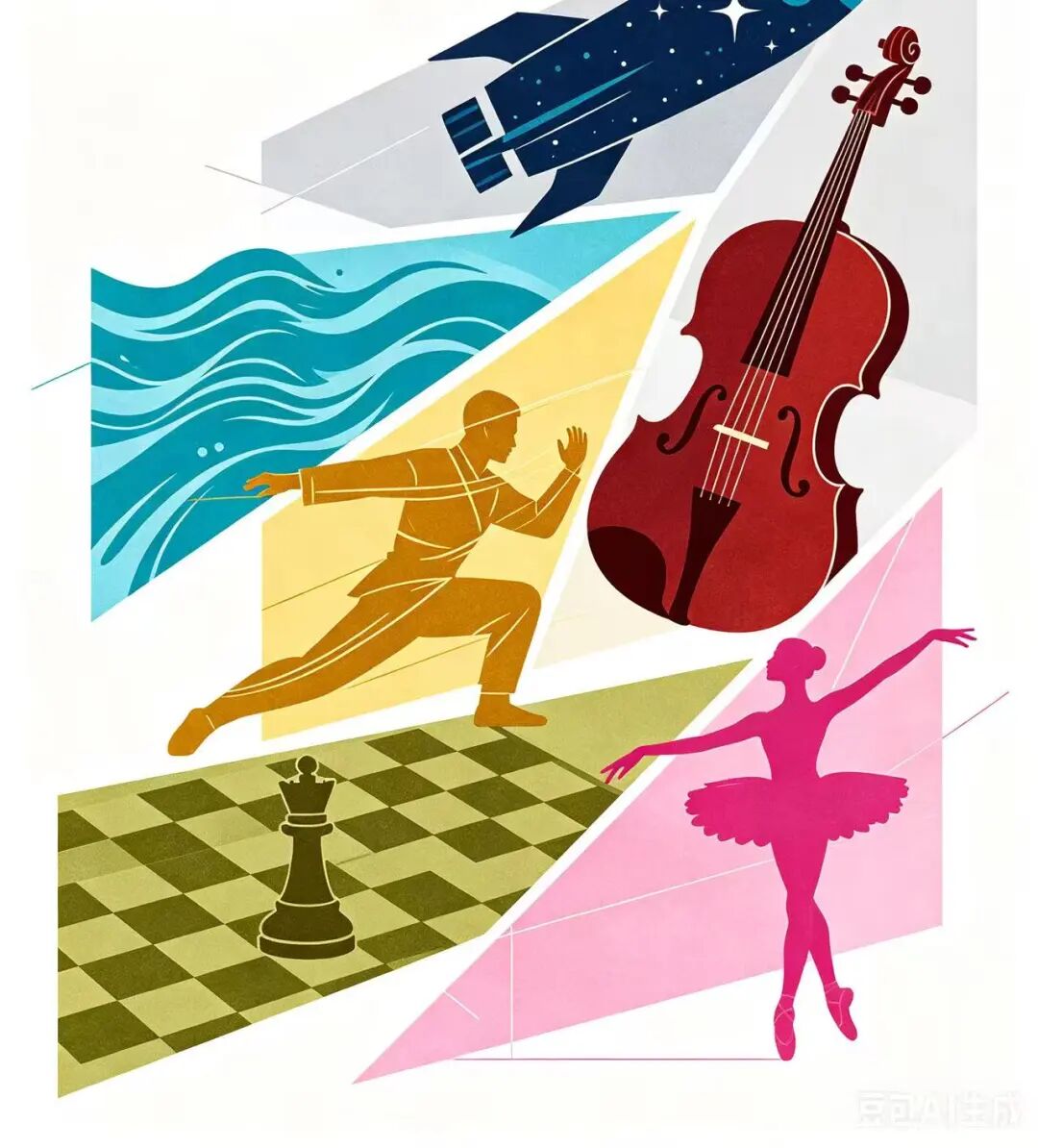
From competitive swimming to spaceflight, from the cello to martial arts, from chess to ballet
Introduction
In 2026, when artificial intelligence can write fluent essays, draw lifelike portraits, and even simulate the melody of a symphony, one question has become increasingly sharp: What exactly are the truly irreplaceable things?
Not knowledge — knowledge can be stored and retrieved.
Not skills — skills can be algorithmically decomposed and replicated.
Not efficiency — efficiency can be infinitely enhanced by machines.
The truly irreplaceable is humanity's endless exploration of its own spiritual world, that long and magnificent journey of a life from chaos to clarity, from instinct to awareness, from "being alive" to "becoming".
In this article, we focus on six extreme roles: competitive swimmer, astronaut, cellist, martial artist, chess grandmaster, and ballet dancer. In their respective fields, they have pushed "continuous improvement" to the very boundary of limits — not by pursuing to be faster, stronger, or better than others, but by living a more complete life through day after day, year after year of long-term dedication. Their stories may provide a rudimentary answer for everyone who is asking "what else about me is irreplaceable" in the AI era.
I. Why Study These Roles?
How Extreme Scenarios Stimulate Ultimate Potential
The research subjects selected in this article come from entirely different fields such as competitive sports, musical arts, martial arts, chess, dance, and spaceflight. On the surface, they share no common traits — one is in a swimming pool, one is in a concert hall, and one is in outer space. But delving into their training methods and life trajectories, you will find a shared deep structure: they all actively chose to move toward the limit, and discovered that irreplaceable "self" at the limit.
Why extreme scenarios?
Because extreme scenarios have a special property: they strip away all non-essential things. In daily life, a person can survive relying on talent, resources, or inertia — you can get by without questioning who you are. But extreme scenarios do not allow such perfunctoriness. When your goggles shatter in an Olympic final, when you lose your vision in space, when you have to go on stage with six fractures, when you have played the same piece for the thousandth time — all external supports fail, and the only thing you can rely on is what you have cultivated within yourself over months and years.
Michael Phelps is not asking "can I swim faster", but "when my goggles are broken and everything is dark before my eyes, what else can I trust?"
Bruce Lee is not asking "can I fight harder", but "when all external forms are stripped away, what is left of me?"
Yo-Yo Ma is not asking "can I play Bach more perfectly", but "when I have played the same piece a thousand times, what is hidden in the change of that single note between the ninth day and the tenth day?"
These people are not studying the ultimate of skills, but the ultimate of the self. What they are asking is not "what can I do", but "what am I". This kind of inquiry is precisely what AI cannot replace — because AI has no "I".
How These Masters Achieve Self-iteration and Self-cultivation
What is worth studying is not just "what they did", but "how they did it" — their self-cultivation methods themselves constitute a complete methodology:
- Michael Phelps uses "adversity rehearsal" to turn unexpected events into contingency plans, and uses visualization training to "walk through" all possible mistakes in his mind in advance.
- Yo-Yo Ma uses "presence" practice to discover tiny changes in repetition, playing the same piece a thousand times but being truly "present" every time.
- Bruce Lee uses "be like water" to dissolve the fixed form of the self, so that actions are no longer hindered by the "I".
- Josh Waitzkin uses "making smaller circles" to move from external rules to internal intuition, and uses "investing in loss" to actively expose weaknesses.
- Misty Copeland uses "going through pain" to turn pain into the depth of expression, and maintains presence in a system that does not recognize her.
- Astronauts use systematic preparation to turn panic into contingency plans, and maintain rationality in an irreversible extreme environment.
These methods seem vastly different, but they share a common name: long-termism. No kind of cultivation is completed by a one-time outburst. Phelps swims 80 kilometers per week, non-stop 365 days a year; Yo-Yo Ma has recorded Bach three times in his life, each separated by more than ten years; Yuri Gagarin went through countless extreme tests in centrifuges and soundproof chambers; Yang Liwei repeatedly experienced overweight, low pressure, and isolation during five years of training — their continuous improvement is not a sprint, but a marathon. It is the process of polishing the inner posture little by little in day after day of repetition.
Psychologist Viktor Frankl discovered logotherapy in a concentration camp. His core finding is: humans are not pursuing happiness, but meaning. And the source of meaning is not given externally, but "grows" from within. This "growth" requires conditions — facing the limit directly, making choices at the limit, and discovering "who I am" in the choices.
This is not a study of "success studies". Success can be measured, replicated, and replaced. This is a study of "becoming studies" — how a person becomes a more complete self, discovers tiny changes in repetition, maintains presence in difficult situations, and finds softness in strength.
II. Research Subjects: A Glimpse of Extreme Professions
2.1 Why Choose "Extreme Professions"?
We did not select "ordinary professions", but those professions that are pushed to the limit in one dimension of mental, intellectual, or physical strength. The reason these professions are "extreme" is not that the work intensity is high (there are many jobs with high intensity), but that they force practitioners to systematically train their inner selves — without training, you cannot survive in that situation, let alone achieve excellence.
A programmer can write excellent code without exercising his body or cultivating his mind. But an astronaut cannot. An athlete can win medals without reflecting on life. But an athlete who pursues "ultimate continuous improvement" cannot — because when he reaches the peak, his opponent is no longer others, but himself.
2.2 Selection and Introduction of Research Subjects
We selected six fields and six representative figures (and groups). Each of them is widely recognized in their respective fields as someone who has pushed "continuous improvement" to the extreme:
Figure
Field
Core Traits
Michael Phelps
Competitive Swimming
23-time Olympic gold medalist, the greatest Olympian in history. He has brought physical training and mental rehearsal to an unprecedented level of systematization.
Yo-Yo Ma
Cello Performance
19-time Grammy Award winner. He has performed Bach thousands of times in his life, discovering new worlds in tiny changes each time. He has turned "repetition" into the art of "presence".
Bruce Lee
Martial Arts and Philosophy
Founder of Jeet Kune Do. He is not the strongest person, but the one who best understands "the essence of strength". He turned martial arts training into a philosophical practice of self-awareness.
Josh Waitzkin
Chess / Tai Chi Push Hands
Author of The Art of Learning. The only person to reach world champion level in two completely different fields (chess and Tai Chi Push Hands). His research subject is not skills, but "learning itself".
Misty Copeland
Ballet Dance
The first black principal dancer at American Ballet Theatre. She still performed on stage with six stress fractures. She turned "resilience" from a psychological concept into physical practice.
Yuri Gagarin and Yang Liwei
Spaceflight
The first human in space (1961) and China's first astronaut (2003). They represent two generations of astronauts who accomplished impossible tasks relying on systematic preparation and inner resilience in the face of the "unknown".
2.3 Where Lies the "Extreme" of These Professions?
The "extreme" nature of each profession is different:
- The limit of competitive swimming is repetition and monotony. Phelps swims 80 kilometers a week, spends 6 hours in the water every day, non-stop 365 days a year. The limit is not a one-time outburst, but facing the same swimming pool, the same movement, and the same monotony day after day.
- The limit of cello performance is precision and presence. What Yo-Yo Ma faces is not the physical limit (although the spinal surgery at the age of 28 was also a challenge), but the limit of "mental presence" — how to be truly present every time in a thousand performances, rather than mechanically repeating.
- The limit of martial arts is the contradiction between strength and flexibility. What Bruce Lee faces is not the problem of "fighting harder", but how to maintain absolute flexibility in absolute strength — "be like water".
- The limit of chess is the entanglement of cognition and emotion. Waitzkin found that failures on the chessboard are not technical problems, but emotional problems. True continuous improvement is not to learn more routines, but to learn to remain clear-headed even under emotional interference.
- The limit of ballet is the unity of pain and beauty. Copeland completed the premiere of The Firebird with six fractures. The limit is not "enduring pain", but "creating beauty in pain".
- The limit of spaceflight is irreversible unknown. In space, a single mistake can lead to death, and you cannot "quit". Gagarin faced the absolute unknown of "a place no one has ever been to"; Yang Liwei experienced a limit during the 26 seconds of rocket resonance where "all his internal organs seemed to be shattered" — this superimposed vibration had never been experienced in training.
III. Comparison of Training Methodologies: An In-Depth Analysis of Six Systems
3.1 Competitive Swimming: Michael Phelps' "Adversity Rehearsal" System
Michael Phelps' coach Bob Bowman has a set of training methods that sound almost cruel: he will intentionally create troubles when Phelps is training.
Suddenly cut off the power of the training hall, letting Phelps swim in the dark swimming pool — this is to train him to maintain a sense of direction even when he loses his sight. Intentionally break Phelps' goggles in advance, so that he cannot open his eyes underwater — this is to train him not to panic when an accident occurs. Sometimes, he even throws things at Phelps while he is training, creating sudden interference.
This is not perverted, but a systematic "Adversity Training" system. Bowman's logic is: all possible mistakes in the competition should be allowed to happen once in training first. In this way, when a real accident occurs, Phelps' body and brain will not enter panic mode, but enter the mode of "I have already experienced this".
The results of this training were verified in a legendary way at the 2008 Beijing Olympic Games. In the 200m butterfly final, water entered Phelps' goggles after he dived in. From the second lane onwards, he could barely see anything — in butterfly stroke, this means you cannot see the pool wall to judge the turning timing. But Phelps did not panic. He silently counted the number of strokes, completed the turn relying on muscle memory, and not only won in the end, but also broke the world record.
After the game, a reporter asked him: "What does it feel like to swim without being able to see anything?"
He replied: "Just like what I imagined, there was no problem at all."
Behind this seemingly plain sentence are thousands of hours of training where "all bad situations have been imagined". Every day before going to bed and after waking up, Phelps will "play" a video in his mind — not a video of the ideal state, but a video of various unexpected situations. What if the goggles are broken? What if the swimming lane is interfered with? What if the opponent suddenly accelerates? He has "rehearsed" every bad situation in his mind, so much so that when they really happen, the brain already has a "script" — this is not calmness, but pre-selected response.
**Core Principle: Do not train for perfection, train to cope with imperfection.**
**Methodology: Adversity Rehearsal — repeatedly expose unexpected events in a controllable environment, turning panic into contingency plans.**
**Mental Training: Visualization Rehearsal — not imagining success, but imagining all possible failures, and preparing coping methods for each failure.**
3.2 Cello Performance: Yo-Yo Ma's "Presence" Practice
Yo-Yo Ma's training is completely different from Phelps'. Phelps trains to "cope with unexpected events", while Yo-Yo Ma trains to "discover new ideas in repetition".
He has recorded Bach's Unaccompanied Cello Suites three times in his life — 1983, 1997, and 2018. Each time he records the same piece, but each time it is different. It is not that the skills are different (the skills have become more and more concise instead), but that the understanding is different, and the way of being present is different.
Yo-Yo Ma once shared a story about practicing the piano. When he was learning a new piece, he learned a few notes on the first day, repeated them on the second day, and still repeated them on the third day... Until the ninth day, he found that "only one note was different". And this tiny difference, on the tenth day, "opened up a whole new world".
This story reveals a completely different logic of continuous improvement: it is not about pursuing "more", but pursuing "deeper". It is not about making the hundredth new change in the hundredth performance, but discovering that one key change between the ninth and tenth day — and then letting that change transform everything.
Yo-Yo Ma underwent surgery for scoliosis at the age of 28, facing the risk of never being able to play the cello again. For six months after the surgery, he could not perform. This "silent period" instead became his most profound training. He discovered that real life is not just about playing the cello, but "living well". The meaning of music does not lie in skills, but in presence — putting yourself in, putting the present moment in, and putting your emotions in.
He uses a stream to describe his performance: the piece and structure seem unchanged, just like a stream seems unchanged — but the flowing water is never the same. Heraclitus said "you cannot step into the same river twice",