Is there only 6 months left for open-source models?
Open-source models are undergoing the most severe survival test to date.
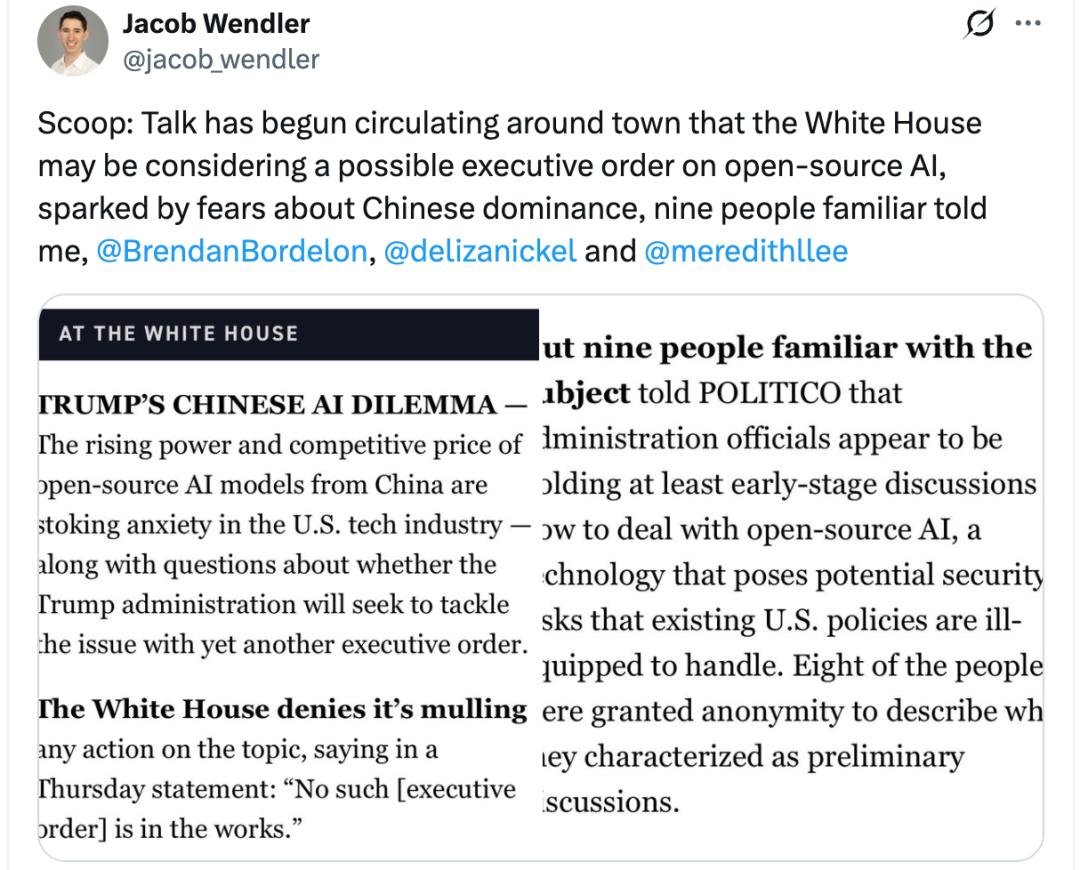
Recently, foreign media reported that the White House is considering introducing an executive order to restrict open-source AI, especially systems developed by Chinese companies.
"I wouldn't be surprised if this administration eventually takes a clear public stance on the use of open-source AI, or even restricts federal agencies from using certain open-source tools," said Senior Research Fellow Adam Thierer.
It is reported that almost all insiders indicated that relevant discussions are still in their early stages, and it remains unclear whether these talks will eventually translate into concrete policies. Even if the measures do not materialize, they have further fueled public skepticism about the Trump administration's chaotic AI governance approach. Even if relevant measures are implemented, they will most likely only affect two groups: models from China, and the use of these models by government departments. But once the first domino falls, the subsequent impacts will be difficult to control.
Currently, open-source models lack a strong, highly concentrated U.S. economic representative who can clearly explain to policymakers the potential costs of suppressing open-source models. It is reported that representatives from Reflection AI have proposed that open-source models should be granted framework exemptions based on model capabilities. At present, Chinese open-source models such as DeepSeek are clearly leading other available open-source models, while Reflection has not yet released a public model.
"No matter what form the ban takes, it will be a serious mistake in the long-term development trajectory of artificial intelligence," stated Nathan Lambert, a machine learning researcher with a PhD in AI from the University of California, Berkeley, who has previously worked at Meta, DeepMind, and Hugging Face.
He said the most likely policy would be to ban or indefinitely postpone any open-weight models whose capabilities significantly exceed the levels of GPT-5.5, Claude Opus 4.8, or GLM-5.2. Given the continuously narrowing capability gap between open-source and closed-source models, this scenario is likely to occur within the next six months.
Open-Source Models Win Token Traffic, Anthropic Takes Most of the Revenue
As AI applications gradually mature, more and more enterprises are shifting to lighter-weight models. So, have open-source models actually "taken a bite out of the market" from Silicon Valley's cutting-edge model vendors?
AI unicorn Decagon is a typical enterprise that leverages open-source models. Approximately 90% of Decagon's workloads now run on open-source models, rather than models from OpenAI or Anthropic. Jesse Zhang, CEO of Decagon, explained that this is not due to cost, nor is it mandated by clients — the real reason is that enterprises have few other alternatives.
"This is not about cost, nor have our clients forced us to do this, although they generally do not object. The real reason is that we have almost no other options."
When you run a customer service AI agent in a production environment, latency directly determines whether the product is usable. No one will use a product that requires waiting 8 seconds for each response in a conversation. Therefore, you need a smaller, faster model. For each model call, there is no need to know the capital of Lithuania or master high school physics knowledge.
However, off-the-shelf small models cannot meet the quality standards required by clients. Only through large-scale fine-tuning for specific tasks can they meet those requirements.
The problem is that cutting-edge model labs basically do not offer this combination. We cannot fine-tune their most powerful models according to actual needs, and their small models do not belong to us, so we cannot shape them as we wish.
Therefore, "small models + deep fine-tuning" essentially means that open-weight models must be used. Cost savings do exist, but they are only a secondary benefit; enterprises feel more at ease with self-hosted models, which is also an incidental advantage, not the fundamental reason for choosing open-source models.
Jesse also put forward a "counterintuitive" conclusion: enterprises' overall spending on expensive cutting-edge models has barely decreased, but the proportion of spending on open-source models is declining.
Although Jesse Zhang did not provide much data to support this view, TechCrunch found some relevant figures.
Vercel's AI Gateway dashboard shows that within a week, DeepSeek's token processing volume quickly rose to first place, now accounting for more than one-third of the total token traffic on Vercel's infrastructure. Zhipu, the maker of the popular model GLM-5.2, also jumped to fourth place during the same period.
However, if you continue to look at total token spending, you will find that Anthropic still accounts for more than half of the total AI spending on the platform. Due to a significant portion of recent changes coming from Anthropic's own price increases, its spending share has slightly decreased over the past month, but the decline is not significant.
Data from OpenRouter shows a similar trend. Compared with Vercel, OpenRouter covers a larger market, but has slightly fewer enterprise users.
In terms of overall usage, DeepSeek V4 Flash is currently the clear winner, processing approximately 5.3 trillion tokens per week. The most popular cutting-edge model, Opus 4.8, processes slightly more than 2 trillion tokens per week.
OpenRouter does not rank by total model spending, but its data shows that the average token cost of Opus 4.8 is about 23 times that of V4 Flash: the average cost per million tokens for Opus 4.8 is approximately $1.37, while V4 Flash costs only $0.06.
Calculated based on this price gap, although Opus 4.8's token usage is significantly lower than V4 Flash's, it still likely accounts for the majority of model spending on the platform.
These figures do not yet include the latest entrant, Nvidia Nemotron. Leveraging Nvidia's strong industry relationships and Nemotron's extremely high adaptability, this model is expected to quickly rank among the top in the market.
These numbers are not yet sufficient to fully validate Jesse Zhang's judgment on the AI application lifecycle, but they at least indicate that cutting-edge model labs like Anthropic have not been significantly impacted by the rise of open-source models — at least not yet.
In Jesse's view, cutting-edge models and open-source models are not competitors. The success of open-source models is not built on cutting-edge model labs losing market share. Instead, they are more like two stages in the same lifecycle: enterprises first use expensive cutting-edge models to verify whether an application scenario is viable, and when the scenario matures, they migrate it to lower-cost open-source models. As more and more mature scenarios shift to lightweight models, new application scenarios continue to emerge, so enterprises' overall investment in cutting-edge models has not decreased significantly.
He explained that when an application scenario first emerges, enterprises will prioritize the most capable general-purpose model available. Because you do not yet know what form the problem will ultimately take, you are willing to pay a premium for intelligent capabilities that may not even be needed in the future. At this stage, it is a reasonable trade-off.
But when an application scenario is fully mature, and the enterprise already understands the distribution of input data, the behavior the model needs to exhibit, and the failure modes that must be prevented, the trade-off reverses. At this point, general-purpose intelligence becomes an extra burden. What enterprises really need is the smallest, fastest model that has been specially fine-tuned to excel at a specific task.
One explanation for the continued high revenue of cutting-edge models is that the market for AI-automated tasks is growing too fast. Even as more mature scenarios are migrated to open-source models, top-tier models can still maintain their market position by dominating the early verification phase of new applications.
"The declining share of open-source model spending is not because open-source models are failing, but because the entire enterprise AI market is still in the earliest stage of the maturity curve," Jesse said. "According to this logic, all the application scenarios today that use cutting-edge models for prototyping may potentially migrate to open-source models in the future." "However, this process will take longer than many people expect."
Furthermore, even if clients begin to shift to open-source models, many application scenarios remain sufficiently complex that they cannot be completely replaced by cheaper models. In any case, this two-tier model economy is likely to become a relatively stable structure in the AI industry.
"The Debate Over Distillation Has Turned Into Suppression of Competitors"
An almost unavoidable reality is that the capabilities of open-source models are becoming increasingly powerful.
Dario Amodei recently attacked open source: In the field of AI, open source is a distraction, or even a false proposition. "Even if the model is made public, you cannot see its internal operating mechanism, so the industry usually refers to such models as 'open' rather than truly 'open-source.' Traditional open-source software can be collaboratively modified, iterated continuously, and enhanced through collective efforts by the community, but these advantages do not fully apply to large models."
Therefore, Amodei said that when he sees a new model, he never first asks whether it is open-source. Even whether DeepSeek is open-source is not important to him. The only question he cares about is: Is this model good enough to beat us on important tasks? Moreover, open source is never equivalent to free. Models are so large that enterprises still need to spend money to run inference on the cloud, and require professional teams for deployment and optimization to ensure the models operate quickly and stably. Instead of obsessing over whether a model is open-source, it is better to focus on whose model can best accomplish the tasks you need to complete.
The above remarks were made against this backdrop: "Cutting-edge open-source models" are increasingly being equated with "products from Chinese model vendors," and discussions about "cutting-edge open-source model capabilities" are inevitably tied to other controversies such as distillation. Foreign media recently reported that U.S. officials unilaterally estimate that unauthorized model distillation causes up to $6 billion in annual revenue losses for U.S. AI labs, but no calculation basis was provided.
In Lambert's view, the capability threshold for the government's so-called "right to review" will continue to change, but once this system is established, the speed at which open-source models get approved will likely be much slower than that of closed-source models. On the one hand, closed-source models are indeed easier to implement security controls on; on the other hand, closed-source model companies are also significantly more capable in lobbying.
Once open-source AI-related policies are released, the approval speed for open-source models will likely be far slower than that of closed-source models. On one hand, closed-source models do make security controls easier to implement; on the other hand, closed-source model companies also have significantly stronger lobbying capabilities.
Lambert directly pointed the finger at Anthropic.
"The current campaign against domestic models is mainly driven by Anthropic. It has detailed what domestic companies are doing through blog posts, letters, and other means. Lambert commented that this campaign may have initially stemmed from genuine business concerns, but now it increasingly looks like a disguised effort to build market barriers for itself: if the model companies accused by Anthropic are banned, its products will receive enormous revenue protection.
"If Anthropic had merely provided information in a more neutral way, such as telling authorities 'the facts are here, it's up to you to decide how to handle them,' the community might have shown more understanding. But what it is doing now is more like directly pushing for specific policies on a rapidly evolving cutting-edge technology, rather than simply sharing information. If Anthropic's technology is as powerful as it claims — so powerful that open-source models with similar capabilities deserve to be banned — then it should first be able to secure its own API. I am still waiting for Anthropic to explain why it cannot do this. At least one of its current claims must be retracted."
Lambert continued that Anthropic is also pulling away the ladder to intelligent capabilities in other ways. In the name of security, it restricts competitors from accessing relevant technologies, so its proposed policy recommendations are consistent with its broader strategy of limiting access. "When many employees are on track to reap rewards that could change their wealth for generations, it is easy to buy into a corporate culture that 'prioritizes security more.' I do not blame these employees, but we must understand Anthropic's corporate strategy in a broader context."
"What Anthropic is effectively asking for is a widespread ban on almost all Chinese open-source models in the United States," Lambert stated bluntly. The products built around open-source models have their commercial logic based on the continuous advancement of models: as model capabilities improve, product-market fit and computational efficiency both increase. Once these models are banned, the emerging open-source model economy will also be destroyed, including inference service companies, fine-tuning firms, new products, and other participants across the entire industry chain.
Anthropic can certainly protect its intellectual property, but Lambert argues that it should not ask the authorities to solidify its market position for it, let alone isolate the United States from the global open-source community. Currently, there is no good policy solution to the distillation problem other than letting labs implement their own technical and commercial constraints.
On security issues, Lambert believes that instead of complex fine-tuning of a model with over 1 trillion parameters rapidly spreading dangerous capabilities, insecure APIs are far more likely to put these capabilities quickly into the hands of malicious actors. "If Anthropic's models really contain extremely dangerous capabilities, the logically most consistent approach would be to not offer these capabilities through a directly queryable API at all, rather than launching it first and then arguing about whether others will distill it."
Therefore, we are now facing two concurrent critical discussions that will both affect the fate of open-source models: one centered on model distillation, and the other on cutting-edge capabilities. These two issues are very different in nature, necessity of response, and applicable policy tools, but they are converging to gradually form a strong narrative supporting "banning open-source models within the next six months."
"The current distillation issue has actually largely become a 'suppression campaign,' because all the solutions on the table will bring huge benefits to the institutions pushing them forward," Lambert said.
"The Open-Source Ecosystem Cannot Be Stopped"
"We do need to develop appropriate policies for cutting-edge open-source models, but a full ban is most likely not the answer," Lambert said. "Even if the United States alone bans the import of certain models, the global open-source community will continue to develop."
He believes that the only thing that can set an upper limit on open-source development is a global agreement on how to manage AI model risks, and we are still far from reaching such an agreement. Any other delaying measures will only make the deployment of AI more unpredictable and chaotic. The eventual outcome will likely resemble the release process of GPT-5.6, except that by then, it will not just be a few companies that are restricted from accessing the benefits of open, affordable intelligence — all malicious actors will still be able to obtain these capabilities immediately.
"The way open-source models enhance security is by enabling more people to access, understand, and scrutinize the models, rather than crippling law-abiding, legitimate participants," Lambert said. "The reality is that the open-source ecosystem cannot be stopped."
To get open source out of this death spiral, Lambert says there is a short-term exit: let a U.S. company release an open-source model with comparable capabilities. In this way, the focus of the discussion will shift to "everyone is in the same ecosystem, and we should collectively address the ever-changing, extremely complex cutting-edge issues."
"This is a survival-level task for open source. Companies that have commercial reasons to release open-source models, such as Microsoft and Meta, should act as soon as possible, because open-source models can turn their complementary businesses into infrastructure advantages," Lambert said. If Reflection already has a decent model that is not yet at the cutting-edge level, it may also need to release it quickly to preserve the business direction it envisions.
Compared to retraining a new model, a faster solution is to immediately form an alliance. Lambert calls on "everyone else" outside the cutting-edge labs to start acting now, thinking about how to continue safely releasing open-source models and defending the principles and values that open-source models represent.
This article is from the WeChat public account "InfoQ" (ID: infoqchina), authored by Chu Xingjuan, and published with authorization by 36Kr.