AI Giants Make a Collective Shift, and Large Models Usher in the "Jevons Paradox Moment"
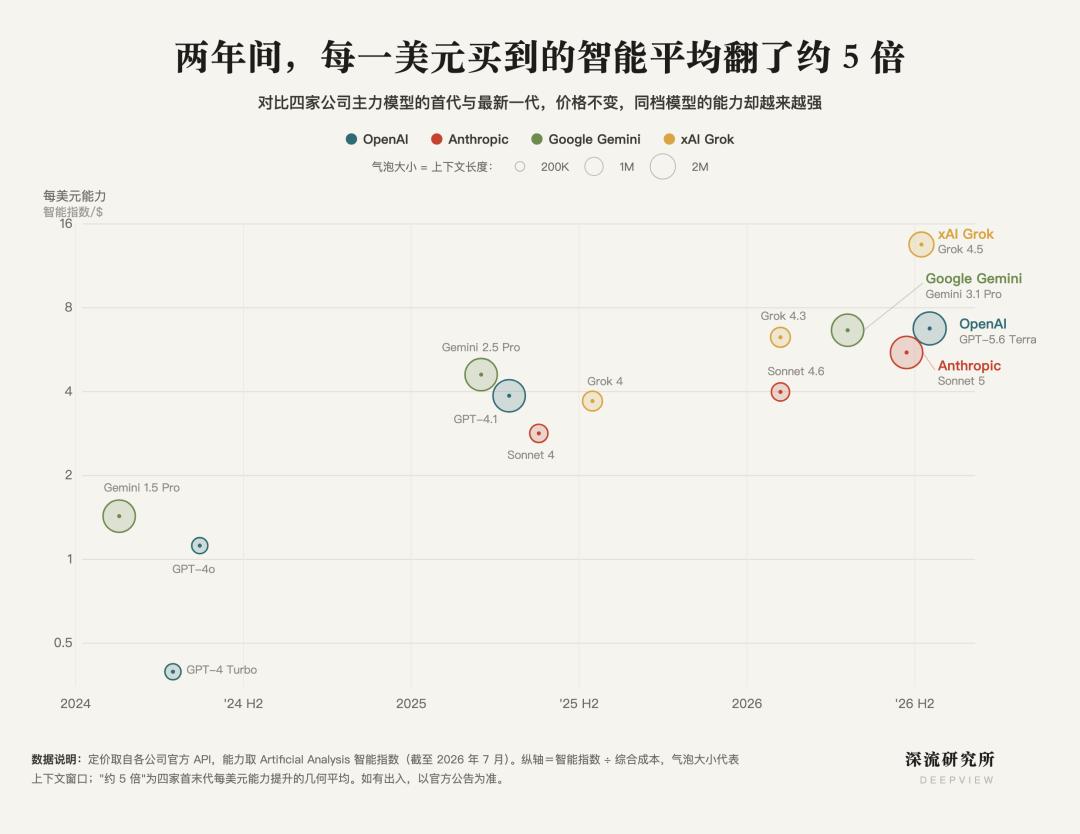
In the past week, Grok 4.5, GPT-5.6, and Claude Sonnet 5 have been released one after another.
What is more notable than the density of releases is the new narrative these companies are building around their models.
The most typical example is Elon Musk. When introducing Grok 4.5, he barely emphasized that it is "xAI's most powerful model," but repeatedly highlighted one point — an "Opus-class model" that is faster, more token-efficient, and lower in cost.
This same shift is also taking place at the other two companies.
OpenAI framed the goal of GPT-5.6 as "making every token produce more useful work." Sam Altman went even further, stating that what enterprise customers truly care about now is the tangible value they get in return for their AI spending. Anthropic, meanwhile, noted that Sonnet 5 can complete agent tasks that only a few months ago required larger, more expensive models.
When "lower costs" become the industry's default priority, the real competition is no longer about "how much to cut prices," but rather at the same price point, whose model can handle more and more complex tasks?
Cost-effectiveness has begun to become the core variable in the competition.
1. The Battle for Cost-Effectiveness: Model Firms Reconfigure Capabilities, Costs, and Use Cases
This shift is first reflected in the model products themselves. Companies are starting to recombine different capabilities, cost structures, and invocation methods.
OpenAI's GPT-5.6 is the most representative example. The "Sol / Terra / Luna" naming system has replaced the "flagship + mini/nano" model hierarchy used over the past few years. This changes the logic of model tiering — previously sorted by capability strength, now divided by use case.
Sol handles high-complexity tasks such as advanced reasoning, programming, and agent operations, yet its price is on par with the GPT-5.5 standard flagship model. Terra delivers overall performance close to GPT-5.5 but falls into the mid-range price bracket of GPT-5.4. Luna, priced at the same level as the open-source GLM-5.2, focuses on high-concurrency, low-latency mass invocations.
The core of this tiered system is aligning capabilities with use cases and adjusting costs to match task requirements. Complex tasks use flagship-level capabilities, daily tasks use mainstream models, and high-frequency invocations prioritize low latency and low cost.
In March this year, OpenAI launched the Standard / Batch / Flex / Priority pricing mechanism, further extending this logic to the invocation layer. The same model can now be priced differently based on how it is used. Batchable, delay-tolerant requests are cheaper, while requests requiring low latency and high determinism are more expensive.
This means price no longer depends solely on model capabilities, but also on the task's requirements for time and stability. Latency, priority, and determinism — previously hidden within system scheduling — are now directly incorporated into the billing structure.
At the end of June, Anthropic's release of Claude Sonnet 5 also aligns with this trend. Sonnet 5 features a built-in "effort" mechanism that allows callers to adjust reasoning intensity based on task complexity — medium effort to control costs, and high effort to approach flagship-level performance.
This breaks the old logic of "locking in costs once a model is selected." Developers no longer simply choose which model to use; they can also decide how much computing power to allocate to a single invocation. Cost-effectiveness thus evolves from a static parameter to a dynamically adjustable feature.
Grok 4.5, released on July 9, brings cost-effectiveness forward to the training stage: first identifying high-frequency use cases, then defining model capabilities and cost structures around those scenarios.
Grok 4.5 is xAI's first model specifically trained for programming and agent tasks, co-trained with Cursor using massive real-world interaction data from the platform. It is priced at $2 per million input tokens and $6 per million output tokens, while featuring a Mixture-of-Experts (MoE) architecture, 500K context window, and configurable reasoning intensity.
Programming and agent tasks typically involve long context windows, frequent invocations, and complex workflows, where a single failure can trigger multiple retries that easily amplify costs. Grok 4.5 chooses to first secure a high-frequency entry point like Cursor, then optimize capabilities and costs around real-world usage patterns.
Together, these three models demonstrate that cost-effectiveness is no longer a simple price tag. OpenAI places different capabilities into different invocation scenarios; Anthropic pushes flagship-level performance into mainstream price ranges and unlocks reasoning intensity adjustments; Grok redefines the standard of "value" within high-frequency programming use cases.
Large language model competition is shifting from "maximizing capabilities" to "optimizing the cost of delivering effective capabilities".
2. The Economics of Cost-Effectiveness: From "Per-Token Price" to "Per-Task Cost"
Unlike traditional internet applications, every invocation of an AI product corresponds to real reasoning costs. The more it is used, the greater the value generated — but the more tangible the cost pressure becomes.
As model competition enters the application phase, cost-effectiveness is evolving from a "pricing issue" to a "business model issue." When models truly integrate into real task scenarios, what determines long-term business sustainability is whether model capabilities can be delivered stably and affordably at scale.
The cost of a real-world task is typically determined by an entire workflow: input/output token counts, number of invocation rounds, context length, tool call frequency, reasoning intensity, and failure retry rates all factor into the final calculation.
This leads to a counterintuitive conclusion: a cheaper-priced model is not necessarily truly cheaper.
If the per-token price is low but requires more dialogue rounds, longer context windows, and higher retry rates, the per-task cost may not be lower. Conversely, a seemingly more expensive model that can complete tasks in fewer rounds, reduce rework, and lower failure rates may ultimately deliver better value.
The unit for measuring model cost-effectiveness is changing — it no longer focuses solely on per-token price, but on the total cost to complete a single task.
The widespread shift of domestic model companies toward MoE and sparse activation over the past year can be understood within this framework.
DeepSeek-V4-Flash has 284B total parameters with 13B activated per token; Qwen3-235B-A22B has 235B total parameters with 22B activated; Kimi K2.6 has 1T total parameters with 32B activated. The recently released official version of Tencent Hunyuan Hy3 also adopts an MoE architecture, with 295B total parameters, 21B activated parameters, and support for a 256K context window.
Domestic large language models are collectively betting on "large total parameters + small activated parameters," which shows that the relationship between model capabilities and invocation costs is being redesigned.
Total parameters determine the size of a model's capability pool — how much knowledge, reasoning, coding, and agent tasks it can cover. Activated parameters determine the actual computing cost of each reasoning run. This is the key value of MoE:
Allowing models to approach the capability boundaries of ultra-large-scale models, while avoiding the full computational overhead of activating all parameters for every invocation.
In other words, cost-effectiveness is now embedded in the model architecture design stage, rather than being merely a post-release pricing strategy.
The official release of Tencent Hunyuan Hy3 is a recent example of this trend. Its highlights go far beyond 295B total parameters — it uses 21B activated parameters to support a much larger capability pool, with a focus on real-world tasks such as agent operations, office work, knowledge processing, and multi-file generation.
Additionally, the official Hy3 demonstrates significantly stronger intelligence than models of similar size, with performance comparable to flagship models 2–5 times its parameter scale. This means Hy3 can handle more complex task types with less actual activated computation.
From preview to official release, Hy3's average daily token consumption has grown 20-fold, indicating that the model's economic efficiency is now being validated at real usage scale.
For domestic model manufacturers, cost-effectiveness is reflected not just in open-source availability and API pricing, but more importantly in the ability to support more tasks at lower costs within real product and developer workflows.
Therefore, this round of cost-effectiveness competition is essentially becoming a "per-task economic efficiency" race.
In the future, model companies will compete not just on the size of their capability pools, but on how much users actually pay to access that pool for each task. The company that can complete more real-world tasks with less computation, fewer rounds, and fewer retries will deliver the highest true cost-effectiveness.
3. The Battle for "Default Invocation": Large Language Models Enter the "Jevons Paradox Moment"
As the unit for measuring cost-effectiveness shifts to "per-task cost," the focus of model competition is also changing. What enterprises and developers truly care about is moving from "which model is the most powerful" to "which model can be stably, affordably, and set as the default for long-term use".
The term "default invocation" refers to the underlying model capability that systems prioritize in high-frequency scenarios such as office work, knowledge management, agent operations, customer service, and coding. It may not always be visible to end users, but it continuously handles massive real-world tasks.
This shift is already being productized by cloud platforms and developer tools. Amazon Bedrock's Intelligent Prompt Routing and Microsoft Azure AI Foundry's Model Router essentially advance model usage from "manual selection" to "unified scheduling": systems route requests to the most appropriate model based on task complexity, cost, latency, and performance.
OpenRouter, LiteLLM, and Dify in the developer ecosystem are playing similar roles. Unified APIs, multi-model routing, budget control, and configurable default inference capabilities are embedding models into higher-level application frameworks and enterprise AI gateways.
This will reshape the competitive landscape of the model market. In the future, many invocations will not be directly decided by end users, but pre-allocated by cloud platforms, AI gateways, development frameworks, and enterprise middle platforms. The models that become part of these systems' default configurations will capture a higher share of real-world usage.
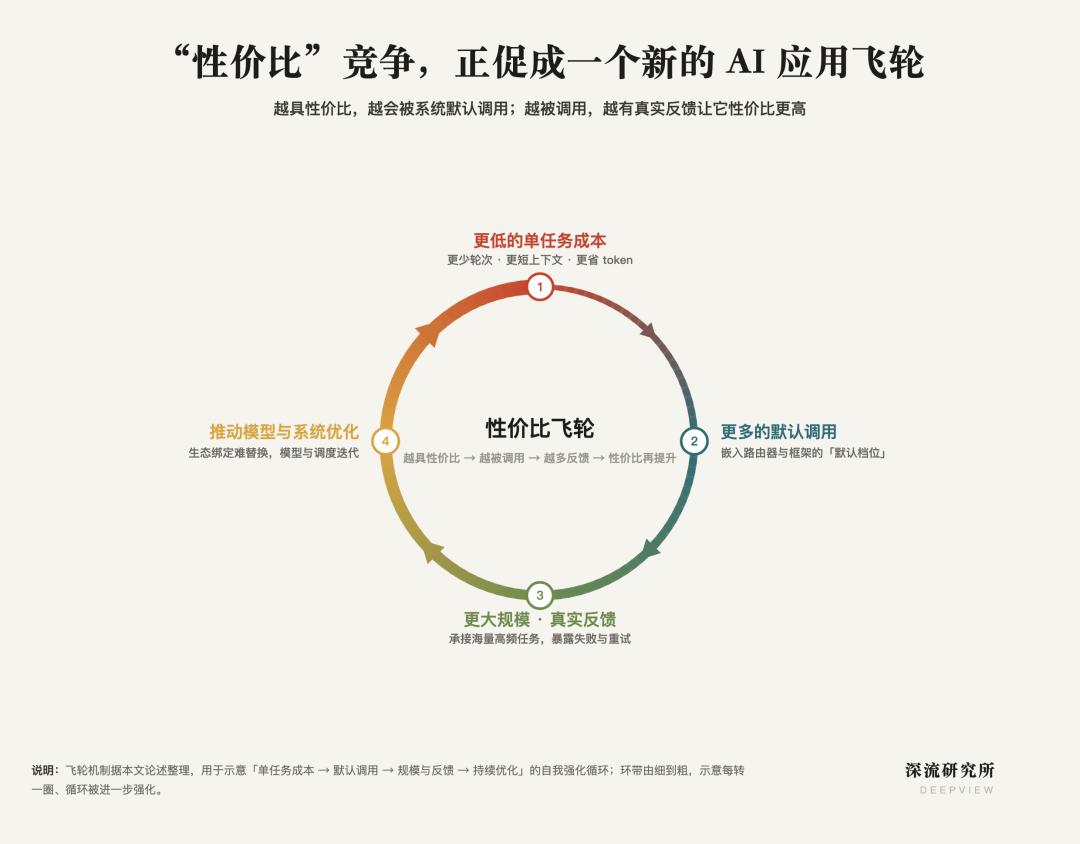
The first value of default invocation is scale. A model that can handle the large, stable volume of daily tasks from enterprises and developers can build a solid commercial foundation, even if the per-invocation price is not high.
Scale also drives feedback. Real-world data on failure rates, retries, user corrections, tool call paths, and context organization will in turn help optimize models and systems. Model evolution relies not only on static benchmarks, but even more on exposure, correction, and iteration through real usage.
More critically, default invocation creates ecosystem lock-in. Once developers fine-tune prompts, tool calls, RAG workflows, agent frameworks, evaluation standards, and security policies around a specific model, that model transitions from a replaceable API to an integral part of the application architecture.
As a result, "cost-effectiveness" forms a new competitive flywheel: lower per-task costs lead to more default invocations; more default invocations bring greater usage scale and richer real-world feedback; this feedback further drives model and system optimizations, which in turn reduce per-task costs even more.
The integration of Tencent Hunyuan Hy3 with WorkBuddy exemplifies this trend. WorkBuddy handles high-frequency tasks such as enterprise office work, file processing, and workflow orchestration, while Hy3 enters real workstreams through this entry point.
Public information shows that from preview to official release, Hy3's average daily token consumption has grown 20-fold, and the number of users voluntarily selecting Hy3 preview on WorkBuddy has increased 6 times. In internal office scenario tests, the official version has raised task success rates from 72% to 90% and cut average processing time by approximately 34%.
This demonstrates that models are beginning to be rigorously tested across real task workflows. Capabilities like task planning, tool scheduling, and multi-agent collaboration only reveal specific issues around failures, retries, processing time, and tool calls when deployed in office scenarios — driving iterative improvements to the models.
Such collaborative optimization has become a shared industry direction.
Google deeply embeds Gemini into work environments like Gmail and Docs, optimizing around high-frequency tasks such as emails, documents, and meeting notes. Adobe Firefly is also integrated into creative workflows in Photoshop, Illustrator, and Premiere, allowing the model to iterate around real editing, generation, and modification pipelines.
Only by entering real task scenarios can models secure stable invocations, gather authentic feedback, and unlock continuous optimization opportunities — ultimately forming a collaborative optimization loop of "model-product-scenario".
As a result, cost-effectiveness competition goes far beyond simple price-cutting races. What it truly reshapes is the boundary of demand.
In the 19th century, economist William Stanley Jevons observed a phenomenon: the more efficient steam engines became, the more coal they consumed. Efficiency gains did not reduce usage — instead, they lowered barriers to adoption, allowing coal to penetrate more industries, power more machines, and extend into longer production chains.
Large language models are now approaching their own "Jevons Paradox moment."
The outcome of cost-effectiveness competition will not necessarily be a reduction in total AI spending, but rather an increase in AI usage density. Model invocations will expand from a small set of high-value tasks to a vast number of daily tasks, ultimately making AI more practical and universally accessible.
This article is from the WeChat public account "Deep Flow Research Institute", authored by Jiang Feng, and published with authorization from 36Kr.