AI short dramas, why do they all share the same face?
Sharp jawlines, thin lips, and a stern gaze that commands authority without anger; oval faces, large eyes, and luminous skin... When users open short drama apps and binge-watch several AI-generated short dramas, they will quickly notice that almost all the male and female leads share the exact same set of facial templates.
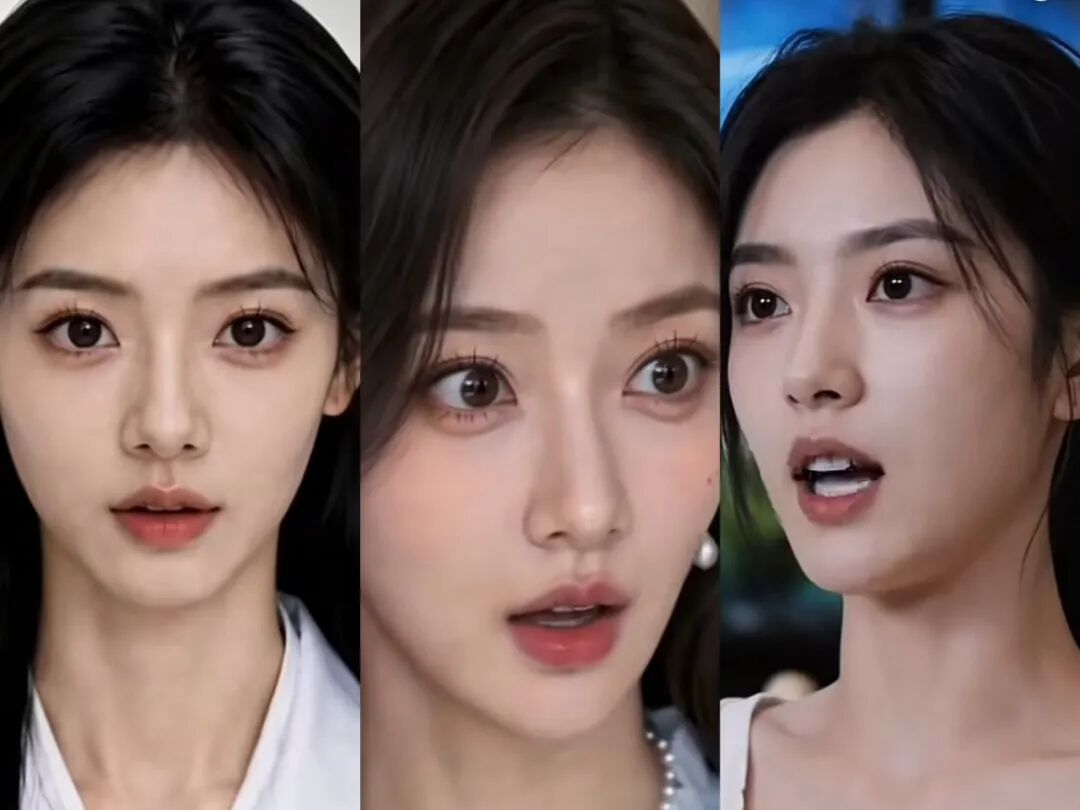
Female leads in multiple AI dramas share nearly identical faces Source: Short drama platform
After watching so many of these works, many viewers even feel disoriented: was the cold-faced CEO in the last drama the exact same person as the general who was expelled from the noble manor in the previous one? On social platforms, similar questions abound, and the phrase "physiological disgust toward AI-generated faces" once even became a trending search on Weibo.
Theoretically, AI models trained on massive datasets can generate an infinite number of unique faces. So why do the protagonists in AI short dramas all end up sharing the same generic face?
Where does this universal "default face" come from?
First, let's clarify how these "look-alike" images in AI short dramas are created.
Generally, there are two main methods for AI to generate human characters: one is to input text prompts and let the large model generate the image automatically, and the other is to provide real human photos as references for the large model to make adjustments.
AI director Mo Zheng explained to China Newsweek that when generating human faces for AI short dramas, if creators simply type the prompt "a beautiful woman drinking coffee in a café" into the text-to-image model dialog box without uploading any reference photos, the AI model will most likely output a standard portrait of a beautiful woman with big eyes, a high nose bridge, a pointed chin, and fair skin.
Mo Zheng noted that during training, text-to-image models are usually set with standard parameters, such as defining Asian beauties as having large eyes, high nose bridges, and relatively light skin tones. Moreover, unpaid models tend to take shortcuts: after synthesizing all parameters, they generate the most common face that appears most frequently in their training datasets.
This same logic applies to male characters too. Mo Zheng observed in his past practice that without refined settings for characters, the Asian males generated by AI often resemble South Korean actors—square faces with distinct Mongoloid features. He speculates this is because current mainstream AI video models are distilled from a large number of South Korean films, with South Korean film and television materials making up a disproportionately high share of the training dataset, leaving the generated characters naturally imprinted with South Korean aesthetic preferences.
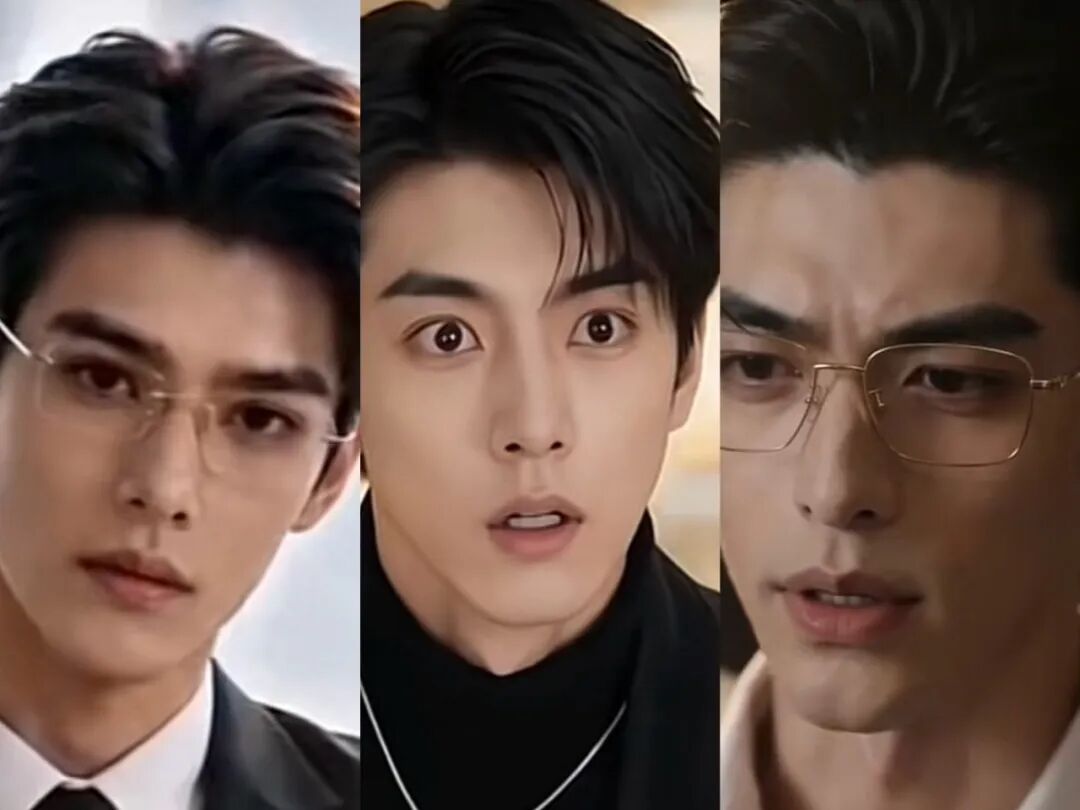
Male leads in multiple AI dramas also share strikingly similar faces Source: Short drama platform
"They look half familiar and half unfamiliar; you often see faces that strongly resemble Takeshi Kaneshiro in art-house style productions," Mo Zheng said.
The gray-area training materials used by models further exacerbate the homogenization of AI short drama content. According to public reports, many AI short drama producers now directly purchase cheap or even pirated material packs online to train their models.
As reported by Justice Network, industry insiders revealed that pirated AI short drama resources, web-scraped content, and user-uploaded infringing materials form the core of these training datasets. Unauthorized "AI short drama material packs" are widely sold online, and a single pack containing more than 20,000 infringing short drama episodes can be purchased for just 0.85 yuan.
Wang Xiwen, dean of the Beijing Huaxia Industrial Internet Intelligent Technology Research Institute, told China Newsweek that the mass production of AI faces has now developed into a highly standardized industrial workflow: producers first use viral, high-performing prompts to generate a standardized beauty base; then lock in a fixed seed value to ensure the character's facial features remain consistent throughout the entire drama; next apply a unified expression template to skip the frame-by-frame refinement of subtle micro-expressions; and finally render the entire video in one go, eliminating the need for segmented image editing.
"This workflow avoids unique facial features entirely, prioritizing error-free mass production, resulting in batches of indistinguishable, uniform digital faces," Wang Xiwen explained.
Algorithms and cost constraints lock in these AI generic faces
When the exact same face plays both the beloved campus crush and a noble ancient aristocratic lady, then transforms into a middle-aged man just by sticking on a beard, audiences naturally refuse to buy into these performances.
"When AI short dramas first launched earlier this year, they were extremely popular, but recently audiences have started to experience aesthetic fatigue," Mo Zheng lamented. This sense of fatigue has even spread to middle-aged and elderly viewers. "I was visiting a museum recently and heard several elderly women saying they no longer trust online videos anymore because they're all AI-generated."
Data from the industry monitoring platform DataEye-ADX shows that in May 2026, approximately 39,500 new AI/animation short dramas were launched on Douyin's native platform in a single month, marking a roughly 10% decline from the 44,100 titles released in April, with new release numbers dropping for two consecutive months. The growth rate of total views for new dramas was only 7%, significantly slower than the rapid growth seen in earlier periods.
These "template faces" are rapidly eroding audience patience. So why are producers still willing to use these highly similar AI-generated faces?
The answer lies in the commercial production costs and time constraints of the short drama industry.
Mo Zheng explained that to create a distinct, unique face, a team usually needs to first produce multi-angle reference images of the character including front views, full-body shots, side profiles, and back views, as well as asset images of characters, scenes, and props to lock in the character's appearance. At the same time, refined prompts—such as specifying pupil color, the presence of moles or freckles, hairstyle, realistic live-action film style, and authentic human skin texture—are required to generate a highly recognizable face.
"Spending 5 to 10 minutes on a single asset image is a reasonable investment of time," Mo Zheng noted. During this process, creators must carefully verify consistency across all angles and repeatedly compare generated images. He gave an example: an AI-generated image might show a character with a single braid from the front, but two braids from the side—these kinds of detail errors are extremely common.
However, achieving this level of refined production comes at a high cost. Mo Zheng cited his ongoing fantasy action film *Sand Demon* to break down the expenses: a monthly subscription for ChatGPT's image generation feature costs 99 USD (about 673 RMB); using the full-performance video generation model, a 15-second video costs roughly 15 RMB, and with a VIP processing channel, the price can rise to 20 to 30 RMB. In comparison, the cost of AI short dramas that all share the same generic face is almost negligible.
"Using Seedance 2.5, a 30-second video could cost 100 RMB, so the technical threshold for high-quality video production is actually rising," Mo Zheng said. If free AI tools like Doubao are used, the final video output is usually the version the model considers the safest, most common, least error-prone, and cheapest to generate.
Wang Xiwen pointed out that commercially, reusing mature template faces eliminates the cost of original character design. From a technical algorithm perspective, earlier-generation AI video tools are prone to distorting distinctive character features during long shots due to dynamic changes, so they prioritize using average public faces with higher fault tolerance. On the traffic side, platform recommendation algorithms naturally favor proven, high-performing character archetypes, further reinforcing path dependence among creators.
Furthermore, Wang Xiwen believes the root cause of the proliferation of homogeneous AI faces lies in the short drama industry's "fast, cheap, high-volume" monetization logic. Producers universally pursue extreme compression of production cycles and refuse to invest in original character development.
A report from the China Netcast Association shows that in the first quarter of 2026, around 128,000 micro short dramas were released across the entire industry, of which approximately 122,000 were AI-generated, accounting for over 95% of the total. According to Wang Xiaoliang, director of the Network Audio-Visual Program Management Department at the National Radio and Television Administration, 33,000 micro short dramas were released and broadcast in 2025.
By calculation, the total output of micro short dramas in the first three months of 2026 is already nearly four times the total output of the entire previous year.
This article is from the WeChat Official Account "China Newsweek" (ID: jwview), written by Xie Jingwen, and republished by 36Kr with authorization.