How to design a high-conversion lottery campaign? A complete breakdown from prizes, rules to communication paths
In WeChat's private domain ecosystem, lucky draws are almost a long-standing interactive gameplay widely adopted by merchants: they can be seen in scenarios such as growing official account followers, activating community engagement, driving foot traffic to offline stores, distributing membership benefits, and promoting brand campaigns. Its advantages are straightforward: users face low comprehension barriers, get quick feedback after participation, the cost is relatively controllable, and it can be easily integrated with scenarios like WeChat Official Accounts, communities, mini-programs, and physical stores within WeChat.
However, precisely because lucky draws seem simple, many campaigns end up being nothing more than "a one-time buzz". The number of participants is there, but target users are not retained; prizes are given out, but subsequent conversions fail to be captured; the front-end page looks lively, while the back-end processes for prize claiming, verification, and data review cannot keep up.
Therefore, the key to a high-conversion lucky draw campaign does not lie in whether the basic prize drawing can be completed, but in whether a complete closed loop can be formed covering prize configuration, participation conditions, gameplay forms, dissemination paths, winning rules, and prize claiming fulfillment.
For enterprise merchants, the lucky draw is not the end goal. What truly matters is: why users are willing to participate, whether they can be effectively engaged after joining, and whether data and user relationships can continue to be precipitated after the campaign ends.
Next, combining the actual capabilities of the "Campaign Lucky Draw" mini-program tool, we will fully break down a set of implementable high-conversion lucky draw design logic from goal setting, prize combination, participation conditions, gameplay design, dissemination paths to prize claiming fulfillment, helping you avoid the pitfalls of "lively but ineffective" campaigns.
You can also intuitively experience the full-link capabilities of the lucky draw tool mentioned in the article through the card below~
I. Define Goals First, Then Design the Campaign
The most common mistake in lucky draw campaigns is "running a campaign for the sake of running a campaign".
Prizes are selected, pages are built, links are distributed, and the number of participants looks decent; but during post-campaign review, you will find that there is no noticeable growth in official account followers, few effective users are retained in communities, and the in-store verification rate is unsatisfactory. The problem is often not that prizes are not attractive enough, but that you fail to think clearly from the very beginning: what exactly does this lucky draw campaign aim to solve?
Different goals correspond to completely different design logic:

Figure 1
Only after the goals are clarified can you have evaluation criteria for prizes, rules, pages, dissemination, and fulfillment. Otherwise, the campaign will easily fall into the dilemma of "seemingly high participation volume but extremely low actual conversion".
A more reliable approach is to define three types of indicators during the campaign planning phase: there can only be one core goal, process indicators are used to observe campaign popularity, and result indicators are used to measure final conversion. For example, participation volume and share count are process indicators; while follower growth, new community members, verification rate, and repurchase rate are indicators that are closer to actual business results.
II. Prize Combination: Not the More Expensive the Better, But "Big Prizes for Traffic Attraction + Small Prizes for User Engagement"
Prizes are the primary driving force that prompts users to click on the lucky draw campaign, but the most common misconception in prize design is blindly pursuing "seemingly expensive prizes".
Many campaigns use mobile phones, cash red envelopes, and high-value physical items as top prizes, which can indeed easily boost the number of participants. However, if prizes are irrelevant to target users and the brand's consumption scenarios, the traffic attracted will mostly be non-targeted: users come for the prizes, leave immediately after the draw, and can hardly be precipitated into the official account, communities, physical stores, or membership system.
A more reasonable prize structure is "highly attractive grand prizes + high-coverage inclusive prizes".
Grand prizes are responsible for creating topics and driving participation, while inclusive prizes are used to improve the winning experience and drive conversion. For example, beauty brands can configure trial-sized products, coupons, or membership benefits; catering stores can offer in-store vouchers, set meal coupons, or redemption codes; educational institutions can provide trial classes, resource packs, or course discounts.
The advantage of this design is that the campaign has sufficient attractiveness, while the budget will not be concentrated only on a small number of winning users. More importantly, inclusive prizes can be connected to subsequent consumption scenarios, making winning not just a notification of results, but an entry point for further conversion.
From an implementation perspective, the prize strategy also needs tool capabilities to support it. Taking lucky draw tools like the Campaign Lucky Draw mini-program as an example, it is compatible with various prize types including physical items, red envelope rewards, coupons, and redemption codes, making it more suitable for building the prize structure of "big prizes for traffic attraction + small prizes for user engagement".
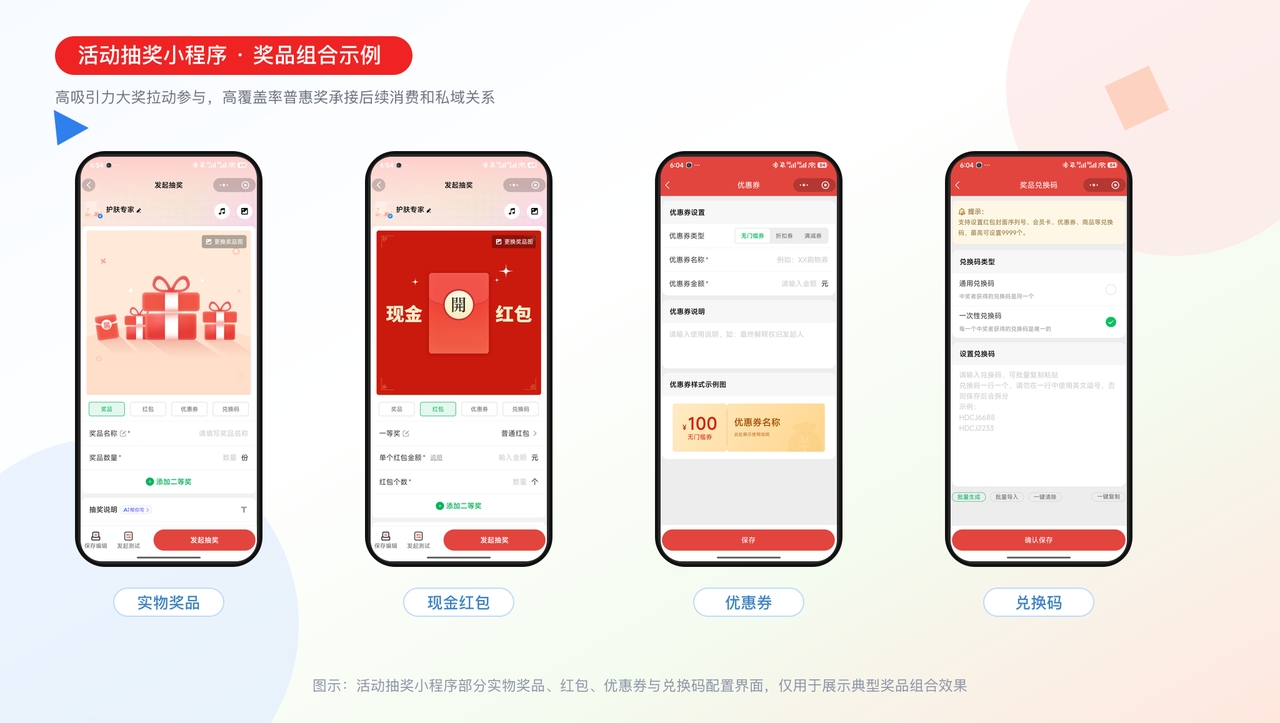
Figure 2
Therefore, prizes are not the more expensive the better — the higher value comes from prizes that can better match target users and support subsequent consumption or private domain relationship building.
III. Participation Conditions: Not Raising Barriers, But Screening the Right Users
Many merchants worry that too many participation conditions will affect the participation volume when running lucky draws. This concern is reasonable, but if there are no participation conditions at all, the campaign will easily attract a large amount of non-targeted traffic: users join once to draw prizes, leave immediately after, and are hard to reach subsequently, making it impossible to judge whether these users are truly valuable.
The role of participation conditions is not to artificially increase difficulty, but to allow users to complete the actions that merchants actually need before joining the lucky draw.
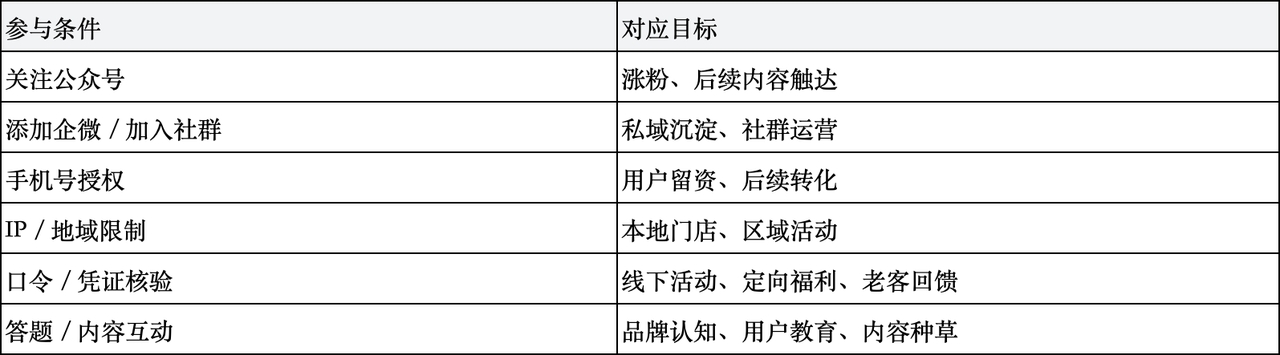
Figure 3
Therefore, when the campaign goal shifts from "getting more people to participate" to "getting the right people to participate", a fully-featured tool like the Campaign Lucky Draw mini-program can play a significant role. It supports functions such as following official accounts, adding corporate WeChat contacts, mobile number authorization, designated regions, passcodes, and credential verification, helping merchants closely tie campaign entry points to operational goals.
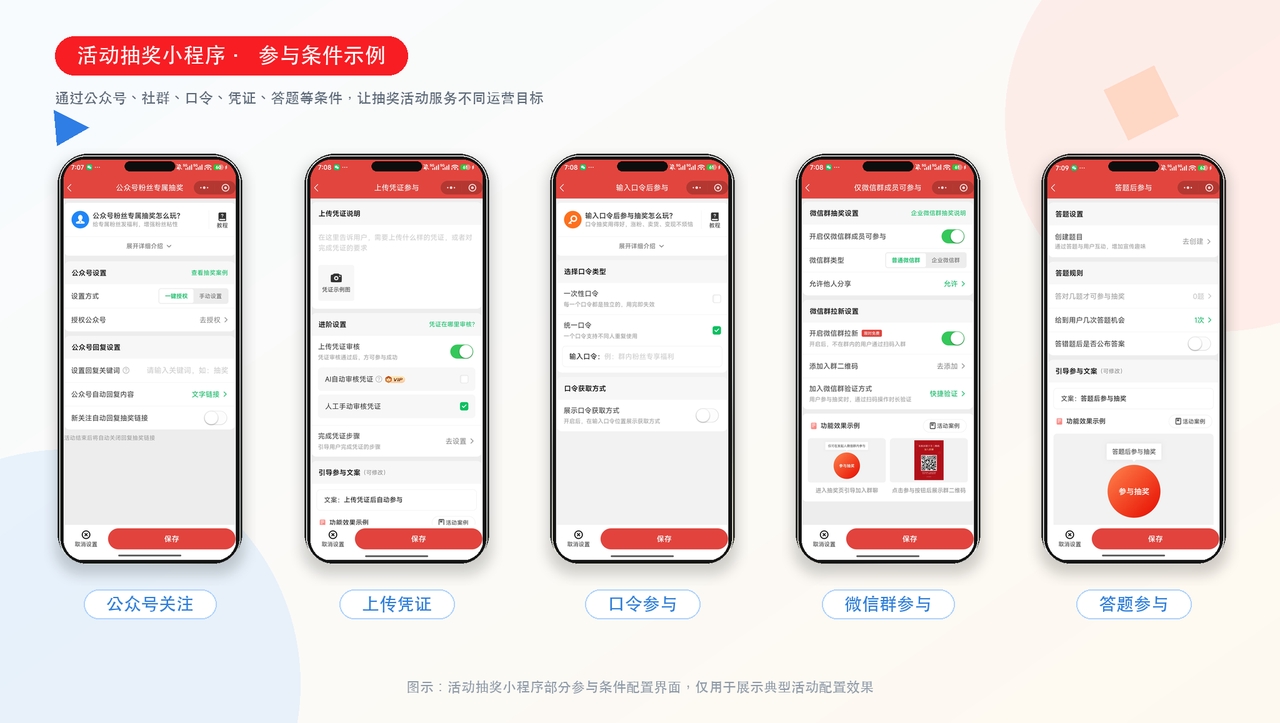
Figure 4
IV. Gameplay Design: The Richness of Gameplay is Essentially the Capability of Scenario Coverage
The number of gameplay modes is not simply a pile of features, but how many campaign scenarios the tool can cover.
When enterprises run lucky draws, they should not only focus on which gameplay is more lively, but first judge which scenario the campaign takes place in and what actions they expect users to complete. Daily engagement, community operations, membership benefits, offline stores, and content interaction have different requirements for gameplay.
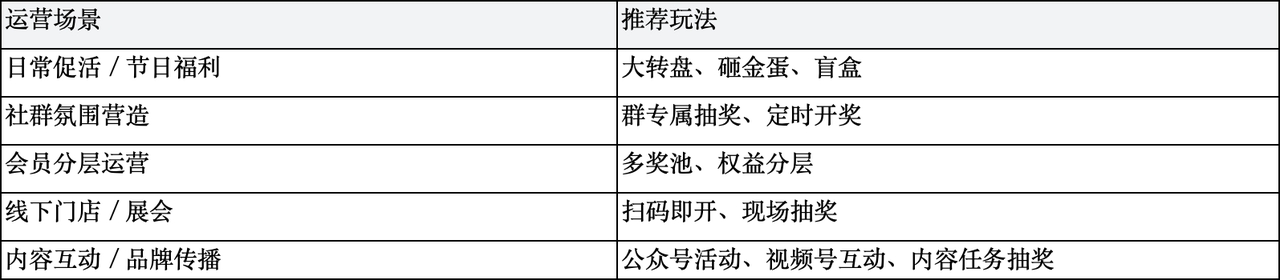
Figure 5
The richer the gameplay modes, the easier it is for merchants to match solutions based on their goals: use low-barrier gameplay for light engagement, stronger visual presentation for brand campaigns, tiered prize pools for membership operations, and instant feedback plus on-site interaction for offline scenarios.
A diverse gameplay system is the foundation of scenario adaptation. In the Campaign Lucky Draw mini-program, merchants can select campaign forms as needed: use spinning wheels, blind boxes, and golden egg smashing for daily engagement; use 9-grid lucky draws, gashapon machines, and card collection gameplay for brand campaigns; use on-site lucky draws, avatar draws, and name list draws in offline scenarios to enhance real-time interaction. The more scenarios the gameplay can cover, the greater the combination space for campaign solutions.
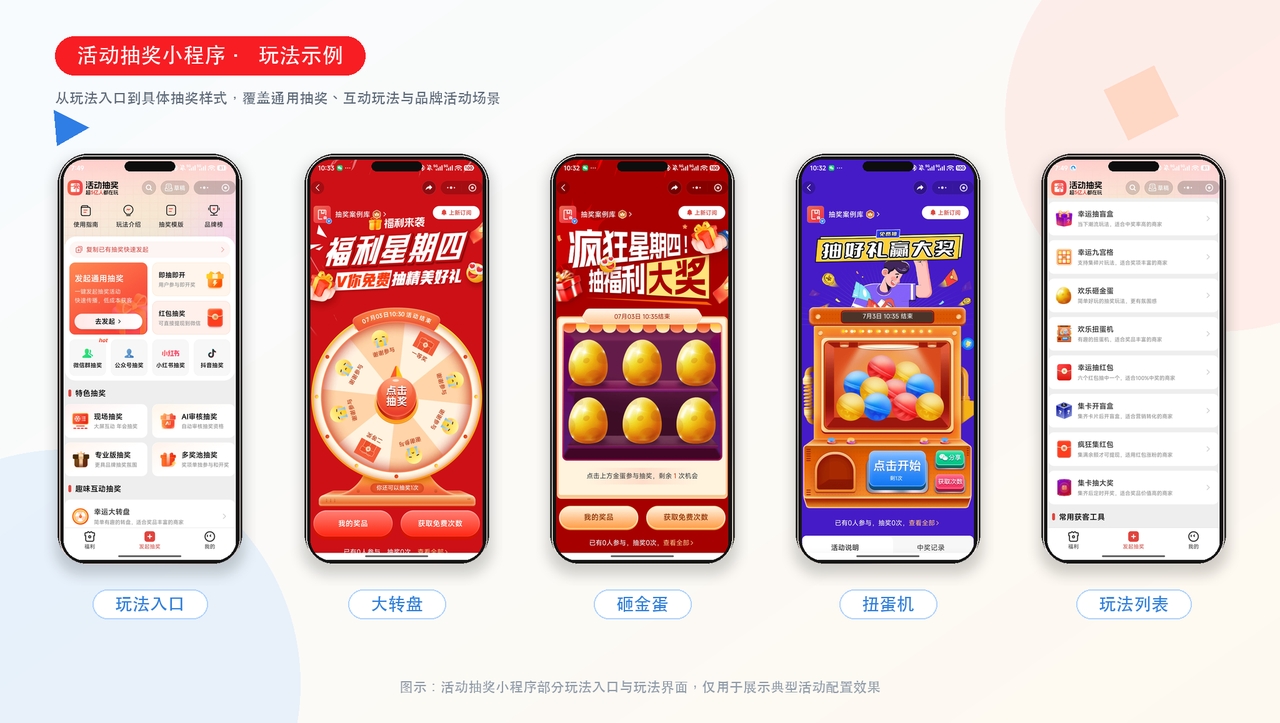
Figure 6
V. Page Presentation: Trustworthiness Determines Whether Users Are Willing to Participate
Whether users are willing to join the lucky draw, the first impression of the page is crucial.
If the page is crude, users will easily perceive the campaign as a temporary benefit, and even doubt its authenticity; a page with clear brand information, custom backgrounds, prize displays, rule descriptions, scrolling winning lists, and comment sharing sections can more easily build a sense of formality and credibility.
Page presentation is not just about "beautifying the interface", but about reducing users' concerns before participation. For corporate campaigns that need to be disseminated externally, page effects will directly affect dwell time, participation rate, and willingness to share. Especially for brand campaigns, store campaigns, and membership campaigns, users not only see prizes, but also judge whether the campaign is real, and whether it is worth participating in and sharing.
In practical operations, page presentation should focus on at least three elements:

Figure 7
Complete page capabilities can effectively build campaign credibility. Leveraging features of the Campaign Lucky Draw mini-program such as custom background images, lucky draw styles, prize displays, winning lists, comment interaction, and winning sharing, you can turn the lucky draw page from a "participation entry" into a more complete campaign landing page. The more trustworthy the page is, the lower the resistance for users to participate and share.
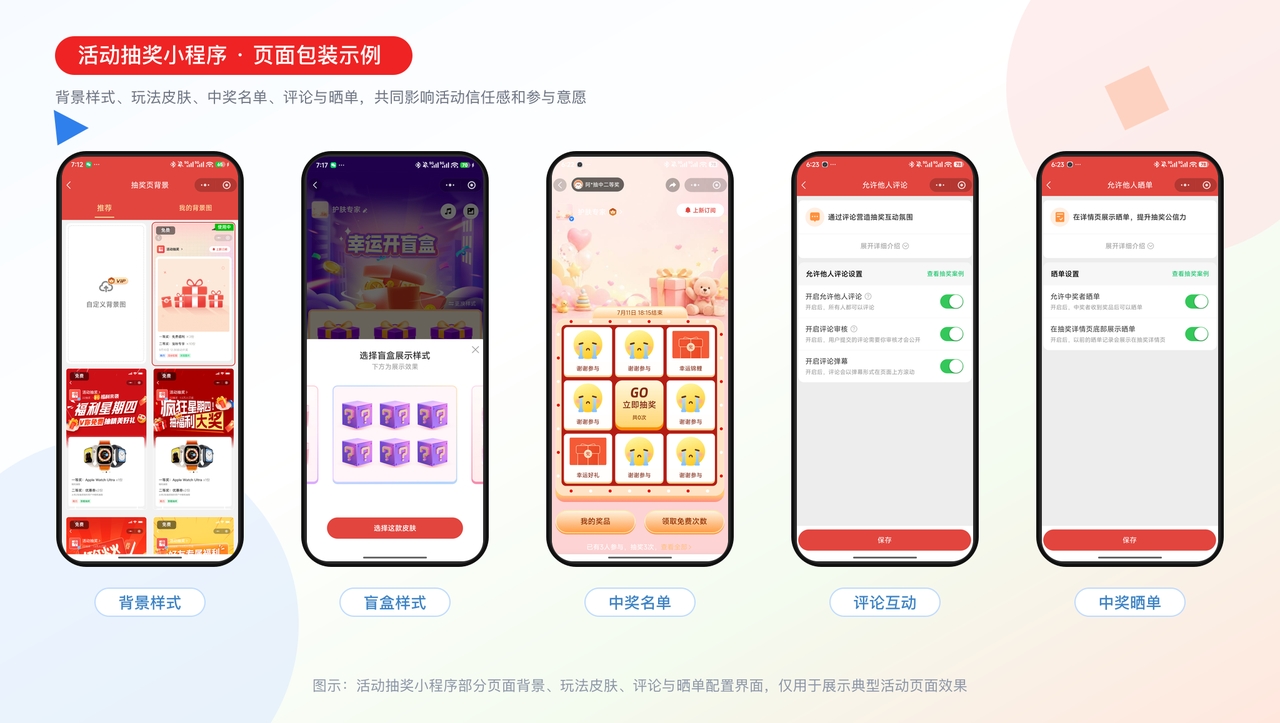
Figure 8
VI. Dissemination Path: Let Users Spread Voluntarily Instead of Forcing Sharing
Lucky draws naturally have dissemination attributes, but within the WeChat ecosystem, dissemination design must strictly abide by platform rules.
Models that rely on forced sharing for participation not only easily touch regulatory red lines, but also arouse user resentment. A more reliable approach is to rely on prize attractiveness, page credibility, and task incentives to guide users to voluntarily complete interaction and dissemination.
Common design methods include:

Figure 9
A good dissemination path does not "force users to share", but gives users reasons to continue participating and willingness to bring in more similar people. In the Campaign Lucky Draw mini-program, merchants can configure functions such as sharing guides, mutual help tasks, and content interaction tasks to guide users to spread naturally, and connect dissemination actions to operational goals such as official account following, community joining, and content interaction.
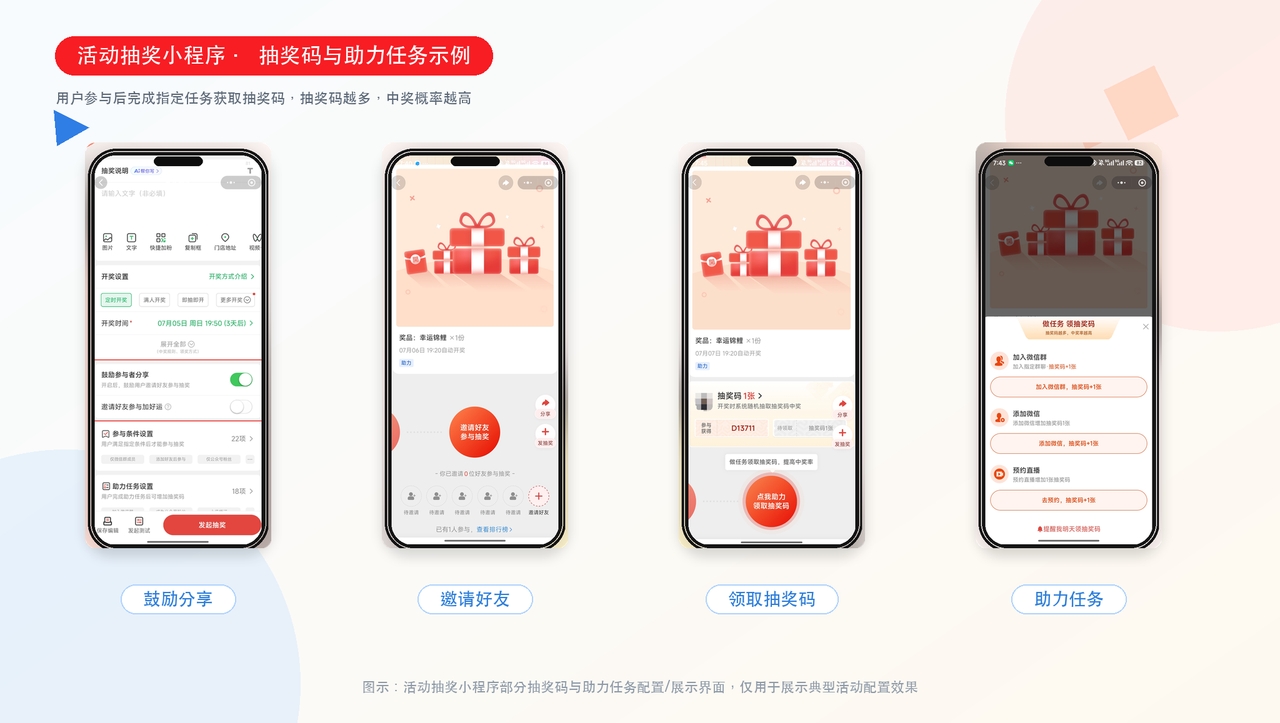
Figure 10
VII. Winning Rules: Back-end Capabilities Determine Whether the Campaign Can Be Implemented Stably
Problems in many lucky draw campaigns do not arise in front-end participation, but in back-end rules. Uncontrollable winning probability easily leads to budget overruns; no limit on prize inventory may cause over-distribution of prizes; unclear participation frequency allows a small number of users to participate repeatedly; lack of anti-cheating mechanisms will undermine campaign fairness.
A complete winning rule system needs to clarify several key points before the campaign goes live:
