Is the single-technology narrative outdated? A new paradigm integrating brain-computer interface, AI, and embodied intelligence has arrived.
What comes after brain-computer interfaces? That's an intriguing question.
When a paraplegic patient uses a brain-computer interface to control a robotic arm to pick up a water cup, they always face a dilemma: if they apply too little force, the cup will slip; if they apply too much force, the cup will be crushed.
This is because current brain-computer interfaces are only "brain-to-machine" one-way transmission, capable of outputting commands but lacking feedback return.
What if we form a perception-decision-execution-feedback loop to achieve two-way interaction between "brain and machine"? This precisely combines the three hottest concepts today: brain-computer interface, embodied intelligence, and AI, and it is exactly the brand-new concept called "Ternary Intelligence" recently proposed by Professor Shu Kai and Professor Hu Feng from the Brain-Computer Interface Research Institute of Tongji Hospital, Huazhong University of Science and Technology.
Is it a technological revolution or a hodgepodge of concepts?
Brain-computer interfaces, AI, and embodied intelligence are all the most popular concepts at the moment.
AI goes without saying. Financing for brain-computer interfaces has repeatedly hit new highs in recent years, and as many as 16 embodied intelligence companies have each seen their valuations exceed 100 billion yuan in just 6 months.
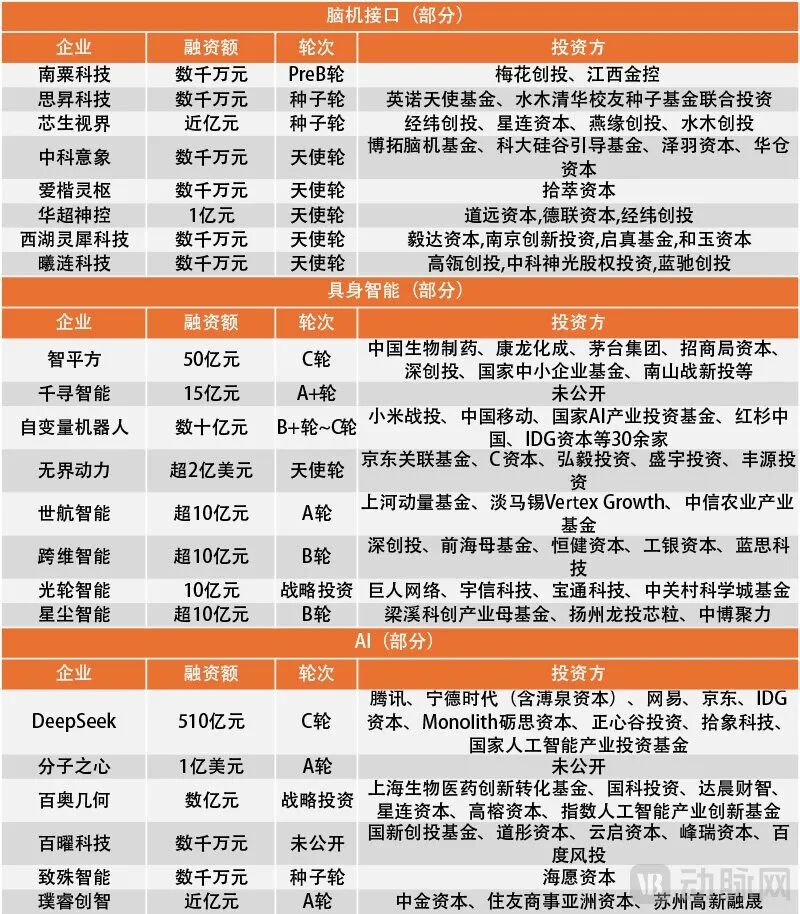
Incomplete statistics of major financing events in several key fields in June
The integration of Ternary Intelligence with these three hottest concepts inevitably leads people to think it is concept-driven hype.
In fact, a basic understanding of the technical logic reveals that the three are perfectly complementary.
Brain-computer interfaces solve the problem of the ultimate form of human-computer interaction, breaking through the indirect interaction methods of traditional human-machine interfaces such as mice, keyboards, and voice, enabling direct connection and communication between the human brain and external devices, allowing brain intentions to be transmitted to machines in the most natural and efficient way.
However, the number of channels in brain-computer interfaces will remain a long-term shortcoming. Non-invasive brain-computer interfaces only have dozens of channels with poor signal quality, and even invasive brain-computer interfaces with thousands of signal channels are just a tiny fraction of the body's natural neural channels.
AI precisely makes up for this shortcoming by decomposing complex tasks at the decoding end and enhancing signal accuracy. On the other hand, large language models endow machines with language understanding, logical reasoning, task planning, and autonomous learning capabilities, enabling them to handle complex semantic information and dynamic environments.
Embodied intelligence provides the possibility for AI to connect with the physical world — the so-called physical AI stage — so that intelligence is no longer limited to the digital world, but can complete tasks and create value in the real world through the chain of perception, decision-making, and execution.
For example, various sensors mounted on a robot can quantify environmental information, encode it into microcurrent stimulation, and transmit it back to the somatosensory cortex, thus turning blind operation into perceptible control, evolving from one-way transmission to a closed loop of "perception-decision-execution-feedback."
In fact, although the concept of Ternary Intelligence is new, its ideological foundation has been widely discussed before.
The CPS (Cyber-Physical Systems) concept, which focuses on the integration of embedded computing and physical processes, was proposed long ago. It later evolved into the CSP (Cyber-Social-Physical) concept, which includes the human social dimension. It went through name changes from CPSS (Cyber–Phisical–Social System) to CPHS (Cyber–Phisical–Human System) and is still in use today, widely referenced in the interdisciplinary field of human-computer interaction.
Essentially, Ternary Intelligence is a concrete instance of the CPHS ideology in the field of brain-computer interfaces. The brain-computer interface corresponds to the Cyber–Human interface, responsible for reading and writing neural signals; AI corresponds to the Cyber intelligent layer; and embodied intelligence is equivalent to the Physical–Human interface.
In the view of Dr. Zhang Dongdong, Director of the Brain Science BU at Aoyi Technology, Ternary Intelligence is the trend of technological iteration: "In fact, the original definition of a brain-computer interface is a two-way brain interface that requires both perception and feedback. It's just that more research has been done on perception, and breakthroughs in sensory input research have only emerged in recent years."
"From the first day Aoyi Technology was founded, we have been laying out the two directions of brain-computer interfaces and embodied intelligence, focusing on peripheral nerve interfaces and bionic hands. The bionic hand itself is a core component of embodied intelligence — it's just that the concept of 'embodied intelligence' didn't exist back then. This is actually the inevitable result of the natural convergence of technologies over more than a decade, not chasing trends."
At present, Aoyi Technology's myoelectric exoskeleton products obtained medical device certifications at the beginning of the year and have been sold to hospitals. Its dexterous hands rank in the first echelon of domestic shipments, and its bionic hands have served tens of thousands of amputee patients in more than 100 countries.
As China's first special fund dedicated to brain-computer interfaces, Heying Brain-Computer Fund has long had keen insights into the field. Its partner Zhang Yutao also believes that Ternary Intelligence, which combines brain-computer interfaces, AI, and embodied intelligence, is an inevitable industrial trend — the inevitable integration of the three fields as their technologies evolve to the current stage, and the only path for the co-evolution of human intelligence and machine intelligence.
"Humans excel at creative thinking, situational judgment, and value decision-making; machines excel at precise computing, massive data processing, and repetitive labor.
Ternary Intelligence forms a complete closed loop of 'human brain - digital brain - physical body,' realizing the complementary advantages of human intelligence and machine intelligence, and giving rise to a brand-new intelligent form: human-machine collaborative intelligence, which is also one of the important paths to artificial general intelligence," Zhang Yutao told VCBeat.
The "Impossible Triangle" of Brain-Computer Interfaces, AI, and Embodied Intelligence
In Zhang Yutao's view, the three technical fields of Ternary Intelligence have all made remarkable progress, and practical applications of pairwise integration have begun to emerge.
Regarding the integration of brain-computer interfaces and AI, large AI models have increased the decoding accuracy of neural signals from the traditional 60-70% to over 90%, achieving a breakthrough from pre-programmed instructions to dynamic semanticization.
"For example, BrainCo's AI model can parse the brain's motor intentions in about half a second. In addition, the world's first AGI-BCI system has realized a two-way closed loop of 'perception-decision-execution,' with an operation delay of only 50ms," Zhang Yutao introduced.
The integration of AI and embodied intelligence endows robots with a certain degree of natural language interaction capabilities, enabling them to understand vague instructions and decompose tasks. Humanoid robots from leading companies such as Fourier Intelligence and Unitree Robotics can already perform simple housework or industrial operation tasks, and embodied intelligence is gradually showing a trend of mass production delivery and commercial breakthroughs this year.
There are even more practical cases of the integration of brain-computer interfaces and embodied intelligence.
At present, non-invasive brain-computer interfaces combined with exoskeletons/pneumatic gloves are routinely used in the rehabilitation departments of thousands of tertiary hospitals across China to help stroke hemiplegic patients restore motor function. High paraplegic patients can also control robotic arms with their minds, and products such as brain-controlled wheelchairs and brain-controlled drones have moved from laboratories to real-world applications.
"Overall, Ternary Intelligence is currently in the early stage of transition from 'pairwise integration' to 'three-way interconnection and integration,'" Zhang Yutao made this judgment in an exchange with VCBeat.
Zhang Dongdong's judgment is largely consistent, but he also points out the significant differences in the development pace of the three technical fields: "AI is advancing the fastest, and has already generated huge productivity in specific industries. In contrast, although there have been breakthroughs in brain-computer interfaces and embodied intelligence, more time is still needed."
Since it is in the early stage, Ternary Intelligence naturally still has much room for improvement.
Zhang Yutao said that in terms of brain-computer interfaces, the respective shortcomings of invasive and non-invasive brain-computer interfaces are well known. Sensory feedback is currently a relatively weak link. Although microcurrent stimulation transmitted back to the somatosensory cortex has been proven feasible in animal experiments, there is still a long way to go before clinical application.
In the field of embodied intelligence, system bottlenecks such as high power density actuators, high-sensitivity tactile sensors, and long battery life have not been broken through.
At the AI level, there is a real-time collaboration problem, mainly manifested in the mismatch of response speeds among the three subsystems, making it difficult to achieve millisecond-level synchronization. In addition, end-to-end training of AI is quite difficult, requiring massive amounts of multi-modal interaction data, and the cost of data annotation is extremely high; at the same time, it is difficult to balance interpretability and security, as the decision-making process of black-box models is unpredictable, posing potential safety hazards.
Zhang Dongdong also lists data as one of the current shortcomings of Ternary Intelligence AI: "The total amount of publicly available EEG data in the world is on the order of 10⁵ hours. If we convert 1 token per second for a single channel, this data is roughly on the order of 10⁹~10¹⁰ tokens — three orders of magnitude less than the 15T text tokens used to train Llama 3. The real gap may be even larger, because affected by noise, the effective information density of EEG tokens is far lower than that of text tokens. The training data available for embodied intelligence is even less than EEG data."
There is also considerable room for improvement at the system level. The complexity of the entire Ternary Intelligence system increases exponentially compared to a single system, making it a huge engineering challenge to ensure real-time performance, reliability, and maintainability. At the same time, as a brand-new concept, this field still lacks unified technical standards and interface specifications, making it difficult for products from different companies to interconnect.
Zhang Dongdong said that taking data standards as an example alone, brain-computer interface signals have multiple modalities. Electrical signals are divided into invasive spike signals and non-invasive field potential signals, plus magnetic signals, blood oxygen signals, acoustic signals, and so on. "Just unifying the internal signals of brain-computer interfaces is a very challenging task."
He admitted that although there have been discussions on standard unification in the industry, higher-level coordination and promotion are clearly needed.
Finally, Ternary Intelligence also needs to improve ethical governance. This is because brainwaves contain the most private information such as people's thoughts and emotions, raising privacy protection issues; it is also necessary to prevent the system from being maliciously attacked or misused.
In addition, the issue of defining responsibility for Ternary Intelligence also needs to be clarified: in the event of an accident, how to divide responsibility between humans, algorithms, and hardware.
Why can it obtain excess premium?
Although there is still a long way to go, the concept of Ternary Intelligence has received much attention because its application fields are extremely wide. In the medical field alone, rehabilitation and assistance for special populations may be the first areas where Ternary Intelligence is deployed on a large scale.
The medical rehabilitation field is undoubtedly the area where Ternary Intelligence technology is relatively mature at present. At present, stroke and traumatic brain injury hemiplegia rehabilitation has realized the combination of non-invasive brain-computer interfaces + exoskeletons/pneumatic gloves, which has been included in medical insurance payment, with huge market demand.
In terms of bedside and even paralysis assistance, patients can use brain-computer interfaces to control robotic arms, wheelchairs, and communication devices with their minds to restore basic living abilities.
In the intervention of mental illnesses, AI-assisted intervention solutions for diseases such as autism, depression, and ADHD based on brain-computer interfaces — represented by digital therapeutics — have already had products entering clinical applications.
The application prospects in assisting special populations are even broader. In terms of assisting people with disabilities in daily life, brain-controlled smart homes, brain-controlled prosthetics, and other methods can help people with disabilities improve their self-care abilities.
Zhang Yutao believes that the progress of domestic brain-computer interfaces is encouraging: "Current visual reproduction technology can already help blind people restore a certain degree of visual function. Providing aphasia patients with brain-computer interface-assisted communication devices can also directly convert their thoughts into speech or text."
As a result, capital is paying more and more attention to the concept of Ternary Intelligence. Companies with such conceptual characteristics usually can obtain higher valuations in the capital market.
Zhang Yutao said that the integration of Ternary Intelligence will produce a significant dimensionality enhancement effect on corporate valuations: "There has been a clear differentiation in the market's valuation logic for different types of enterprises. The valuation of pure brain-computer interface hardware companies is more based on product sales volume and market share. The valuation of pure embodied intelligence hardware companies is based on mass production capacity and delivery progress. As for AI algorithm companies, their valuation is mainly based on model capabilities and data scale."
He believes that platform-based enterprises with ternary integration capabilities can obtain higher valuation premiums because they can open up the data closed loop of "brain-intelligence-body" to form a strong network effect. At the same time, this platform capability can quickly enter multiple application scenarios, reducing single-market risks. On the other hand, this comprehensive platform capability also helps build technical barriers and raise the entry threshold for competitors.
"The valuation of such enterprises is mainly based on ecological value and long-term growth, with huge improvements in both relative and absolute valuation values," he added.
Zhang Yutao further stated that Heying Brain-Computer Fund has clearly taken Ternary Intelligence as its core investment line and has already reserved investable targets: "Our investment strategy can be summarized as 'scenario first, technology as the foundation, ecology as the wing.' Landing scenarios are the most valued, because while technological breakthroughs are important, starting from the end, the ultimate measure is whether it can solve practical problems or create commercial value."
"We will also prioritize investing in projects that have clear application scenarios and can achieve commercialization within two years. At the same time, taking into account the layout of core technologies, we are continuously focusing on the layout of key core technologies such as brain-computer interface chips, high-density electrodes, and high-precision actuators. As the foundation for the development of Ternary Intelligence, these technologies have high strategic positioning value."
Finally, Zhang Yutao also said that Heying Capital will continue to build an ecological investment system, investing in high-quality enterprises in the upstream and downstream of the industrial chain to form a complementary ecological network, promoting resource sharing and business cooperation among invested enterprises, and jointly driving the cluster development of the Ternary Intelligence industry.
Aoyi Technology provides a real footnote to this valuation logic. Zhang Dongdong revealed that Aoyi Technology is one of the few domestic companies that has both the brain-computer interface and embodied intelligence concepts, and it is the only company in China that has received support from two brain science funds at the same time.
"In fact, 10 years ago when the company was just founded, we laid out the two directions of peripheral nerve signal analysis and decoding and intelligent bionic hands. We didn't deliberately use concepts to boost valuations, but this intersection did bring about an increase in valuation."
The Final Puzzle Piece
Although brain-computer interfaces are still a brand-new field, Ternary Intelligence is undoubtedly opening up the next boom — a boom of system-level integration.
Current brain-computer interfaces are still in a relatively low-level form. With the advancement of technology, the entire system will gradually evolve from mind control to tactile feedback, and then to a sense of embodiment, so that patients can truly perceive that the robotic arm has become their own "hand." This is the ultimate form that brain-computer interfaces hope to achieve.
This is not only a puzzle of technology, but also a puzzle of business models, which will lead to a qualitative change in the valuation logic.
Whoever can make a breakthrough first may seize the initiative in the next round of technological dividends. After all, when the human brain can directly control a steel body, we are no longer talking about a simple medical device market, but a new era of human augmentation.
References:
Yang Jing, Wang Xiao, Wang Yu-Tong, Liu Zhong-Min, Li Xiao-Shuang, Wang Fei-Yue. Parallel intelligence and CPSS in 30 years: An ACP approach. Acta Automatica Sinica, 2023, 49(3): 614−634 doi: 10.16383/j.aas.c230015