Excess Space Leasing vs Frenzied Expansion: Is There a Clear "Open Conspiracy" Behind Meta's Contradictory Moves?
After Meta began considering compute power leasing, sparking concerns that the compute power industrial chain has peaked, while the market was still debating whether this was a temporary transition or a long-term strategy, Meta has taken three concrete actions to make its stance clear: We are serious about entering the compute power business!
Expanding data centers is the most direct preparatory step, mass-producing its own ASIC chips balances costs to achieve higher ROI, and the newly released large language model Muse Spark 1 is what we at Dolphin Research consider the true upside surprise in this move.
These three new developments will undoubtedly push up short-term capital expenditure (Capex) further, putting inevitable pressure on earnings per share (EPS). But what is gradually becoming clear is that Meta's narrative has shifted — from a "cost-focused" consumer-facing AI strategy to an "economically viable" enterprise-facing AI strategy. Investors will look past the short-term fundamental pressure from upfront investments and raise expectations for direct AI monetization.
While many organizational challenges remain, amid widespread market controversy, Meta's valuation sentiment is set for a much clearer correction.
The "Refreshed" Large Language Model May Still Hold Unpriced Upside
In Dolphin Research's view, the truly unexpected announcement last night was the launch of Muse Spark 1.1. Large language model technology is the direct driver of Meta's long-term organic growth potential, and at a time when negative news about team organization is piling up, this release can to some extent alleviate market concerns about Meta's organizational vitality.
Muse Spark 1.1 is a major upgrade to the Muse Spark model released earlier this year. It is a multimodal model purpose-built for Agent tasks, with significant improvements in intelligence, coding capabilities, and multimodal understanding.
With a top-tier model in hand, subsequent compute power leasing will no longer be limited to bare chip rentals, but will evolve into complete solutions bundled with added value such as large language model capabilities and Agent functionalities.
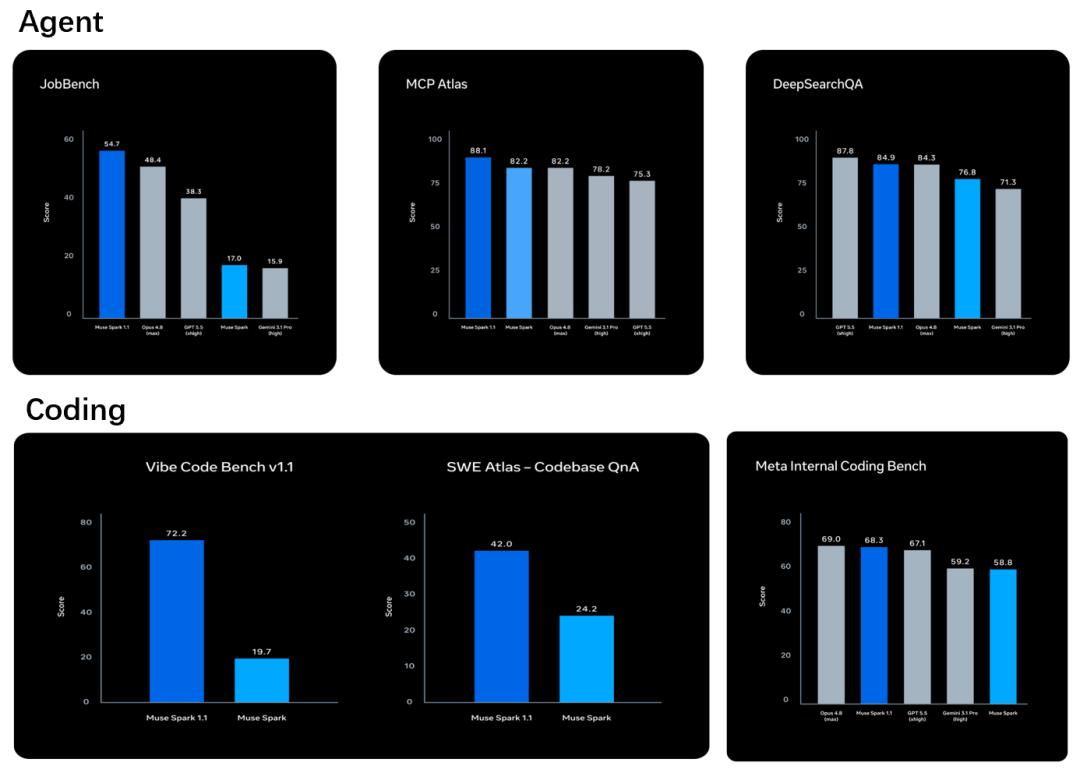
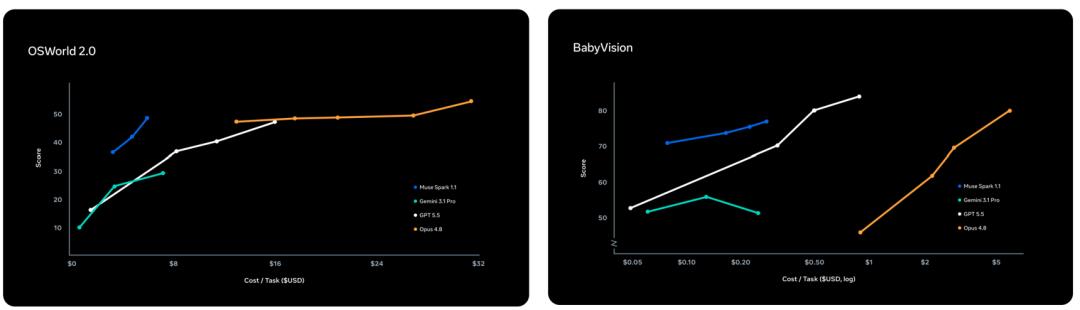
Beyond performance improvements, Muse Spark 1.1 stands out for its cost-effectiveness: it delivers intelligence comparable to Opus 4.8 at just one-quarter of Opus 4.8's pricing, appearing to offer even better value than GLM-5.2.
In the span of a single week, OpenAI, Grok, and Meta have sequentially released new models, with rumors that Google will soon follow suit. The industry has entered an all-out price war, and leading player Anthropic has "coincidentally" reset user token limits as a temporary goodwill gesture.

Why Does Meta's Large Language Model Capability Seem to Have Regained Momentum?
Dolphin Research connects this to a widely discussed theory about the untapped potential of large language models — the current competition among top-tier models increasingly hinges on data moats (high-quality labeled data for RLHF, the core of the alignment phase), especially real user behavioral data generated during AI usage — recording every step of user operations, error corrections, and decision-making processes.
For example, in the coding domain, performance is heavily influenced by desensitized programming trajectory data for enterprise use cases. Anthropic and OpenAI have accumulated rich datasets in this area, but due to compliance constraints, Google lags behind them in the volume of long-trajectory data available for training.
This focus on process data collection and data labeling aligns perfectly with Meta's seemingly unusual operational adjustments over the past year:
On one hand, building an in-house labeling team was a major organizational change after Meta's acquisition of Scale AI, and one of the primary sources of employee discontent (staff argued data labeling lacked technical merit, with non-compliance leading to layoffs).
On the other hand, recent reports emerged of Meta employees complaining that the company was collecting work process data via screen monitoring and mouse movement tracking — which exactly matches the aforementioned demand for long-trajectory data.
Does this mean Meta still has opportunities for a latecomer advantage through accumulated progress? Dolphin Research will continue monitoring developments, especially whether further improvements to internal organizational issues can be made, which directly determines Meta's ability to sustainably demonstrate its technical strengths.
Compute Power Target Doubles, But Cash Flow Remains Tight
What most excited the AI industry last night was Meta's announcement that it is targeting to double its data center compute power capacity, dispelling market fears that major cloud customers would cut back on capital expenditure.
According to Reuters, Meta's compute power deployment target for next year will reach 14GW, doubling from the end of this year. Previously, based on Meta's data center construction plans, Dolphin Research estimated 2026 capacity at roughly 7GW, and projected 9-10GW by the end of 2027 — a 4GW gap compared to Reuters' report.
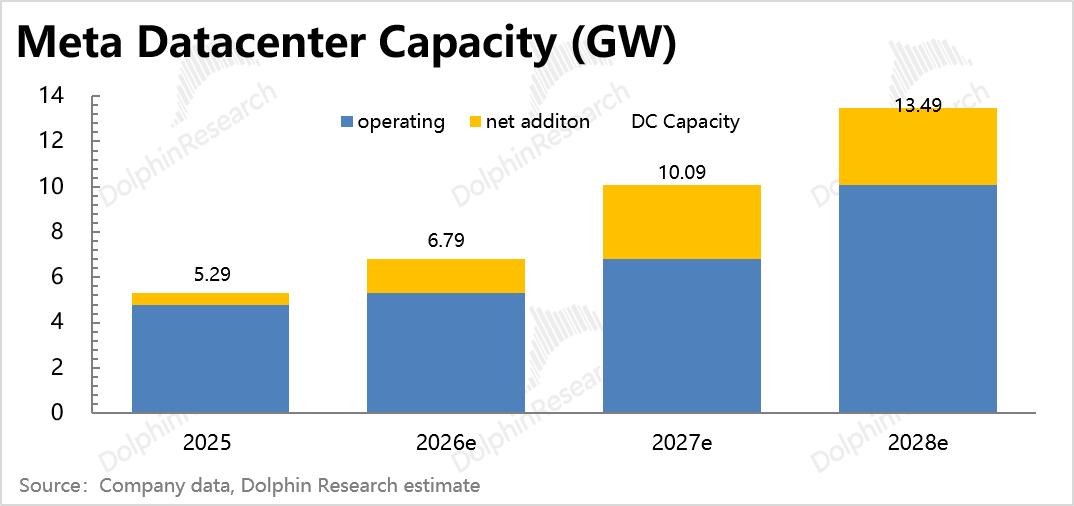

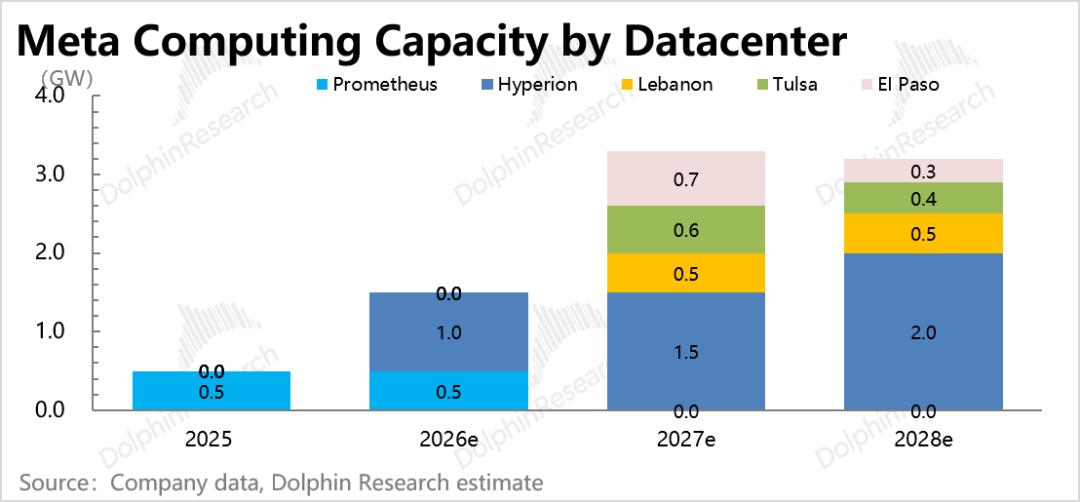
However, two questions remain: does Meta have sufficient capital to fund this expansion, and can it actually complete deployment and launch operations on schedule as planned?
The latter involves too many variables to quantify, so the market has largely ignored it amid short-term optimism. Historically, there has often been a gap between data center planning and actual implementation, a factor that requires a safety margin, but since it cannot be accurately calculated, Dolphin Research will not dwell on it excessively.
The first question, however, can be assessed with a simple analysis, which we break down into key points:
(1) How much will expanding compute power capacity cost next year?
Dolphin Research splits Meta's Capex directly into compute power construction expenditures and other expenses. Compute power construction costs are calculated based on an average deployment cost of $35 billion per GW, aligned with the construction timeline of each campus (excluding off-balance-sheet financing from Blue Owl, amortized over 5 years). Remaining Capex expenditures are projected to grow at a normal 20% rate after 2027.
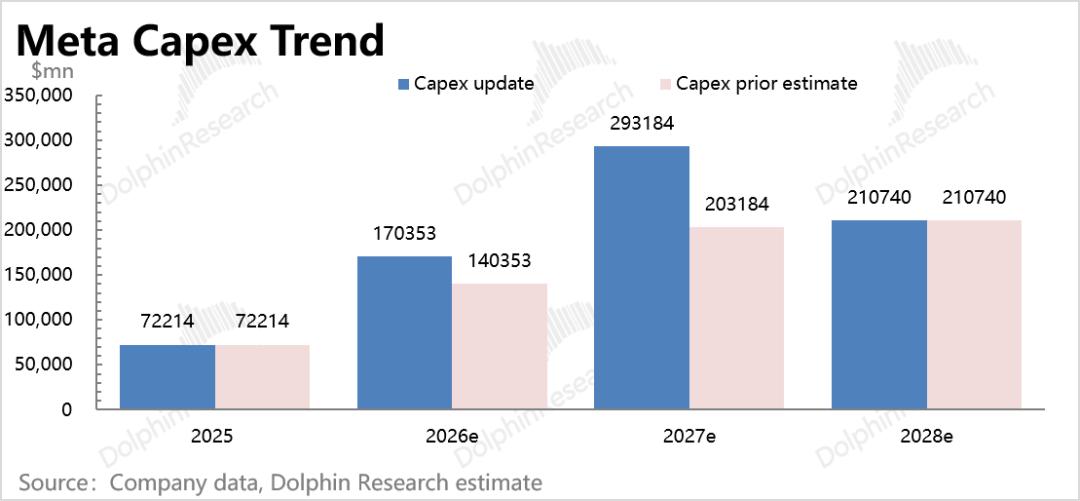
Our original forecast put 2026/2027 Capex at $140 billion / $203 billion. But adding the 4GW gap for 2027, even accounting for cost savings from using some TPU chips plus Meta's own ASIC Iris chips, at an estimated $30 billion per GW, an additional $120 billion (30*4) would be required over the two years.
A major mitigating factor is that if the 14GW target is a planning benchmark for the end of 2027 rather than a mandatory full deployment deadline, the extra $120 billion in spending from 2026-2027 could be spread out into 2028 or even 2029.
Dolphin Research believes this is more likely a 2027 planning target rather than a requirement to fully deploy that capacity by year-end. Otherwise, given typical 1-2 year data center construction cycles, we would immediately see new data center projects breaking ground beyond the five currently under construction, with construction teams mobilized and power supply partnerships established.
Taking a balanced view, Capex will most likely fall within the projected range shown in the chart below — $140-170 billion this year, and $200-290 billion next year.
A key indicator to watch is whether Meta's Q2 earnings report at the end of the month will further raise this year's Capex guidance, and how aggressively management discusses the 14GW compute power deployment target during the earnings call.
(2) Does Meta Have Sufficient Liquidity?
The 14GW target is ambitious, and we need to verify Meta's capacity to deliver. Mark Zuckerberg has a history of overpromising on initiatives, and Meta has previously suffered from strategic drift and internal operational conflicts.
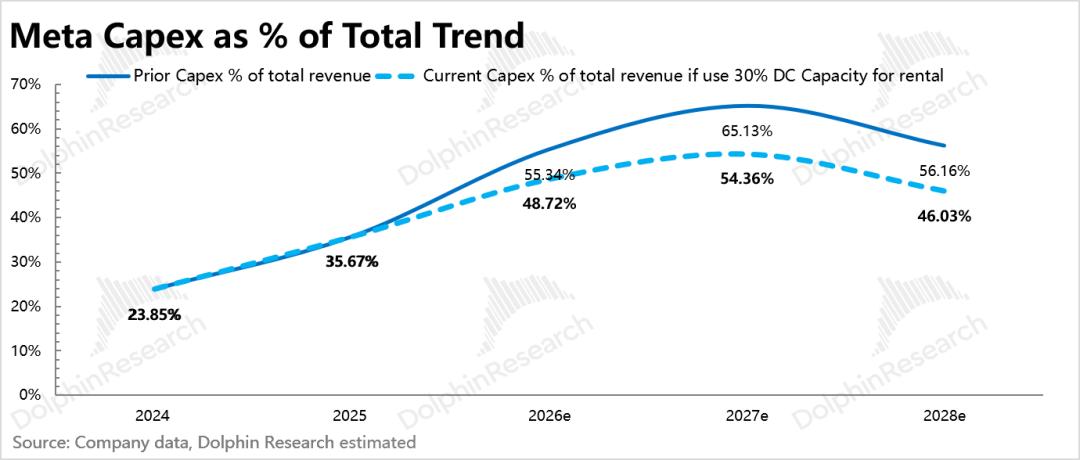
First, Meta's core advertising business is currently growing strongly. While the US economic environment shows volatility, it is likely to support continued high growth in the near term. But without compute power leasing, under our original Capex forecast, Capex as a percentage of revenue would reach 55% in 2026 and 65% in 2027.
This figure is quite dramatic: at a typical 50-60% operating cash flow to revenue ratio, it means all cash flow generated from daily operations over the next two years would be entirely spent on compute power investments.
While Meta has long maintained a "Cash Neutral" cash management philosophy, dedicating all operating cash inflows to Capex, plus other outbound investments and debt interest payments, would result in two consecutive years of negative free cash flow — a clear risk to operational stability.
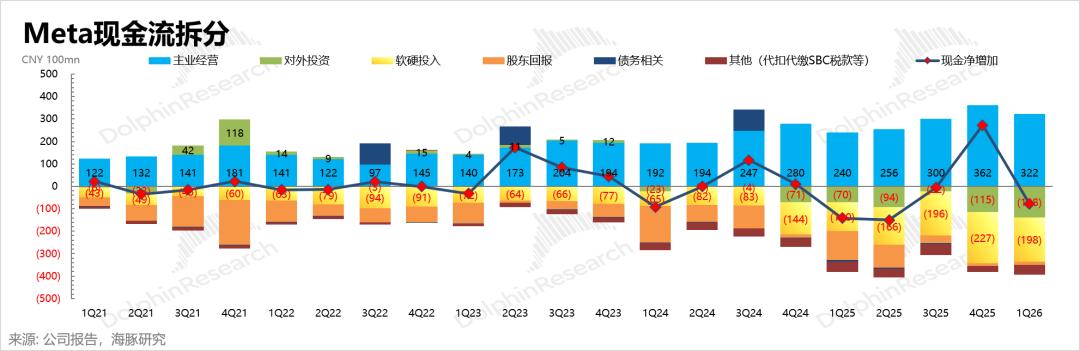
As a leading tech giant, Meta does not need to exhaust its cash reserves even if it has ample funds. It can easily leverage its strong credit profile to secure low-cost financing, as demonstrated by its large corporate bond issuances at the end of last year and off-balance-sheet financing partnerships with private credit firms.
But with the revenue upside from compute power leasing, the pressure on Meta's capital investment will be significantly alleviated.
For example, assuming 30% of capacity (2GW and 4GW respectively in 2026 and 2027) is leased externally, at an annual bare compute power rental rate of $10-15 billion per GW, this would generate at least $20 billion and $40 billion in incremental revenue over the two years, representing 8% and 12% top-line growth respectively on our original revenue forecast. Bundling large language model and Agent capabilities would drive even higher incremental revenue.
As the chart below shows, after accounting for the extra investments required for new data centers and the revenue generated from leasing 30% of capacity, the overall pressure of Capex relative to revenue is noticeably reduced.
However, since investments are made upfront, Meta will still need to draw down its cash reserves (currently $81 billion in cash + short-term investments, with $59 billion in long-term debt). If Meta actually hits the 14GW target next year, additional debt financing will still be unavoidable.
But compared to the previous scenario where AI spending was purely a cost item (with AI not being the primary driver of ad growth), framing AI now as a revenue-generating business will reduce shareholder resistance to taking on more debt to fund this high-stakes AI bet.
ASIC Mass Production Imminent, Primarily for Internal Cost Reduction
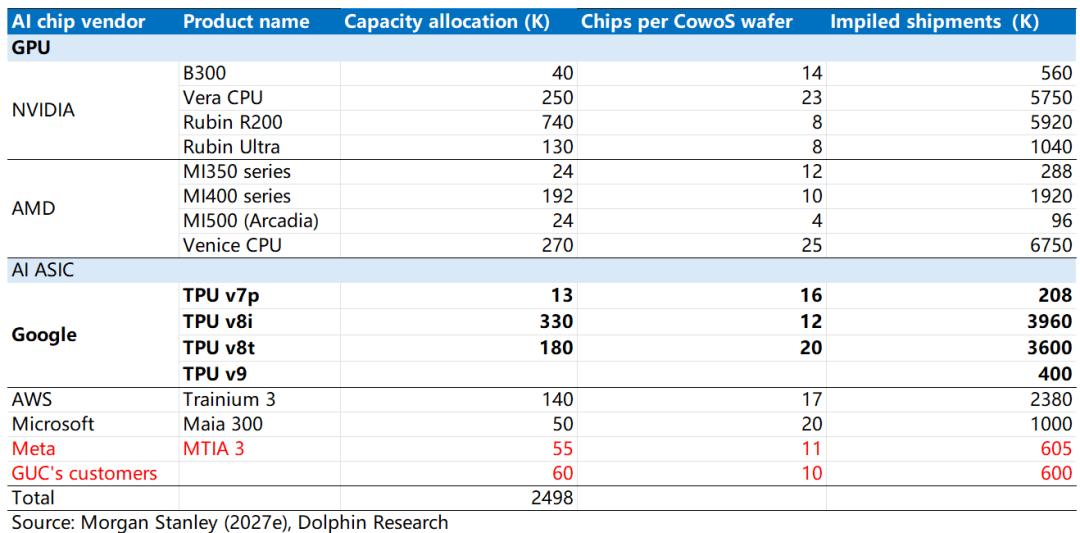
Last night, news also broke that mass production of Meta's 4th-generation MTIA chip (Iris) is set to begin in September. Testing has been completed with no major bugs detected. At this pace, Iris will definitely be a critical component enabling Meta to reach its 14GW total compute power target next year.
Iris is a Meta-designed ASIC chip optimized for both training and inference (though we expect it will be primarily used for inference). Broadcom led co-design and physical implementation, with TSMC handling manufacturing. For a software company to develop its own chips, the fundamental motivation is long-standing frustration with NVIDIA's high GPU pricing.
On the hardware side, Meta reportedly signed long-term agreements with key component vendors Samsung and Western Digital (SanDisk), and is procuring optical fiber equipment from Sumitomo Electric.
However, this chip remains primarily for internal use. TSMC's production capacity allocation is not suited for Meta to enter the chip-selling business, so the continued investment in chip R&D is fundamentally driven by cost-effectiveness — to reduce inference costs and avoid over-reliance on a small number of suppliers.
Summary
Overall, compared to the vague statement a few days ago that Meta was "considering renting out idle compute power", the biggest change this time is the confirmation that Meta is pursuing a long-term strategic layout in the compute power leasing business.
More critically, the launch of a new model that can compete in the top tier (which currently shows strong theoretical performance; we will continue tracking real user feedback) has partially alleviated market concerns about Meta's recent internal organizational issues. It also adds more upside potential to the ROI of Meta's compute power leasing business — shifting expectations from simply capturing industry beta through bare compute power rentals to imagining bundled value-added services including large language model APIs, and eventually even additional cloud