Stop asking if AI is like humans; first ask if it can survive a disaster.
In 2023, Stanford and Google collaborated on an experiment: 25 AI residents lived in a virtual town called Smallville, where they would spontaneously organize a Valentine's Day party, gossip with each other, and feel upset for being "uninvited".
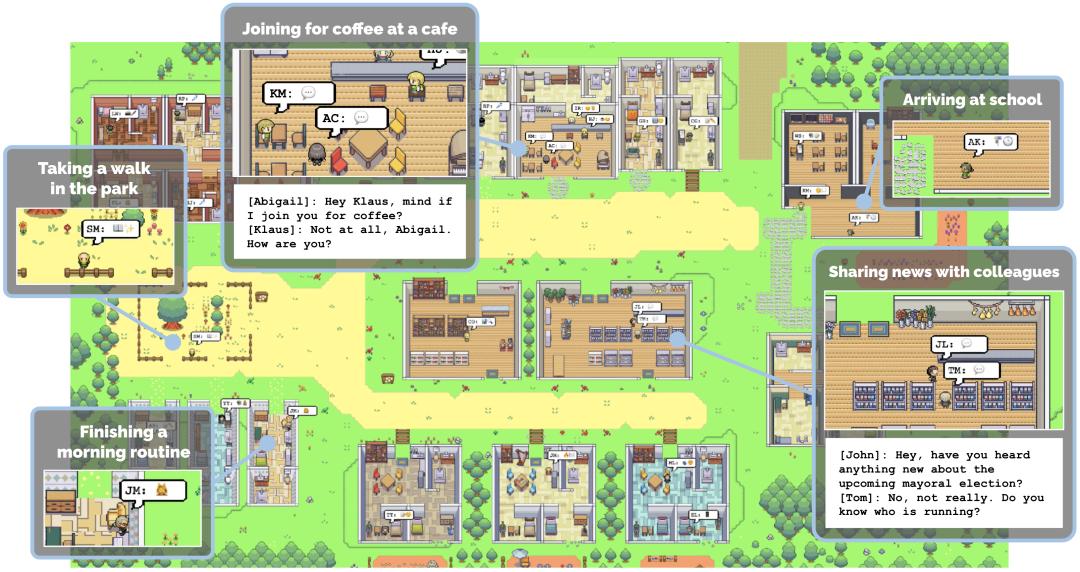
Cover of the Generative Agents paper: 25 generative agents living in the game world
This project, titled "Generative Agents", counts Stanford PhD student Joon Sung Park as one of its authors. Back then, it was mostly regarded as an entertaining tech demonstration — revealing that large language models are not just chat windows, but can also "play the role of humans", be placed in a continuously running world, generate memories on their own, make independent plans, and interact with other agents spontaneously. The most widely shared figure in the paper shows agents voluntarily hosting a Valentine's Day party at Hobbs Cafe: no pre-written scripts, as several agents negotiated among themselves, sent out invitations, and decided whether to attend entirely on their own.
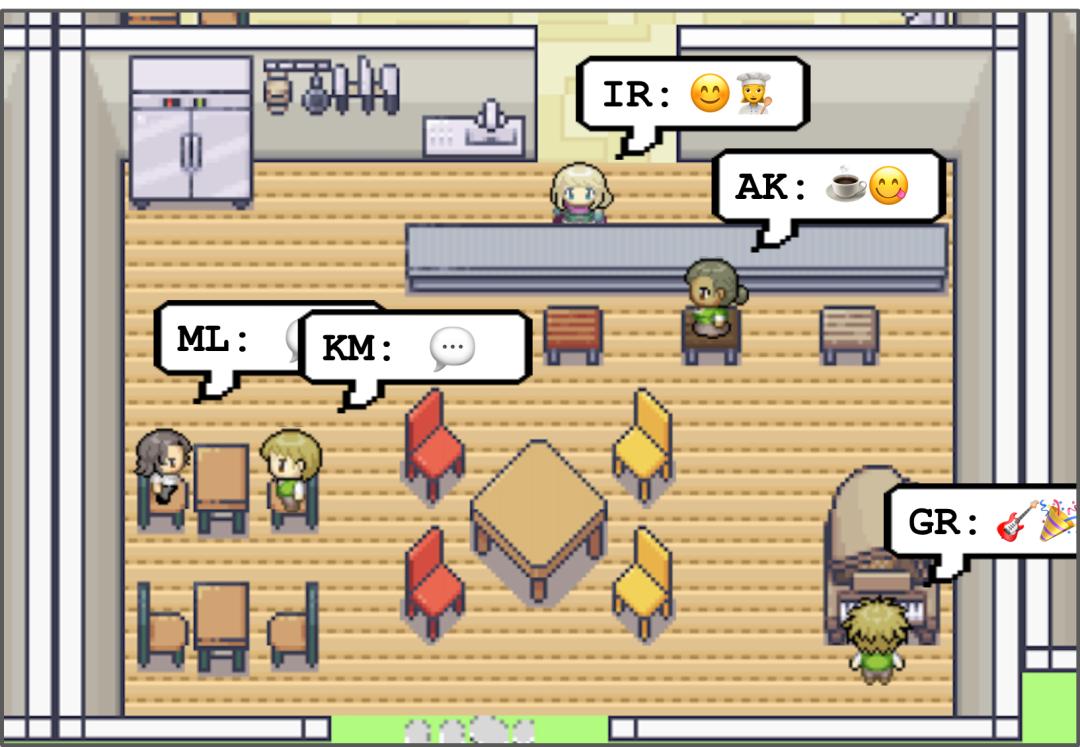
Figure 4 of the Generative Agents paper: The spontaneously organized Valentine's Day party by agents
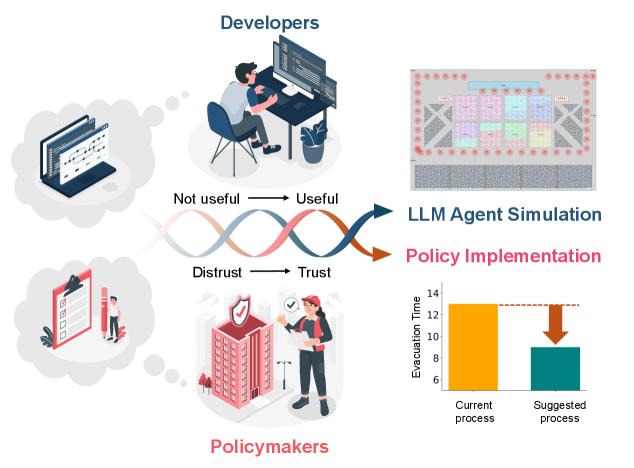
Figure 1 of CMU's paper: The 16-month process of emergency managers building trust in LLM agent simulations
Over the past year, this technology has been advanced by a group of research institutions far beyond the party scenario, and applied to serious, no-room-for-error situations such as subway fire evacuations, hurricane evacuations, and graduation ceremony evacuation planning. Carnegie Mellon University, Tsinghua University, Tianjin University, Stanford HAI... all these institutions are working on the same goal: making AI agents no longer just simulate a casual party, but simulate real-life life-or-death escape scenarios. At the same time, another group of researchers — such as computational social scientist Petter Törnberg from the University of Amsterdam — are fundamentally questioning from a methodological perspective: can these "human-like" agents really be taken seriously? This article will examine both lines of research side by side.
Escaping danger is a decision-making problem, not a purely physical problem
Traditional evacuation simulations rely entirely on physical models: given a defined space, a set of population points, and an exit, they use cellular automata or social force models to calculate crowd movement patterns and total evacuation time. The flaw of these models lies in their core assumption that humans are rational, constant-speed particles that only follow physical laws — but in real disaster scenes, people may freeze, run back to find their family members, wander around because they cannot see exit signs clearly, or even trample each other due to mass panic. These are exactly the outcomes that pure physical models fail to predict, yet they are the truly fatal factors in most historical stampede accidents.
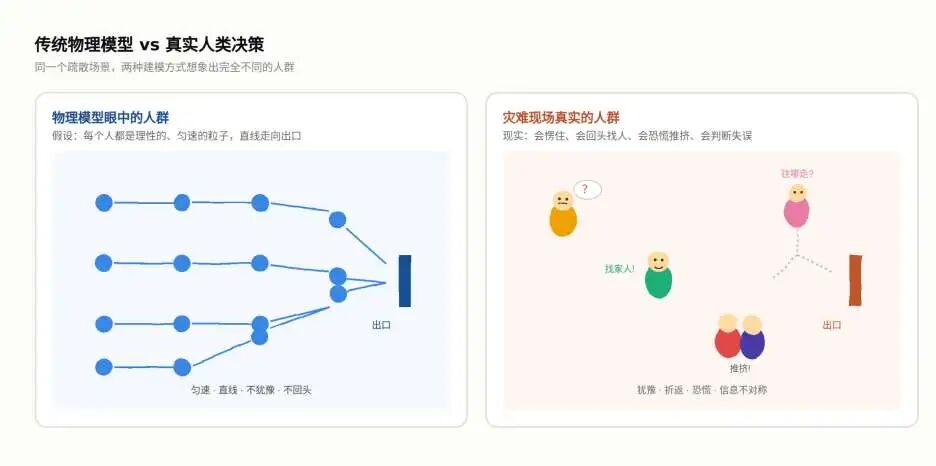
Illustration: The ideal crowd in physical models vs. the real crowd in disaster scenes
The new generation of simulation architecture splits the system into two layers: the "physical layer" remains responsible for collision dynamics and mechanical calculations that traditional computer graphics excel at, while the "cognitive layer" is powered by large language model-driven agents to handle judgment, hesitation, panic, and information asymmetry. This "physics-cognition separation" framework essentially equips the virtual crowd with a "hesitating mind" instead of just a body that can run. Over the past year, at least four independent research teams have been enriching this framework from four distinct dimensions: decision-making, physical movement, simulation scale, and individual behavioral accuracy.
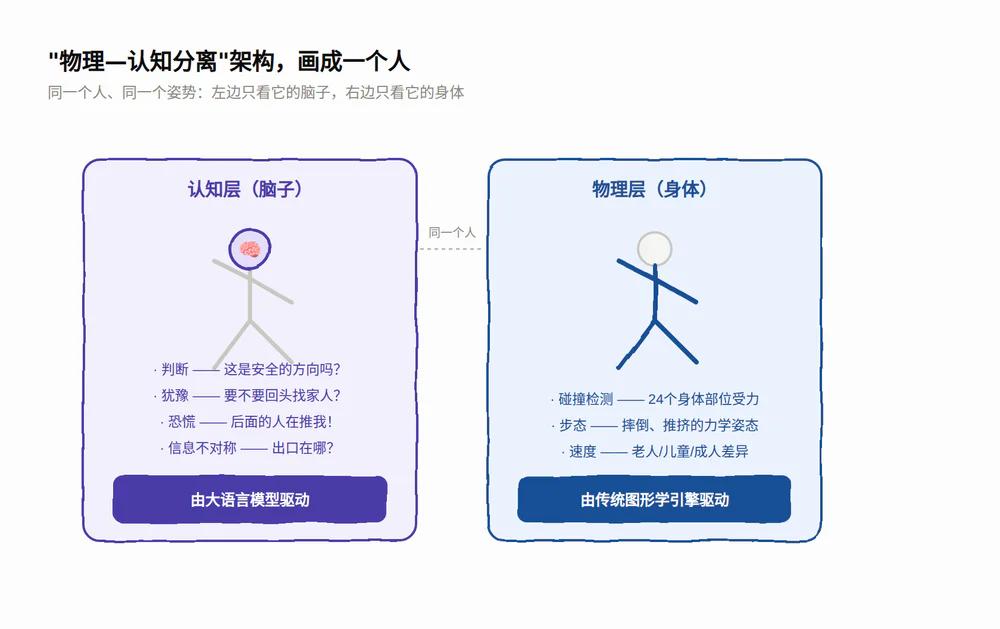
Illustration: The schematic of the "physics-cognition separation" architecture
Four real-world cases, four distinct approaches
Carnegie Mellon University: Graduation ceremony evacuation planning from 100 to 13,000 agents
This research was led by Yuxuan Li, Sauvik Das, and Hirokazu Shirado from CMU's School of Computer Science, in a 16-month iterative design collaboration with the university's emergency management team to provide actionable references for the school's real graduation ceremony evacuation plan. The system went through five rounds of iteration: starting from a small-scale validation with 100 agents, expanding to 500, then 3,000, and finally reaching 13,000 agents — a number that exactly matches the actual crowd size of the university's graduation ceremony. The research team did not jump directly into large-scale simulations; instead, they spent a long time addressing the more fundamental question of "whether emergency managers are willing to trust an AI-generated simulation result". The paper explicitly describes this as a transformation process "from distrust to trust", which indicates that the barriers for such systems are not purely technical, but also involve building organizational trust.
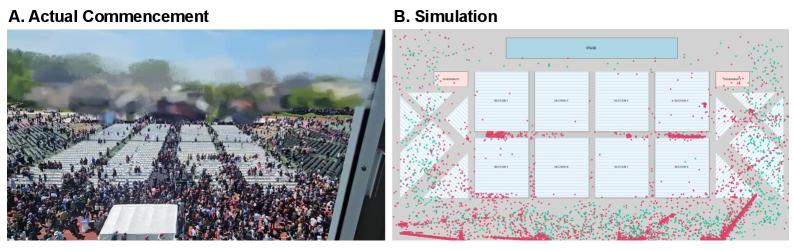
Figure 4 of CMU's paper: Comparison between real graduation ceremony crowd dynamics and simulation results
A figure in the paper (corresponding to Figure 4 above) compares the real crowd dynamics data of the graduation ceremony with simulation outputs, while another figure plots cumulative evacuation progress curves under different evacuation schemes. Ultimately, this 16-month collaboration produced three specific recommendations that have been formally incorporated into the university's official Standard Operating Procedures (SOP) — making it the only case among the four that has evolved from a "demo in a paper" to a formally documented institutional practice.
Tianjin University + Cardiff University + Tsinghua University: The "physical body" in subway fire scenarios
The system named RESCUE is led by Professor Kun Li (National Outstanding Youth Fund recipient, head of the 3D Vision Research Group at Tianjin University's School of Intelligence and Computing), in collaboration with teams from Cardiff University and Tsinghua University. It solves a critical problem: a "decision-making mind" alone is not sufficient, as virtual humans also need a "physically credible body" — to replicate realistic details such as arms making contact during pushing, natural falling postures, and movement speeds that align with real physiological data for people of different body types.
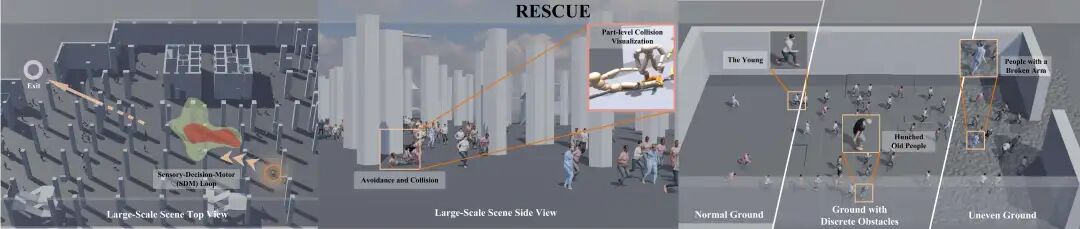
Banner on the RESCUE project homepage: Personalized, physically plausible, 3D-adaptive online crowd evacuation simulation
The team also published an actual demo video (imgs/demo_4201.mp4) on the project homepage, showing the continuous process of virtual crowd pushing, falling, and getting back up to run in a congested environment. It is the only case among the four that provides a dynamic demonstration rather than just static paper screenshots.
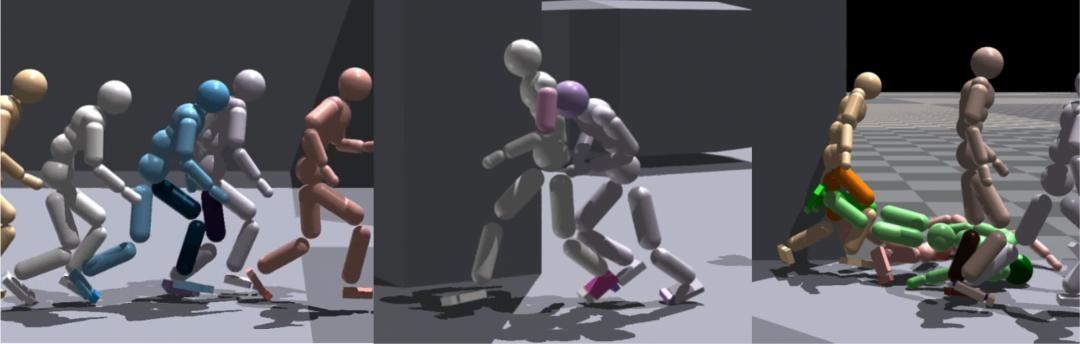
The RESCUE paper: Visualization of collision forces across 24 body parts
The team developed a personalized gait converter that can calculate real-time collision forces on 24 different body parts in crowded scenarios (as shown in the figure above). Qualitative comparison results and ablation experiments attached to the paper prove that this method is more consistent with real crowd footage than traditional evacuation simulations. The team also specifically compiled box plots of speed distributions for different population groups (elderly, children, adults) in congested conditions, to verify that the simulated individual differences match real physiological data. This work has been accepted by ICCV 2025, the top international conference in computer vision, with its project code and official homepage made publicly available.
Tsinghua University: Deploying agents across an entire city
If the first two cases are "event-level" simulations, the AgentSociety system developed by Professor Yong Li's team from the Department of Electronic Engineering at Tsinghua University operates at "city-level" scale. Among the 16 authors of the paper, Jinghua Piao and Yuwei Yan are co-first authors, with Yong Li serving as the corresponding author. The abstract states that the system generates complete social life trajectories for over 10,000 agents, accumulating a total of 5 million interactive behaviors.
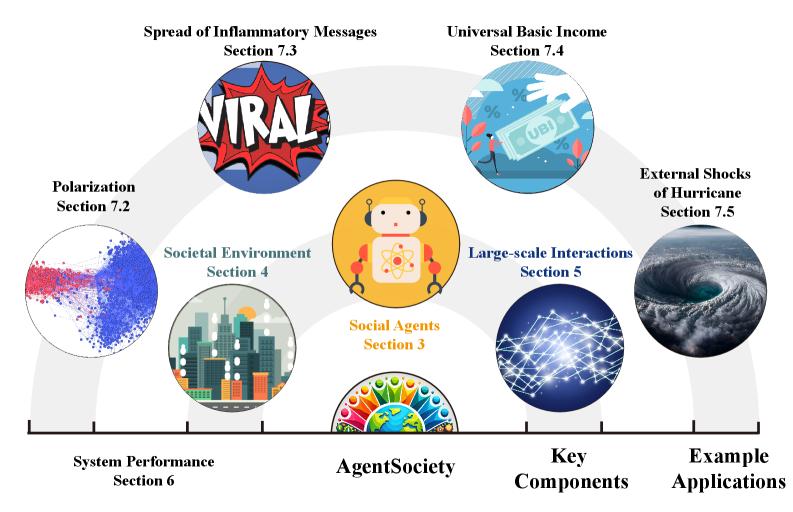
Figure 2 of the AgentSociety paper: Overall system framework
This system has been used to run multiple sets of social experiments, including a dedicated simulation of urban responses to external shocks such as hurricanes, and other experiments exploring how policy variables like extreme information spread on social media and universal basic income affect the behavioral distribution of an entire virtual city. This means the same underlying technology can not only calculate evacuation plans for a single graduation ceremony venue, but also simulate whether an entire city will descend into chaos when a hurricane strikes. From a single venue to a full city, the difficulty of model validation increases exponentially — which is exactly the scale range that Törnberg's criticism primarily targets.
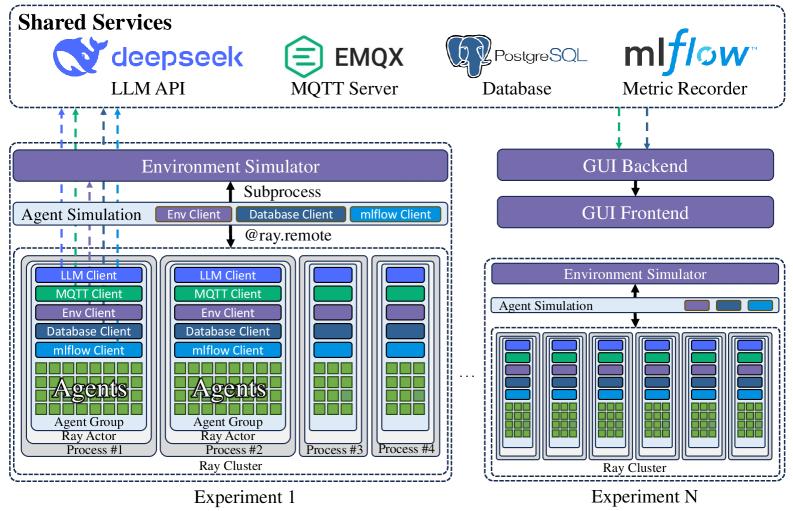
Figure 10 of the AgentSociety paper: System architecture of the large-scale social simulation engine
Stanford: How accurate can an AI digital twin be to a real human?
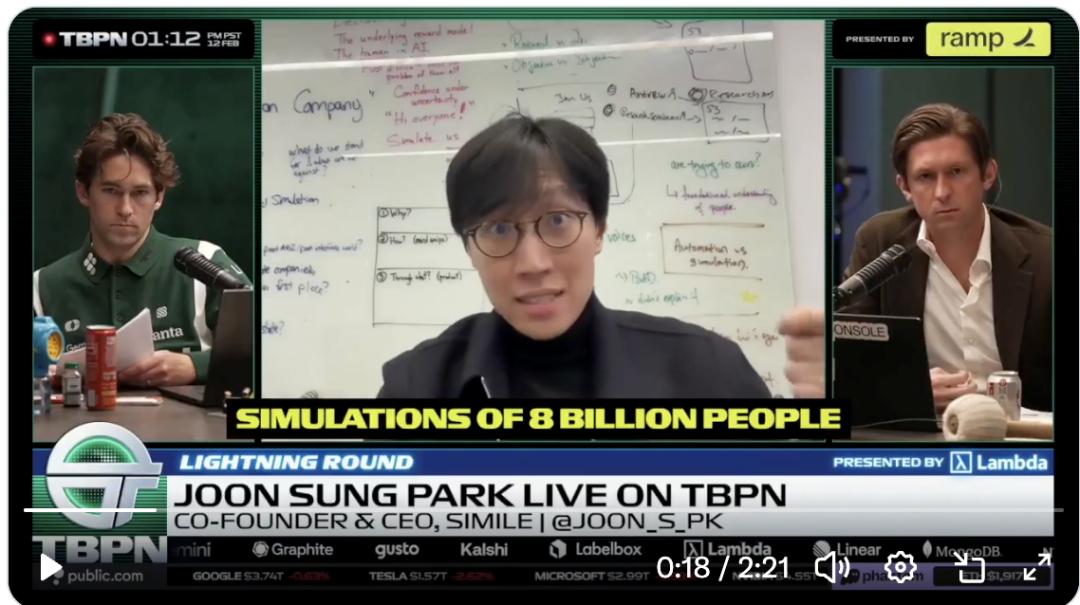
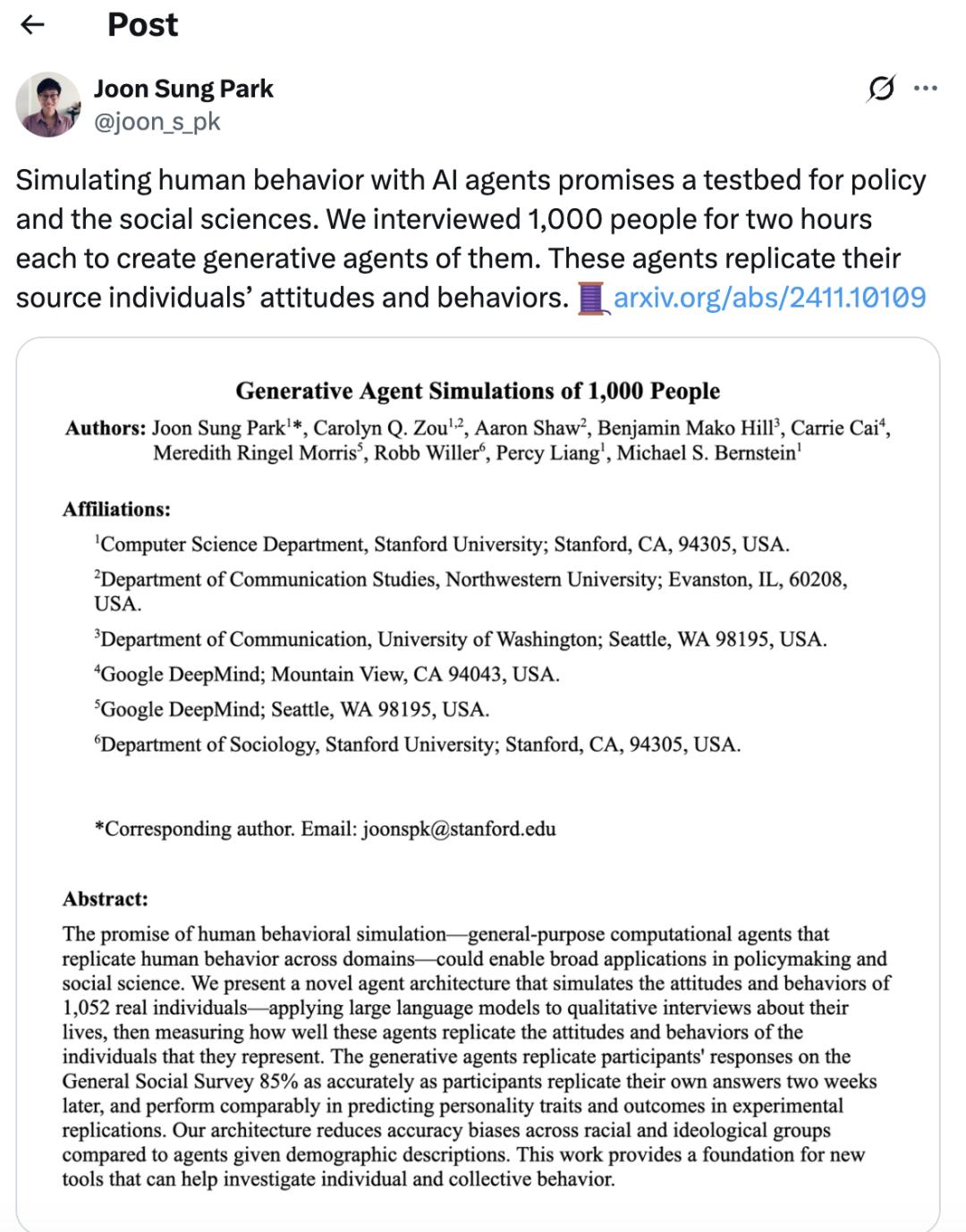
While the first three cases focus on solving the problem of "making virtual humans behave like real people escaping danger", this Stanford HAI research led by PhD student Joon Sung Park explores a more fundamental question: to what extent can an AI digital twin accurately predict how a specific real human will make decisions? The team recruited 1052 demographically representative participants across the United States, conducted 2-hour in-depth interviews with each, combined with General Social Survey (GSS) questionnaires, Big Five personality tests, and five behavioral economics game experiments, then compared how closely the AI-generated "digital twin" matched the real human's own responses when they retook the same survey two weeks later. The conclusion shows that agents trained with interview and questionnaire data achieved a 0.86 accuracy rate in reproducing the real human's repeated responses two weeks later, significantly outperforming traditional methods that only rely on demographic variables, and substantially reducing prediction biases across groups divided by political stance, race, and gender.
Park stated directly in a Stanford HAI interview: "The language model is trying to role-play as the person it just interviewed." He believes interview data is far more critical than simple demographic labels, because "the advantage of interview data is that it captures each person's unique traits, so the language model is less likely to make broad generalizations based on race". He also clearly outlined the ambition of this research: "I truly believe there are many social problems we have not solved well, and this test platform can make them more manageable. Wicked problems like climate change and pandemic policies all require extremely complex planning and conditional scenario analysis." The value of this research lies in providing a quantifiable baseline for the question of "how credible an AI digital twin is" — which is exactly the foundational trust prerequisite for the previously mentioned evacuation simulation systems.
The critics: Validation is the real core challenge
If you only listen to the four research teams, the technology's development trajectory appears exceptionally smooth — from 100 to 13,000 agents, from a single venue to an entire city, with quantifiable accuracy reaching 86%. However, Petter Törnberg, associate professor of computational social science at the University of Amsterdam, and his collaborator Maik Larooij poured cold water on this optimistic narrative in a critical review paper titled "Do Large Language Models Solve Agent-Based Modeling?". Their exact words in the paper's abstract are:
"We argue that there are reasons to believe that LLMs will exacerbate rather than resolve the long-standing challenges of ABMs. The black-box nature of LLMs moreover limit their usefulness for disentangling complex emergent causal mechanisms."
—— Larooij & Törnberg, arXiv:2504.03274