AI curiosity-chasing dramas top the charts, is the overseas short drama ecosystem undergoing drastic changes?
Cockroach people, seahorse people, fruit people...
You might find it hard to imagine that these absurd, even bizarre non-human AI characters are now the top stars of the most viral short drama series on overseas short-video platforms.
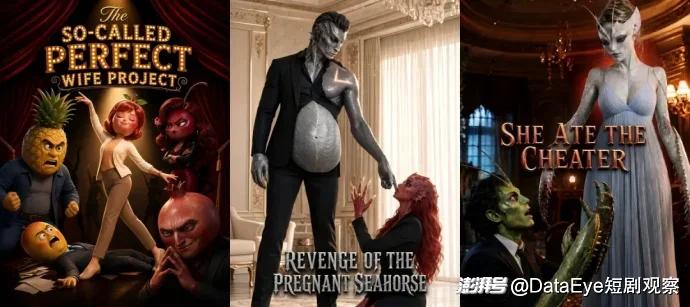
Recently, the top 3 spots on TikTok's short drama popularity chart have been dominated by three special AI-generated dramas:
Mr. Mango's Infidelity, Pregnant Seahorse Father
Revenge, and Cockroach Lady Betrayed During Pregnancy — none of these three productions feature human characters at all.
Looking back further, the statistics are even more staggering.
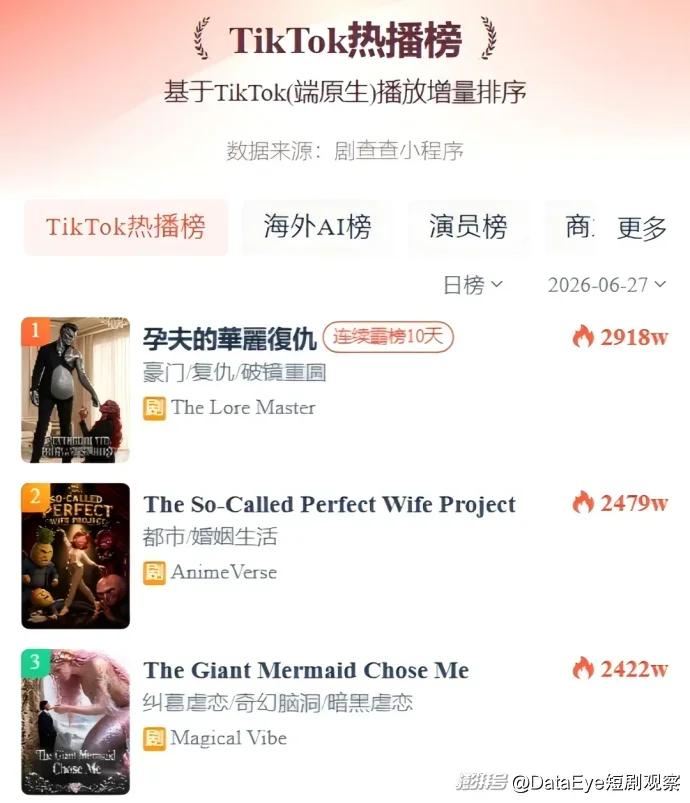
Revenge of the Pregnant Seahorse once claimed the number one spot for ten consecutive days, with a weekly playback increase of 360 million views across its two seasons!
During the same period, 7 AI dramas featuring fruit people, seahorse people and other non-human characters broke into the top 20 of the overseas short-video drama popularity rankings, with individual titles seeing daily playback surges ranging from millions to tens of millions of views.
But switch to a different ranking list, and the situation changes completely.
Looking at DataEye's overseas short drama popularity chart over recent months, non-human characters like fruit people and seahorse people have almost never appeared in the top 30. At most, there are werewolf themes or anthropomorphic beast stories like The Lion's Captive, where characters are highly humanized with only tiny non-human elements like tails or ears retained, boasting polished production that stands in stark contrast to the unapologetically bizarre style of cockroach people dramas.
One chart sees hundreds of millions of views and unbroken dominance; the other has no trace of these titles at all. What exactly is going on behind this contrast?
1. The Same "Overseas Short Drama" — Two Distinct Content Ecosystems
Before diving deeper, it's necessary to understand what these viral non-human drama protagonists actually are.
Imagine you're a short-video user,
you're very likely to stumble upon this scenario while scrolling:
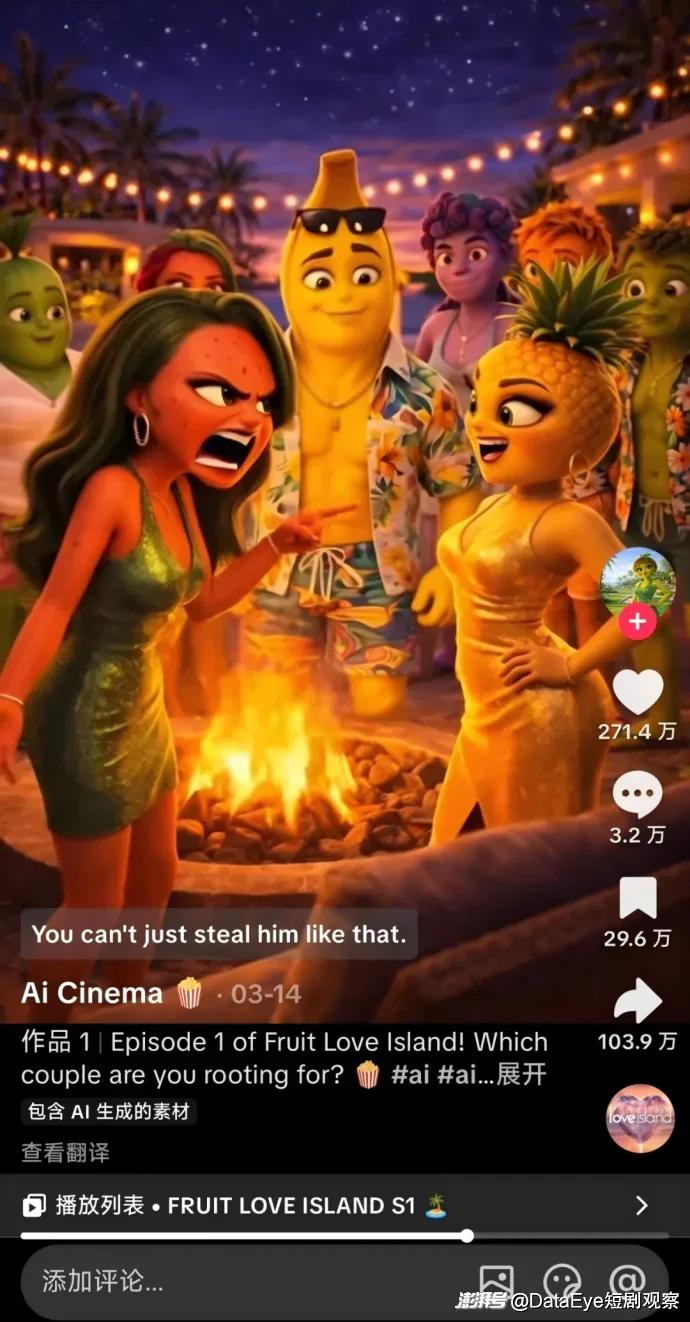
Around a campfire, an anthropomorphic female character with a pineapple head and bright yellow dress snatches a handsome banana-headed man away, only to get punched hard in the face by another anthropomorphic woman with a watermelon rind skin, who is grinding her teeth in rage.
— This is an AI-generated "fruit dating show" called Fruit Love Island, whose creator gained 3 million new followers in just 9 days.
Scroll down a couple more screens, and the vibe shifts entirely:
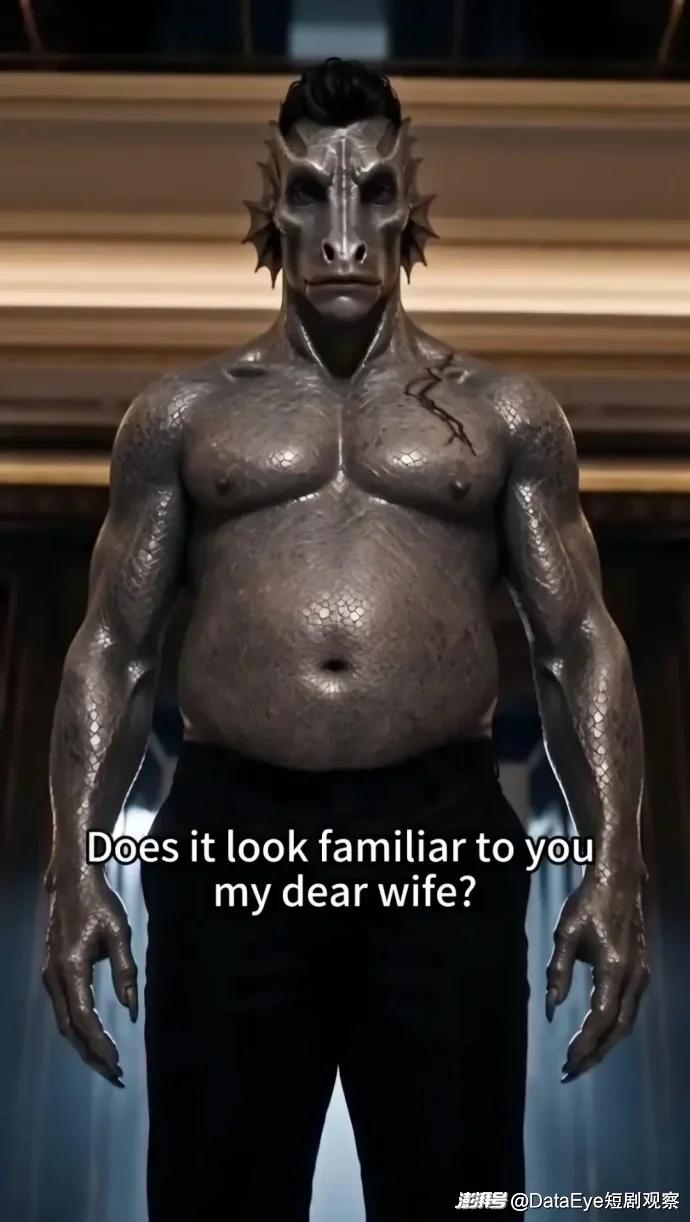
A dark-skinned character with a seahorse head stares angrily at the camera, heavily pregnant.
— This is the AI short drama Revenge of The Pregnant Seahorse, built around the natural fact that male seahorses carry pregnancies, which once held a dominant, unmatched viewership lead on TikTok.
Scroll further down, and even more bizarre elements catch your eye:
A character with antennae on their head, dressed in dark green, raises a hard, serrated arm to feed medicine to their wife, then turns around and calls her a "stupid incubator".
— You guessed right, this is the tangled love and hate story between cockroach people in the drama She Ate the Cheater.
These productions share common traits: low production costs, non-human characters, high-intensity melodramatic plots, and extremely high view counts.
They are not supported by the traditional overseas short drama market, but by a completely different business model. If we separate this ecosystem of bizarre AI dramas and compare it to the traditional overseas short drama market, we find the two are almost parallel universes.
The bizarre short drama ecosystem on overseas short-video platforms: non-human leads, hundreds of millions of views
TikTok's short drama popularity data tells a clear story. On June 27, the seahorse pregnancy AI drama Revenge of The Pregnant Seahorse dominated the charts for 10 straight days, with nearly 30 million new daily views;
In the weekly ranking from June 15 to 21, 7 AI dramas featuring fruit people, seahorse people and other non-human characters landed in the top 20 of TikTok's short drama popularity list;
On June 29, non-human AI dramas took over all top 3 spots.
Traditional short dramas on overseas platforms: dominant CEOs, emotional stories, underdog triumphs
Over the same period, DataEye's overseas short drama popularity chart had a completely different look.
The dual-female gangster drama I'm Her Most Dangerous Obsession claimed the top spot with a popularity score of 5.792 million; across the entire top 30, there was not a single non-human AI drama with obvious bizarre traits.

This is a fascinating phenomenon: both belong to the overseas market, yet they present two entirely different content ecosystems.
The DataEye Research Institute points out: the root cause lies in the difference between their two business models.
TikTok's bizarre AI drama ecosystem is built on the "attention economy". As a global short-video platform with over 2 billion monthly active users, short dramas are just a small part of its massive content ecosystem, and these bizarre non-human AI short dramas are only a subset of that — huge user traffic is TikTok's core strength.
The overseas market is geographically scattered with wildly varying user preferences, which means bizarre content will always find an audience; at the same time, since platform algorithms prioritize completion rates and interaction rates, free, rapidly updated content with high visual novelty and intense melodrama naturally stands out as the optimal solution to grab users' attention.
Most dedicated overseas short drama apps operate on the "value economy". Users pay for subscriptions or individual episodes, so the apps must deliver content that feels worth the cost — strong plot quality, polished visuals, well-rendered characters, all are essential.
Take leading platforms as examples: Dianzhong launched the "Double 100 Million" AIGC Global Co-creation Initiative, investing 150 million USD in dedicated overseas funding, while DramaWave has fully completed its AI-native transformation. They are betting on high-quality content that convinces users to pay, not on novelty-focused fruit people and seahorse people.
At the end of the day, the same wave of AI technology, applied to two different business logics, has spawned two completely distinct "content species".
This is not a matter of which is better — it's just a segmented market choice.
2. How Did These "Non-Human" Bizarre AI Dramas Come to Be?
To understand the bizarre AI short drama ecosystem on short-video platforms, you first need to understand the platforms themselves.
These global short-video platforms with over 2 billion monthly active users have an incredibly broad user base — ranging from US President Donald Trump to ordinary users all over the world, in cities and rural areas alike. Everyone can be a content consumer, and everyone can be a trendsetter.
This extremely diverse user group creates wildly varied demands, which naturally provides fertile ground for niche, marginal, and bizarre content to take root.
And the seed that made it all possible is the maturity of AI technology.
At the end of 2025, ChatGPT launched a custom GPT called Object Talk, with a very simple function: users only need to input the name of any item, and the tool will automatically generate prompts and scripts for anthropomorphizing that item. It then redirects to OpenArt, where users can complete the full workflow of generating visual assets and dynamic videos — that's how an anthropomorphic video is born.
The Intelligencer section under New York Magazine once reported: the earliest Object Talk productions at the end of 2025 were educational short videos, such as a drop of water explaining hydration, or a bottle of hand soap angrily teaching skincare tips.
In February 2026, the trend took an unexpected turn.
AI-generated fruit infidelity videos posted by TikTok user @trombonechef went viral, such as a story about Ms. Strawberry having an affair with Boss Eggplant and giving birth to a child who looked nothing like her husband. Data shows that just one clip from @trombonechef racked up 26 million views on TikTok. In the following month, similar videos exploded in popularity.
In March 2026, a milestone moment arrived.
TikTok user @ai.cinema021 used AI to recreate the hit British reality dating show Love Island, releasing Fruit Love Island. It blew up immediately after launch, earning the creator 3 million new followers in 9 days — making it the fastest-growing account on TikTok US. Major outlets including CNN, Forbes, and USA Today all covered the phenomenon.
After that, content featuring seahorse people, cockroach people and other non-human characters emerged one after another. While their core plots still follow familiar tropes from human short dramas, they are usually even more melodramatic and bizarre.
Overall, the evolution from early detergent skincare tutorials, to fruit AI infidelity stories, to seahorse pregnancy plots essentially follows the same formula: continuously amplifying the "novelty variable" to keep raising the bar for viewer attention.
Apart from the inherent fast pace and high emotional intensity of short dramas, there's another key mechanism that makes this content so engaging: anthropomorphism naturally lowers the psychological barrier for viewers.
Two professors from the Australian Catholic University broke down the addictive logic of this content, highlighting a "moral disengagement mechanism": since all characters are anthropomorphic and clearly not real people, audiences face almost no psychological burden when watching intense scenes of infidelity, betrayal, and revenge — the thought that "they're not real humans anyway" drastically reduces ethical hesitation.
On top of that, there's another critical advantage that helped these bizarre AI dramas blow up: cost. This type of content is inherently suited for low-cost mass production.
In comparison, high-quality AI-generated hyper-realistic human dramas have strict requirements for visual polish and content quality. Even with AI drastically lowering production barriers, they still require significant capital, technical skill, and time investment. But for fruit people and seahorse people dramas, character designs don't need to look realistic, and production is far simpler. With certain AI tools, users can generate a complete video in just minutes by describing the story. Individual creators or small teams can rapidly produce content in bulk, maintaining consistent exposure through high output.
3. A Polarized Content Battle
Of course, while these productions are churning out viral hits with hundreds of millions of views that hook audiences, their explosive popularity also comes with an equally massive wave of backlash.
The DataEye Research Institute noted that reports from outlets including CBC, Mashable, and The Independent all used the term "AI slop" to describe this content. The two Australian Catholic University professors mentioned earlier went even further, labeling it outright as "unethical brain rot".
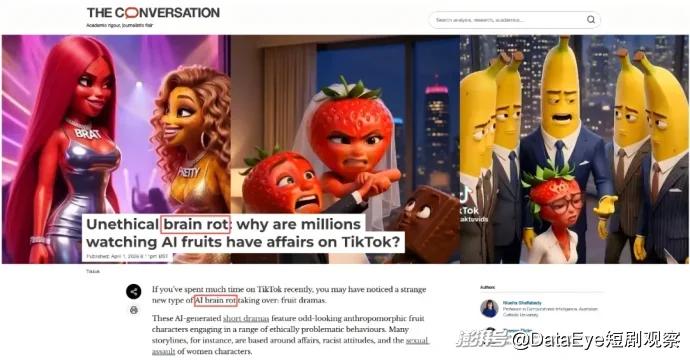
"Brain rot", as the name suggests, implies the content rots your mind — a clear sign of how strongly opponents reject it. Back in March this year, a popular Swedish artist even lost a huge number of followers after sharing a fruit AI short drama, sparking fan outrage.
Even the breakout hit Fruit Love Island was soon mass-reported by users, leading to multiple episodes being taken down. By late March, creator @ai.cinema021 was swiftly banned by the platform for posting low-quality AI content.
But as things stand now, banning one fruit AI creator has only inspired thousands more to pop up, and even evolve further.
The DataEye Research Institute argues: AI content may vary in quality, but users' diverse demands do not. Whether it's seahorse pregnancy stories or hyper-realistic emotional dramas about dominant CEOs, they are essentially the market's response to different user needs.
From fruit infidelity, to seahorse pregnancy, to cockroach people romance, these non-human short dramas of different species cater to audiences with varied preferences. Some watch for plot twists, some for the novelty, and some might just use them as background noise — but hundreds of millions of views are no bubble. For a fast-growing content ecosystem like AI short dramas, the very existence and viral success of this genre is a valid market signal.
But the real problem these dramas face is not "will they go viral", but "how long can they last".
In April this year, the Cyberspace Administration of China launched the "Clear the Chaos — Rectify Misconduct in AI Applications" special campaign, targeting prominent issues like AI-tampered classic works and "digital garbage" content.
In May this year, the Redguo platform blocked and removed over 20,000 non-compliant animated dramas.

Overseas, the Brazilian government specifically called out "fruit AI short dramas", pointing out they contain violent content. Meanwhile, Brazil's Ministry of Justice and Public Security announced it would raise YouTube's age rating threshold from 14 to 16 years old — and YouTube is one of the main platforms where these fruit AI dramas spread.
It's clear that both domestic and overseas regulators are tightening oversight of AI content in tandem.
When AI regulation, copyright compliance, content innovation, and public opinion pressures all pile up at once, the question of whether fruit people, seahorse people and their peers can evolve from novelty consumption to a sustainable content genre will determine if this path can go the distance.