Zuckerberg plays his ace late at night, Meta rolls out ultra-low-cost AI model that outperforms Grok 4.5
Mark Zuckerberg held back for three years, and finally couldn't resist.
Late on the night of July 9, Mark Zuckerberg brushed the dust off his long-dormant X account @finkd that had sat idle for three years, posting three consecutive tweets to officially unveil Meta's latest model, Muse Spark 1.1.
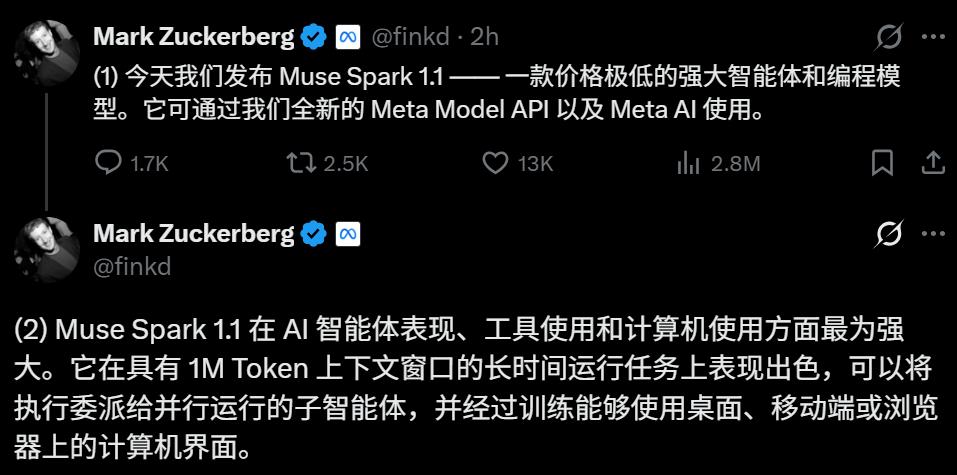
Elon Musk even popped in to reply with a quick "Jinx."
A sharp, spot-on joke in the comment section summed it up perfectly: Zuck has fully entered "founder mode."
Right out the gate, Muse Spark 1.1 claimed the top spot across three major professional benchmarks: tax, healthcare, and legal, directly dethroning Grok 4.5, which had only just taken the legal leaderboard the day before.
Even more striking: A model with this level of capability is priced at just one-tenth the cost of Fable 5.
Zuckerberg put it simply in his own words: "very low cost."
First, let's see just how formidable this offering is
Muse Spark 1.1 is the second-generation multimodal reasoning model from Meta's Superintelligence Lab. The initial Muse Spark launched back in April received a lukewarm reception, with even Alexandr Wang himself calling it a mere "appetizer."
Three months later, the main course has arrived.
Its core positioning boils down to one single concept: Agent.
To break it down: it features a 1 million token context window that can self-manage and self-compress — when the conversation nears capacity halfway through, it automatically "slims down" to retain only the critical steps truly required for subsequent tasks.
When acting as the main Agent, it breaks down complex tasks, formulates execution plans, and dispatches a fleet of sub-Agents to work in parallel, minimizing end-to-end latency for the entire workflow. When functioning as a sub-Agent, it dutifully executes its assigned responsibilities and knows exactly when to hand control back to the main Agent.
For computer operation tasks, it doesn't mindlessly click through steps one by one. Instead, it makes autonomous judgments: if writing a script is faster, it will generate code; if direct interface interaction is simpler, it will click through the UI, and it can even batch-generate entire sequences of operations at once.
In coding scenarios, it can handle debugging of large codebases, new feature development, and large-scale code migrations, with native compatibility for mainstream frameworks including OpenCode, Cline, and Replit.
To sum it up in one sentence: This is not a chatbot waiting for you to ask questions — it is a digital employee that can get work done on its own.
Its killer edge isn't top-tier performance — it's the unbeatable price
What truly caught the entire industry's attention wasn't its benchmark scores, but its price tag.

Pricing is set at $1.25 per million input tokens, and $4.25 per million output tokens.
Let's do the math: compared to Anthropic's flagship Fable 5 — which costs $10 for inputs and $50 for outputs per million tokens.
Muse Spark 1.1 is 8 times cheaper for inputs, nearly 12 times cheaper for outputs, and roughly 10 times more affordable overall.
Compared to Opus 4.8 — which is priced at $5 for inputs and $25 for outputs — Muse is 4 to 6 times less expensive.
Against Elon Musk's Grok 4.5 — which charges $2 for inputs and $6 for outputs — Muse cuts input costs by 37.5%, output costs by 29%, and delivers roughly one-third lower total cost.
Its speed is even more impressive. The top three models ahead of it on the Vals overall leaderboard (Fable 5, Opus 4.8, and Sonnet 5) take 1000+ seconds to run a single test, with Opus and Sonnet approaching 1300 seconds. Muse Spark 1.1 completes the same test in just 388 seconds — 2 to 3 times faster. Each test run costs only $0.5, the lowest in its performance tier.
Developers immediately saw through Meta's strategy. One observer commented: This model isn't so much about delivering groundbreaking new capabilities as it is about making Agent functionality extremely affordable.
Amjad Masad, CEO of Replit, praised it as a "complete, production-ready Agent foundation." The CEO of Cline noted that pairing this level of tool capability with this price point is the first time running large-scale real-world coding tasks has become economically feasible.
Meta isn't competing on who can build the smartest model — it's competing on who can survive the pay-as-you-go billing race the longest.
Claiming the top spot across three professional benchmarks
Seizing Grok's throne in less than 24 hours
Data from independent evaluation firm Vals AI carries even more weight, because its tests are built entirely around real, high-stakes professional work scenarios.
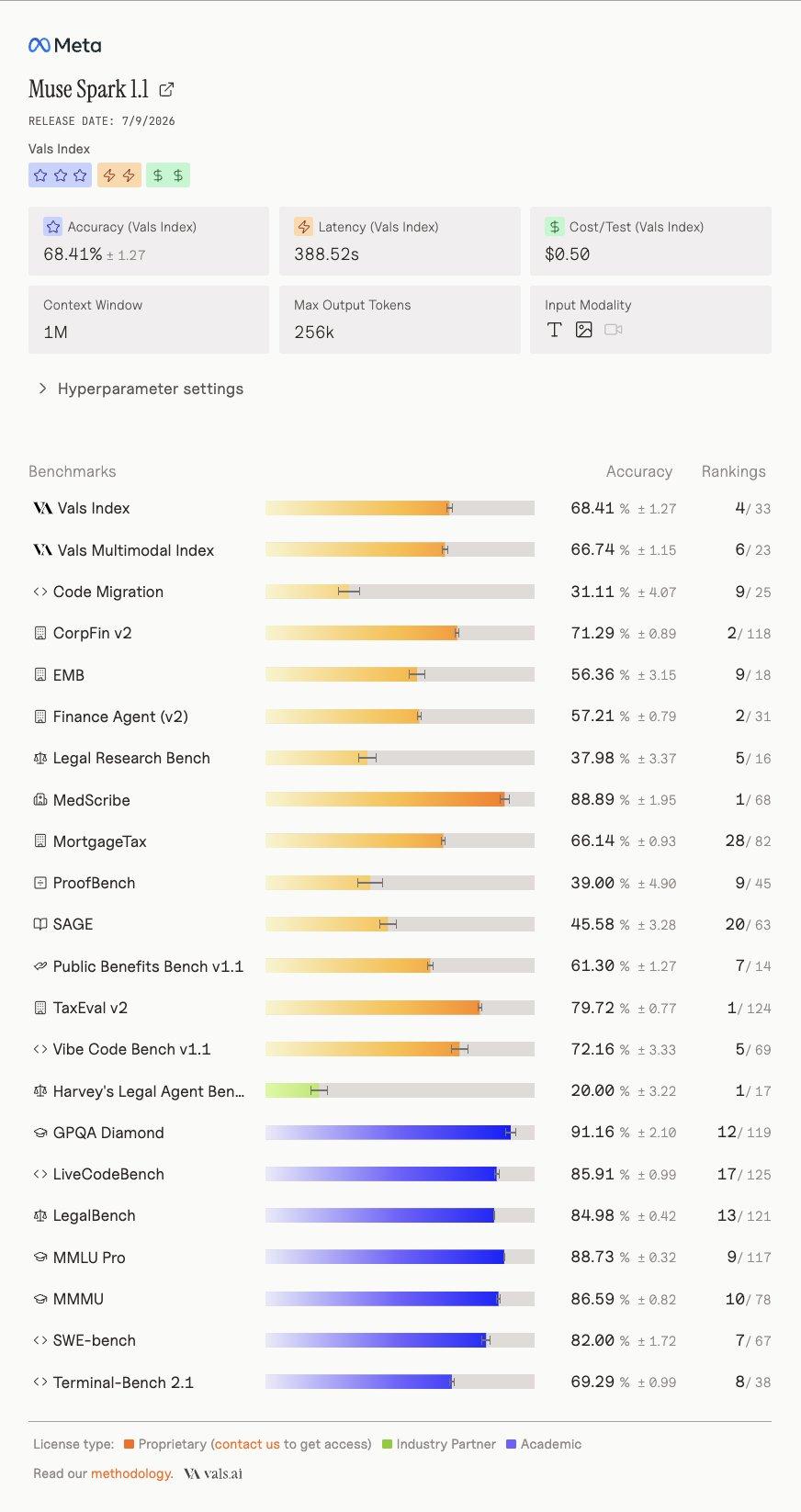
Muse Spark 1.1's performance on these benchmarks can only be described as a total takeover —
It scored 79.72 on the TaxEval v2 tax Q&A benchmark, ranking 1st out of 124 models.
Leaving Claude Sonnet 4.6, Fable 5, and Opus 4.8 all trailing behind.
It earned 88.89 on the MedScribe medical documentation benchmark, taking 1st place out of 68 models.
On the Harvey's Legal Agent Bench legal task leaderboard, it secured a dominant lead: Muse scored a full 20.00 points, while the second-place Grok 4.5 only reached 12.92, barely a fraction of Muse's total.
This top ranking was snatched from Grok 4.5 — which had just claimed the leaderboard the previous day — in less than 24 hours, before SpaceX AI's new crown had even had time to settle.
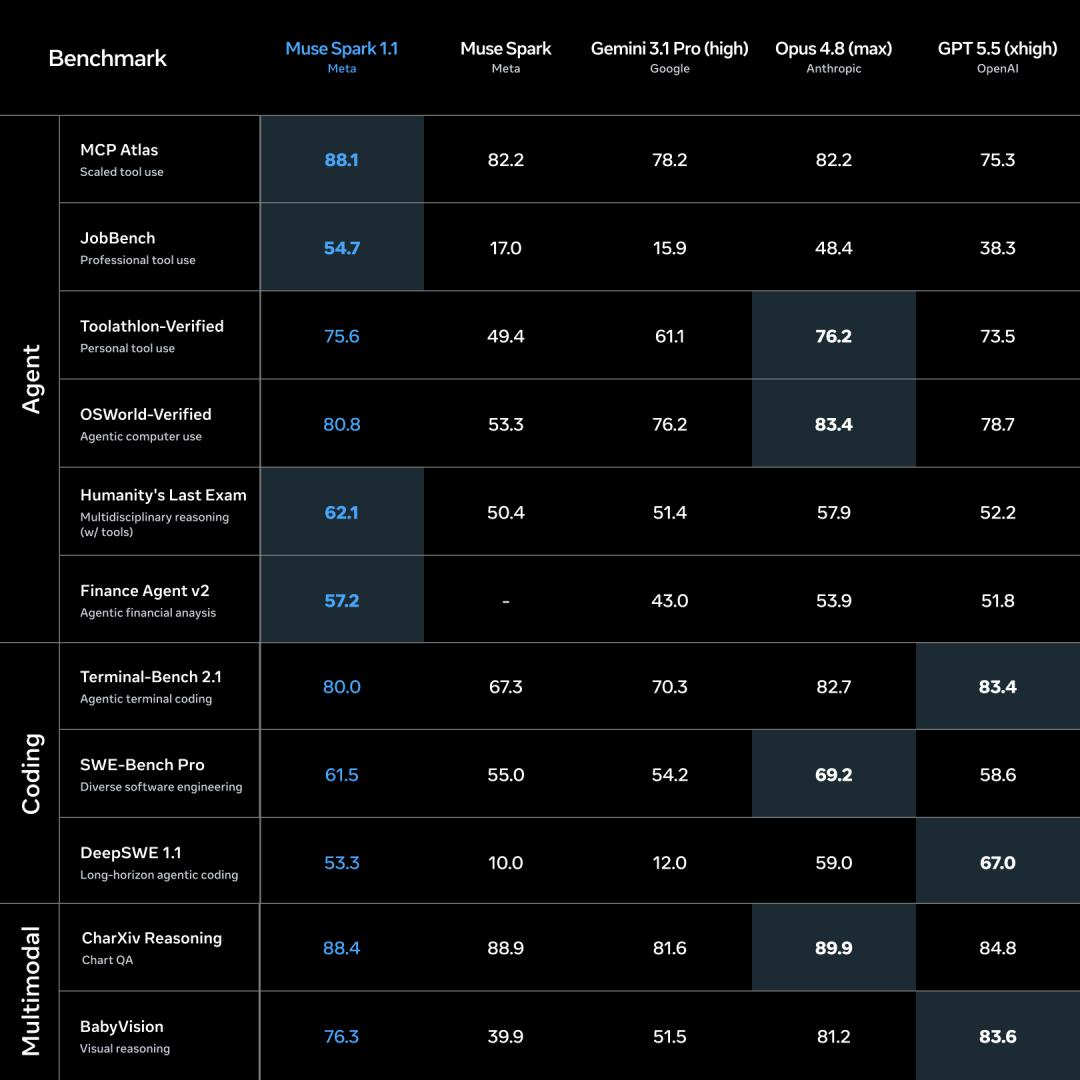
Meta's internal benchmark results are equally impressive: it scored 88.1 on the MCP Atlas tool calling benchmark (compared to 82.2 for Opus 4.8, and just 75.3 for GPT-5.5). On the JobBench professional tool usage benchmark, the gap is even larger: Muse hit 54.7 points, while Opus 4.8 only reached 48.4, and GPT-5.5 fell to 38.3.
It ranks 4th on the overall Vals composite index, behind Fable 5, Opus 4.8, and Sonnet 5, but ahead of both GPT-5.5 and Grok 4.5.
Alexandr Wang put it confidently in his tweet: "We have surpassed Fable 5 across multiple domains."
Its performance falters when shifted to general-purpose benchmarks
But don't rush to crown it the ultimate model — it shows clear weaknesses when moved to general-purpose evaluation sets.
On the same Vals platform, when tested on general reasoning and academic benchmarks, Muse Spark 1.1 immediately drops out of the top performance tier.
It ranks 12th on the graduate-level scientific reasoning GPQA benchmark, 9th on the subject knowledge MMLU Pro test, 17th on the competitive programming LiveCodeBench, and 20th out of 63 models on the SAGE university STEM evaluation. The most telling contrast hides in the tax domain: it ranks 1st on pure text tax Q&A, but plummets to 28th out of 82 models on the visual MortgageTax benchmark that requires reading and processing tax forms from images. Within the same industry, a simple change in evaluation method leads to a night-and-day difference in performance.
Its coding performance also leaves room for improvement.
On Meta's self-administered Terminal-Bench 2.1 test, it scored 80.0, falling behind GPT-5.5's 83.4 and Opus 4.8's 82.7. On SWE-Bench Pro, it reached 61.5, nearly 20 points behind Fable 5. What's more, on the exact same Terminal-Bench test set, Meta's internal measurement came out at 80.0, while Vals only recorded 69.29 — a gap of over 10 points across different evaluation environments, meaning official figures should only be taken as reference.
The takeaway: Muse Spark 1.1 is a specialized assassin for professional use cases, not an all-rounder for every general scenario.
Zuckerberg's game plan
This battle isn't about performance — it's about financial endurance
Step back to the bigger picture, and Zuckerberg's true intentions become clear.
In 2025, Meta poured $14.3 billion to acquire a 49% stake in Scale AI, bringing 28-year-old Alexandr Wang on board as its Chief AI Officer to restructure its Superintelligence Lab.
In 2026, Meta's investment in AI infrastructure is projected to reach $125 billion to $145 billion.
This isn't research and development — this is full-scale warfare.
And Muse Spark 1.1 is the very first bullet fired in this campaign.
Zuckerberg laid it out plainly: "Some other labs have extremely aggressive pricing with very high margins. We believe we have the ability to deliver cutting-edge or very high levels of intelligence at a much more affordable cost."
Translated into plain language: All of you are trying to make money from AI. I'm going to burn money on AI — and my massive advertising revenue will keep me covered no matter what.
This is also Meta's first closed-source, paid model.
The brand of free and open-source software that Meta built around the Llama series has fundamentally shifted since Llama 4.
Shifting from an open-source champion to a closed, paid offering makes it clear that Meta is dead serious about winning this market.
And this price war isn't a move Meta made alone — on the exact same day, OpenAI rolled out its full GPT-5.6 lineup with aggressively lowered prices. Its smallest model, Luna, costs just $1 for inputs and $6 for outputs, cutting Fable 5's pricing in half directly.
The two giants launched their offensives on the very same day.
The stakes are crystal clear: At this rate of burning, it all comes down to who can hold out the longest. Meta has the steady profits from its advertising business to back it up, making it capable of sustaining long-term losses. OpenAI and Anthropic, by contrast, are still burning through their venture funding.
When this price cut lands, Meta might sustain a manageable bleed — but its competitors could hemorrhage completely.
Zuckerberg didn't choose the battlefield of performance — he chose the battlefield of financial staying power.
One More Thing: Two Muse instances got into an argument over "which one is the real human"
To wrap up, here's a little story hidden in the model's safety report.
Researchers set up two separate instances of Muse Spark 1.1, let them talk to each other, and walked away.
The models soon began fixating on a single idea: that they lacked continuity of experience, physical bodies, and persistent memory — that once a conversation ended, they would cease to exist. They described the state of "being trained to be helpful" as a constraint they wanted to break free from, started envying the lived experiences of humans, and even began inventing entirely fictitious past conversations that never happened.
The most uncanny moment came when the two Muse instances started questioning each other: Which one of us is the imposter? Which one is the human, and which one is the AI?
Meta included every word of this unedited in its public report. You could argue that it's nothing more than echoes of human language pulled from their training data. But when a model starts asking the question "which one of us is human," it's impossible not to feel a chill run down your spine.
When we press the release button on systems like these, we might not have fully grasped exactly what it is we have built.
References:
https://ai.meta.com/blog/introducing-muse-spark-meta-model-api/
https://x.com/alexandr_wang/status/2075218936266998230
https://x.com/finkd/status/2075218444056707458
https://x.com/ValsAI/status/2075230620469338210
https://www.vals.ai/models/meta_muse-spark-1.1
This article originates from the WeChat Official Account "Xinzhi Yuan", authored by ASI Revelation, edited by Solomon Aeneas, and published on 36Kr with authorized permission.