Gold in the Light: The Next Stop of AI in the Eyes of a Tech Investor
Recently, "light" has become the most overcrowded keyword in the secondary market.
Optical modules, CPO (Co-Packaged Optics), thin-film lithium niobate, and all-optical switches have successively become trending topics, with a number of previously little-known companies seeing their stock prices repeatedly pushed higher by capital during trading hours. A popular joke in the market goes: You need to stand in the light, not just stand there motionless.
This narrative is not unique to the A-share market. In April 2026, Lightelligence debuted on the Hong Kong Stock Exchange, becoming the "world's first AI optical computing stock". At this year's COMPUTEX, Jensen Huang shared the stage with Marvell's CEO, clearly pointing to "connectivity" — the very domain where light plays a central role — as the next decisive factor in AI infrastructure. On stage, he called Marvell "the next trillion-dollar company", a single line that ignited the entire optical communication sector.
As an early-stage investment institution that has been laying out the optical sector for years, our judgment is: Light is not a "universal cure" for AI, but as large models push computing power, power consumption, and real-time performance to their limits simultaneously, optics has become an unavoidable link in the chain.
In this industry research report, we attempt to discuss the following questions:
- In optical communications, what are the real demands and what are just concepts?
- How far away is optical computing from our current reality?
- In this round of opportunities, what position do Chinese companies occupy?
Mapping the full optical story: From materials and chips to communications and computing
The optical industry chain is extremely long, with numerous technical branches. Materials, chips, devices, modules, communications, interconnection, and computing are deeply intertwined, and multiple related concepts are often confused. Before diving into this industry report, it is necessary to first place all these pieces into a unified landscape.
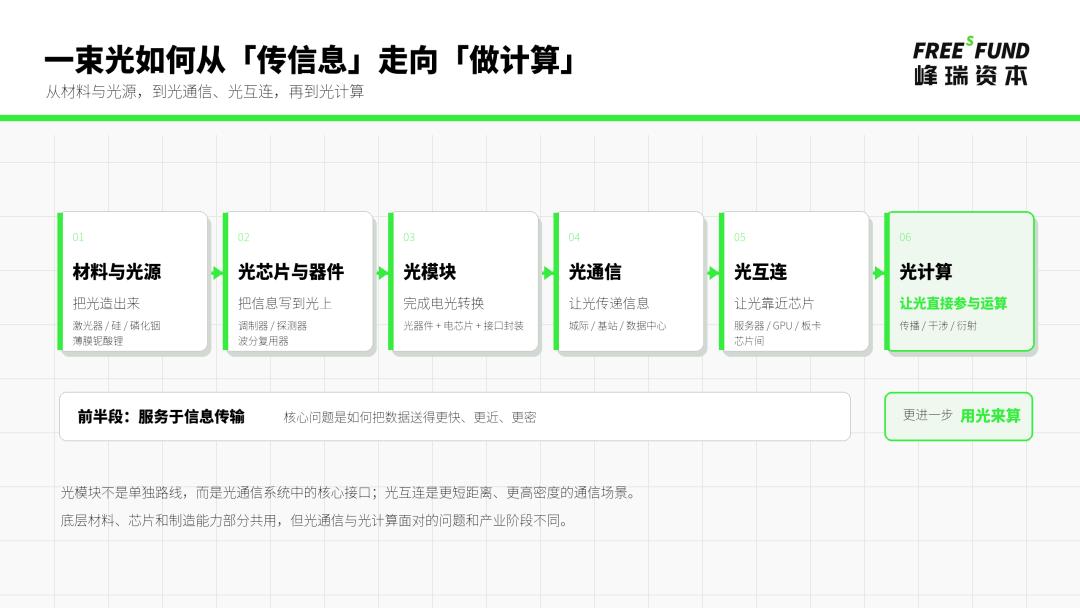
『Optical』 industry chain roadmap.
If we summarize the entire chain in one sentence, it can be roughly understood as: First generate light, then encode information onto it, let light travel between different devices, and finally receive and restore the signal. Taking it a step further, we can directly use light to complete computing operations.
Following this chain, the most upstream segment is materials and light sources. Lasers are responsible for generating light; materials such as silicon, indium phosphide, and thin-film lithium niobate perform functions like light guiding, light emission, or modulation, which directly affect the speed, loss, and integration methods of devices. Further downstream are optical chips and devices, including modulators, detectors, wavelength division multiplexers, optical phased arrays, etc. These components are responsible for loading signals onto light, receiving light, merging or splitting different wavelengths, and controlling the direction of light respectively.
Optical devices such as lasers, modulators, and detectors, packaged together with electrical chips like drivers and DSPs, as well as interfaces, form optical modules. They connect host devices to optical fibers, handling the conversion between electrical and optical signals. In other words, optical modules are not an independent technical route, but the core "interface" in optical communication systems.
Optical communications refers to a larger system: using light to transmit information. In the past, light has been widely used for communications across oceans, between cities, between base stations, and within data centers. In the AI era, it has further penetrated into servers, GPUs, and even between chips on the same circuit board. This shorter-distance, higher-density application is commonly known as optical interconnection. Optical modules, CPO, and LPO solve the problem of how light enters devices and gets close to chips; all-optical switches are responsible for directly switching optical paths in the network.
Optical computing takes this a step further. Optical communications focus on making data "travel" faster, while optical computing explores whether we can directly use light to "compute". The former still serves information transmission, while the latter leverages the physical properties of light such as propagation, interference, and diffraction to perform calculations. The two share some underlying materials, chips, and manufacturing capabilities, but they address different problems and are at different industrial stages.
Almost all the various concepts about "light" in today's market can be understood within this chain.
AI is not failing to compute — its data paths are completely jammed
Most people assume that AI's bottleneck lies in computing power, specifically a shortage of GPUs (Graphics Processing Units). But the first thing that hits the ceiling is not "computing", but "connectivity".
1. The memory wall and the physical limits of PCBs (Printed Circuit Boards)
Think of each GPU as a factory: large model training is a continuous process of transporting and coordinating resources between tens of thousands of these factories. What often clogs the assembly line is not the production capacity of a single factory, but the road connecting different factories. The first wall is the memory wall.
To alleviate this, the industry developed HBM (High Bandwidth Memory), stacking multiple layers of memory like a sandwich — effectively expanding a single linear dimension into a planar structure, which brings a huge leap in capacity. However, circuit boards themselves have physical limits: today's AI server boards have been stacked to dozens of layers, while mobile phones only use 6 to 8 layers, approaching the absolute upper limit. Even the "electronic fabric" used in these high-layer boards has become a hot speculative theme in the secondary market.
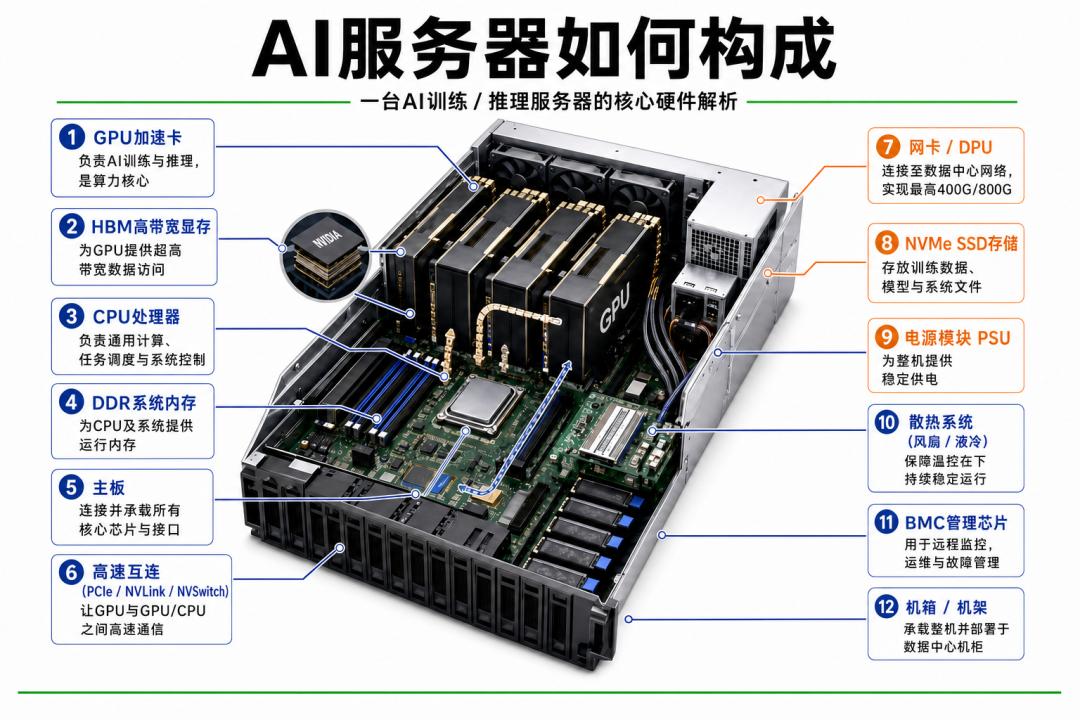
Core hardware components of AI training and inference servers. GPUs, HBM, CPUs, and DDR handle computing and data access, while PCIe, NVLink, NVSwitch, and other technologies are responsible for high-speed interconnection. Network cards, storage, power supply, heat dissipation, and management modules jointly support the operation of the entire system.
2. Three tiers of interconnection are under simultaneous pressure
What makes the situation more tricky is that it is not just a single road that is jammed — all three tiers of interconnection are congested at the same time.
Interconnection between servers is known in the industry as Scale-out;
Interconnection between multiple GPUs inside a single server is called Scale-up;
Going even deeper, interconnection between chips on the same circuit board is called Scale-in.
At all three tiers, electrical interconnection is increasingly reaching its limits.
A straightforward comparison: Copper cables can typically only stably transmit signals for about 3 centimeters on a circuit board, and a few meters inside a device, while optical fibers can maintain stable transmission over 100 meters or even several kilometers. In terms of power consumption, a copper interconnection consumes around 15 watts, while an equivalent optical interconnection only uses about 5 watts.
Therefore, it is not so much that "light" has suddenly become popular, but that electrical paths have first hit their physical ceilings.
3. Why is NVIDIA in such a hurry?
NVIDIA's recent actions speak volumes: It has successively invested in industry chain companies including Marvell, Lumentum, and Coherent, and reached a cooperation with Corning. Together with other AI computing giants, NVIDIA has also proposed technical routes such as CPO, MicroLED, microring modulators, and OCS (Optical Circuit Switch). The reason why a giant that originally only focused on computing power has personally stepped in to "direct" optical communications is simple: Its own demands are growing exponentially, and the pace of existing suppliers cannot keep up.
Once the industry chain leader accelerates, the entire sector is rapidly ignited. The demand is real, but technical routes have not yet converged, and a chaotic mixed landscape is equally real — with no shortage of companies trying to "hitch a ride on the light trend".
Some others have chosen the opposite direction. Instead of struggling to connect tens of thousands of chips together, they can make an entire wafer into one giant chip, allowing most calculations to be completed locally inside the chip, thus bypassing the interconnection bottleneck. The representative of this approach is US-based Cerebras. However, this is a pure electrical chip path, which comes with high costs in terms of heat dissipation and yield, and ultimately cannot avoid other physical limits.
Yet one thing is almost universally agreed upon: Everyone is looking at the same exit — light.
Why light, of all things?
To understand why light can take on this new role, we can start with a basic physical principle.
Photons have no mass, so they are inherently superior to electrons in terms of speed, power consumption, and signal-to-noise ratio. The simplest proof is that submarine optical cables can transmit signals across thousands of kilometers to the other side of the ocean — a task that electrical transmission simply cannot accomplish.
This is also the underlying judgment that underpins our decade-long unwavering bet on optics: In many links of communications and computing, the physical properties of light are inherently better than those of electricity.
In fact, optical communications have long been ubiquitous, even if we rarely notice it. Transoceanic submarine cables, inter-city metropolitan area networks, backhaul connections between different generations of base stations, and interconnections between servers in data centers all fundamentally rely on optical fibers. But this round of AI development has put forward new demands: Short-distance scenarios that previously could be handled by electricity, such as inside servers and between chips, now all need to adopt optical solutions.
So how are signals loaded onto light? Fundamentally, there are two approaches: One is to make the light source carry the signal itself, the other is to keep the light source stably lit and add a "modulator" behind it to alter the signal. The latter path, silicon photonics, is the current mainstream, but the single-wavelength transmission rate has essentially hit its ceiling at 200G. To push further to higher speeds, we need a new material called thin-film lithium niobate, which is almost an unavoidable option for achieving 1.6T and 3.2T high rates. On this track, Chinese teams are relatively advanced, and we have invested in one such company.
However, there is still uncertainty about the incremental value of optics in AI infrastructure, which comes from AI itself. Currently, the largest demand side for computing power is model training, with all major companies building massive GPU clusters. But for the next stage of inference, no one can say for sure how large the dedicated data centers need to be built, or how they should be designed. If agents and end-side assistants are widely deployed in the future, the requirements for low latency will continue to rise, which will further push up the demand for optics. But if inference operations mainly reuse existing training clusters, the incremental demand will be much smaller. This uncertainty is an important reason why the optical communication sector is "hot yet chaotic".
There is also an unavoidable hard nut in the optical module industry: DSP (Digital Signal Processor), which is equivalent to the "CPU" of optical communications. It is specifically responsible for restoring distorted and blurred signals — without it, high-speed signals cannot be recognized at all. The problem is that this chip is expensive and power-hungry, accounting for roughly one-third of the cost and nearly half of the power consumption of an optical module. The delivery lead time for high-end DSPs has stretched to almost a year, and the market is largely controlled by two US companies, Marvell and Broadcom.
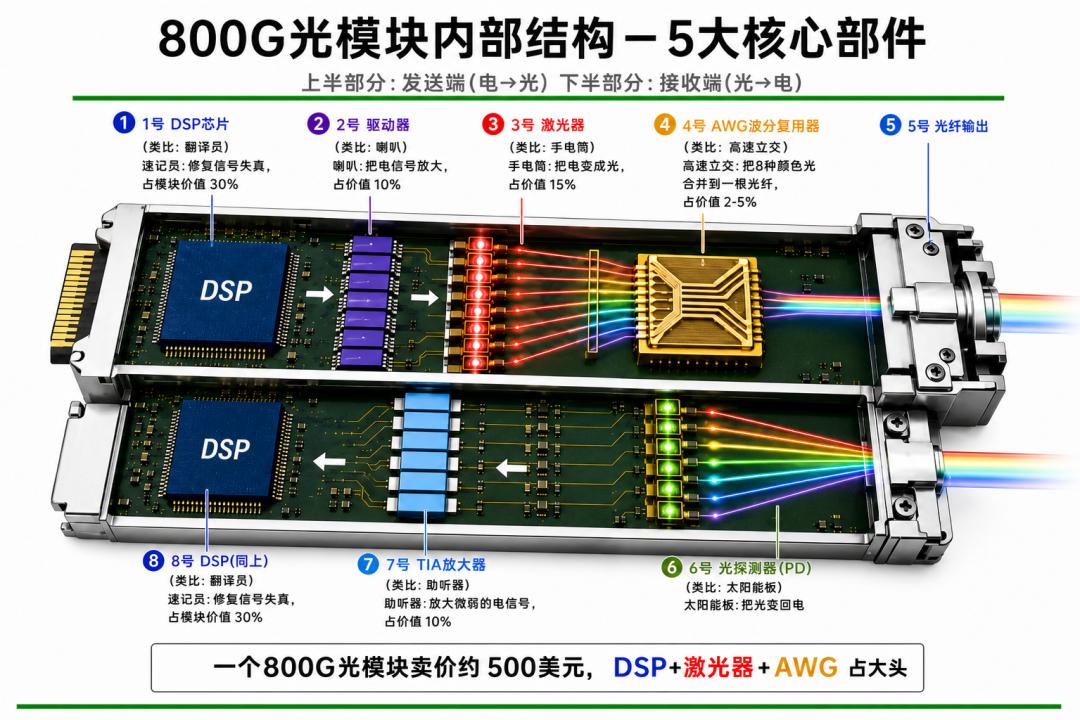
Schematic diagram of the internal structure of an 800G optical module. The transmitting end and receiving end complete electrical-to-optical and optical-to-electrical conversion respectively, with main components including DSP, driver, laser, AWG wavelength division multiplexer, photodetector, and TIA amplifier.
To be frank: It is not that we are restricted by any administrative order from other countries, but that our own technology has not yet reached the required level. High-end optical DSP is a chip with extremely high technical complexity and difficulty, and we still need some time to catch up in this field.
Few people doubt the general direction of optics. But there is far from a consensus on which specific path will succeed, or who will achieve it first.
So in this still-unclear landscape, what position does China occupy?
In this game, China stands on the "creation" side for the first time
I was once asked a question: Are optical chips just another direction for "domestic substitution"?
My answer is no. This is different from the stories we are familiar with in the past. When we first looked at GPUs, it was essentially a domestic substitution scenario: NVIDIA had already achieved success overseas, and we were catching up from behind. But for new directions in the optical sector today, such as CPO, LPO (Linear-drive Pluggable Optics), thin-film lithium niobate, and OPA (Optical Phased Array), China and overseas players are starting from the same starting line. From the current perspective, we are not at a disadvantage in this round, and in some links we are even more advanced — such as thin-film lithium niobate chips. Of course, in the technical fields where we lead, there is often no clear "reference point", meaning no overseas comparable products to follow. Many peers may see this as uncertainty and risk, but in my view, this is a good thing — because it means you are the pioneer.
As the first to eat crabs, you get the chance to grab the biggest and best ones.
Currently, in the AI optical interconnection track, there are two types of players. The first type are the leading optical module companies that have seen the sharpest stock price rises in the secondary market. They are mainly producing mass-produced traditional optical modules, with demand coming primarily from NVIDIA's data center construction — essentially continuing to expand within an existing large market. In this traditional pluggable optical module market, the pattern of large manufacturers is already relatively stable, leaving few opportunities for new players like startups. But in new directions, startups and giants are basically on the same starting line. Startups can even enjoy a window of opportunity because they are more focused and make decisions faster.
The optical industry landscape is huge, and over the years we have been laying out investments along different technical routes, backing relevant entrepreneurial teams for every key path.
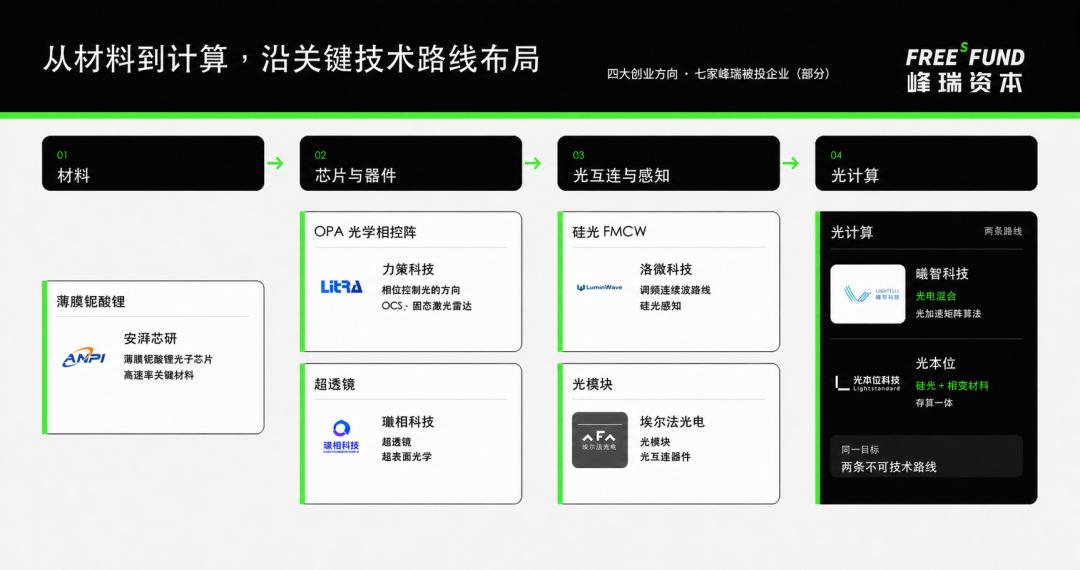
FreeS Fund's investment layout in the optical sector.
Let's start with the most-discussed area: optical computing. Lightelligence, which we first invested in 2017, listed on the Hong Kong Stock Exchange this April. It follows an optoelectronic hybrid path, using light to accelerate the matrix multiplication operations that are the most computationally intensive part of AI, while leaving other operations to be handled by electrical chips. Another company we invested in 2022, LightCentric, takes a different approach: using silicon photonics combined with phase-change materials to integrate storage and computing into a single unit, creating "storage-computing integration" that delivers smaller unit size and lower power consumption. For the same big goal, we have bet on two distinct technical routes.
The second line is thin-film lithium niobate. As mentioned earlier, this material is almost unavoidable for developing towards 1.6T and 3.2T transmission rates. Whether it is upstream wafer manufacturing or chip design, Chinese teams have made great progress in recent years, and Anpei, which we invested in 2021, is one of the leading players.
The third line is OPA, Optical Phased Array. Its working principle is somewhat similar to the flat-panel antennas used in 5G, using phase to control the direction of light instead of mechanical rotation. This technology has two major applications: all-optical switches (OCS) and solid-state LiDAR, the latter of which will be deployed in vehicles in the near future. There are not many teams in the world that can