Led by a Chinese team, secured 6.8 billion in financing, and focused on AI chips.
A dramatic turn of events.
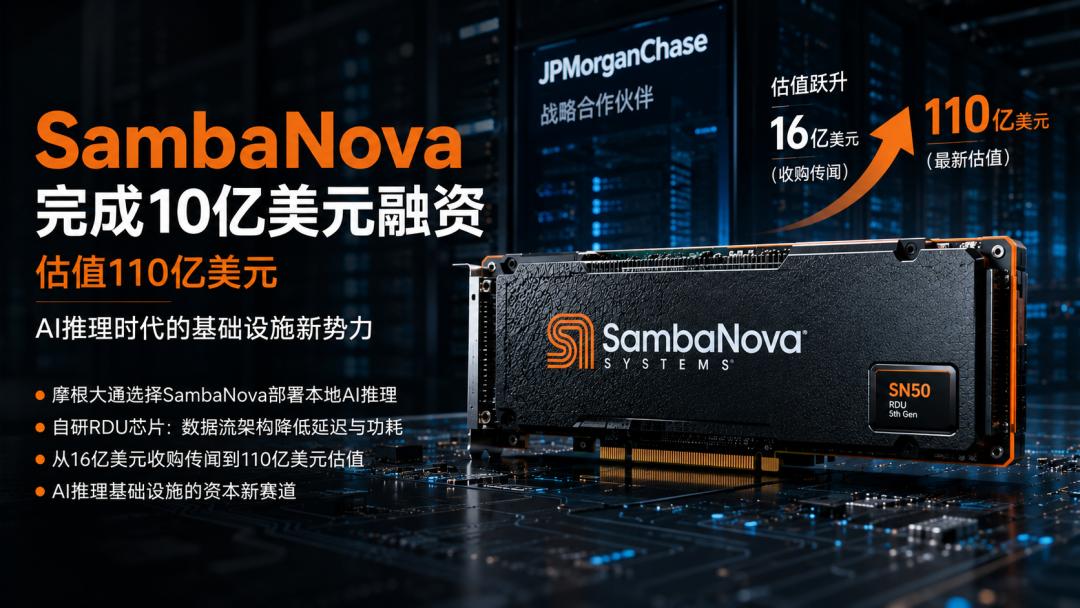
Inference chip firm SambaNova announced the completion of its Series F funding round, raising $1 billion (approximately 6.8 billion yuan), with a post-money valuation of $11 billion (around 74.8 billion yuan).
Just a few months prior, acquisition talks between SambaNova and Intel were reported. Intel was discussing acquiring SambaNova for roughly $1.6 billion, including debt, but the deal ultimately fell through.
What happened between the $1.6 billion potential acquisition price and the $11 billion current valuation? Why is the capital market so bullish on SambaNova?
9 Years of Entrepreneurship, Finally Arriving at the AI Inference Era
Founded in 2017, SambaNova is headquartered in San Jose, California. Its three co-founders represent a classic Silicon Valley AI hardware startup lineup: one industry veteran with deep expertise in enterprise-grade chips, and two academic figures from Stanford University.
CEO Rodrigo Liang is of Chinese descent, born in Taipei and raised in Brazil. He previously worked at HP, Sun Microsystems, and Oracle, developing high-performance processors for enterprise servers. Kunle Olukotun is a professor of Electrical Engineering and Computer Science at Stanford, widely recognized as a pioneer in multi-core processor design. Christopher Ré is also a computer science professor at Stanford, with long-term research focus on machine learning, data systems, and AI infrastructure.

SambaNova CEO Rodrigo Liang Source: SambaNova Official Website
SambaNova delivers a full-stack AI infrastructure solution: it develops self-designed chips, and also provides server systems, cloud services, and software offerings.
SambaNova secured aggressive funding in its early stages. In 2021, it closed a $676 million Series D funding round led by SoftBank Vision Fund 2, pushing its valuation above $5 billion. At that time, the company had raised over $1 billion in total, earning a reputation as one of the most well-funded AI infrastructure startups.
However, capital soon realized that building a viable NVIDIA alternative was an extremely challenging path. SambaNova went through a tough downturn marked by funding difficulties, zero revenue streams, and layoffs.
Later, SambaNova shifted its strategic focus to AI inference and cloud services. It was during this period that Intel initiated acquisition discussions. For a company valued at over $5 billion in 2021, the potential $1.6 billion acquisition price itself reflected how drastically the market had re-evaluated its worth at that point.
But the AI industry evolves at a rapid pace. As AI applications moved from demo prototypes to production-grade systems, inference costs began to emerge as a critical real-world pain point.
SambaNova's opportunity finally arrived.
The JPMorgan Chase Order Matters More Than Funding
SambaNova's most significant breakthrough might not be the new funding round, but securing a marquee enterprise client.
Alongside the funding announcement, SambaNova revealed that JPMorgan Chase had selected it as its inference infrastructure partner. The bank will deploy SambaNova's SN40 and SN50 systems to enable secure on-premises AI inference. Darrin Alves, CIO of Infrastructure Platforms at JPMorgan Chase, stated in the announcement that the bank's AI infrastructure must meet extremely high standards for performance, control, and reliability.
Banks are notoriously hard-to-convince customers. Financial institutions impose strict requirements on data security, system stability, auditability, latency control, and permission management.
For SambaNova, JPMorgan Chase represents a large segment of enterprise clients: major corporations that want to leverage AI without moving all their data and workloads to public clouds.
The core demands of these clients are threefold: first, data must remain within their own controlled environment; second, costs need to be predictable; third, performance and latency must stay consistently stable.
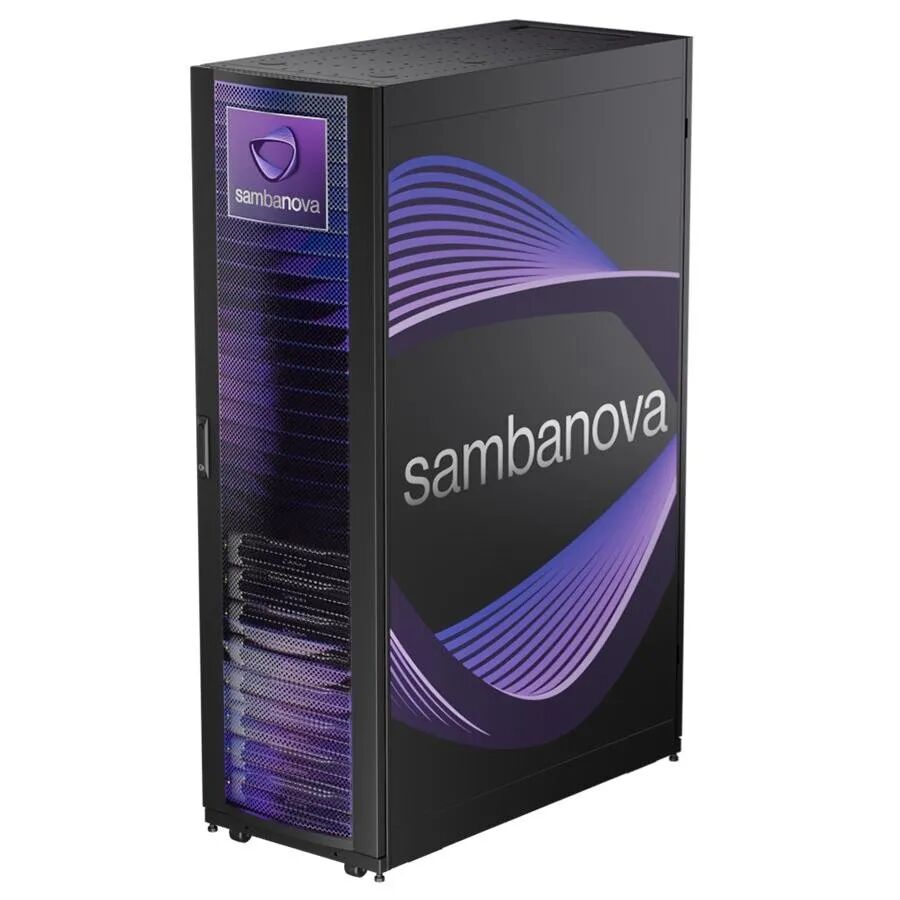
SambaNova SambaRack Inference System Source: SambaNova Official Website
SambaNova's core chip is not a GPU; it is called an RDU, short for Reconfigurable Dataflow Unit. The key bottleneck in AI inference is not raw computing power, but the overhead of moving data between memory and processing units. Traditional GPUs for inference require frequent access to external memory, which introduces unnecessary latency and energy consumption. SambaNova claims its dataflow architecture allows data to flow through the chip like an assembly line, eliminating redundant data movement and thus reducing both latency and power usage.
The SN50 launched this year is SambaNova's 5th-generation RDU. The company states the SN50 is purpose-built for agentic AI inference, ideal for AI coding agents, enterprise copilots, model hosting platforms, and large-scale inference services. SambaNova also notes that the SN50 can be combined with the SambaRack system to support larger models, longer context windows, and seamless multi-model switching.
Another key client partnership is with Intel.
In February this year, SambaNova and Intel signed a multi-year collaboration agreement, aiming to deliver more cost-effective AI inference solutions for AI-native companies, model providers, enterprises, and government agencies.
The relationship between Intel and SambaNova is quite nuanced.
On one hand, Intel previously considered acquiring SambaNova. On the other hand, Intel CEO Pat Gelsinger concurrently serves as the chairman of SambaNova. While Intel lags behind NVIDIA in the AI GPU market, it still dominates the CPU ecosystem deployed across the vast majority of enterprise data centers worldwide.
They aim to communicate to customers that AI inference will not be dominated by a single type of chip. Future data centers will operate more like an assembly line: GPUs handle processing long prompts, RDUs rapidly generate tokens, and CPUs manage tool orchestration, code execution, and task scheduling. The collaboration between SambaNova and Intel essentially tells customers: you don't need to completely rebuild your entire data center around GPUs; you can run AI agents efficiently in your existing on-premises enterprise server rooms.
Inference Demand Unleashes a Lucrative Market Boom
Over the past year, capital has clearly been aggressively chasing AI inference infrastructure opportunities.
Groq raised $750 million in September 2025, pushing its valuation to $6.9 billion. Groq focuses on developing AI inference chips optimized for pre-trained models, and has also secured a $1.5 billion commitment from Saudi Arabia to deliver its AI inference solutions.
Cerebras has gone public with a market capitalization of $49 billion, specializing in wafer-scale AI chips designed for both large model training and inference, reporting $510 million in revenue last year.
In June, Baseten raised $1.5 billion at a $13 billion valuation. The company sells software and infrastructure to help enterprises customize AI models, claiming its revenue has grown 20 times over the past year driven by surging inference demand in real-world production use cases.
Etched is even more ambitious. It develops Sohu, an ASIC chip purpose-built exclusively for Transformer models. According to TechCrunch, Etched announced in June this year that its inference systems based on this chip have secured $1 billion in contracted orders, valuing the company at $5 billion.
In the AI inference market, enterprises are willing to pay for solutions that deliver lower per-token costs, on-premises deployment capabilities, and differentiated performance advantages.
Not all these companies are striving to become the next NVIDIA. Cerebras bets on wafer-scale chips, Etched focuses on Transformer-specific ASICs, SambaNova targets enterprise on-premises inference, and Baseten builds a model deployment platform. Their real opportunity does not lie in capturing the entire GPU market, but in addressing niche, high-value, and pain-point inference scenarios. As long as a solution is cheaper or faster than GPUs in a high-frequency use case, it holds substantial commercial potential.
The content in this article is for informational purposes only and does not constitute investment advice.
This article originates from the WeChat Official Account "Pencil News" (ID: pencilnews), authored by Huang Xiaogui, and published by 36Kr with authorized permission.