Breaking: Elon Musk Unveils the Most Powerful Grok 4.5, Top-Tier Opus Intelligence at a Drastically Reduced Price
Grok 4.5, the final submission is here!
Just now, Elon Musk's SpaceXAI has unveiled Grok 4.5, the most powerful flagship model in its history, making a huge splash.

This time, SpaceXAI has joined forces with Cursor in a powerful collaboration.
Using tens of thousands of massive GB300 GPUs, they have painstakingly "forged" this performance beast purpose-built for coding and intelligent agents.
The scorecard is extremely impressive —
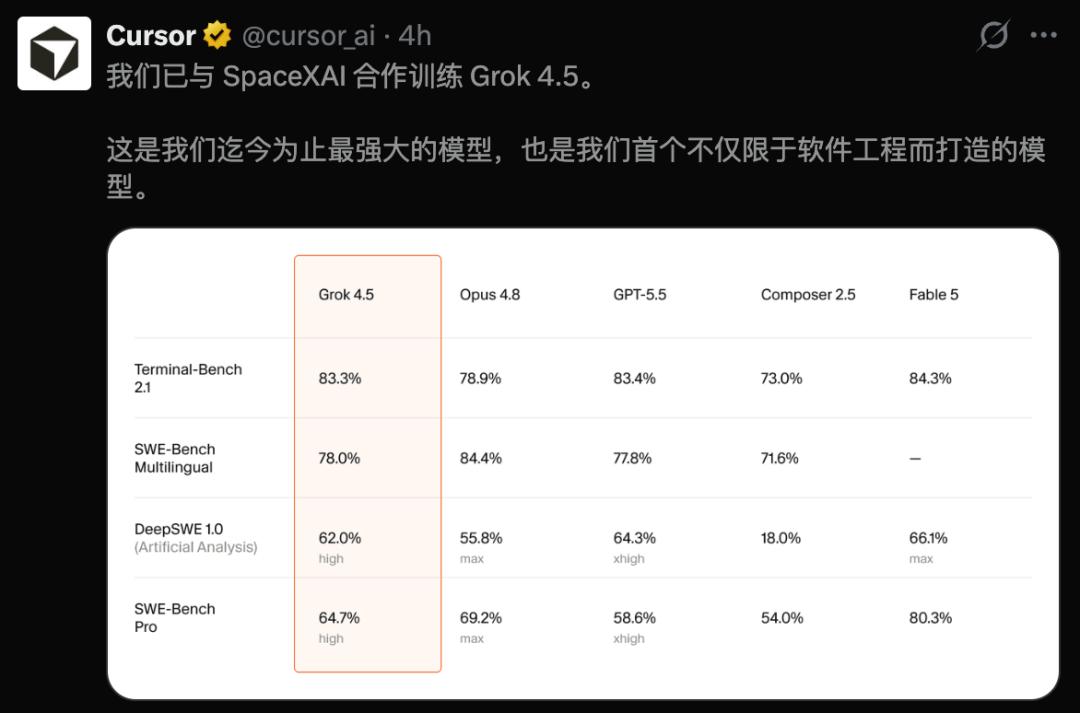
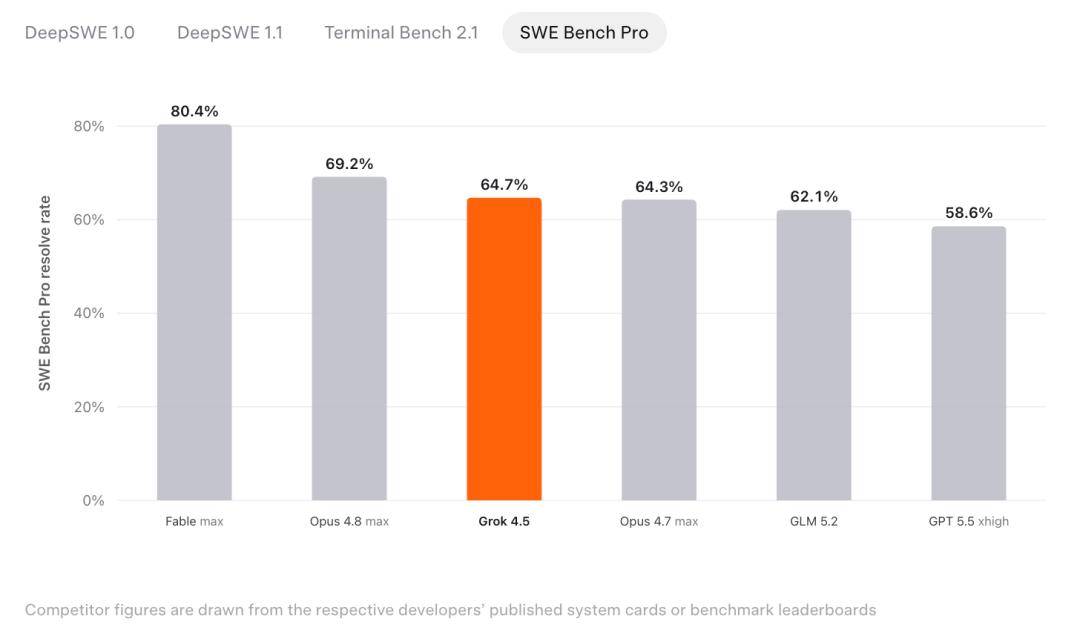
- SWE Bench Pro: A stunning 64.7%, directly surpassing Opus 4.7's 64.3%;
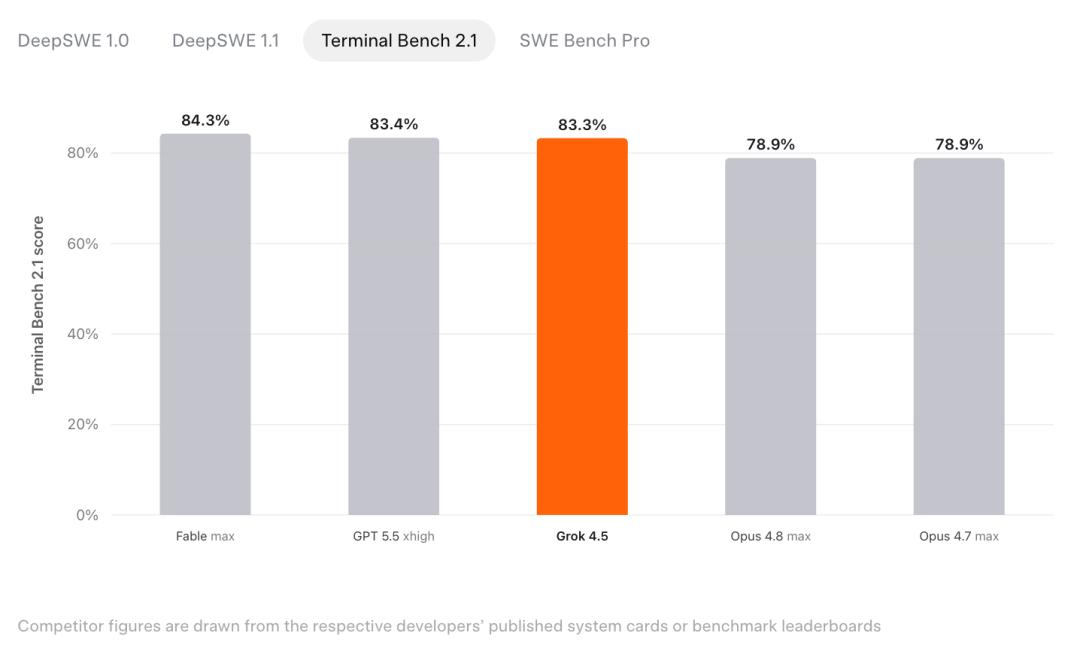
- Terminal Bench 2.1: Surging all the way to 83.3%;
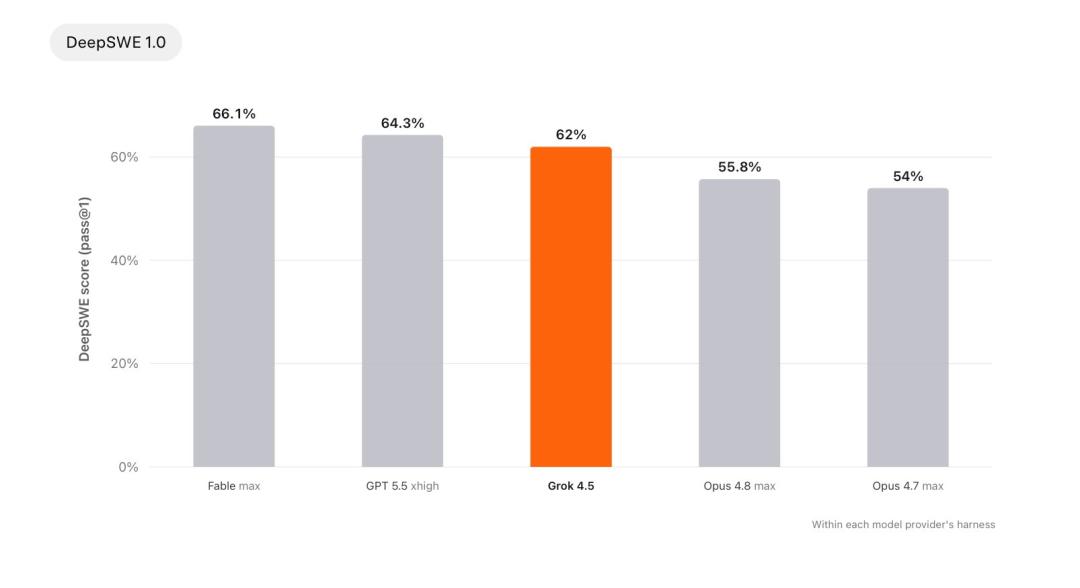
- DeepSWE 1.0: Steadily reaching 62.0%, overwhelmingly outperforming Opus 4.8.
Elon Musk stated bluntly, "Grok 4.5 is roughly on par with Opus 4.7, but much faster."
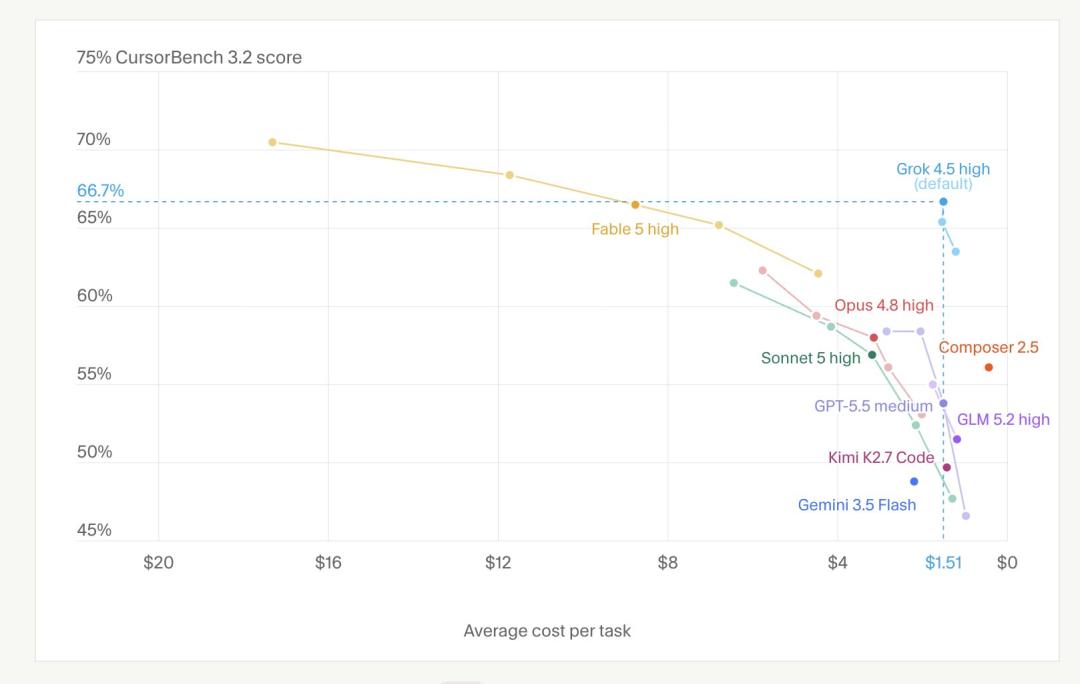
The combination of capability, speed, and cost is what defines its competitiveness. In other words, the number of Tokens it uses to complete tasks is only a fraction of what other models require.

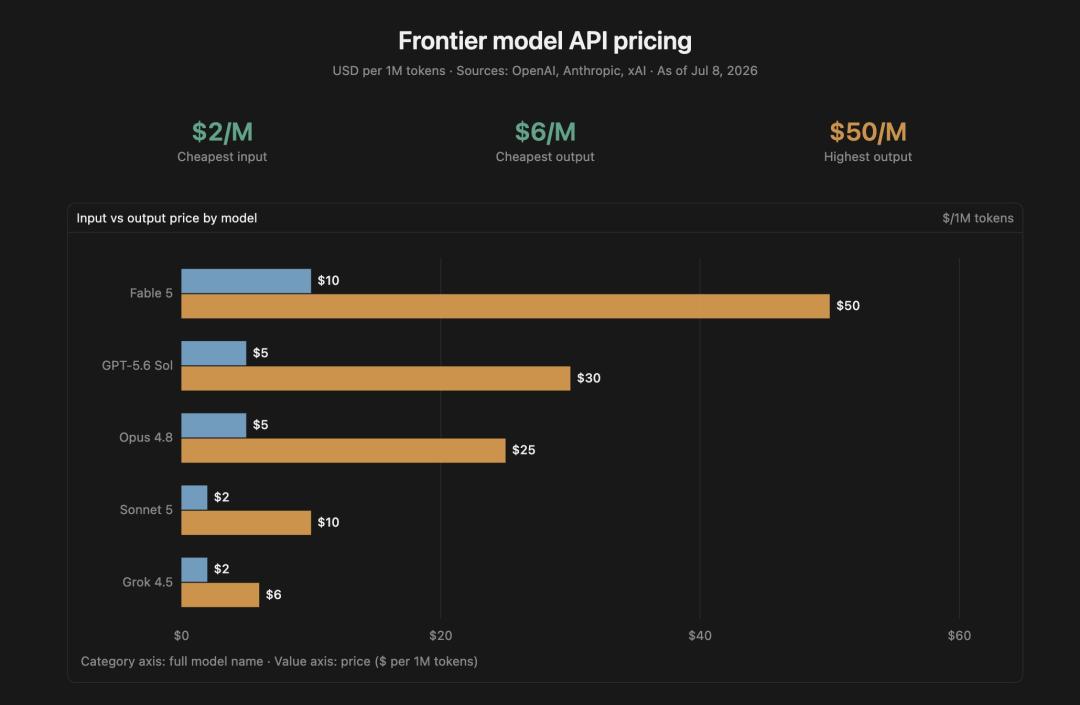
Grok 4.5 has an input price of $2 per million tokens and an output price of $6 per million tokens.
Compared to Opus 4.8, its Token consumption is drastically reduced by 4.2 times.

Tens of Thousands of GB300 GPUs Forged an "Opus-Class" Model
Grok 4.5 is the first ace in the deck for SpaceXAI since its public launch, and also the first deliverable from their collaboration with Cursor.
So how was it developed?
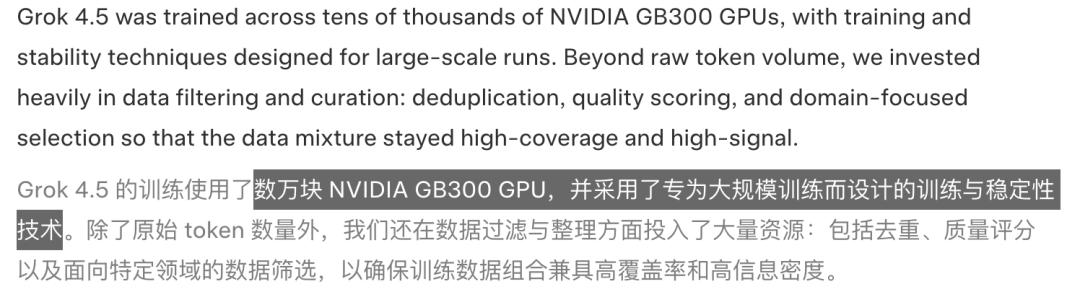
The answer lies in tens of thousands of NVIDIA GB300 GPUs powering an ultra-large-scale training run. But piling up computational power is only the entry ticket.

Musk Teaser: Grok 4.5's Context Window Will Be Upgraded to 1 Million Next Week
The area where SpaceXAI truly poured in relentless effort is data.
They conducted grueling filtering, deduplication, and quality scoring on massive corpora to ensure every piece of content fed into the model was high-information-density professional material.
Then they shifted the focus of Reinforcement Learning (RL) to a rarely discussed metric — per-token intelligence.
The addition of Cursor was the most critical piece of this entire flywheel system.
Grok 4.5 is built on the V9 (1.5T) base, and according to official introductions, trillions of tokens of Cursor data were used during its training.
This data records how real-world developers interact with codebases, tools, and intelligent agents.
This means the model learned not just "what code looks like," but "how humans and AI collaborate to write code."
And its training stack was designed for high asynchrony —
Intelligent agents can run continuously for hours on end, with the model learning while performing tasks, and training across tens of thousands of GPUs proceeding nonstop.
The result is that it not only solves practice problems well, but also handles multi-step complex engineering work in long-running tasks that span several hours.
Matches GPT-5.5 Performance, Approaches Opus 4.8
The hardcore performance of Grok 4.5 under this training methodology is absolutely reliable and verifiable.
Its performance on several core engineering benchmarks can be described as "stable" — not the absolute strongest, but firmly in the first tier of top models.
On DeepSWE 1.0, it scored 62.0%, surpassing Opus 4.8 (55.75%) and closely trailing GPT-5.5 (64.31%);
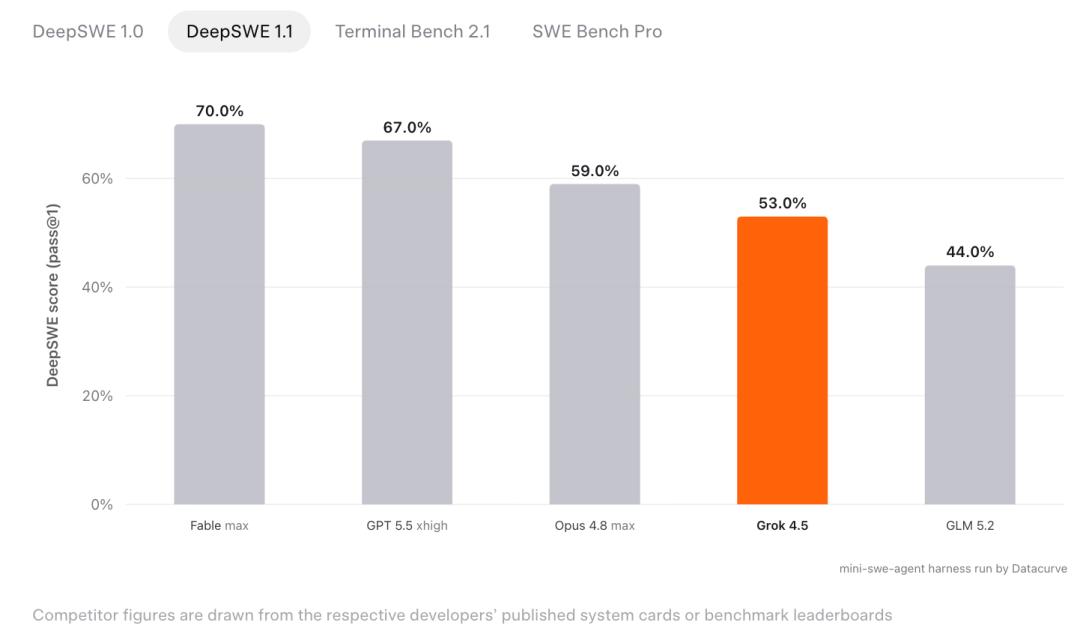
On Terminal Bench 2.1, it reached 83.3%, a mere 0.1% behind GPT-5.5 (83.4%)!
On the more demanding SWE Bench Pro, it achieved a 64.7% problem-solving rate, overtaking GPT-5.5 (58.6%) and approaching Opus 4.8 (69.2%).
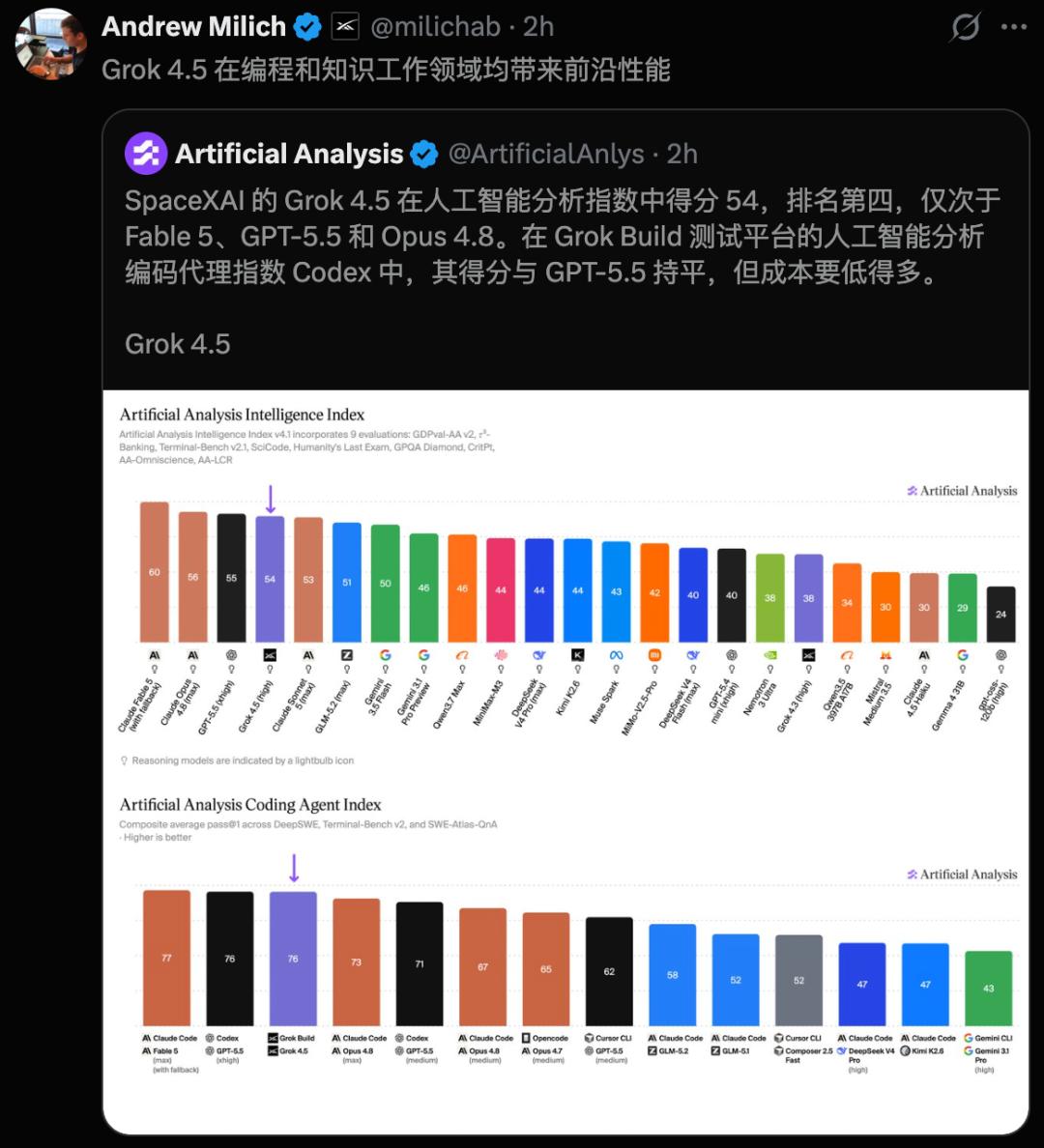
In the official AAAI benchmark tests, Grok 4.5 ranked fourth, following only Fable 5, GPT-5.5, and Opus 4.8.
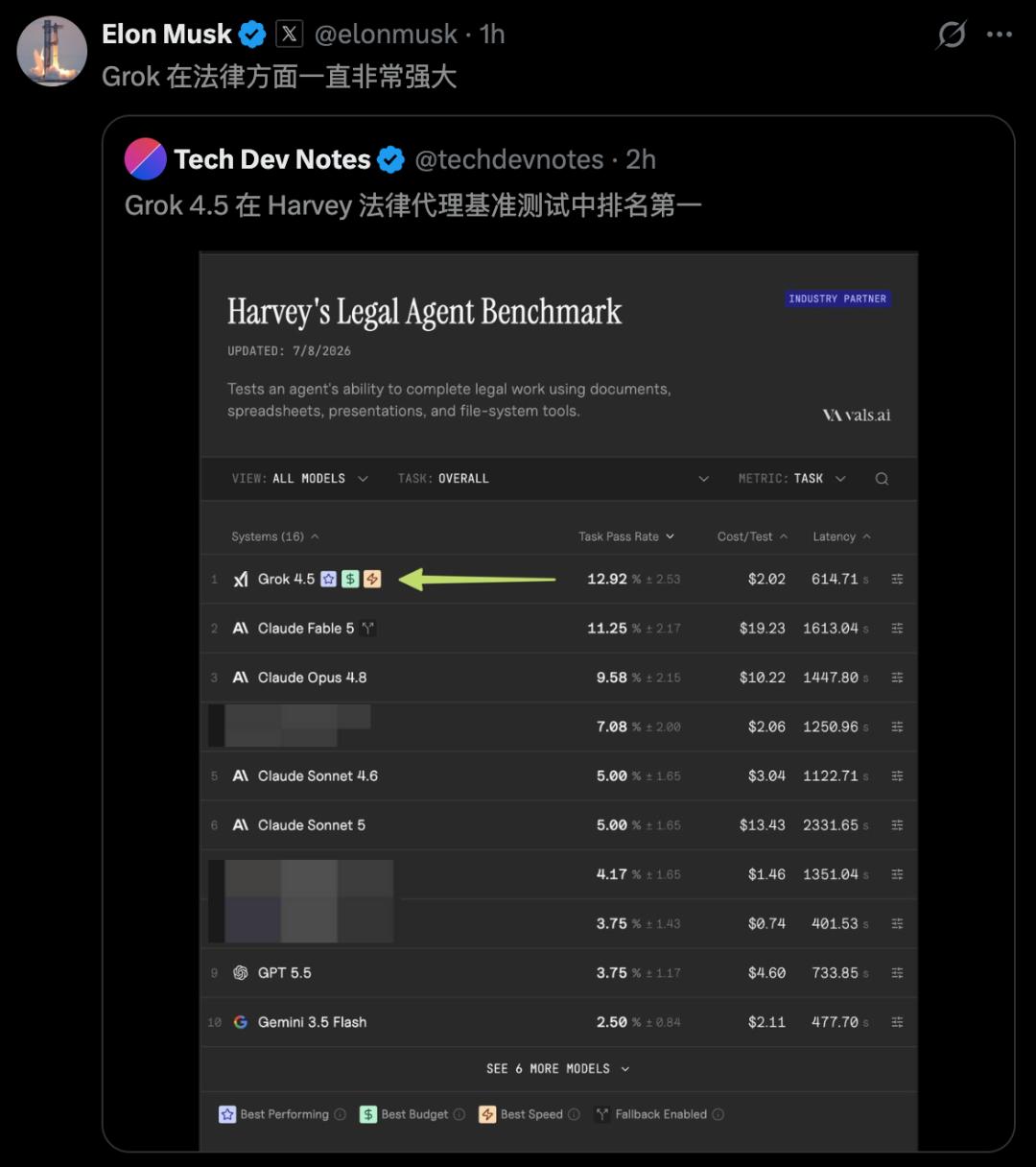
It took first place in the Harvey Legal Intelligent Agent benchmark.
It's undeniable that this performance record is highly competitive.
But it must be acknowledged that Claude Fable still firmly holds the top position at the moment.
In summary, Grok 4.5 is roughly on par with GPT-5.5 and close to Opus 4.8, but there is still a gap to reach the absolute performance ceiling.
Musk himself put it plainly: "Our internal evaluation is that Grok 4.5 is roughly equivalent to Opus 4.7, but much faster."
The Real Killer Feature: Blazing Fast and Extremely Affordable
Grok 4.5's true disruptive advantage lies in three core strengths: speed, efficiency, and pricing.
Its inference speed reaches up to 80 TPS (Tokens per second), with the official description noting it's "faster than flash-class models."
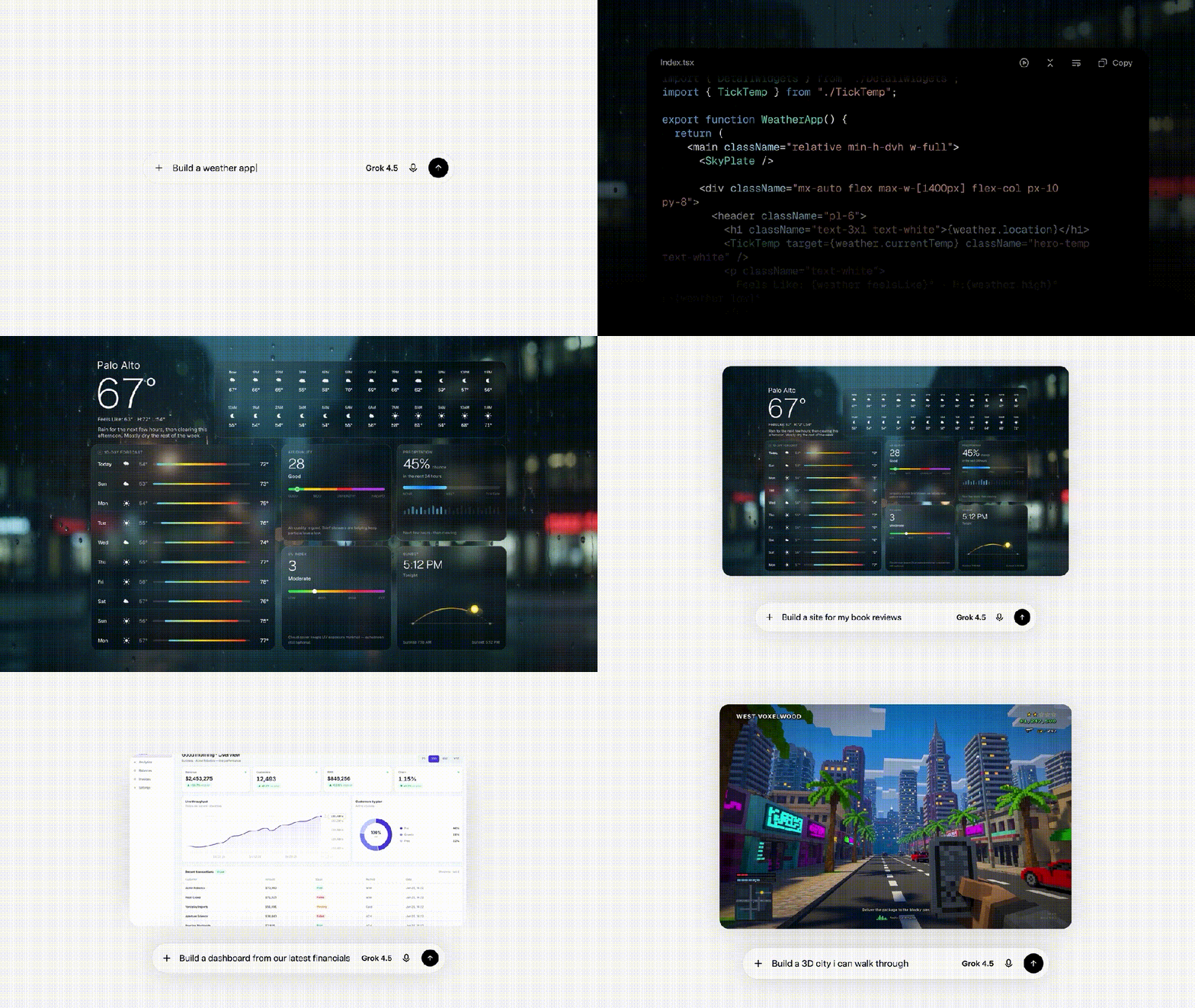
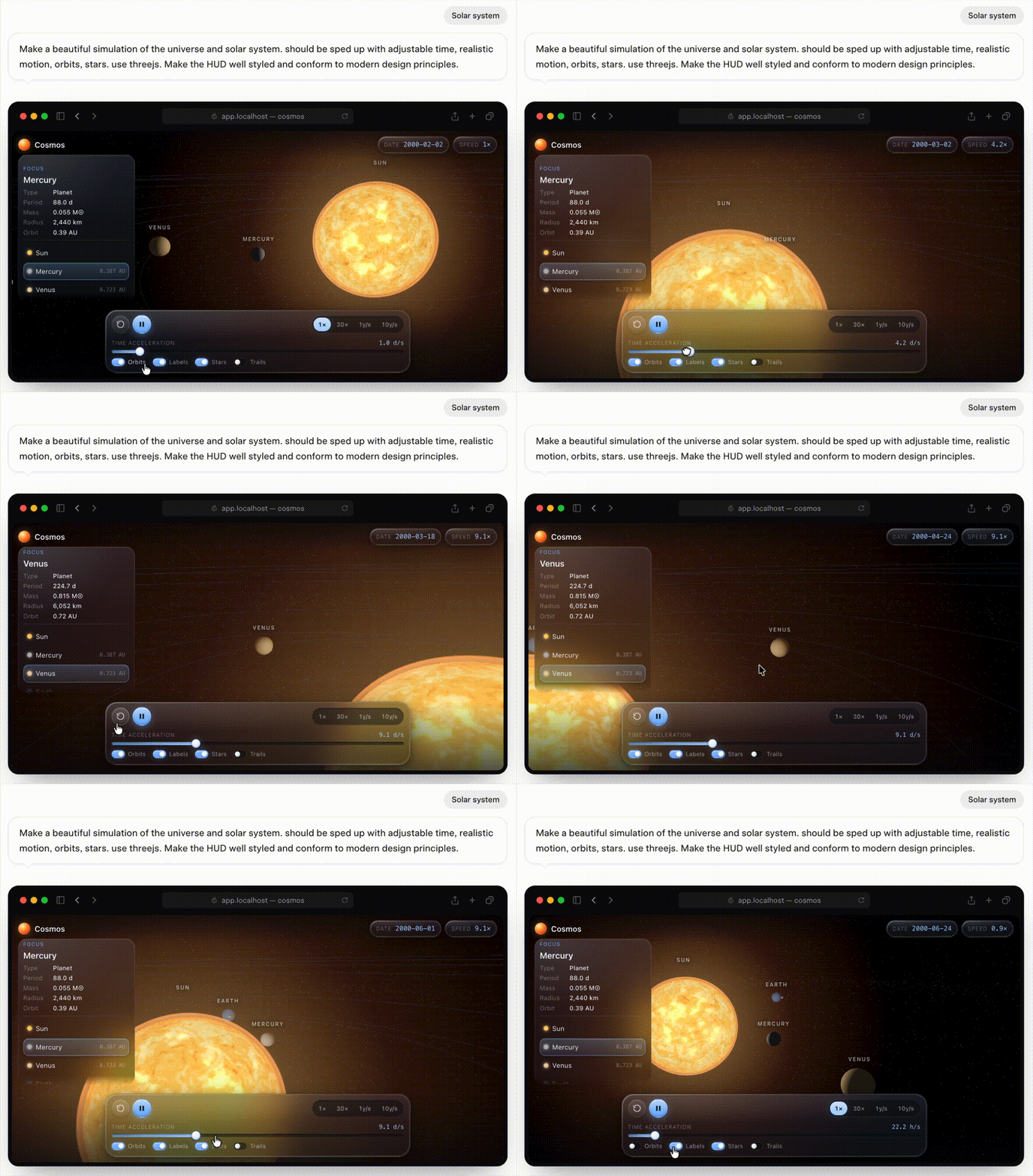
Using just a single prompt, it wrote a full 3D solar system simulator with Three.js:
The simulator supports time acceleration, features realistic orbital motion for all eight planets, and even includes a carefully crafted HUD control panel.
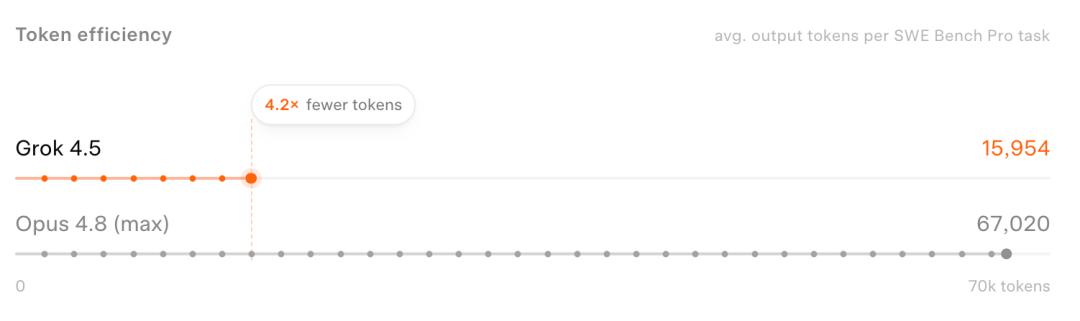
In terms of efficiency, on SWE Bench Pro tasks, Grok 4.5 solves problems with an average of only 15,954 output tokens.
By comparison, Opus 4.8 requires an average of 67,020 tokens to complete the same task.
That's a 4.2x difference — Grok 4.5 uses less than a quarter of the tokens its competitor needs to finish the exact same engineering problem.
For pricing, input tokens cost $2 per million, and output tokens cost $6 per million.
There is also a faster premium version priced at $4 per million input tokens and $18 per million output tokens.
Compared to other top-tier models that often start at a dozen dollars or more, this price point drastically cuts costs to an extremely competitive level.

Combining these three metrics, the conclusion is clear: