Why are the Liblib platforms that cannot be eliminated from the market still sought after by capital?
The market has always shown noticeable divergence in its judgments of AI application companies.
One perspective holds that AI application companies are the group closest to real commercialization in the AI era. Compared with the long, costly, and uncertain R&D investments of foundational model companies, application firms are closer to users, iterate their products faster, and can more easily verify users' willingness to pay. They can translate new capabilities into concrete products the moment model capabilities are unleashed, deliver them to users, and generate revenue as soon as possible.
The other perspective is relatively cautious. Many AI application companies do not own the foundational models, lack control over computing power, and do not necessarily secure stable user entry points. They seem to be moving very fast, but this speed may only be built on model dividends and the explosion of public attention—they can acquire users in the short term, but in the long run, they will face the erosion of product capabilities by foundational models, the impact of Token price fluctuations on their business models, and their so-called barriers will be constantly re-evaluated.
Evoken Technology is an AI application company that has recently been pushed to the center of such divergence and questioning.
The company previously known to the market as Liblib announced that it had completed a nearly $300 million Series B+ financing round, with a post-money valuation exceeding $2 billion. After the financing, the company adopted the new name Evoken, attempting to integrate products including Liblib, Lovart, StarFlow, and LibTV into a unified corporate narrative: an AI application company serving the next generation of creative production methods.
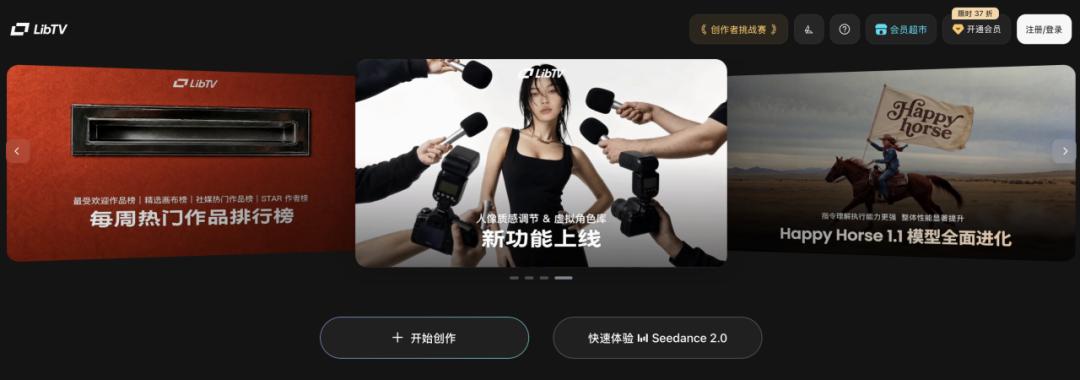
Supporters see Evoken's ability to continuously seize technical windows, believing its value is not only reflected in creating hit products, but in translating model changes into products, users, and revenue consecutively at different technical milestones. Critics argue that Evoken's business model is essentially a "Token transfer station", whose capabilities largely come from aggregating and scheduling mainstream models, and gaining price advantages through computing power discounts and purchasing second-hand API shares.
This controversy is not unique to Evoken. A group of AI application companies currently cannot answer this question well: when you do not own the models, do not control the computing power, and users may switch to other platforms quickly, where exactly is your real value?
In the long run, this answer may not lie only in the current products themselves, but in whether the team can bet on future products. More precisely, it depends on whether such companies have the ability to continuously capture important technical change milestones, and quickly translate these changes into products, users, and revenue.
In a stage where model technologies, interaction methods, and product forms are all still evolving without fixed patterns, people can see a vague distant vision, but cannot find a clear lighthouse guiding them to definite opportunities. Ultimately, they have to rely on human experience and judgment to identify opportunities, organize resources, implement quickly, and continuously adjust their direction.
In the eyes of investors, teams that can continuously seize definite opportunities amid changes are more valuable than those that only bet on opportunities that are still in flux.
01
An AI Application Company with New Consumer Brand Vibes
At this stage, AI application companies give people a feeling very similar to that of new consumer companies a few years ago.
It is not that their specific businesses and products are similar, but their overall temperament is alike. Back then, new consumer companies not only sold coffee, skincare products, scents, and low-alcohol beverages, but also targeted new consumer groups, promoted new aesthetics, and advocated new lifestyles. Beyond products, they were better at building a narrative: behind a demand that had not yet been fully verified, there was a definite trend of the times.
A few years later, this set of entrepreneurial rhetoric has reappeared among AI application companies. Only that "lifestyle" has been replaced by "work style", "new consumer groups" by "super individuals", and "brand opportunities" by "the Agent era".
AI applications no longer position themselves merely as design tools, but frame themselves as AI designers, creative teams, and delivery services; they no longer just talk about AI Search, but push themselves into the categories of Super Agent, AI Workspace, and AI Employee; they repeatedly emphasize that AI should not only think, but also act; they extend their scope from Chatbox and canvas to Agent workspace and the full multimodal creative production chain.
This rhetoric is not all packaging—AI is indeed transforming the form of work tasks.
When a designer collaborates with AI, they may no longer just input prompts, but draw and modify on the canvas to let the AI understand their own style and preferences; when a knowledge worker uses AI, they do not only search for information, but hope to integrate browsers, documents, spreadsheets, PPTs, and Agents into a single task entry point; people using Agents expect their tasks to be broken down, executed, and delivered smoothly.

Just as new consumer companies once used branding to fight against homogenization, AI application companies are using grand visions to resist competition from tech giants and the erosion from foundational models. The narratives of these companies often include overly exaggerated claims, and they are building on a highly uncertain technical foundation. The entire product is still like a small raft floating on the sea, but the company seems to have used its vision to organize investors, users, employees, and media onto a large cruise ship.
Immature technologies and incomplete products result in strong user curiosity but low loyalty and low switching costs. A user may come today because LibTV is cheap and does not require queuing, but leave tomorrow because the original model provider cuts prices or another tool works better. The challenge for these companies is that they need to both tell compelling stories and generate revenue; they need to prove that they are still riding the trend, and demonstrate that users are willing to pay for their products.
Questions have naturally arisen from this. Although the customer acquisition, retention, repurchase, marketing, community operation, and KOL promotion of AI application companies all look like growth machines that have been repeatedly trained in the new consumer era, AI applications face model iterations, downward penetration of tech giants, and shifts in product paradigms—these changes are faster and more thorough than the supply chain, channel, and consumer group changes that new consumer companies encountered.
The lesson left by new consumer trends to the market is that a narrative can expand the imaginative space of a category, but cannot replace repurchases, gross margins, and stable user mindsets. AI application companies today are facing similar scrutiny: why users come, stay, and keep paying is more important than the moment they are first impressed.
02
Lacking the Ability to Lock in Victory
The capital market and the broader market, which have gone through the baptism of the new consumer wave, will no longer easily pay for the same old tricks. Behind this similarity, there are often overly unstable foundations and too many uncertainties.
But neither a polished narrative nor short-term hit products can provide a realizable expectation that convinces everyone. People will ask: if AI applications do not develop their own models, where does their irreplaceability come from? How much of their capability improvement is generated by themselves? Are all these AI applications just short-lived "Token transfer stations"?
The essence of this questioning is to ask what the foundation and barriers of AI application companies are, and whether they can have the ability and initiative to lock in victory in the competition.
The so-called "locking in victory" does not mean gaining users and revenue in the short term, but having a foundation that latecomers cannot easily bypass: models, entry points, data, ecosystems, or some kind of long-term non-switchable user mindset.
Judging by the standards of traditional technology companies, these firms are not at the very bottom of the industry chain. Their contributions do not lie in pre-training parameters or building expensive computing power clusters, but in providing product judgment, task decomposition capabilities, interactive design experiences, and context engineering. Their core competition is not technological breakthroughs, but the speed of translating model capabilities into product experiences and business models.
Evoken Technology chose not to build foundational models, nor to directly compete in the general Agent track, but to focus on vertical application Agents. The judgment of Chen Mian, the company's founder, comes from his experience in the internet era: startups should avoid the main tracks of large models and big tech companies, and build differentiation in niche gaps.
In a previous interview with LatePost, Chen Mian summarized the value of vertical application companies into two things: understanding the special working methods in a specific industry, and accumulating the experience and data required for that industry.

Similar to Evoken, many AI application companies are evolving their product capabilities alongside the advancement of underlying models. On one hand, they have all created special work interfaces or experiences: Manus and Genspark transformed the dialog box into the user's work studio, while Flowith has been building product capabilities around the canvas form from the very beginning. On the other hand, they are also developing more efficient context environments and task execution chains.
However, doing so may only give them a time difference: they can see how users will use the models earlier than model companies, package new capabilities into products faster than big tech firms, and occupy specific workflows and user mindsets earlier than their peers. A time difference can bring an opportunity window, but it can hardly automatically turn into a moat. The next model iteration, price cuts from original model providers, or further downward penetration of tech giants may all require them to re-prove what unique assets they still own.
Ji Yichao from Manus wrote in his technical blog: if model advancement is a rising tide, Manus wants to be a ship, not a pillar fixed on the seabed. This passage almost metaphorizes the choice of all AI application companies: they cannot control the tide or lock in victory, but can only make themselves better adapted to floating and moving forward.
03
The Value of Being Good at Choosing the Right Course
Without the ability to lock in victory, companies can only keep adjusting their course to ensure they can move forward efficiently along the right heading. The dream of AI applications is to become a new species in the AI era. But for now, they must constantly prove amid successive waves that they are not just bubbles brought by the tide.
Evoken Technology evolved from tools to communities, then from communities to Agents, and finally returned to being an AI tool provider. Each shift was not moving from one definite goal to another, but quickly switching from the previous course to a newly emerged, more valuable course.
Behind these course shifts lies the judgment logic of entrepreneurs like Chen Mian. As an entrepreneur with a background in product management and commercialization, he has worked at Tencent, 360, Baidu, Didi, and Missfresh before joining ByteDance to lead the commercialization of Jianying and CapCut. These experiences made him not obsessed with self-developing underlying technologies, but more convinced of the importance of products, users, commercialization, and seizing opportunity windows.
This is also the entrepreneurial method he has repeatedly expressed: application entrepreneurs need to combine "cognitive leadership and extreme execution". In other words, they do not have to be the creators of the trend of the times, but must judge earlier than others where the trend is heading. Every shift of Evoken Technology is a re-calibration of its course among model capabilities, user demands, and market consensus.

Chen Mian is not directionless. On the contrary, it is precisely because Chen Mian has always paid too much attention to the direction that every wave of model capability improvement, peer product iteration, and capital consensus makes him feel that the original course is not far-reaching enough. Since technology has not reached its mature stage, Evoken's course will continue to change.
AI application entrepreneurs have dreams, but every change—model iteration, peer growth, and tech giants' downward penetration—requires them to prove that they are still afloat. They must constantly adjust their posture, update their revenue, financing, and growth data, and keep telling new stories, just to avoid being swept away by the next wave. But dreams are often not shattered by a single failure, but gradually fade away in these repeated choices of "having to follow the trend".
Because the waves are too strong, the companies that can truly survive are even more precious. They cannot only chase the waves, but must be good at choosing the right course, and turn every model iteration, user migration, and product shift into their own stable capabilities: knowing which types of users are worth serving, which workflows can retain budget, and which context and delivery relationships will not be easily taken away by the next model update.
The value of being good at choosing the right course lies in: when neither technology nor products can lock in victory, human experience, judgment, and decision-making ability become the most valuable assets to be priced at this stage. This is probably the core reason why capital is willing to continue betting on companies like Evoken.
This article is from the WeChat official account "Narrow Broadcast", written by Li Wei, and published with authorization from 36Kr.