The Path to Breaking Through the "Nominal Prosperity" of Data Trading
Introduction: Data, hailed as the "new means of production," has been idling for 23 years
Since 2003, China's internet industry has gone through 23 years, spawning countless miracles of the digital economy. Empowered by cloud services and digital intelligence, data is widely recognized by the economic circle as a new means of production, which is almost one of the greatest consensuses of this era. However, this consensus has not translated into actual transactions. To this day, China's data trading market has only achieved formal implementation: trading venues are established, trading activities occur, data is incorporated into the asset category, and basic operations such as ownership definition and asset consolidation are completed. But the entire sector is still in the stage of "nominal trading", and has not yet formed a model that can substantially drive industrial development. Most transactions remain at the level of superficial data circulation, lacking in-depth exploration and matching of underlying industrial demands, let alone building a win-win business logic for both buyers and sellers. This means that a factor market with high hopes has long had a complete framework, but it has always hovered above real business scenarios. For decision-makers, what really needs to be clarified is not "whether data is valuable", but "under what conditions and through what paths can data be truly sold, purchased, and generate profits". The answer given in this report points to one term - buyer demand.
I. "Nominal Prosperity": A Functional Framework Lacking Substantial Value
In the past, many data exchanges failed to form a stable, continuous, and vibrant market, not because there were too few rules, but because they did not follow the commercial essence of data trading from the very beginning.
The common dilemma of these exchanges is that they are only obsessed with conceptual packaging of data circulation, but are unwilling to make efforts to solve practical obstacles. They neither promote the basic transformation of data from scattered to tradable, nor build a benefit rule that benefits both parties. As a result, the so-called trading market always starts from beautiful concepts and visions, cannot truly integrate into real business life, and is of no benefit to the real economy. The core of the business world is equal exchange of value, and empty visions cannot replace solid benefit support. Data trading should have been a demand-driven market, but at this stage, most of the in-depth data that can truly meet demands is not easily accessible. This leads to the situation where the framework is functional but lacks substantial value.
II. Two-Step Approach: First Resolve "Tradability", Then Ensure "Sustainability"
The smooth operation of data trading relies on two progressive and indispensable steps: "infrastructure construction" and "rule formulation". The "rules" here are not merely simple trading rules, but the logic hidden behind buyers and sellers that enables both parties to obtain commercial benefits.
The first step, the trading foundation, essentially solves the problem of whether data "can be traded". Original data is often scattered, ambiguous, lacks ownership definition and unified standards, and cannot directly enter circulation. To transform data from "non-tradable" to "tradable", the key is to complete standardized sorting: clarify the source boundary and usage scope, define ownership, and eliminate ambiguity. Only when buyers are clear about what they are buying and in what scenarios it can be used, and sellers are also clear about the boundary of the rights they are transferring, can data truly have a trading foundation.
The second step, trading rules, essentially ensures that transactions "can be sustained". A transaction is not a one-off sale, but an exchange of value: the seller's value is reflected in data monetization, and the buyer's value is reflected in the effective usability of data. Without a win-win commercial calculation logic for both parties, transactions will be one-off. It is worth noting for decision-makers that there is a division of leading power behind these two steps: the construction of the trading foundation is led by regulatory agencies and legal research, while the formulation of trading rules is led by the market. The former solves the problem of legality, and the latter solves the problem of sustainability — their nature is completely different, so they cannot be handled with a single line of thinking.
III. Three Cornerstones: Usability, Ownership Clarification, and Depth, Which Restrict "Tradability"
The construction of the trading foundation is mainly hindered by three intertwined obstacles: data usability, data ownership clarification, and data depth.
Data usability is restricted by the gap in industrial digitalization. Some industries introduced digital tools very early, but early systems lacked unified standards, and data was scattered in incompatible platforms, forming "data silos" within enterprises, and often existed in the form of plain text, scanned copies, and unstructured tables, which were difficult to extract and correlate for verification. Some industries are in the early stage of digitalization, where a large amount of data is recorded offline or manually entered, with omissions, errors, and no coding, resulting in huge sorting costs even for collection. More critically, data structuring does not only mean "having fields", but requires "unified definitions, compatible formats, and consistent logic". For the same indicator of "user activity", System A counts it by daily login times, System B by single usage duration, and System C by weekly interaction frequency. Such structured data cannot be directly connected to demands even after buyers obtain it, greatly reducing its usability.
Data ownership clarification is restricted by the non-physical nature of data and its complex interest boundaries. First, multi-party ownership: a piece of transaction data may involve multiple participants such as both trading parties, service platforms, and payment institutions. Each party contributes information elements, but it is difficult to define who has full ownership. Once ownership is ambiguous, the transaction cannot be concluded. Second, privacy obstacles: most data carries sensitive information. Even if ownership is clarified, sellers cannot transfer it arbitrarily. They must simultaneously define privacy boundaries, strip off sensitive information, define anonymization standards, and prevent misuse after transactions. Third, cross-border challenges: different countries have extremely different regulations on data sovereignty and data cross-border transfer. The ownership division recognized domestically may be directly illegal abroad, making the ownership clarification result unenforceable.
Data depth is restricted by the core value demand of transactions. Superficial statistical data only stays at the level of phenomenon recording, such as how many times a certain behavior occurs and the total of a certain indicator, which can be standardized by unifying the statistical caliber. But what buyers really want is in-depth insights that can penetrate phenomena and touch the essence of the industry: core variables driving industrial fluctuations, correlation logic between different links, and evolution trends of potential demands. The scarcity of such data comes from two dilemmas — collection difficulty (which requires cross-subject and cross-scenario integration of full-chain information, with extremely high coordination costs) and transformation difficulty (original data has no inherent depth, and professional capabilities are required to transform it into insights with decision-making value, which not all data holders possess). The implication for decision-makers is straightforward: the tradability of the data in your hands does not depend on the "volume" of data, but on its position on these three cornerstones. The closer it is to "in-depth insights", the scarcer, more valuable, and more difficult to replicate it will be.
IV. Book Value Illusion: Asset Consolidation Does Not Equal Value, Prices Can Only Be "Verified" Through Transactions
Around the world, legal research on the trading foundation has mostly achieved established goals: clarifying the legal basis for the independent existence of data, allowing it to be counted as an asset on the enterprise's balance sheet. The value of this is to fill the gaps in traditional accounting systems and make the economic value of data factors concretely presented.
However, there is a cognitive trap that decision-makers easily fall into: asset consolidation does not mean that the fair value of data has been assessed. Putting data on the balance sheet is essentially a typical seller's thinking — it reflects "how much I think this data is worth", rather than how much the market is willing to pay for it. The real value of data cannot be self-proven by valuation models, but must be reflected through actual transaction processes.
Then where does the price come from? The report gives a clear pricing formula:
(Profit after data usage − Profit before usage) ÷ Usage volume = Pricing for single data usage
What is more counterintuitive is its directionality: this pricing is inversely proportional to the seller's technical level and the degree of market competition. The higher the technical level, the lower the unit price may be; the fuller the market competition, the lower the unit price may be. In other words, in this market, the stronger the seller and the more competitors there are, the harder it is to sell at a high price, which is exactly the opposite of many decision-makers' intuition about "technology premium".
V. Buyer Motivation Determines Transaction Completion: Three Tiers of Payment Willingness, With AI Training Currently in the "Medium" Tier
Since the price is determined by the buyer's profit, what really determines whether a transaction can take place is the buyer's payment motivation.
First, let's look at what sellers have. Tradable data assets are divided into three categories: own data (accumulated over years of operation, the most valuable, and scarce), externally purchased data, and mixed data (either a necessary supplement for platforms to output data products, or scarce data obtained through enterprise or government relations — the report states directly that this is essentially a "privileged operation" behavior). In reality, sellers who have the ability to conduct data trading have fully competed, and there is almost no high premium for data. Then look at buyers. Buyers are usually related to sellers in the upstream and downstream of the industrial chain, and their willingness to pay is divided into three tiers according to their purposes:
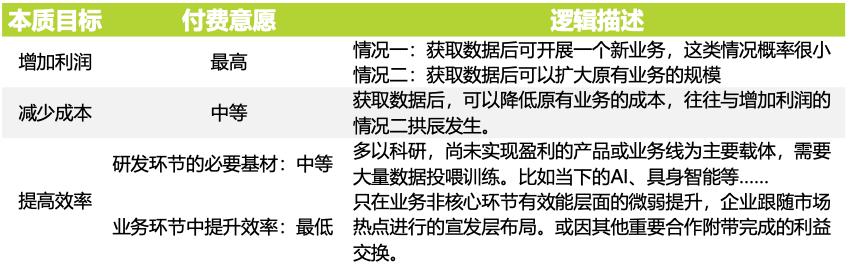
In principle, all three types of demands can facilitate transactions, but only the type that can actually increase profits and expand the original market functions can substantially promote data trading. The third type of "efficiency improvement" demand usually only occurs under the promotion of administrative purposes.
Although the current demand for data from AI and embodied intelligence is huge, in the eyes of sellers, it falls into the medium payment willingness tier of "necessary R&D materials", which has not yet been profitable and is mainly used for model training. In other words, demands with only such medium willingness are usually not enough to drive the actual occurrence of data transactions.
VI. Four-Step Pricing Method: The Value of Data Is "Calculated" Through A/B Testing
The report proposes that in seller-led transactions, the entire commercial link can be split into four steps, each step answering "how much is this batch of data really worth".
The first step, the seller sends personnel to be stationed on site to clarify the buyer's demands and develop models. Since buyers and sellers are mostly upstream and downstream in the industrial chain, the more deeply the seller understands the buyer's business model, the more efficiently the data will operate in the buyer's system. However, the report points out its hidden danger: this model is no different from traditional 2B services, which highly depends on the buyer's digitalization level, digitalization concept, and the attitude of senior management. If all three are poor, the effect of data implementation will be greatly reduced.
The second step is to inject data, and the buyer uses part of the business as a "test field" to run A/B testing. This is the core link for data pricing and the key to verifying whether data is useful. The evaluation indicators combine conventional sales models, including the pass rate and purchase rate of the two A/B groups. For long-cycle businesses, subsequent risk data and repurchase rate will also be monitored.
The third step is to calculate the profit difference between the two groups, determine the value of single data usage based on this, and evaluate the annual usage volume. This profit difference is the total result of the transaction between the two parties, and also the ultimate embodiment of the seller's data value. The difference between value and price depends on the profit-sharing negotiation between the two parties on the total profit.
The fourth step is to complete the transaction and carry out subsequent maintenance and upgrading. Model iteration and buyer business optimization will force sellers to adjust the initial model, which is also a continuous test of the seller's technical capabilities. After this process, the practical conclusion is: from the current market perspective, the proportion of profits that sellers can obtain is very low. There are two reasons: first, the final value output depends on the buyer's complete business chain, and data is only an auxiliary factor, so it is difficult to "take the lead" at the social level; second, data suppliers in mature fields face fierce competition. More subtly, a large amount of data is deposited on the seller's servers, which can be legally counted as assets on the balance sheet, but cannot bring direct benefits; at this time, even if the transaction is severely discounted, it is a real income for the seller, which further intensifies the involution among sellers. The only premise for extreme price reduction is the leap of the seller's technical capabilities: when the data remains unchanged, solving and calculating more information useful for the business is the key to opening up the market.
VII. Credit and Marketing: The Only Two Successfully Implemented Cases, and the Pricing Reality of "0.07 Yuan Per Call"
Theory needs to be reflected in practical cases. At present, the two fields that have truly successfully implemented data trading and achieved immediate results are financial credit (especially online credit) and marketing.
In the credit field, sellers are platforms that master user credit risk data from multiple platforms, and buyers are banks, consumer finance companies, and loan assistance platforms that carry out credit business. Most buyers and sellers are peers. In terms of processes, the seller is stationed on site to develop models and run A/B testing. What banks mainly focus on is the difference between the credit delinquency rate after using external data for risk control and the average delinquency rate of the platform. Because bad debts need to be accrued from net profit, a drop in the delinquency rate directly means an increase in profits, and this part of the increased profit is the "total pool" for negotiation between the two parties.
In principle, the profit-sharing ratio is 3:7 or 4:6 for sellers: buyers, but the report states directly: given the current fierce competition, this ratio has basically lost its reference value in industrial applications, and now most transactions are priced at a fixed price of about 0.07 yuan per data call. For comparison, the central bank's credit reporting system, which plays a core role in this field, charges banks 1 yuan RMB per call, which is much higher than the price of fintech companies. The call price of the central bank's credit reporting data is much higher than that of fintech companies, which precisely reflects its authority and scarcity.
In the marketing field, the logic is simpler: sellers are platforms that master basic user portraits and consumer data of netizens, and buyers are various advertisers. Model construction is often supported by the advertiser's existing system. What advertisers want is only the "reach effect calculated according to the model", and they do not care about the reach method and channel. A/B testing mainly focuses on the difference in sales success rates, so as to determine how much market scale the data has expanded for the company, and use it as a basis for profit sharing.
Why did these two fields succeed in implementation? The report gives three reasons, which are also transferable judgment criteria:
Perfect digitalization foundation — they are the fields with the most concentrated internet profits and the highest level of digitalization;
Fixed business model — data applications among peers are highly similar, upstream and downstream in the industrial chain are familiar with each other, the loss of model construction and business negotiation is small, and consensus is easy to reach;
Long application history — there is a strong top-down consensus within enterprises, many unimplementable details are followed by "established conventions", and administrative risks are small, which solves a big problem in current China.
From another perspective, these three points are exactly the "gap list" why other industries have been slow to implement data trading.
VIII. Customized Transactions Led by Buyer Demand Will Inversely Force Digitalization Upgrading
There is no one-size-fits-all universal model for data trading; in the short term, what can truly push it from concept to implementation is "customized data trading led by buyer demand".
Its logic is highly similar to that of SaaS. Both need to abandon the general product thinking and be oriented to the buyer's actual business scenarios: SaaS provides customized functions by adapting to enterprise processes, while data trading polishes data products according to the buyer's business logic. Both take the buyer's actual profit as the measurement standard.
A deeper ripple effect is that once this model becomes mainstream and is scaled up for replication, it will inevitably inversely drive the systematic upgrading of the digitalization foundation of various industries. Because the smooth implementation of data trading depends on standardized, high-quality, and interoperable data supply, while the fragmentation and non-standardization of digitalization in various industries is currently the main obstacle to model replication.
Here we need to distinguish two types of "digitalization": one is the current digitalization dominated by cloud service vendors selling products, and the other is digitalization driven by real demands. The latter is very likely to be the digital transformation that companies intending to develop data businesses carry out in their own business links after clarifying the real demands of target customers' business flows. Its cycle is very long, and it may even lose the market before forming business; but compared with the former, it is more in line with the real demands of industrial development. This also means that there is still a long way to go for ideal data trading: industrial development cannot only focus on immediate issues and stare at itself, because in today's era where industries intersect and resonate