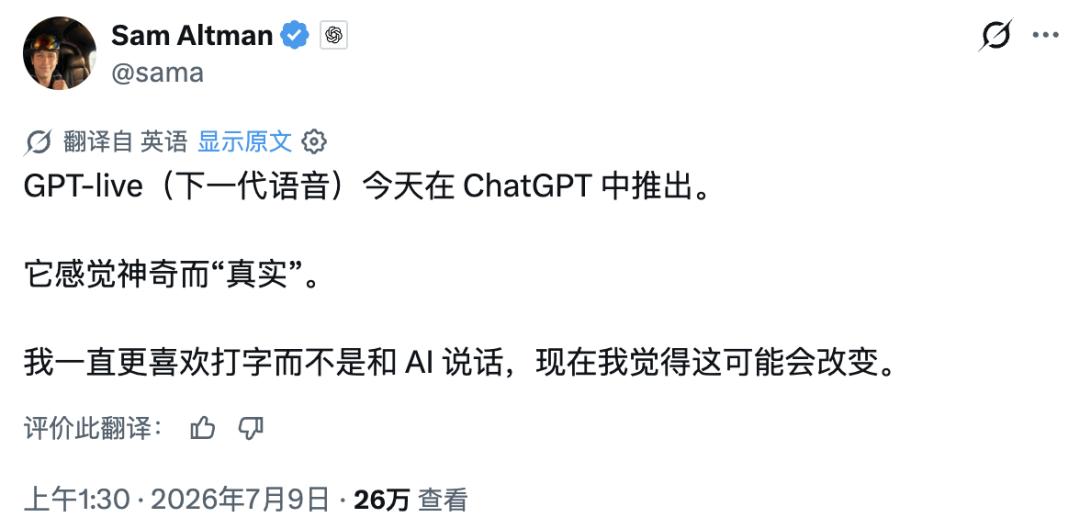
Just now, ChatGPT has received a major voice upgrade, and OpenAI's Sam Altman says: "It's both magical and real."
If you frequently use AI voice assistants, you've almost certainly experienced those infuriating moments that spike your blood pressure:
You pause for just a split second, and the AI rushes to interrupt you and start generating a response; or a burst of background noise is misinterpreted as you finishing your sentence. The entire conversation unfolds like a strictly turn-based "you speak, I respond" ritual.

To solve this exact problem, OpenAI has just officially launched its next-generation voice model, GPT-Live. True to its name, this update has fully brought ChatGPT's voice capabilities to life.
According to official disclosures, over 150 million people use ChatGPT's voice and dictation features every week to practice foreign languages, tell bedtime stories, or pass time during their commutes. Starting today, these 150 million users will experience a leap forward that redefines what AI conversations feel like:
The AI is no longer a cold, rigid question-and-answer machine. It becomes a "super assistant" that responds with natural cues like "mhmm" and "right" to keep the conversation flowing, waits patiently when you stumble over your words, and even quietly researches information in the background while casually chatting with you in real time.
Ditching Turn-Based Interactions: AI Finally Gets Emotional Intelligence
To understand how powerful GPT-Live is, we first need to see how "clunky" previous AI voice systems used to be.
In the early days (like the first generation of ChatGPT Voice), AI voice relied on a cascading system: you speak -> speech-to-text conversion -> large model generates text response -> text-to-speech conversion -> audio playback. Bouncing data between multiple separate models made the process frustratingly slow, and the tone came across as stiff and unnatural.
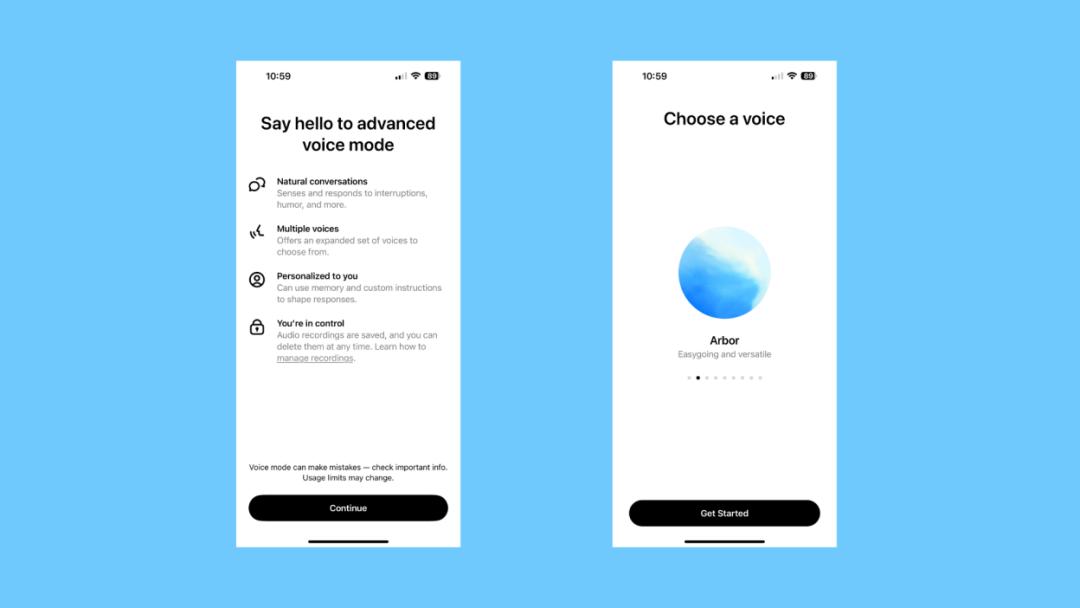
With the later Advanced Voice Mode, OpenAI built an end-to-end large model that processed audio streams directly. Latency dropped significantly, but it still suffered from a fatal flaw: it was locked to rigid turn-based interaction.
It had to monitor your voice nonstop, and as soon as it detected "silence", it assumed you had finished speaking and immediately started its own response. This silence-detection-based mechanism made it extremely vulnerable to being tricked by background noise.
The underlying architecture powering GPT-Live is called full-duplex architecture.
This means it can finally listen and speak at the same time. It's no longer a walkie-talkie — it works like a real phone call. Every single second, the model makes countless interactive decisions: should I speak now? Should I keep listening? Should I pause? Or should I gently interrupt the user?

Translated into real user experience, this change is a transformative leap:
It learns to use natural conversational cues: When you're speaking at length, GPT-Live won't stay completely silent. It will appropriately interject with phrases like "mhmm" and "got it". These tiny, natural feedback moments give you a strong sense of psychological comfort while you talk.
It knows when to stay quiet: If you say "let me think for a second", or clearly pause mid-sentence to gather your thoughts, it will pick up on that cue and wait patiently without interrupting.
Maximum noise resistance: Even if you're walking down a busy, noisy street with people talking loudly around you, it can accurately lock onto your voice and won't randomly cut you off due to unrelated background sounds.
Thanks to its ability to listen and speak simultaneously, it even excels at real-time translation: before you finish a sentence, it can already deliver the translated version, letting two languages flow seamlessly within the same conversation.
To match this unprecedented level of naturalness, OpenAI has completely remastered all 9 exclusive voice profiles in ChatGPT, making their expressive quality even more lifelike.
Chatting in the Foreground, Reasoning in the Background
If the full-duplex architecture only makes GPT-Live more pleasant to talk to, its second major underlying design overhaul reveals OpenAI's bold ambition for the future form of AI products.
In the past, we always expected a single model to handle everything: respond instantly, and solve complex calculus problems. But reality presented a harsh tradeoff — speed and depth are inherently conflicting when it comes to computing resources.
So OpenAI made an extremely smart design choice for GPT-Live: Decoupled architecture.
GPT-Live is purpose-built as a foreground interaction model, with its core mission being to keep conversations smooth and natural at all times.
When your query requires web-wide search, deep logical reasoning, or complex Agent task execution, GPT-Live will quietly offload that work in the background to OpenAI's latest state-of-the-art large model — the first model available for this background processing is GPT-5.5.
The most brilliant part is that while GPT-5.5 is busy crunching through complex calculations, GPT-Live never goes idle.
It keeps interacting with you using natural voice to keep you engaged, buying time for the background processing to finish. Once the reasoning result is ready, it seamlessly integrates that answer into the ongoing conversation. You can even adjust GPT-5.5's reasoning intensity based on your needs: pick Instant for maximum speed, or choose Medium or High for deeper, more thorough thinking.
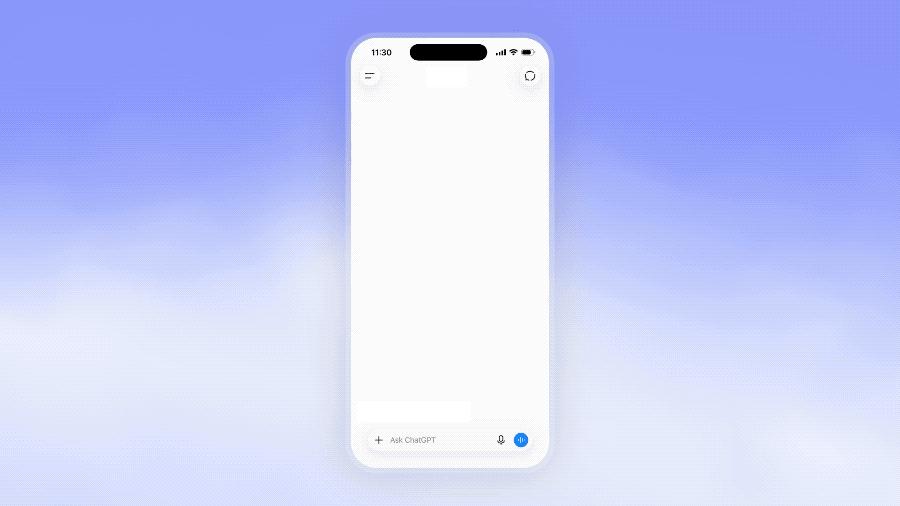
This design also lays a long-term strategic foundation: separating foreground chatting from background reasoning means the backend reasoning model can be upgraded at any time.
OpenAI has clearly stated that whenever a new state-of-the-art model is released, the model powering GPT-Live's background processing will be updated accordingly. Barring any unexpected changes, the GPT-5.5 series models will be launched very soon, and GPT-Live's release acts as the perfect forward outpost for this rollout.
The performance improvements from swapping out background models are immediately noticeable. In official blind tests where participants held 5 to 10 minute continuous conversations with different voice systems, GPT-Live-1 completely outperformed the previous Advanced Voice Mode with a 75.7% user preference rate.
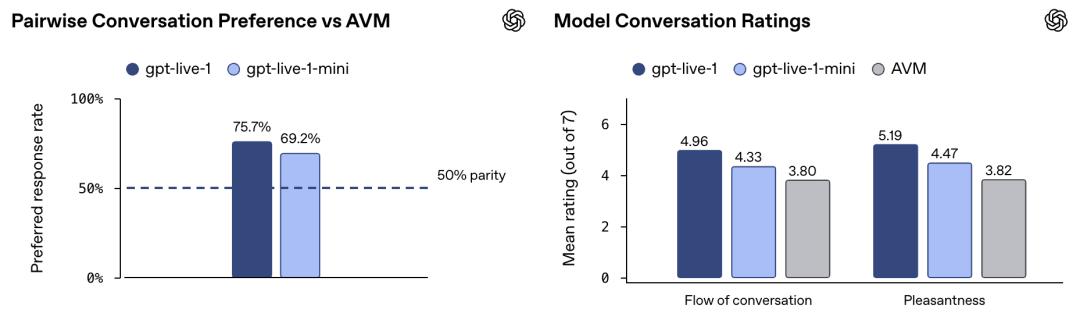
Even the scaled-down GPT-Live-1 mini scored a 69.2% preference rate. On a 7-point scale measuring "conversation fluidity", GPT-Live-1 earned 4.96 points, compared to only 3.80 points for the older Advanced Voice Mode.
On hard technical benchmarks, the gap is even more dramatic:
GPQA (expert-level physics, chemistry, biology reasoning): At the high-intensity reasoning setting, GPT-Live-1 achieved an 84.2% accuracy rate — nearly double the 45.3% score of the previous Advanced Voice Mode.
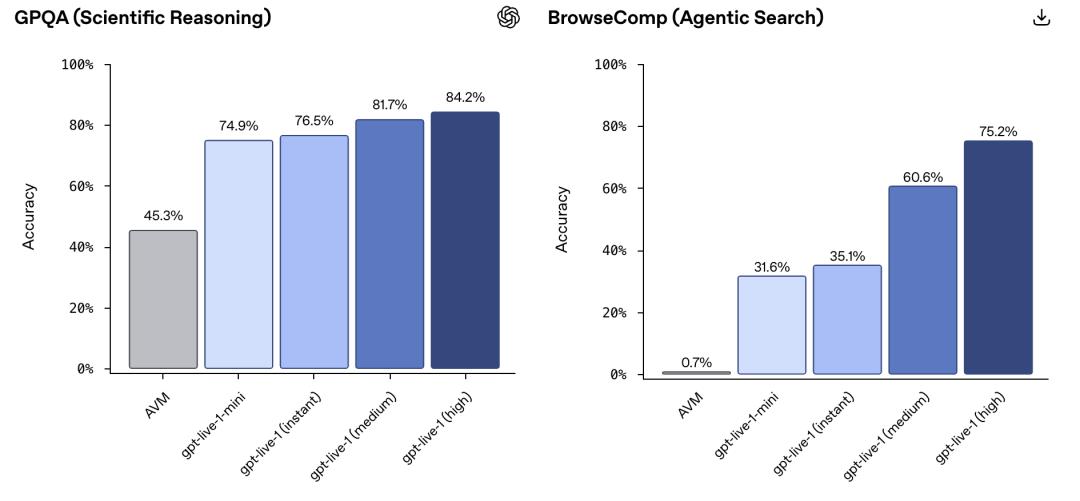
BrowseComp (complex web search and Agent capabilities): This is the most staggering improvement. The older Advanced Voice Mode only managed a pitiful 0.7% accuracy, while GPT-Live-1 reached a peak of 75.2% — jumping directly from "completely unusable" to "fully capable of getting real work done".
Internal Telecom test (multi-turn simulated customer service support): GPT-Live-1 also outperformed across the board in task success rates, demonstrating its potential as a voice-powered Agent for handling real-world business operations.
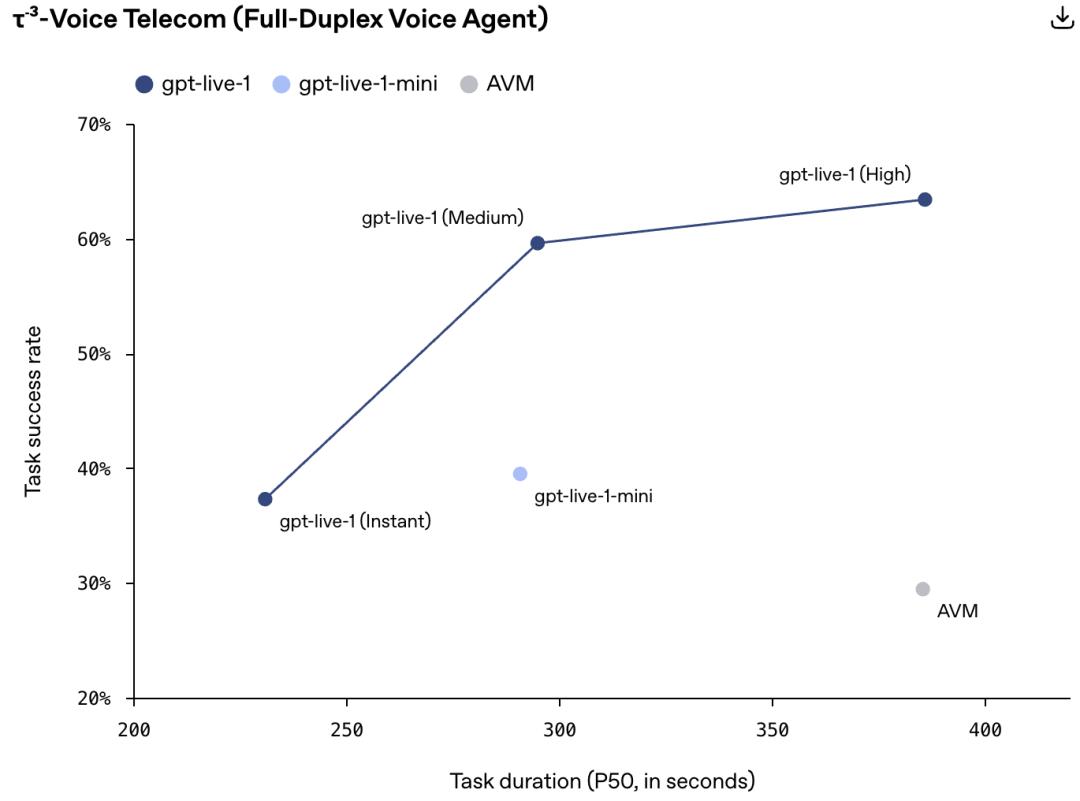
This separated foreground-background architecture not only resolves the long-standing tradeoff between low latency and deep reasoning, but also opens up massive business opportunities for developers. OpenAI has confirmed that an API version is coming soon, and developers and enterprises can already submit registration forms to get notified the moment it launches.
Voice Is No Longer Just Audio — It's a Brand-New Operating System
Beyond the audio experience upgrade, GPT-Live also introduces visual cards.
Pure voice output is often inefficient. Now, when you chat with GPT-Live, whenever you encounter information that benefits from visual presentation, rich visual cards will pop up directly on your screen.
Voice is no longer just an input method — it's evolving into a super entry point that unifies search, memory, image recognition, and document processing.
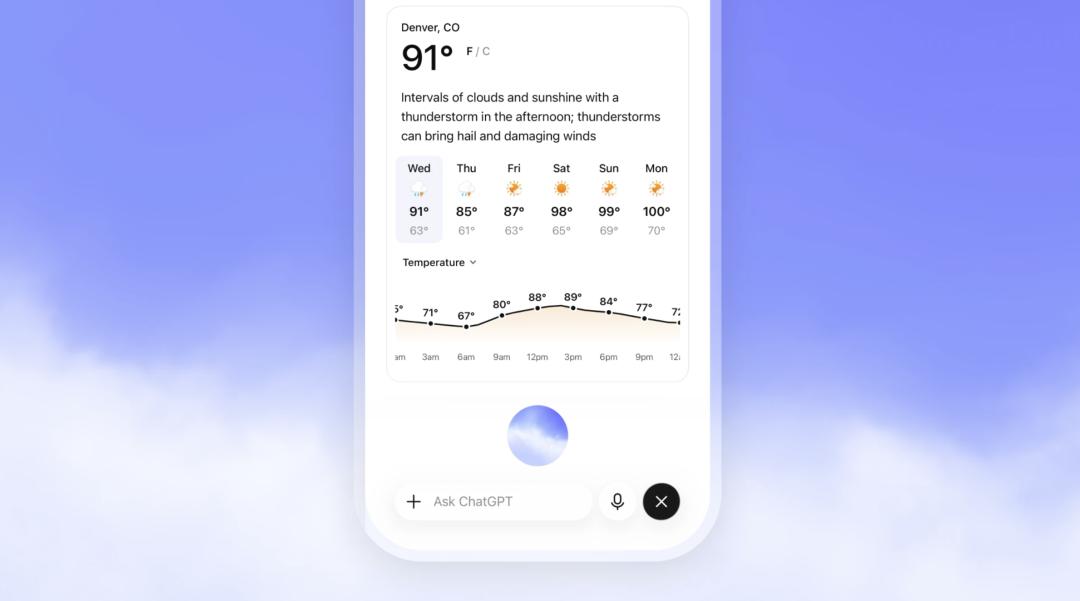
OpenAI makes no effort to hide this ambition: their official statement notes that this research will gradually unlock the ability to complete more complex, longer-duration, Agent-like tasks entirely through voice. Today it checks the weather for you; tomorrow it might make phone calls to handle official business on your behalf.
However, the more human-like an AI becomes, the greater the risks it carries.
In its official System Card, OpenAI dedicates extensive documentation to GPT-Live's safety measures. Because real-time voice interaction happens so quickly, traditional post-hoc content moderation simply cannot keep up.
To address this, OpenAI has introduced brand-new "native audio evaluation" and "synthetic data evaluation" systems, specifically designed with red-teaming exercises targeting harmful content. If the system detects the model generating dangerous speech, it can immediately steer the conversation toward a safe response, or in extreme high-risk scenarios, directly terminate the voice connection and push you to expert-vetted crisis intervention hotlines.
Additionally, for underage users, the system has built-in Parental Controls, and age-appropriate behavior guidelines are embedded directly at the model's core level.
Regarding widespread concerns about "voice cloning scams", OpenAI explicitly states: GPT-Live is strictly restricted to using only pre-defined official voice profiles, and will never offer functionality to impersonate real human voices.
Even more notably, OpenAI has established a long-term regulatory framework specifically to study "emotional dependency". Just like the movie *Her* depicts, when an AI's voice feels so authentic, and it responds to your sad moments with gentle, understanding "mhmm" cues, humans will inevitably form emotional attachments to it.

Right now, GPT-Live is rolling out globally to users on iOS, Android, and the web. Paid subscribers on Go, Plus, and Pro plans will get the full-power GPT-Live-1 by default, while free users will also get access to the GPT-Live-1 mini version. (Note: At launch, screen sharing and video calls are not yet supported on GPT-Live; you will need to switch back to the older voice mode to use those features.)
A quick small note: GPT-Live is currently optimized only for the most widely used languages on ChatGPT. In less-supported languages, it might speak with a distinct "foreign accent" and occasionally fail to convey your intended meaning accurately. OpenAI says they are working rapidly to expand language support.
Looking back over the past few years, our expectations for AI have been constantly evolving.
At first, we just wanted it to understand our commands and stop giving irrelevant answers. Later, we hoped it could help us write code, generate spreadsheets, and become a versatile productivity tool.
But today, when GPT-Live speaks softly in your ear with a natural, slightly paused tone saying "Yeah, I'm listening", you suddenly realize:
Rather than an omnipotent, god-like system, what we truly crave is someone who will never lose patience, who is always willing to listen, and who genuinely understands what you are saying. At the end of technology's relentless sprint, we ultimately return to the comfort of human connection.
Official blog post link:
https://openai.com/index/introducing-gpt-live/
This article originates from the WeChat public account "APPSO", authored by APPSO — the team that discovers tomorrow's innovative products — and is republished by 36Kr with official authorization.