Who is creating unicorns? Exploring the full capital landscape behind 19 star robotics companies
In the first half of 2026, China's robotics industry witnessed a concentrated wave of unicorn births.
The latest unicorn data from IT Juzi shows that in the first half of the year alone, 19 robotics/embodied intelligence enterprises were newly promoted to unicorn status (valued at over $1 billion), covering the entire industrial chain including humanoid robot complete machines, dexterous hands, vision systems, power systems, computing power platforms, and leasing platforms.
They include Zhisquare, Zilianbian, Qianxun Intelligence, Lingxin Qiaoshou, Jijia Shijie, Sudoo Technology, and others.
Among these 19 companies, some already have a monthly output of a thousand units and have settled in automobile manufacturing workshops; some have just completed industrial and commercial registration, with their teams not yet fully in place.
But the common point is — all of them have completed at least one round of financing at the 100-million-yuan level or above, and within the first half of the year, their valuations have all exceeded $1 billion.
The birth of a unicorn is never the sole achievement of an entrepreneur.
Behind the $1 billion valuation threshold lies a capital network composed of local governments, state-backed funds, internet giants, industrial players, top-tier VCs, securities firms, insurance capital, and even overseas sovereign wealth funds.
IT Juzi has broken down the investor lineup of these 19 new robotics unicorns one by one, to see exactly who is footing the bill for this robotics feast.
I. 19 New Robotics Unicorns
Overview of Investors
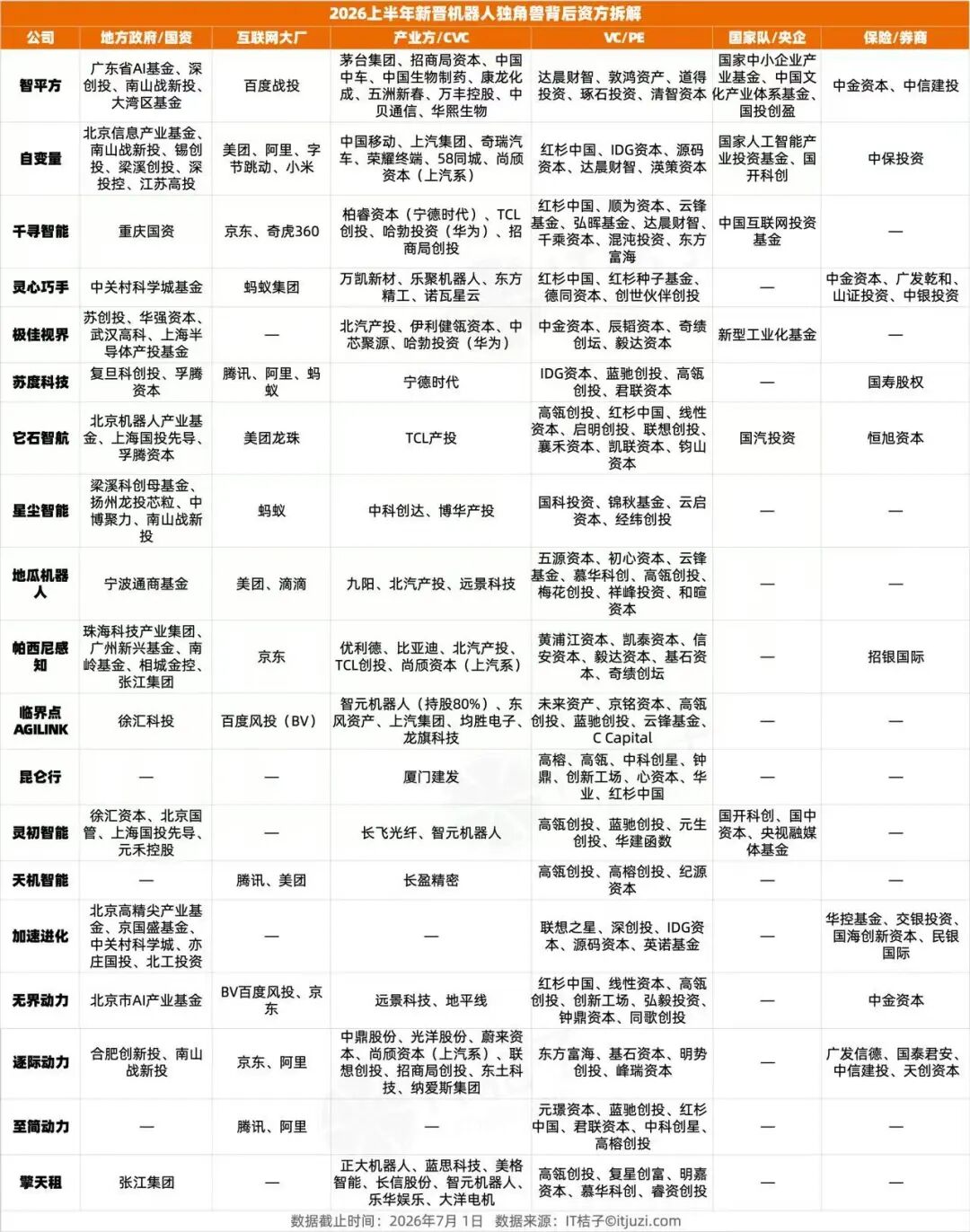
II. Local Governments and State-Owned Capital: 16 Backed by Local State-Owned Capital
At least 16 out of the 19 companies have received investments from local governments or state-owned funds.
This is one of the most notable features of the 2026 robotics financing boom — local governments are no longer just "offering policies", but directly "putting in real money".
Currently, only Kunlunxing, Tianji Intelligence, and Zhijian Power have not yet seen the presence of local state-owned capital.
Government investment funds can be divided into three tiers:
1. National-Level Funds
Six newly promoted unicorns have received investments from national-level funds: Zhisquare (National SME Industrial Fund, China Cultural Industry System Fund, SDIC Chuangying), Zilianbian (National Artificial Intelligence Industry Investment Fund, China Development Bank Tech Innovation), Qianxun Intelligence (China Internet Investment Fund), Lingchu Intelligence (China Development Bank Tech Innovation, Guozhong Capital, CCTV Converged Media Industry Investment Fund), Jijia Shijie (New Industrialization Fund), and Tashi Zhihang (China Automotive Investment).
The access criteria for national-level funds are the highest, which means the targets must have "strategic significance" rather than just "commercial prospects".
2. Provincial/Regional-Level Industrial Funds
This is the most active category of state-owned capital in the robotics track:
•Guangdong/Shenzhen: Guangdong AI Fund, Shenzhen Venture Capital, Nanshan Emerging Strategic Industry Investment, Guangdong-Hong Kong-Macao Greater Bay Area Series Funds → Heavy investments in Zhisquare, Zilianbian, and Zhujidongli
•Beijing: Beijing Information Industry Development Fund, Beijing High-End Precision Industry Fund, Jingguosheng Fund, Beijing AI Industry Investment Fund, Zhongguancun Science City, Yizhuang State Investment, Beigong Investment, Jingguorui → Investments in Zilianbian, Accelerated Evolution, Wujie Power, and Lingchu Intelligence
•Shanghai: Xuhui Capital, Shanghai SDIC Pilot, Zhangjiang Group, Xuhui Tech Investment → Investments in Lingchu Intelligence, Tashi Zhihang, Qingtianzu, Linjiedian, and Paxini
•Hefei: Hefei Innovation Investment → Zhujidongli
•Zhuhai/Guangzhou: Zhuhai Science and Technology Industry Group, Guangzhou Emerging Fund → Paxini Sensing
•Chongqing: Chongqing State-Owned Capital → Qianxun Intelligence
•Suzhou: Xiangcheng Financial Holding, Yuanhe Holdings → Paxini and Lingchu Intelligence
3. District/Park-Level Funds
Zhongguancun Science City Fund (for Lingxin Qiaoshou and Accelerated Evolution), Ningbo Trading Fund (for Digua Robotics), Nanling Fund (for Paxini), Liangxi Science and Technology Innovation Parent Fund (for Xingchen Intelligence), etc. These funds are relatively small in scale, but they represent the fierce competition among local governments to "retain enterprises" — the fact that Lingxin Qiaoshou stayed in Zhongguancun, Beijing, and Digua Robotics stayed in Shenzhen, all relies on the stabilizing role of park funds.
Key Finding: Local government investments follow a clear "geographic binding" logic — Shenzhen invests in local Shenzhen companies, Shanghai invests in local Shanghai companies, and Beijing invests in local Beijing companies. Very few companies like Zhisquare and Zilianbian have achieved cross-regional state-owned capital coverage, which in itself is a signal of a higher valuation ceiling.
III. Internet/Tech Giants: 11 Big Players Place Bets, Covering At Least 15 Unicorns
11 internet/tech giants have participated in the investment of at least 15 of the 19 unicorns. With the entry of corporate strategic investments, they bring not only capital, but also scenarios, data, and ecosystems.
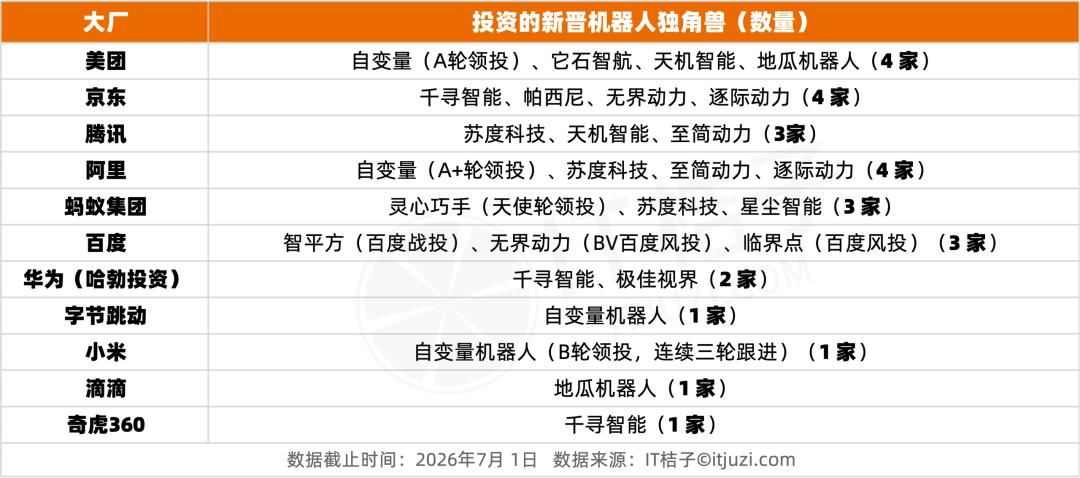
The Most Notable Phenomena:
1. JD.com is a grossly underestimated big-player investor. Previously, market attention focused on Tencent and Meituan, but IT Juzi's data shows that JD has actually invested in 4 companies — tied for first place with Meituan. JD's investments cover the entire robotics industry chain (complete machines, AI brain, dexterous hands, production lines), and its logistics scenarios have the most rigid demand for robots.
2. Huawei officially enters the market through Hubble Investments. This is a major signal previously ignored by the market. Huawei has invested in Qianxun Intelligence (humanoid robot) and Jijia Shijie (vision/world model), which means Huawei has begun to integrate robotics into its strategic landscape of "chips + operating systems + ecosystem". Combined with Huawei's layout in AI chips (Ascend) and operating systems (HarmonyOS), its capabilities in the robotics field go far beyond financial investment.
3. "Tencent + Alibaba investing in the same company at the same time" has become the new normal. Both Zhijian Power and Sudoo Technology have seen Tencent and Alibaba enter the market simultaneously. This was almost impossible in the past — the two giants were in a competitive relationship in most tracks. But in the field of embodied intelligence, they chose to "place bets together", which shows that the uncertainty in this track is so great that even giants need to diversify risks and form a joint encirclement.
4. Zilianbian is the only company that has gathered investments from all four big players. Meituan (led Series A), Alibaba (led Series A+), ByteDance, and Xiaomi (led Series B) — Zilianbian is the only embodied intelligence company in China that has obtained strategic investments from four internet giants at the same time. Xiaomi's strategic investment has followed up for three consecutive rounds, which fully demonstrates its determination. The signal value of big players collectively placing bets is extremely strong — they have the strongest scenario verification capabilities, and a company favored by all four has the highest possibility of obtaining orders in the future.
5. Meituan is the big-player investor with the clearest industrial logic. Zilianbian (AI brain), Tashi Zhihang (dexterous hands), Tianji Intelligence (robot body), Digua Robotics (computing power platform) — Meituan's investments cover the upper, middle, and lower reaches of the robotics industry chain, and each company can directly connect with Meituan's delivery/warehousing scenarios.
6. Ant Group led the angel round investment of Lingxin Qiaoshou, which is Ant's heaviest bet in the hardware field. Leading the investment of several hundred million yuan in the leading company of the dexterous hand track shows that Ant is no longer satisfied with following the trend, and has begun to make independent layouts on the core components of embodied intelligence.
IV. Industrial Players/CVC: Who Is Locking the Supply Chain with Capital
The depth of involvement of industrial capital (CVC) is an important indicator for judging the maturity of a track. IT Juzi's data shows that in the 2026 new robotics unicorn boom, the participation of CVC is unprecedentedly active — at least 17 out of the 19 companies have obtained investments from industrial players.
1. The New Energy/Automobile Industry Chain is the Most Active CVC Camp
The SAIC Group system is the most active automotive industrial CVC in this wave. Through direct investment and its subsidiary Shangqi Capital, SAIC Group has continuously placed bets on 4 unicorns:
The layout of the SAIC system covers AI brain (Zilianbian), dexterous hands (Linjiedian, Paxini), and complete machines (Zhujidongli), making it the single automotive industrial CVC with the widest coverage among the 19 unicorns.
Other automotive industry chain CVCs:
•BAIC Capital Investment: Simultaneously invested in Jijia Shijie, Digua Robotics, and Paxini (3 companies), which is the automotive CVC with the second widest coverage after the SAIC system.
•CATL: Invested in Qianxun Intelligence through Bairui Capital (founded by co-founder Li Ping), and directly invested in Sudoo Technology. CATL's logic is "both investor and customer" — Qianxun Intelligence's humanoid robot has operated flawlessly on CATL's battery production line for nearly a thousand batteries, and this production line itself has been verified by CATL with real money.
•BYD: Invested in Paxini Sensing. Another new energy vehicle company has entered the market, favoring the application of tactile sensing in automobile manufacturing.
•NIO Capital: Invested in Zhujidongli, representing the bet of new energy vehicle companies on humanoid robots entering automobile production lines.
•Zhongding Incorporated, Guangyang Incorporated: Invested in Zhujidongli, representing the transformation of auto parts enterprises to robotics parts.
•Joyson Electronics: Invested in Linjiedian, an auto parts enterprise extending into the dexterous hand direction.
•Eson Precision: Holds 27% of the shares of Tianji Intelligence, which is the highest shareholding ratio by an industrial player among the 19 companies — Eson Precision itself is a precision manufacturing enterprise, and investing in Tianji Intelligence is a strategic move to extend downstream.
2. Technology/Semiconductor Industry Chain
•Huawei/Hubble Investments: Invested in Qianxun Intelligence and Jijia Shijie (see the big players section above for details)
•Horizon Robotics: Invested in the angel round of Wujie Power, an AI chip enterprise extending into embodied intelligence
•SMIC PE, Shanghai Semiconductor Industry Investment Fund: Invested in Jijia Shijie, representing the optimism of domestic semiconductor capital on the robotics chip track
•ThunderSoft: Invested in Xingchen Intelligence, an intelligent operating system enterprise extending into robotics
•Kyland Technologies: Invested in Zhujidongli, an industrial internet enterprise entering the market
3. Consumer/Retail/Cultural Entertainment Industry Chain
•CP Group (CP Robotics): Invested in Qingtianzu, the global agriculture + food giant favoring the application of robots in agriculture/food processing scenarios
•Yili Group (Jianling Capital): Invested in Jijia Shijie, reflecting the food and beverage giant's demand for intelligent manufacturing
•Lens Technology, MEGA Technology, Changxin Incorporated: Simultaneously invested in Qingtianzu, consumer electronics supply chain enterprises extending into the robotics track
•Joyoung: Invested in Digua Robotics, a small home appliance enterprise's cross-border move into robotics
•Bloomage Biotech: Invested in Zhisquare, a medical aesthetics/biotechnology enterprise's cross-border move into robotics
•YH Entertainment Group: Invested in the angel round of Qingtianzu — an entertainment company crossing over to robotics, the most unexpected industrial player among the 19 companies
•Nais Group: Invested in Zhujidongli, a daily chemical enterprise entering the market
4. Telecommunications/Operators
•China Mobile: Invested in Zilianbian Robotics for two consecutive rounds, with the operator looking for an entry point for the "next-generation intelligent terminal"
5. Peers Investing in Peers
•Leju Robotics: Invested in the Series A+ round of Lingxin Qiaoshou — a humanoid robot complete machine enterprise investing in a dexterous hand enterprise, a typical case of mutual investment between upstream and downstream in the industrial chain
The investment logic of industrial CVCs is almost all "supply chain locking" rather than "financial return".
CATL's investment in Qianxun is for production line verification, BAIC's investment in Digua is for automotive-grade chips, and Eson Precision's 27% shareholding in Tianji is for manufacturing capability extension. The SAIC system's three consecutive rounds of investment in Zhujidongli essentially aims to lock in future robot suppliers for automobile production lines. This means these industrial players will actively provide orders and scenarios after investment — a "value-added service" that pure financial VCs cannot achieve.
V. Top-Tier VC/PE: Who Invests the Most and Places the Most Accurate Bets
Among the 19 unicorns, 4 VCs have invested in more than 4 companies, earning the title of "all-round investors".
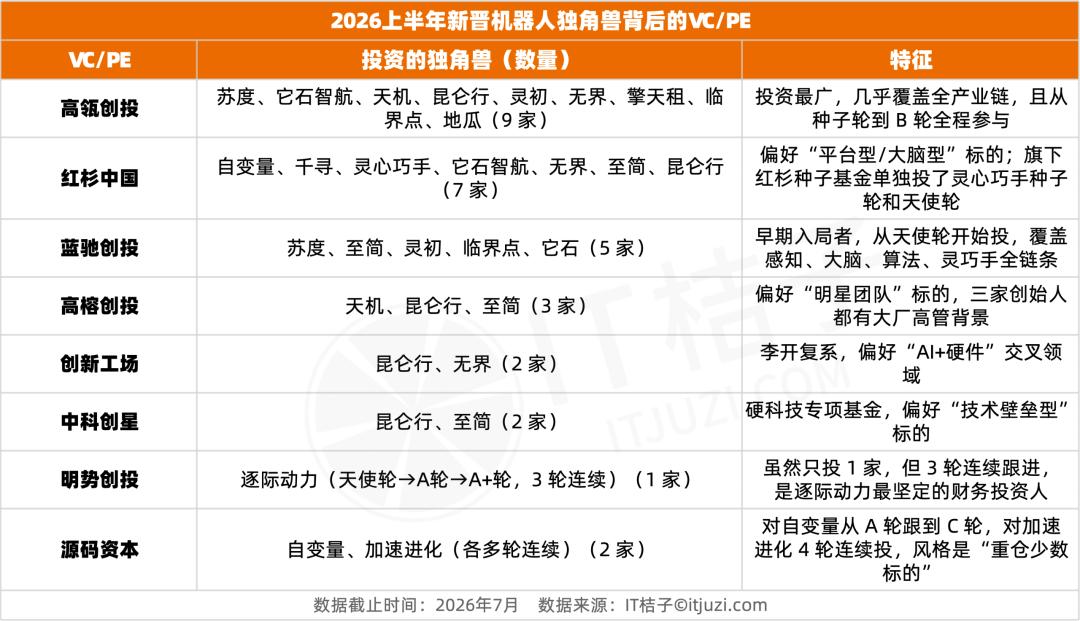
Hillhouse is the well-deserved top player in this wave of robotics investments. Hillhouse has invested in 9 companies, achieving almost "full coverage" — from complete machines (Tianji, Sudoo)