At Stanford, Witnessing the Hype and Reality of Physical AI
In 2026, robotics foundation model company Skild AI completed a $1.4 billion Series C funding round, pushing its valuation above $14 billion. This marks the largest single financing deal to date in the Physical AI (embodied intelligence) track.
The company's co-founder and CEO Deepak Pathak will appear at a summit at Stanford University next month. Sharing the stage with him will be Carnegie Mellon University emeritus professor Manuela Veloso — who founded RoboCup and previously served as Head of AI Research at JPMorgan Chase, representing three decades of accumulated academic expertise in robotics.
Pathak, by contrast, represents the newest generation: emerging from CMU's labs with the goal of building a universal intelligent brain for all robots.
One is a new-generation talent who chose to launch a startup after earning top academic honors, the other is a distinguished senior academician who moved from the academic world to Wall Street before returning to the forefront of industrial innovation. On July 12, these two generations will gather at Stanford to discuss "The Next Layer of AI".
Deepak Pathak holds nearly every top honor a young AI researcher could hope to earn: MIT TR35, PAMI Young Researcher Award, ONR Young Investigator Award, and Sloan Research Fellow. At CMU, his doctoral advisor was Turing Award winner Raj Reddy.
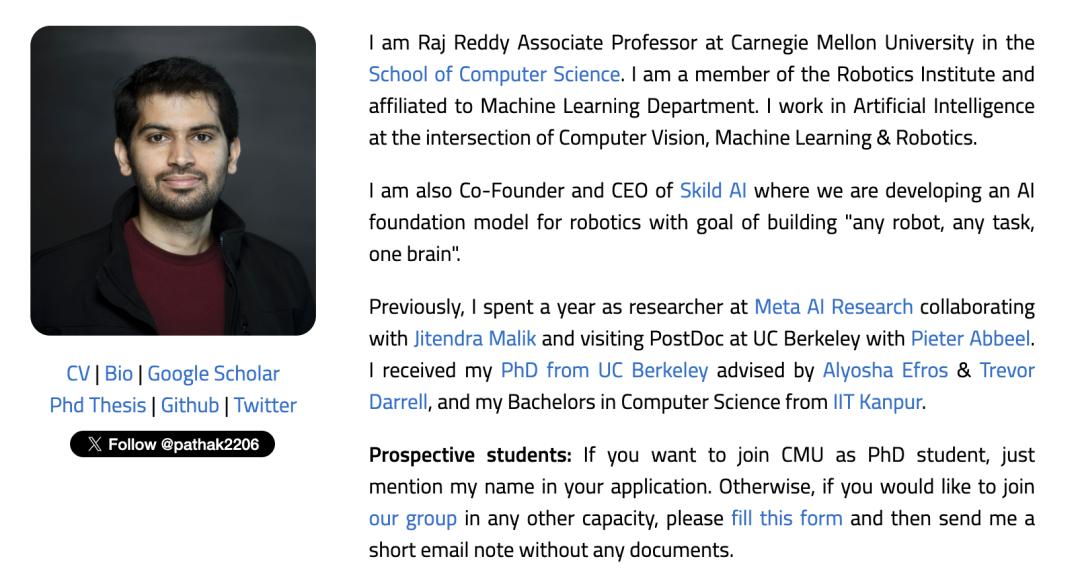
Deepak Pathak
Following a traditional career path, these accolades would have been more than enough to secure him a tenured faculty position at a top-tier university. Yet Pathak chose to build a company. Skild AI is developing a "universal robot brain" — a foundation model that, in theory, can adapt to any robot, any task, and any real-world environment.
The $14 billion valuation demonstrates that capital is willing to back this high-risk path. It also sends a clear signal: the Physical AI track is aggressively recruiting top AI talent at a significant premium. From OpenAI and Google DeepMind to Skild AI, the competition for robotics foundation models is fundamentally a competition for talent and data.
Manuela Veloso's career trajectory offers a different reference point. She spent 30 years conducting research at CMU, published over 400 papers, and founded RoboCup — the event known as the "World Cup of Robotics", with a long-term goal of fielding a fully autonomous humanoid soccer team capable of defeating the human World Cup champions by 2050.
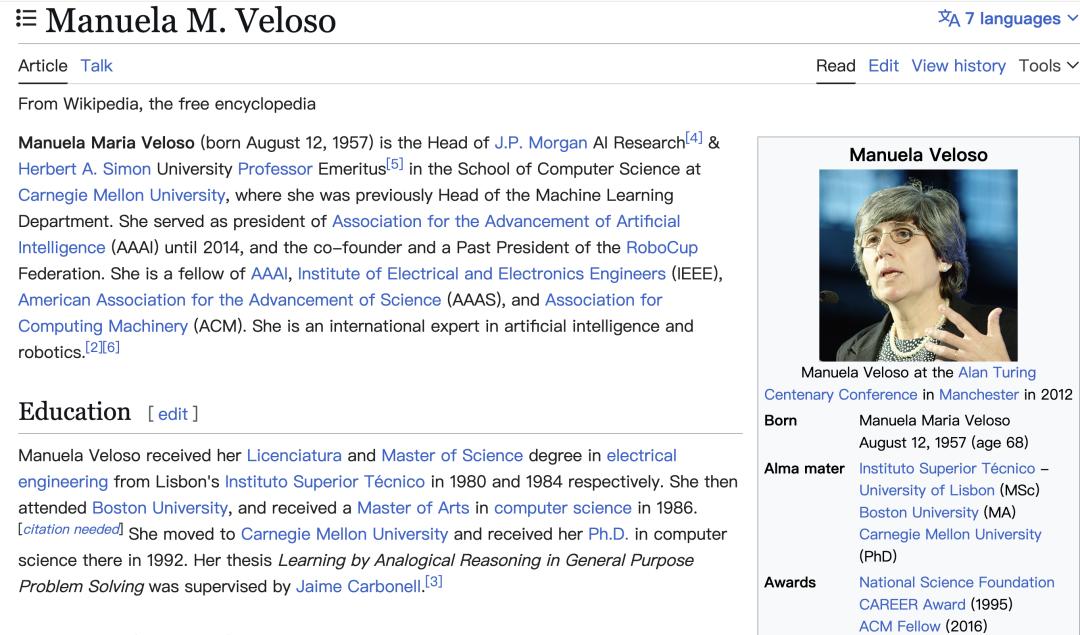
Manuela Veloso

RoboCup: The event celebrated as the "World Cup of Robotics"
Later, she joined JPMorgan Chase as Head of AI Research, translating her academic expertise into practical applications for the financial sector. Now she has returned to the intersection of academia and industry to share the stage with Pathak.
Their conversation may touch on a critical career-related theme: in the Physical AI era, career paths for robotics professionals are evolving from a binary "academia vs. industry" choice into a continuous spectrum where "academia is industry".
This summit is hosted by the AI Robotics Alliance of America (AIRA), with co-organizers including EPIC Connector, Titanium Media, Esee Vision, and Silicon Landing. The sponsor list includes Tencent, Aether AI, Starbot, and EAI Robotics — offering a glimpse into how leading Chinese tech giants are seeking technical footholds at key global Physical AI hubs.
The event also features a high concentration of Chinese researchers: Stanford University Assistant Professor Shuran Song (a global leader in embodied intelligence and robot vision), Jiajun Wu (one of the most prominent young researchers in embodied intelligence perception), and UCSD Assistant Professor Bivi Huang (founder of Aether AI), among others, are all confirmed attendees.
Beyond the intimate fireside chat between Pathak and Veloso, the summit will host multiple panel discussions covering embodied intelligence, world models, AI healthcare, and more. U.S. Representative Ro Khanna will discuss AI policy, Cisco President Jeetu Patel and Oracle VP Jun Qian will lead a conversation focused on "Enterprise Agents". Yuval Noah Harari, author of *Sapiens: A Brief History of Humankind*, will also deliver a keynote speech via pre-recorded video.
● © AIRA · Yuval Noah Harari, author of *Sapiens: A Brief History of Humankind*, delivers a dedicated message to attendees of this summit
For Chinese audiences, however, the true value of this summit may lie not in grand narratives about "where civilization is heading", but in a more tangible trend: as AI moves from behind screens into the physical world, capital, talent, and technology are being reconfigured at an unprecedented scale.
What does the commercialization path for robotics foundation models look like? Where will the required training data come from? When can we expect truly functional products to launch? The answers to these questions will shape the career trajectories of AI talent over the next five years.
*Workplace Bonus* will bring readers ongoing on-the-ground coverage of this summit, capturing key signals of emerging industry trends.
Below is the full speaker lineup and event agenda:
Humanity & AGI Summit 2026: Robotics for Future Civilization
Date: July 12, 2026
Venue: Stanford University
🎫 For readers interested in attending in person, we have secured an exclusive 15% off ticket link for *Workplace Bonus* readers directly from the organizers (we do not earn any commission from ticket sales, you may copy the link to access the official exclusive discount checkout page):
https://luma.com/wkolq6uc?coupon=BONUS

Speaker lineup and agenda are subject to on-site adjustments, please refer to the latest official announcements on the summit website for final details.
🎫 For readers interested in attending in person, the event organizers have opened a 15% off ticket link exclusively for *Workplace Bonus* readers (we do not participate in any revenue sharing from ticket sales, you may copy the link to visit the official dedicated discount ticket page):
https://luma.com/wkolq6uc?coupon=BONUS
This article originates from the WeChat Official Account "Workplace Bonus", written by Wang Ke, and is republished with authorization from 36Kr.