AI Agent does not lack applause; what it lacks is orders.
An AI coding tool was acquired by Elon Musk's SpaceX for $600 billion.
Three weeks ago on June 16, SpaceX disclosed in an SEC filing that it had signed a merger agreement with Anysphere, the parent company of Cursor, with the entire transaction paid in stock and expected to close in the third quarter. The $600 billion deal translates to over 4 trillion yuan. The company being acquired was founded only four years ago.
What Cursor received was not widespread acclaim, but a $600 billion offer sheet. Yet along this same timeline, many more Agent entrepreneurs are living out a different narrative. At product launches, their offerings appear almost omnipotent: writing code, researching information, handling customer service, screening resumes—acting like tireless digital employees. But once entering the procurement process, enthusiasm quickly fades: business teams call it "imaginative," IT departments ask "can it access our permissions," legal teams question "who is liable for errors," and finance teams inquire "how will billing work." In the end, the Agent that wowed the entire audience dies amid a polite line of "we'll think it over." No contract is signed, no budget is approved, and cash reserves dwindle day by day.

Research firm Gartner issued a stark verdict on this scenario: by the end of 2027, over 40% of AI Agent projects will be canceled. An even harsher estimate states that among the thousands of companies claiming to build Agents in the market, only about 130 actually possess genuine capabilities, while most others have merely rebranded older products under a new buzzword.
On one side stands the sky-high $600 billion transaction, while on the other side countless projects stall at the pilot phase. The question of "can this make money" already has an answer. The real question is: Why can't the acclaim most companies receive translate into actual orders?
I. First, Let's Look at Who's Cashing In
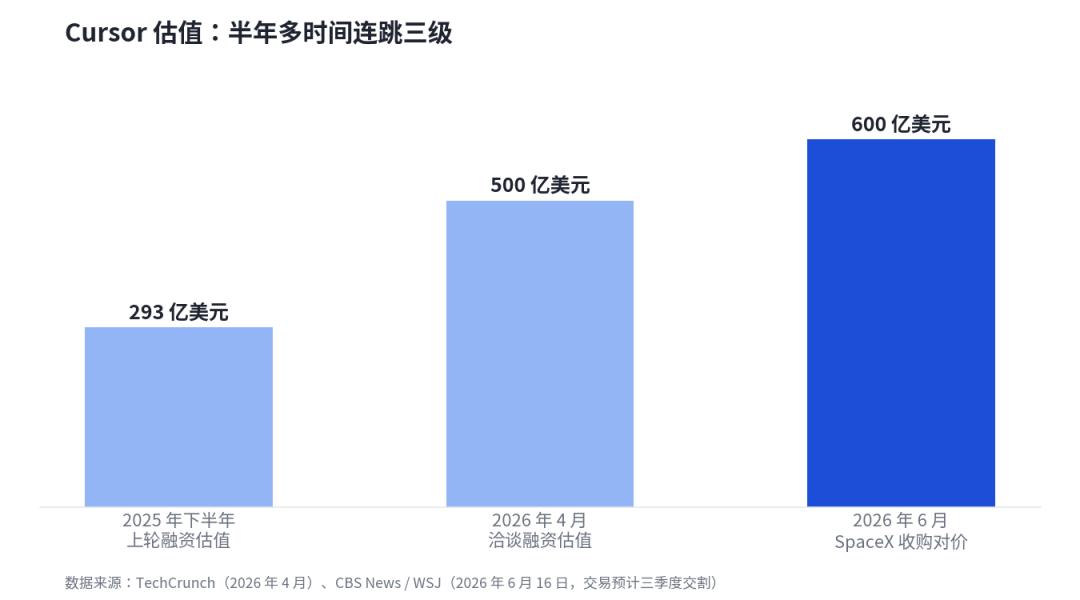
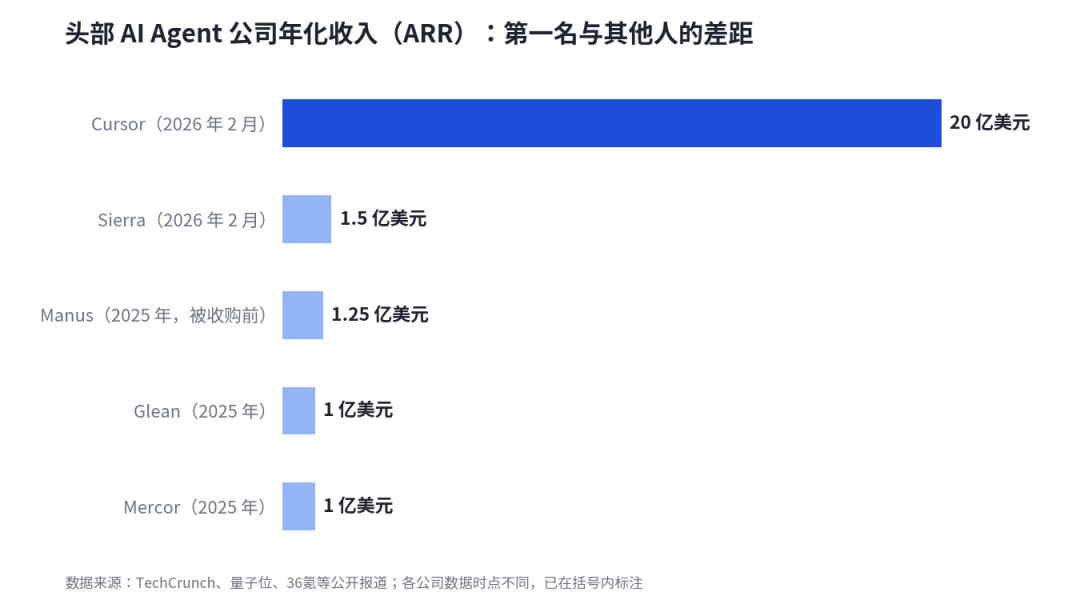
Why is SpaceX willing to pay $600 billion? According to TechCrunch, as of February this year, Cursor's annual recurring revenue (ARR) had reached $2 billion, with the company projecting it will exceed $6 billion by the end of the year—a threefold annual increase. Its valuation therefore jumped three levels in just over half a year: it stood at $293 billion in the second half of 2025, rose to $500 billion during financing negotiations in April this year, and was then fully acquired by SpaceX for $600 billion in June.
Coding is the first use case where Agents have achieved monetization; the second is customer service. Sierra, founded by former Salesforce co-CEO Bret Taylor, hit $100 million ARR in less than two years, which rose to $150 million by February this year; in May, it secured a further $950 million in funding at a valuation exceeding $15 billion. According to TechCrunch, over 40% of Fortune 500 companies are already its clients. The ones writing the checks are the largest corporations in the world.
Add to this list Mercor for AI recruitment, Glean for enterprise search, and general Agent company Manus— which reached a $125 million annualized revenue just 8 months after launch. It was acquired by Meta for approximately $2 billion at the end of last year. While that deal is currently being unwound due to regulatory review, no one has ever doubted the legitimacy of its revenue figures.
This list could go on even longer. In the second half of 2025, the investment circles circulated a third-party curated ranking of the "20 Most Profitable AI Agent Companies Worldwide" (figures not individually verified by each listed company), which revealed a far more interesting statistic than just "who is making money": the top-ranked company generates $3.2 million in revenue per employee annually, while the bottom-ranked company only manages $45,000—a 70-fold gap. This is just the disparity between companies that made the list; outside the rankings lies the silent majority.
These profitable companies operate in wildly different fields: coding, customer service, resume screening, file searching. But if you ignore *what* they do and only look at *how* they charge money, you'll discover three surprisingly consistent common traits.
II. Profitable Companies Have Mastered Three "Boring Little Things"
First: The work they do can be verified.
Imagine hiring a renovation team. If they say "we'll make your home more stylish"—would you sign a contract? Probably not. But if they say "we'll lay 80 square meters of tiles, perfectly level and aligned, no payment required if inspection fails"—you'd feel comfortable signing.
Cursor sells code that either runs correctly or doesn't. Sierra sells "resolved customer service tickets," with resolution rates explicitly written into contracts. Mercor sells candidates that get hired. Clients don't need to "trust AI"—they just need to verify the deliverable.
Kunlun Wanwei CEO Fang Han stated at the end of 2025 that the next critical technological battleground is whether Agents can automate "verifiable processes" at scale. Translated plainly: only work that can be inspected gets assigned to AI; only work that can be inspected generates revenue.
There are already success stories of this. Brazilian digital bank Nubank, which has 130 million users, published results from its customer service Agent in a research paper: in the scenario of reissuing bank cards, AI-powered service delivered a 37-point higher NPS (Net Promoter Score) than the control group, with a 29% higher rate of issues resolved without human agents. When metrics improve, budget justifications become straightforward—it's that simple.
Meanwhile, failed projects typically pitch themselves as "supporting management decision-making" or "improving organizational efficiency" during demos. These sound impressive, but how do you verify "decision support"? How do you measure "efficiency"? Demos don't require acceptance criteria, but contracts do.
Second: The billing method aligns with the cost structure.
Agents consume massive computing power, which translates directly to real costs. The industry bills by tokens—think of it as the electricity meter for the AI world: every time an Agent "thinks," the meter ticks up.
Sierra's billing model is therefore clever: no fixed annual fees, instead charging per "resolved ticket." More tickets mean more computing power consumed, but revenue rises in lockstep. Income and costs are tied together, avoiding the absurd scenario of "the more business we get, the more money we lose."
By contrast, many stuck companies follow traditional software pricing models, charging annual fees "per user." But Agents' core selling point is *reducing* the number of employees a company needs. Selling a "headcount-saving" product on a per-head basis leaves clients unable to quantify what they're paying for, and vendors unable to forecast their computing costs. Both sides are confused, and contracts never get signed.
Third: They know exactly who is paying, and that budget already exists.
Cursor taps into companies' pre-existing R&D budgets. Sierra replaces pre-allocated customer service outsourcing expenses. Mercor captures fees that would otherwise go to headhunters. These are recurring annual expenditures, and Agent companies simply divert that existing budget stream.
Many general Agent products, however, require clients to create entirely new budgets specifically for "AI transformation." In 2026, when every company is focused on cost reduction and efficiency, waiting for a new budget to work its way through approval processes often means startups will run out of cash before the money arrives.
These three points boil down to one simple truth: An Agent's value doesn't increase by being more human-like—it increases by being more like a product that fits onto a procurement list. This runs directly counter to the popular industry narrative of "universal digital employees."
III. Between "Wow" and Payment Lie Three Barriers
Having looked at the winners, let's examine where most companies get stuck.
Consider the most widely cited statistic in this industry: MIT released a report in August 2025 stating that 95% of enterprise AI pilot projects fail to deliver measurable returns. While the methodology behind this number is debated and may not be perfectly accurate, no one in the industry disputes that "most pilots die before generating revenue." Why?
First barrier: Demos showcase the best-case scenario; production reveals the worst-case scenario.
At a product launch, an Agent with 90% accuracy is enough to win applause. But deploy it in a finance department, and 1 in 10 numbers will likely be wrong—with no way to tell which ones. That forces employees to manually verify every single result. The labor supposedly saved by AI is entirely spent double-checking AI outputs, making the overall equation worse than before.
Worse still, raising accuracy from 90% to 99% doesn't just cost 10% more—it requires several times the investment in error prevention and correction. Currently, no client is willing to fully cover that cost. Most pilot projects quietly die for exactly this reason.
Second barrier: Who is liable when things go wrong?
What happens when AI processes an unauthorized refund, or overlooks a critical risk clause in a contract? Who pays for the resulting losses? Traditional software has clearly defined liability clauses for failures, but most Agent contracts lack an entire section addressing "compensation for underperformance." Without that section, enterprise procurement and legal teams will never sign off. You can clap at a demo, but payment requires a signature.
Third barrier: The numbers don't add up.
As mentioned earlier, per-user pricing doesn't work for Agents. It's worth noting that even industry giants are hitting this wall—Salesforce, Microsoft, and others are completely rethinking their pricing models. The difference is that giants can afford the cost of trial and error, while startups cannot.
These combined issues pull Agents from the demo stage back to the reality of contract negotiations. Over the past year, AI's capabilities haven't failed—what's failed is the entire supporting framework around those capabilities: how to verify work, who pays for mistakes, and how to bill. Many Agents fail to monetize not because their demo isn't impressive enough, but because a viable contract cannot be written.
IV. Even Generating Revenue Doesn't Guarantee Profitability
But even after revenue starts flowing, the problems aren't over. Some companies that manage to clear all three barriers still find their bottom line in the red.
Traditional software is a great business because selling an additional copy costs almost nothing, leading to gross margins of up to 80%. Agents are different: every time you serve a customer, the "electricity meter" keeps ticking. Multiple analysis firms have repeatedly emphasized this year: AI companies' gross margins are generally far lower than those of traditional software vendors.
The most illustrative example is the very company that's been most successful. According to TechCrunch, Cursor's enterprise business has already turned profitable, but its consumer-facing business is still losing money. The logic is simple: individual users pay a fixed monthly fee, but computing costs scale with usage—the more heavy-duty users code, the more money Cursor loses. The misalignment described in the second section becomes painfully real here: when pricing doesn't match cost structure, scaling operations only widens the gap. Even the industry leader relies on funding to subsidize consumer users, so the financial situation of smaller companies is easy to imagine.
That's why "outcome-based pricing" has evolved this year from a niche experiment to an industry lifeline: shifting billing units from "number of accounts" to "number of tasks completed" ties costs directly to revenue. The constraints of inference costs are forcing this generation of AI companies to master financial discipline far earlier than the previous generation of software companies—and that financial competence is becoming a more critical threshold than technical prowess.
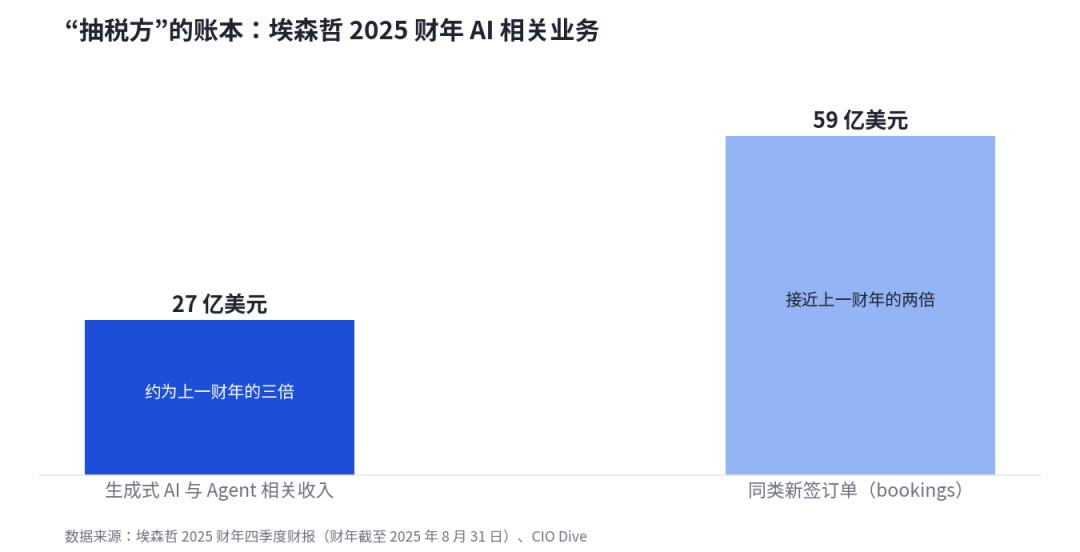
There's another layer of costs further upstream: for every dollar an application company earns, a portion has already been siphoned off. Computing power and model vendors take their cut first; at the "last mile" of enterprise deployment, consulting firms and system integrators take another slice—after a client becomes impressed by an Agent, their first big payment often goes to firms like Accenture to help rework systems and enable integrations. In its 2025 fiscal year, Accenture generated $2.7 billion in revenue from generative AI and Agent-related services alone—roughly triple the previous year's figure. A significant portion of the "deployment" success stories startups pitch to investors actually end up in other companies' income statements.
Looking back at Manus: according to its official disclosures, the platform has processed over 147 trillion tokens and spun up 80 million virtual machines. No matter which application providers survive or fail, the "electricity meter" keeps running. For applications to survive, there's only one path: every unit of computing power consumed must correspond to revenue that can be collected.
Epilogue
The rules of the AI Agent game have fundamentally shifted. In 2024, impressive demo videos drove traffic; in 2025, compelling financing stories drove valuations; but by 2026, the market truly cares about one thing: who can sign contracts, collect payments, and convert revenue into actual profits.
So why do orders only land in the hands of a few companies? Because winning orders never depends on having the most dazzling demo—it depends on being the first to master those three "boring little things": verification, accounting, and budget alignment.
If you're an entrepreneur, you can test your business with three questions: Can your customers verify the work your product does? Does your billing model align with your cost structure? Is the money your customers pay coming from an existing budget, or do they need to create a new one just for you? If you can answer "yes" to all three, there's a path forward even if the barriers are high. If you answer "no" to any one, no matter how impressive your demo is, it remains just a demo.
One final note: clearing these three barriers once doesn't guarantee permanent safety. Every time upstream vendors adjust model pricing, the height of these barriers changes. Getting past them earns you a ticket to the game—but staying on top is where the real business happens.
Even the best demo only proves something "looks usable." Before clients write a check, they need clear answers to: how to verify results, how to calculate costs, and who takes responsibility for errors.
This article is from the WeChat public account "Qidian Wai", author: wiwi, published with authorization from 36Kr.