Eve of Listing | A PhD Candidate at Harbin Institute of Technology Rushes for Hong Kong Stock Exchange IPO with a Market Value of Tens of Billions, Only One of the Three Founders Remains
This article is approximately 3,600 words long. It is recommended that you spend 8 minutes reading it.
Author | Peng Xiaoqiu
Editor's note: The "On the Eve of Listing" column focuses on the critical moments when companies sprint into the capital market. Every prospectus hides a company's ambitions, business cycles, and concerns before going public. This is the second installment— Beijing Rock Robotics Co., Ltd.
At 10 a.m. on July 6, the Hong Kong IPO offering of Beijing Rock Robotics Co., Ltd ended. The IPO was priced at HK$38 per share, with a board lot of 100 shares, corresponding to a market capitalization of HK$9.946 billion. The total funds raised were HK$875 million, and five cornerstone investors subscribed for 31.4% of the shares.
Beijing Rock Robotics Co., Ltd's IPO journey was not smooth. As early as December 2024, it signed an A-share listing guidance agreement with Guotai Junan and Haitong Securities. However, in August 2025, it voluntarily halted the A-share listing process and turned to the Hong Kong stock market. Interestingly, although its headquarters is located in Zoucheng, Jining, Shandong, the founding team hails from Beijing.

Three consecutive years of losses, but the operating losses are rapidly narrowing
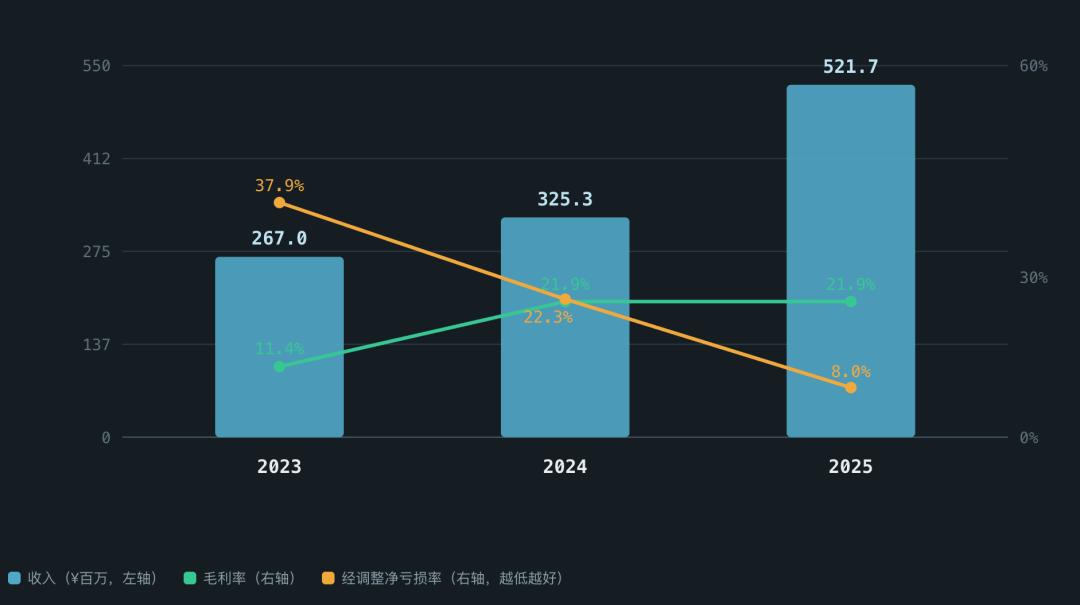
Beijing Rock Robotics Co., Ltd's revenues from 2023 to 2025 were RMB 267 million, RMB 325 million, and RMB 522 million respectively, with a compound annual growth rate of approximately 39.8%. In 2025 alone, the revenue increased by 60.4% year-on-year, showing rapid growth.
(Image source/Compiled by Yingke)
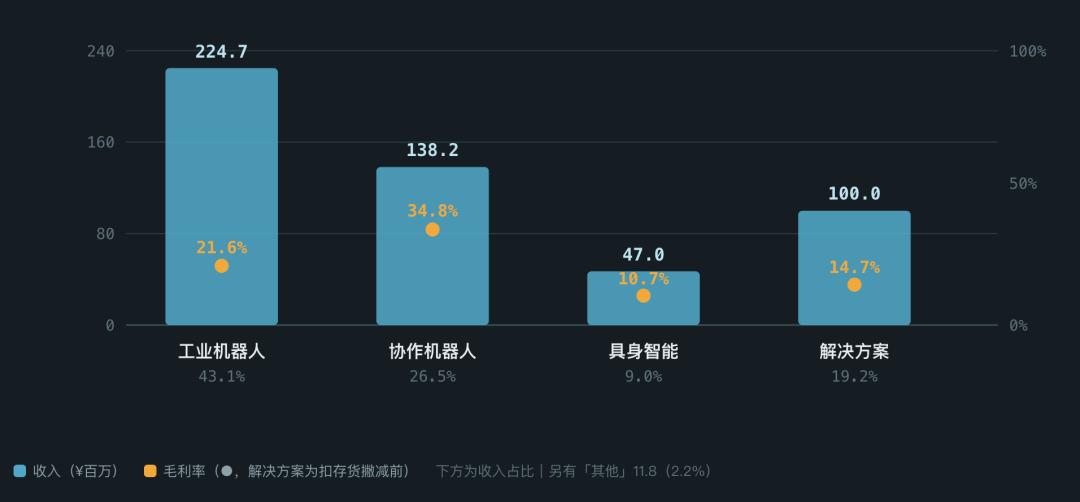
Its revenue consists of two parts: robot product sales and robot solution services. In 2025, the sales of robot products reached RMB 410 million, accounting for 78.6%, while the solution services generated RMB 100 million, accounting for 19.2%. The robot product segment can be further divided into three categories:
Industrial robots generated RMB 225 million in revenue (accounting for 43.1%), which is the company's core business. Among them, the revenue from light-load robots was RMB 197 million, making it the dominant product;
Collaborative robots generated RMB 138 million in revenue (accounting for 26.5%), which is Beijing Rock Robotics Co., Ltd's distinctive product;
Embodied intelligent robots generated RMB 47.01 million in revenue (accounting for 9.0%). The revenue soared from RMB 2.76 million in 2023 to RMB 47.01 million in 2025, more than 16 times in two years, making it the fastest-growing new engine.
(Image source/Compiled by Yingke)
However, the other side of growth is gross profit. Beijing Rock Robotics Co., Ltd's overall gross profit margin in 2025 was only 21.9%, which is not high among robot companies. Breaking it down:
The gross profit margin of industrial robots was 21.6%. In 2025, due to intensified competition and price pressure from a few customers, the average price decreased significantly, and the gross profit margin also slightly declined;
The gross profit margin of collaborative robots was 34.8%, which is the most profitable among the three categories and has been increasing year by year;
The gross profit margin of embodied intelligent robots plummeted from 30.6% in 2024 to 10.7% in 2025 - because the AR series of humanoid force-controlled arms, which were promoted in 2025, were fulfilling large orders. The early production process was immature, and the unit cost was high, which dragged down the overall performance.
An counterintuitive detail: Beijing Rock Robotics Co., Ltd has a much higher gross profit margin overseas. In 2025, the gross profit margin of the overseas market was 47.1%, more than twice that of the Chinese mainland market (20.7%). However, the overseas revenue in 2025 was only RMB 46.6 million, accounting for 8.9%, which is not enough to support the overall business.
Therefore, Beijing Rock Robotics Co., Ltd relies on industrial robots to build its basic business volume, collaborative robots to generate gross profit, and embodied intelligent robots to tell the growth story. Each of the three business segments has its own advantages, but also its own weaknesses - industrial robots are in a price war, embodied intelligent robots are sacrificing gross profit for scale, and the high-gross-profit overseas market is still too small.
Beijing Rock Robotics Co., Ltd reported losses of RMB 157 million, RMB 192 million, and RMB 179 million in 2023, 2024, and 2025 respectively, with a total loss of over RMB 500 million in three years. However, if we break down the losses, we will find that the core reason is not the operation: The financial costs were RMB 69.3 million, RMB 100 million, and RMB 120 million in the three years respectively, and most of them were the interest on redeemable liabilities.
According to the adjusted figures disclosed by Beijing Rock Robotics Co., Ltd: After excluding items unrelated to the main business such as the interest on redeemable liabilities and share-based payments, the adjusted net loss narrowed from RMB 101 million in 2023 to RMB 72.468 million in 2024 and RMB 41.672 million in 2025. The corresponding adjusted loss rates decreased from approximately 38% in 2023 to approximately 22% in 2024 and approximately 8% in 2025 (calculated by dividing the adjusted loss by the annual revenue).
As the company scales up, the cost is reflected in the working capital. Beijing Rock Robotics Co., Ltd The days sales of trade receivables increased from 131 days in 2023 to 181 days in 2024 and then decreased to 165 days in 2025. The prospectus states that in order to penetrate new markets and attract and retain customers, the company extended the credit period for customers with good credit from a maximum of 90 days to a maximum of 180 days. Although the company managed to reduce the days sales of trade receivables in 2025 by strengthening collection efforts, a 165-day payment term means that for every RMB 1 of goods sold, it will take about half a year to receive the payment.
Correspondingly, the absolute value of accounts receivable has increased from RMB 117 million to RMB 267 million in the past three years, and the inventory has increased from RMB 99 million to RMB 195 million. The days payable outstanding has also increased to 164 days, which has partially offset the capital occupation. Beijing Rock Robotics Co., Ltd has also clearly stated in its cash flow improvement measures that it will use acceptance bills and letters of credit to extend the payment terms for suppliers. Behind this strategy is the use of the payment terms of upstream and downstream partners to maintain the company's operation.
Beijing Rock Robotics Co., Ltd has had negative cash flows from operating activities for three consecutive years: The cash outflows were RMB 95.233 million, RMB 120 million, and RMB 77.52 million in 2023, 2024, and 2025 respectively. Its ability to generate cash has not been stably established.
Even more striking is the year-end cash balance: It plummeted from RMB 451 million in 2023 to RMB 21.81 million in 2024 and only RMB 14.8 million in 2025. The prospectus explains that the sharp decrease in cash is mainly due to the increase in financial asset investments and time deposits measured at fair value, which led to a decrease in bank deposits. This is in line with the company's cash management policy.
In other words, Beijing Rock Robotics Co., Ltd has moved its idle funds into wealth management products and time deposits. As of the end of 2025, it actually held cash of RMB 14.8 million, demand time deposits of RMB 134 million, and short-term wealth management products of RMB 232 million. The total is approximately RMB 380 million, of which more than 70% can be redeemed at any time or will mature within one month. In addition, it has non-current time deposits of RMB 121 million and available bank credit of approximately RMB 60 million. Based on this, the directors and sponsors have judged that the existing resources are sufficient to support the company for about two years, and if the net proceeds from the fundraising are included, it will be about four years.

Ten rounds of financing in ten years, only one of the original founders remains
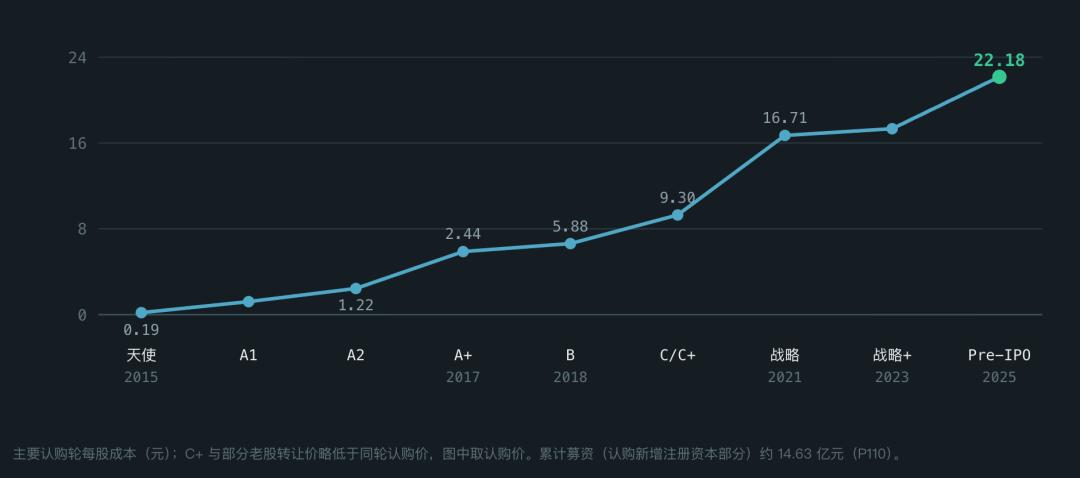
Since the angel round in 2015, Beijing Rock Robotics Co., Ltd has completed ten rounds of financing, including the angel round, A1 round, A2 round, A+ round, B round, C round, C+ round, strategic round, strategic+ round, and finally the Pre-IPO round in 2025. The total funds raised from the subscription of new registered capital alone reached approximately RMB 1.463 billion.
Angel round (May 2015) Xizang Meiling entered the company at a price of RMB 0.19 per share;
A2 round (May 2016) The price per share was RMB 1.22;
A+ round (September 2017) Tsinghua Unisplendour Ginkgo Venture Capital entered the company at a price of RMB 2.44 per share;
B round (July 2018) GSR Ventures, Bosch Ventures (Sinobo Capital), Achiever Ventures, etc. participated in the round at a price of RMB 5.88 per share;
C round (August 2020) XH Fund (Xianghe Capital), Su Xiang participated in the round at a price of RMB 6.63 per share;
C+ round (May 2021) Shenzhen Capital Group, Yitang Capital, Yuanyi Yongxuan participated in the round at a price of RMB 9.30 per share;
Strategic round (December 2021) Southern Hope, a subsidiary of New Hope Group, invested RMB 277 million at a price of RMB 16.71 per share;
Strategic+ round (2023) National Manufacturing Transformation and Upgrading Fund invested RMB 400 million at a price of RMB 17.33 per share;
Pre-IPO round (June 2025) Pinghu Jinluo invested RMB 195 million at a price of RMB 22.18 per share. Other institutional investors include Tianqi Zefeng, Quanzhou Shanyue, Yankuang Capital, Yixing High-tech Zone, Zhang Yong... The cost per share ranges from RMB 10.44 to RMB 22.18.
(Image source/Compiled by Yingke)
The cost per share has increased by approximately 117 times from RMB 0.19 in the angel round to RMB 22.18 in the latest round. Pinghu Jinluo, which entered the company in 2025, has the most expensive entry ticket.
Behind the investors is a typical lineup of industry players, state-owned enterprises, and star VCs:
National Manufacturing Transformation and Upgrading Fund - The largest institutional shareholder, holding 9.67% of the shares and making a single investment of RMB 400 million. Its largest shareholder is the Ministry of Finance, and Yu Shihua, a non-executive director on the board, comes from this fund;
New Hope Group - Southern Hope, controlled by Liu Yonghao, holds 6.96% of the shares and entered the company in the strategic round;
Shunwei Capital - Founded by Lei Jun and Xu Dalai, Shunwei Capital holds 6.44% of the shares through "Golden Growth III" (which took over the B-round shares from Achiever Ventures);
Bosch Ventures - Bosch, a global automotive parts and industrial giant, entered the company in the B round through Sinobo Capital, which is led by its Shanghai venture capital arm;
Shenzhen Capital Group - Entered the company in the C+ round and holds approximately 2.91% of the shares;
Plum Ventures (Wu Shichun) - One of the earliest angel investors and still holds shares in the company;
GSR Ventures (Pan Xiaofeng's group) - Has repeatedly increased its investment through multiple funds such as GSR III, Pinghu Jinluo, and Jiaxing Yuanshi;
Far East Horizon (Yuanyi Yongxuan), TR Capital, Xianghe Capital... And a long list of local state-owned enterprises in Shandong/Jining: Shandong Zhengfang, Zoucheng New Kinetic Energy, Zoulu Fund, Huida Luxin, Yankuang Capital.