Ontology, Models and Scenarios: How Embodied Intelligence Crosses the Next Threshold

In 2026, embodied intelligence still remains in the spotlight.
According to CrunchBase data, as of mid - May 2026, Chinese robot companies have completed 176 financing rounds this year, with a total financing amount of approximately $5.6 billion, exceeding the total for the entire year of 2025. Globally, in the past six months, embodied and industrial robots have frequently appeared on the list of the top ten weekly financing amounts.
Corresponding to the capital enthusiasm, robot companies' demonstrations have shifted from running and dancing to stable and continuous work in specific scenarios, as well as more dexterous hand operations.
However, the enthusiasm has created a lot of noise. When almost all companies are talking about data and models, and the industry's attention is occupied by the debate on technical routes, how can we determine which are just temporary differences in the process of industrial evolution and which are the key variables that truly affect the long - term productivity of robots?
This is the question that Ren Xiaoyu, the founder of Dongyi Technology, most wants to clarify.

Following this question, we further inquire:
Will both ontology companies and embodied basic model companies ultimately move towards full - stack development? If not, what aspects must a company at least master to form its own complete closed - loop?
When motion control begins to be regarded as a gradually mature basic ability, what difficulties does the popular concept of the "cerebellum" cover up for robots to move from the performance stage to real - world productivity scenarios?
When the supply chain matures, will the advantages of hardware ultimately only lie in cost and delivery efficiency? Or does the hardware itself still determine what robots can learn and the ability boundaries that models can ultimately reach?
Before the wave of large models pushed embodied intelligence to the forefront, Ren Xiaoyu had been engaged in the research of complex multi - joint robots for a long time.
In the process of controlling complex bodies, he formed a basic judgment on embodied intelligence: The value of AI is not only to make existing robots smarter, but also to allow humans to re - imagine what kind of bodies robots can have.
He calls this possibility "hardware freedom."
Based on this judgment, Dongyi Technology has experienced two key milestones since its establishment.
First, it enabled a full - size heavy - duty electric - driven humanoid robot to complete a backflip. This proves that the team has the systematic ability of complex ontology and motion control.
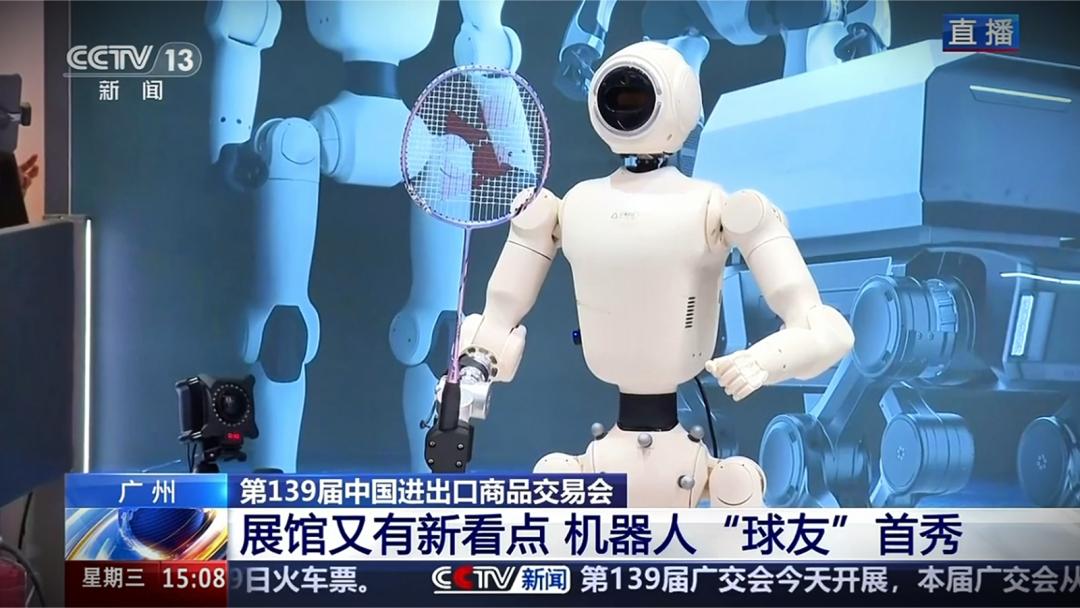
Second, a bipedal humanoid robot autonomously played badminton with a human, and at the same time, the C2 small humanoid robot entered the mass - production stage.
The former advanced the ability from motion control to real - time decision - making and human - robot interaction, while the latter means that the company has started to move from technology verification to product delivery.
These two milestones also correspond to Ren Xiaoyu's understanding of the changes in embodied intelligence in the past few years.
In his view, 2025 was the "year of robot performances": The industry needed to prove that complex multi - joint robots could be stably controlled. By 2026, robots had to start interacting with humans, understanding the environment, making real - time decisions, and completing more continuous tasks in the real world. In the future, robots will need to truly create value and become productive forces capable of independently completing work.
It was also in this process that Ren Xiaoyu saw problems closer to the real constraints of the industry and developed a deeper and more dialectical understanding of these problems.
The following content is edited and compiled based on the conversation between Xinglian and Ren Xiaoyu. The first - person perspective is Ren Xiaoyu.
The technological inflection point of embodied intelligence: Neural networks start to successfully control multi - joint robots
In the past two years, embodied intelligence has received great social attention. However, from the perspective of technological breakthroughs, the real inflection point occurred as early as 2022 - neural networks began to be able to successfully control multi - joint robots. Once this was verified, all the problems about robots that people discussed would only be a matter of time to solve.
It wasn't until 2025, when robots had a series of public exposure opportunities such as sports events, marathons, and Spring Festival Gala performances, that the inflection point of public perception was reached. Of course, this also benefited from the breakthrough in motion control ability since last year.
There are two key issues among them:
1. Why are other technical problems solvable after neural networks can control multi - joint robots?
First of all, although since 2023, the concepts of ontology, cerebellum, and brain have been split, for robots, the brain and the cerebellum are essentially the same. They both use AI and neural network nodes to drive robots. From this perspective, the most critical issue is how to pack more neural networks into the hardware.
For example, running may only require a 5 - megabyte network. To do sorting and cooking, more neurons need to be stuffed into the hardware ontology. Whoever can pack more networks into the limited hardware ontology may be stronger in the future. This is also the development strategy of five well - known American bipedal humanoid robot companies, Boston Dynamics, Tesla, Figure AI, 1X, and Agility Robotics, in the past two years: increasing the scale of the model on the hardware ontology and achieving autonomy for specific scenarios (the origin of autonomy is the increase in model size).
In the past, when we used traditional methods to develop multi - joint robots, it was difficult to see the future. Because traditional control needs to ensure the robustness and controllability of robots. As the number of degrees of freedom increases, the control difficulty of the system will increase exponentially. For example, from the perspective of motion control, a robot with one degree of freedom can be a vacuum cleaner, a robot with three to six degrees of freedom can be a robotic arm, and a robot with twenty or thirty degrees of freedom enters the category of humanoid robots.
In the past, people mostly thought of robotic arms, and they didn't dare to imagine beyond that. Since 2022, when we tried to use reinforcement learning to control multi - joint robots, we found that the robustness of neural networks is very good. The more complex the hardware, the stronger the AI ability is. If the hardware becomes simpler, the powerful generalization ability and robustness of AI will be restricted when attached to the hardware.
This is equivalent to hardware freedom. No matter how complex the hardware is, as long as we can imagine it, we can quickly achieve control over it. In the future, there may be more complex forms than humanoid robots, with hundreds or even thousands of joints. For example, a large number of joints can form a deformable house.
At that time, I realized that this might be something that would have a profound impact on society. To this day, it has just started to gain momentum.
Of course, according to the popular understanding, the development of the cerebellum is indeed faster than that of the brain. Because this is a new industry, and AI has just started to command robots. It must first start with the robot's own movement ability, be able to achieve good balance and behavioral ability, and then develop strong decision - making intelligence.
The next step of motion control is to more intelligently integrate various capabilities and at the same time coordinate and cooperate well in hardware design.
2. What is the most critical breakthrough in motion control ability?
From 2023 to 2024, after one year of mutual iteration between software and hardware, the compatibility became better, and part of the Sim - to - Real gap problem was solved. By 2025, heavy - duty electric - driven humanoid robots weighing seventy or eighty kilograms could perform perfect backflips. The significance of this is that the Sim - to - Real problem in motion control has been solved.
In fact, looking back at the development of robots in the past two years, both the algorithms and hardware solutions have changed greatly. Although robots look the same from the outside, the internal hardware solutions and architectures have undergone rapid iterations.
Take the C - series small robots of Dongyi Technology as an example. They have been iterated for about four or five months, with several versions. Each version has obvious advantages over the previous one. For example, at the beginning, we were very happy when the robot could walk and run, but it was not robust and would collapse with a kick; the next generation was more robust but not strong enough; the next generation was stronger but not generalized enough; after generalization was achieved, it was too heavy, so we continued to reduce the weight. It was iterated generation by generation like this. We ultimately hope that it can reach the basic movement ability of an adult.
However, a robot is a systematic project, like a wooden barrel. To make it progress, each shortcoming needs to be improved by one centimeter, rather than relying on the development of a single long - board. If you only focus on a single function, it's very simple. But it's not easy to make it match the movement ability of an adult in all aspects. The main challenges are, first, to more intelligently integrate various capabilities, and second, to coordinate and cooperate in hardware design. It is necessary to ensure that the motion control model remains stable and reliable while it is getting larger.
As the motion control problem is solved, it will increasingly play the role of a general infrastructure. The interaction and decision - making abilities of robots in an open environment are all based on this.
To form a business closed - loop, the ontology, model, and scenario need to be linked
If we split the embodied technology stack into two parts: ontology and AI, in my opinion, the two are strongly coupled. That is, only by simultaneously opening up these two parts can a company form its own business closed - loop. Just like Figure, with System 0, System 1, and its own ontology, the three are integrated. The decision - making model, motion control model, and hardware are all important, and at the same time, they need to be linked with the scenario.
Hardware is the key to future differentiation. Just like Boston Dynamics and Figure both target industrial scenarios, but it's obvious that they are going in two different directions. Figure focuses on operations, such as lightweight tool handling and some part assembly; Boston Dynamics focuses on heavy - load operations, like moving a large refrigerator or carrying a tire. In these two situations, the robots will be completely different at the hardware level.
Among them, the most critical part is the actuator. It determines 80% or even 90% of the performance of the entire robot, and the BOM cost may account for 60% to 70%. Therefore, the actuator must have good performance and characteristics. This is a strategic issue. For example, we chose the cycloidal drive because it has advantages such as large load capacity and good rigidity. Other manufacturers also use planetary or harmonic drive routes. Regardless of the technical advantages and disadvantages, strategically, the hardware should have its own solution, and it's important to have its own team with the ability to build the ontology internally. Only in this way can there be a solid enough foundation for building the motion control part and the decision - making part.
As for the end - effector, the development from grippers to dexterous hands is just a process. Last year, most people still used grippers because they are cheap and affordable for laboratories. However, as the cost of five - finger dexterous hands gradually decreases, they will naturally be popularized. People are always fond of new things and tired of old ones. In the future, if there are more bionic ones, they will definitely be replaced. This is mainly related to the user experience, and it's hard to go from luxury to frugality.
Of course, from the perspective of the overall industrial chain, I am conservative about whether robot companies should do everything on their own. There may be boundaries for data and computing power because both have their own business closed - loop logics. For data, there can be a physical simulation engine or a factory for collecting real - world data, and then the data can be packaged as a data asset. Computing power also has its own hardware and software. If there is anyone who can do all these well, it might be Nvidia or Tesla.
Hardware first or data first: Effective data needs to be based on the ontology
Many people are discussing whether the Scaling law of embodied intelligence can be realized. I think it definitely can. Motion control has gradually shifted from single - action control to data - driven control. From the previous single - trajectory debugging and training to now training a model with 10 hours, 20 hours, or 100 hours of human data for the robot to execute all actions, this was unimaginable before. Even a small motion control model follows the data Scaling law, and the decision - making model is even more data - driven. But the key lies in where the data comes from, what the model architecture and hardware solution are, and which comes first among these three.
In our internal view, we should first determine the hardware. Only after having the hardware can we have data, and only after having data can we have a model. This is not a one - time linear process, but a cycle where the hardware generates data, the data trains the model, and the model then exposes problems with the hardware.
Tesla is now concentrating on building hardware and has not emphasized externally what embodied models it has released or how much data it has collected. Because having a hardware foundation first, then data, and then a model is the first - principle. Even large language models cannot escape this law.
Where does the data come from? The Internet. The reason why large language models can obtain massive amounts of Internet data is also the result of years of construction and operation of computing devices, networks, intelligent terminals, and content platforms. Embodied intelligence also needs its own physical infrastructure, but robot hardware is more expensive, and the efficiency of generating real - world data is also lower. The same is true for embodied intelligence. The hardware is indeed expensive, but the logic is like this. If you want to skip steps, it's easy to start over. It depends on everyone's ability to find new and good solutions.
Of course, at this stage, whether to use human data, synthetic data, or real - machine data to train the model is just a matter of proportion. As long as this data can support the robot to start the training cycle in the scenario, it has value. It's just that data is currently being hyped up a lot. I think it's quite dangerous because before the hardware architecture is finalized, some data collected may be meaningless. There is also reusable data that is independent of the ontology on the market, but it's not certain what proportion this kind of data will account for in the future when the entire hardware is ready.
Real - machine data is very valuable. Only after the robot is not afraid of falling can we collect data in large - scale and mass - replicated ways. Not being afraid of falling means that before the entire hardware fails, the robot can get up by itself after falling. In other words, as long as the electrical system does not lose power and there are no electrical system failures, the robot can operate normally. No matter being kicked or rolling head - first on the ground, it can recover by itself. This is a stable machine. If it really falls, there should also be protective measures to protect itself, so as to reduce the cost of hardware maintenance.
From the perspective of data requirements, compared with the decision - making model, motion control requires a relatively smaller amount of data. But compared with the earliest motion control models, it requires much more. In the past, one trajectory was enough, but now 20 hours of trajectories are needed. The longer hours of data required for motion control are different from the long - range task data required by the decision - making model. Long - range tasks refer to long - range decision - making in the logical chain, including how to make logical judgments and decisions to form a complete long - chain closed - loop. Although motion control has many task actions, it does not need to form a complete link closed - loop. It focuses on how to break up and mix so much data together, like kneading dough, to form a uniform dough so that each action can find a similar one in it. Long - range tasks are like stretching the dough into a noodle. Whoever can stretch the noodle longer, as long as it doesn't break, has stronger