The Loop World Model (LoopWM) is highly likely to be the architecture for the next-generation general world model.

In the past year, the World Model has almost become one of the most crowded tracks in the AI field.
From video generation to robotics, from embodied intelligence to spatial intelligence, almost everyone is talking about the same vision: enabling AI not only to understand the world, but also to predict and simulate it, and ultimately learn to act in it.
However, there is far from a consensus on what today's World Model actually is. The architecture has not converged, the data has not converged, the evaluation system has not converged, and there is still an ongoing debate about "what a World Model should look like".
In this stage of a hundred schools of thought contending, most teams choose to continue along the visual route: generating more videos, longer videos, and a more realistic physical world. However, Adam Lu, the founder of FaceMind, attempts to approach from another path.
Instead of focusing on generating the world frame by frame, they keep the reasoning in the Latent Space; instead of defining the goal as a stronger video model, they attempt to solve the long - term error accumulation, computational efficiency, and reasoning stability issues that have long existed in World Models.
This is also the background for the birth of LoopWM.
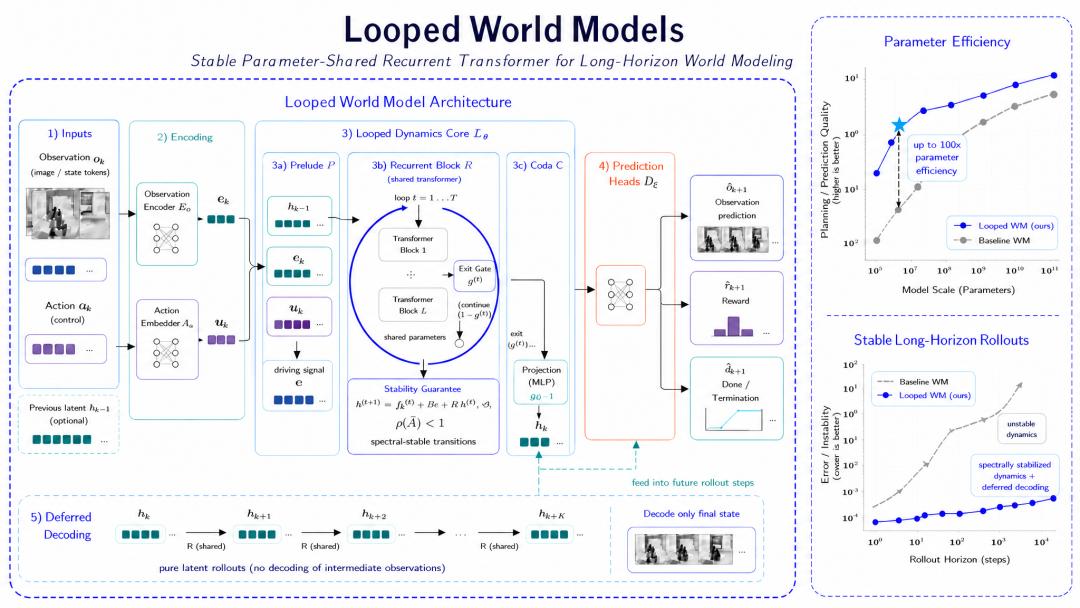
This work proposes a Loop World Model architecture. Instead of continuously stacking parameters and computational power, it tries to make the model iterate repeatedly like thinking, continuously correct its state in the latent space, and allocate limited computing power to truly important reasoning steps through mechanisms such as Early Exit and Deferred Decoding.
To some extent, LoopWM is not just discussing a specific model, but a larger question: When World Models eventually move towards robots, industrial systems, and even the real physical world, will the future Scaling Law continue along the path of "large models + large computing power", or will a new computational paradigm emerge?
Adam Lu said that from his research experience at Imperial College and the Chinese University of Hong Kong to his judgment on the world model during the entrepreneurship process; from the design logic of LoopWM to his predictions about architecture convergence, Test - Time Scaling, robot text understanding, and the future three years of the world model.
In addition, in a conversation with the host of ZP Flight, Adam also discussed the ChatGPT moment of the world model. It may not have arrived yet, but the truly important questions are becoming clearer: Future AI should not only generate the world, but also learn to think in it. And LoopWM is the answer they have provided. We have also compiled these fragments in full for everyone to more intuitively feel the thinking and collisions of front - line researchers in real contexts.
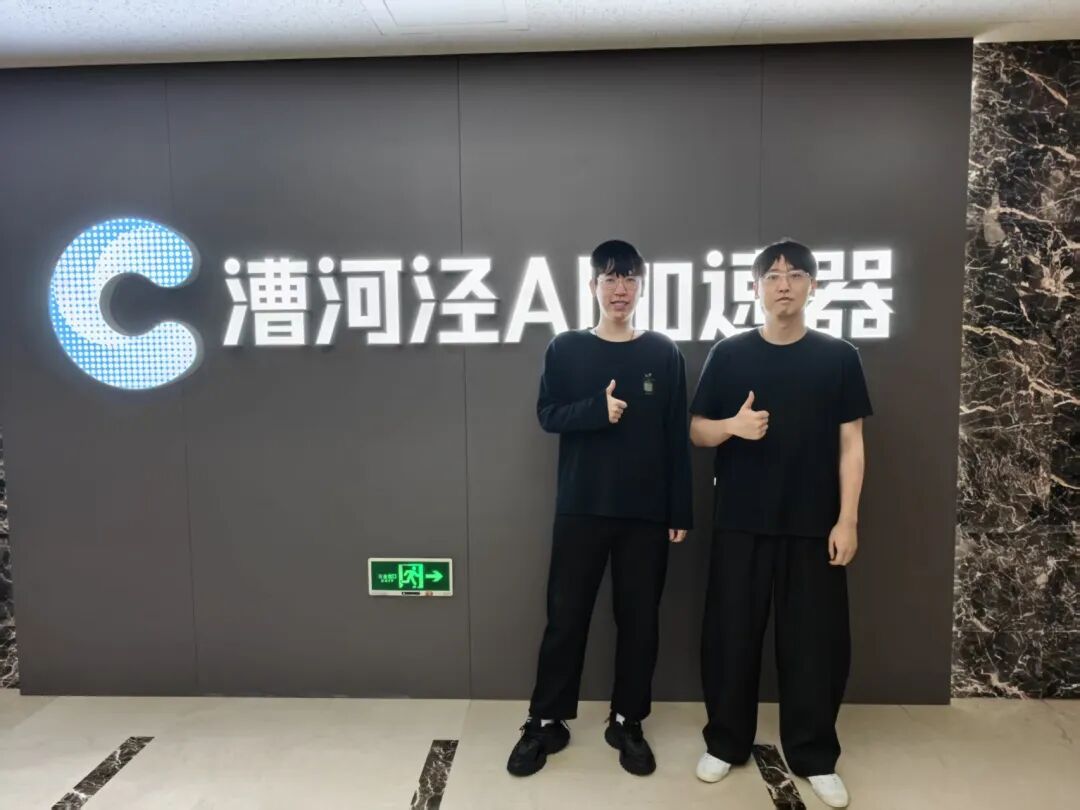
FaceMind CEO Adam Lu (left) & FaceMind CTO Victor Wei (right)
The host is Zou Tianyuan from the Institute for Artificial Intelligence and Industrial Technology (AIR) of Tsinghua University, whose research directions include world models, multi - model fusion, data privacy, and data synthesis.
Many world modeling methods use an exponential approach to generate more possibilities for the future world and then select an optimal solution when doing test - time scaling. What we want to do is a linear test - time scaling method suitable for the field of robots or world models. Deferred Decoding is mainly to avoid decoding the possibly wrong state at each step and then amplifying the error. We hope it can continue to reason in the latent space and make further inferences with a more continuous representation.
Since the loop model itself has the property of a loop, the most core problem in the early stage of training is that it is difficult to directly optimize long - horizon tasks. And it won't work if we just throw all the data in and train it randomly. So we implemented hierarchical curriculum learning.
Some relatively simple tasks are often ignored in traditional deep stacked layers, especially in very deep models where gradient vanishing may occur. The Loop architecture performs much better in this regard. I think the core reason is that the deeper the model, the more suitable it is for handling difficult problems, but the task complexity of world models varies greatly.
The difference in task difficulty in the embodied field is very obvious: There is a huge difference in difficulty between making a robot move around in a room and making it pick up a glass of water. This difference is suitable for the loop architecture. Currently, when people look at world models, they are basically still solving problems at the spatial level. But we definitely hope that future robots can first imitate humans and then go beyond them. Whether robots can understand text in the spatial world is a problem that has not been fully solved yet.
In essence, the World Model is a World simulator to solve the problem of insufficient realism in the existing simulation environment. It's possible that the current WAM architecture is not the optimal solution for the future because WAM is essentially a form of joint training, but more elements of the World Model may serve as a data source for embodied scenarios.
Circulating in the latent space, LoopWM tries to bypass the old inertia of frame - by - frame generation
ZP: Before formally delving into LoopWM, could you introduce yourself in chronological order? How did your experiences from studying for your undergraduate and master's degrees at ICL, obtaining a PhD at CUHK, interning at MSRA, and later founding FaceMind influence your current choices?
Adam: I studied for my undergraduate and master's degrees in computer science at Imperial College London from 2017 to 2021. I chose computer science mainly because I like playing games and writing programs. At that time, I didn't have a particularly strong research orientation. I spent more time writing code and also developed some small games. Nowadays, it's much more convenient to write code with the help of AI, but back then, I basically wrote every line by myself, and I really enjoyed the process.
When doing my graduation project at Imperial, I met a teacher, Daniel Rueckert, who had a great influence on me. Once, I took a paper from a large institution to discuss with him and said that I thought it was a great paper, perhaps because it was from Google. He reminded me not to just look at the title or the institution. Even if the authors are from Google, we should still look at the actual contribution of the paper. He also told me that regardless of the institution, as long as the contribution is good and novel enough, one can create very interesting things. A person with real taste should be able to put aside biases. This incident had a profound impact on me. It made me realize that scientific research and innovation are very global and don't have strong boundaries. As long as the contribution is valuable, it should be recognized. At that time, I was just doing my undergraduate graduation project, but I already had high expectations for scientific research.
Later, I chose to continue doing AI research. On the one hand, I really wanted to engage in scientific research. On the other hand, it was also related to my long - standing love for anime and works like "Sword Art Online", which contain a lot of imagination about AI. After graduation, I went to the Chinese University of Hong Kong to pursue a PhD and conducted research under the guidance of Professor William. He is a relatively low - key teacher who doesn't promote himself much in China, but I think he is very talented.
I'll admit that I probably have a bit of talent in scientific research. At the beginning of my PhD, I quickly produced a first - author paper. There were only my teacher and me as the authors, and it also won a good award. At that stage, I thought I might be quite good at research. However, during my PhD, I also started thinking about entrepreneurship. When running benchmarks, I quickly found that benchmarks sometimes don't represent the actual effect of something when it is applied in the real world. For example, when I was doing benchmarks on the PersonaChat dataset in the early days, I found that there are many things in the industry that are not written in papers and not directly told to junior researchers. The benchmarks themselves may also have flaws, especially some dialogue datasets. The way their data is collected has limitations, and some are even collected based on false data. So during that time, I gradually realized that if I wanted my research to be more meaningful or truly applied in real life, starting a company might be more appropriate. I thought I had received enough academic training and hoped to put the technology into practice.
From 2022 to 2023, I interned at MSRA for a while. After the internship, my first thought was to start my own company. At that time, I was still a student, so I didn't operate it full - time. The topic the company initially chose didn't really match our team's profile. We developed AI companion products, which are more application - and operation - oriented and less technology - intensive. Later, from 2025 to 2026, after I graduated, the company officially started operating, and we adjusted our direction to world modeling. Up to now, the company has been working in this direction. I think it better suits our team's background and capabilities.
The company has also received several rounds of financing from investors such as Starlink Capital, 360 Group, and Miracle Plus. The shareholders are very supportive of what we are doing. They also believe that our team is well - suited to work on world models. The competition in the world model field is indeed fierce this year, but we have also produced some outputs that I think have high contributions. Recently, people from some large institutions often come to communicate with us. NVIDIA might be one of the first large foreign companies to notice our solution. They evaluated this work as a "highly valued contribution", which shows that this paper has received some attention in the industry, and NVIDIA is the closest to us in this regard.
ZP: How did your research taste gradually form? How do you judge whether a problem is worth working on?
Adam: Probably the most important thing is to read more and do more. For example, during the summer vacation before I started my PhD, I basically read a large number of papers crazily.
I think for junior researchers, it's very important to just start working. Some people in the academic community might say that combining A and B is not a good idea, or a certain combination is not interesting enough. A very junior researcher might spend a lot of time thinking about what to do to have a significant impact. However, based on my own experience, sometimes combining A and B can also be eye - opening. The key lies in what specific A and B are and how you combine them.
So the core is to have your own judgment. There is a lot of information on the Internet, and each piece of information may bring a cognitive bias. For example, if you browse a lot of reviews on Zhihu today and see others saying that combining A and B is not good work, you might be influenced. But in fact, combining A and B might be a good thing.
My style is to first find a direction that I think is probably feasible and then just start working on it. I think for many things, before you really understand them, you can start quickly, see the results, use the results to give yourself feedback, and then iterate and adjust the direction.
ZP: When the company later decided on the general direction of world modeling, was it a similar judgment logic?
Adam: Not exactly the same. I think deciding the general direction for a company is different from academic research. Academic research emphasizes finding something relatively new. For example, if you come up with a very new idea, reviewers usually spend time carefully judging its novelty and contribution because most academic reviews are anonymous and don't consider the researcher's background. As long as the novelty is strong enough, there is a possibility of acceptance.
However, when a company, especially one seeking financing, selects a direction, the logic is different. World modeling is an important consensus. The investment community generally prefers to invest in a mature concept and then add a good team, and the solutions within can be a bit more novel. If it's something completely brand - new, VCs might be scared.
So when a company chooses a general direction, it doesn't need to innovate from the start. A more appropriate approach is to first enter a mainstream, important, and widely recognized direction and then make specific innovations within it. After the company reaches a certain stage and has enough endorsements, it can then pursue greater innovation.
In my view, FaceMind's work on world models itself doesn't have a huge amount of innovation, but I think LoopWM is a significant innovation. At least from the feedback in the academic community, many people think it's a major innovation. Some people on X also think it might be a brand - new direction for world models.
LoopWM
ZP: A very important feature of LoopWM is that it performs long - horizon reasoning through an iterative loop. Did you encounter any numerical stability or other training difficulties during training?
Adam: Since this model itself has the property of a loop, the most core problem in the early stage of training is that it is difficult to directly optimize relatively long - horizon tasks. We found that it won't work if we just throw all the data in and train it randomly.
So we implemented hierarchical curriculum learning. The first layer is from simple tasks to difficult tasks. The classification method is that we first train a common world model and also use other people's world models for classification. Those short tasks that are easy to distinguish and have a relatively high accuracy rate are classified as simple tasks; tasks with a relatively low accuracy rate are classified as difficult tasks.
The second layer is to do the curriculum according to the number of steps, for example, from 1 step, 2 steps, 3 steps, all the way to 100 steps. Now our experiments have reached one or two hundred steps. We think the longer the rollout, the more difficult it is. So finally, we combine the two dimensions: the shorter and simpler the task, the easier it is to classify and the simpler it is, and then we progress in order from simple to difficult. This way, the training effect will be better.
ZP: Apart from sorting, do you have any specific observations about the training data? Which type of data is more useful, and which type is less useful?
Adam: We first discovered a problem in the common architecture: Some relatively simple tasks are often ignored in traditional deep stacked layers, especially in very deep models where gradient vanishing may occur. The Loop architecture performs much better in this regard. I think the core reason is that the deeper the model, the more suitable it is for handling difficult problems, but the task complexity of world models varies greatly.
Specifically for the loop architecture, we found that certain data in the simulation environment is very effective. For example, some dexterous hand simulation data from ManiSkill and DexArt. Since dexterous hand operations involve more dimensions and a wider range of complexity, they are very helpful for training. On the contrary, if it's just ordinary gripper - type simulation data, the effect is relatively less good. Continuously adding this type of data to the training won't bring such obvious benefits.
ZP: Did the idea of the loop architecture come directly from the problem of gradient vanishing in simple tasks? Are there any other reasons?
Adam: It's due to multiple factors, mainly two reasons. The first is closely related to the field of robotics or embodied intelligence. For a robot, there is a huge difference in difficulty between making it move around in a room and making it pick up a glass of water. Moving is relatively simple, while picking up a glass involves more dimensions and more constraints, so it's more difficult. The difference in task difficulty in the embodied field is very obvious, which makes it suitable for the loop architecture.
The second reason is test - time scaling. We didn't fully write this in the paper, but our method can perform test - time scaling, especially by giving it some perturbations after the loop converges and letting it continue to loop. We've seen that many world modeling methods use an exponential approach to generate more possibilities for the future world and then select an