What Happens When a Product Manager From a Top Tech Company Pursues a PhD in Computer Science?
In the past two days, I've been leading the team in tackling the underlying technical framework of the brain-computer interface large model. What's particularly interesting is that one of our frameworks comes from an academic article, which uses the multi-agent concept to split the EEG processing.
Here is the methodological process of this article.
BrainAgent: A Large Language Model-Driven Multi-Agent Framework for Autonomous Brain Signal Understanding
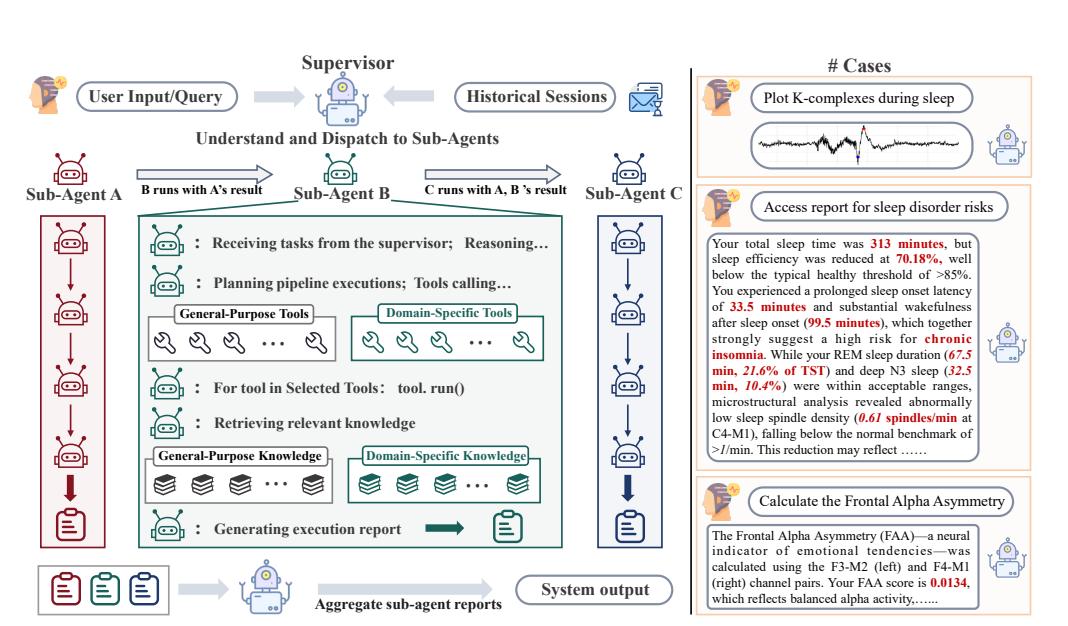
This article uses the multi-agent idea to separate emotions and sleep states during the sleep process, rather than manual processing. Each agent is used for separate scheduling.
Although this article doesn't directly explain how to specifically process EEG encoding, it introduces a very important concept. This concept of using agents to process EEG can greatly improve efficiency.
If I hadn't pursued a Ph.D. and just worked as a product manager, I would hardly know this method.
When I was a product manager, I could only translate requirements into R & D functions to meet business needs. This is the practical operation of engineering.
Just like the article doesn't mention how to process the EEG algorithm. By continuously manually handling EEG processing, the iteration only optimizes the signal strength, rather than designing the entire technical architecture.
This process is just time-consuming and laborious, like walking blindly on a single path. While this article spends a lot of time and effort, experiments with different ideas, and finally finds the most effective method through the cooperation of multiple agents and the scheduling of the general agent. It also discovers that the larger the model parameters, the better the effect. With small parameters like 8B, the results are almost nonsense.
Academic research can guide the design of technical architectures and product architectures. As a product manager, it can strengthen the technical barriers and help me understand the technical competitiveness of the product in the industry.
Designing functional modules for a product itself is not complicated. However, to meet business needs, achieve commercialization, and have strong technical barriers, I believe that pursuing a Ph.D. in computer science is the greatest enhancement for a product manager.
The significance of pursuing a Ph.D. in academia lies not in open-source projects but in technical ideas.
In my second year of Ph.D., I think technical ideas and product ideas are two completely different concepts. Product ideas need to consider commercialization and user experience. For example, from mobile to PC and social gameplay, these are product ideas. While technical ideas are to give your product stronger vitality. For example, when we do multi-modal retrieval for brain-computer interfaces, there are EEG, FMRI, and MEG. These different data belong to multi-modal, and each modality has its own data cleaning, annotation, and preprocessing.
If I hadn't pursued a Ph.D. in computer science, a medical product manager would hardly think about how to use different technical architectures to complete this part of the work, which is also a task that consumes the company's R & D costs. They would think it's the CTO's job.
Actually, with the research ability from computer science Ph.D. literature and papers, a product manager can find relevant decoding algorithms on their own, combined with the convenient AI literature and method retrieval nowadays.
By checking the limitations and conclusions of methods in similar scenarios, a product manager can find the most suitable technical implementation route for product R & D and understand the industry's technical background. After all, papers published in top journals in the past year must represent advanced technical routes.
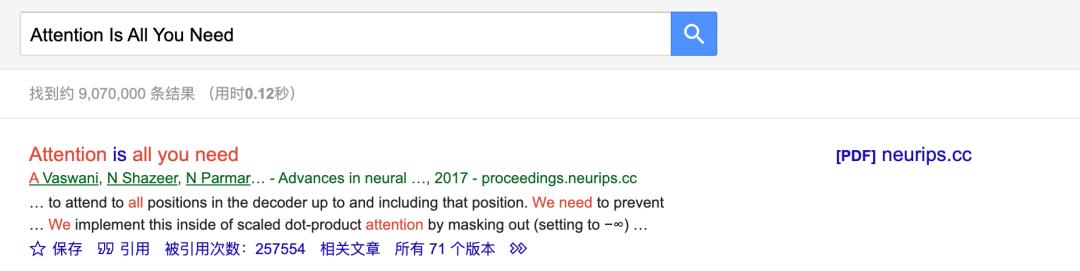
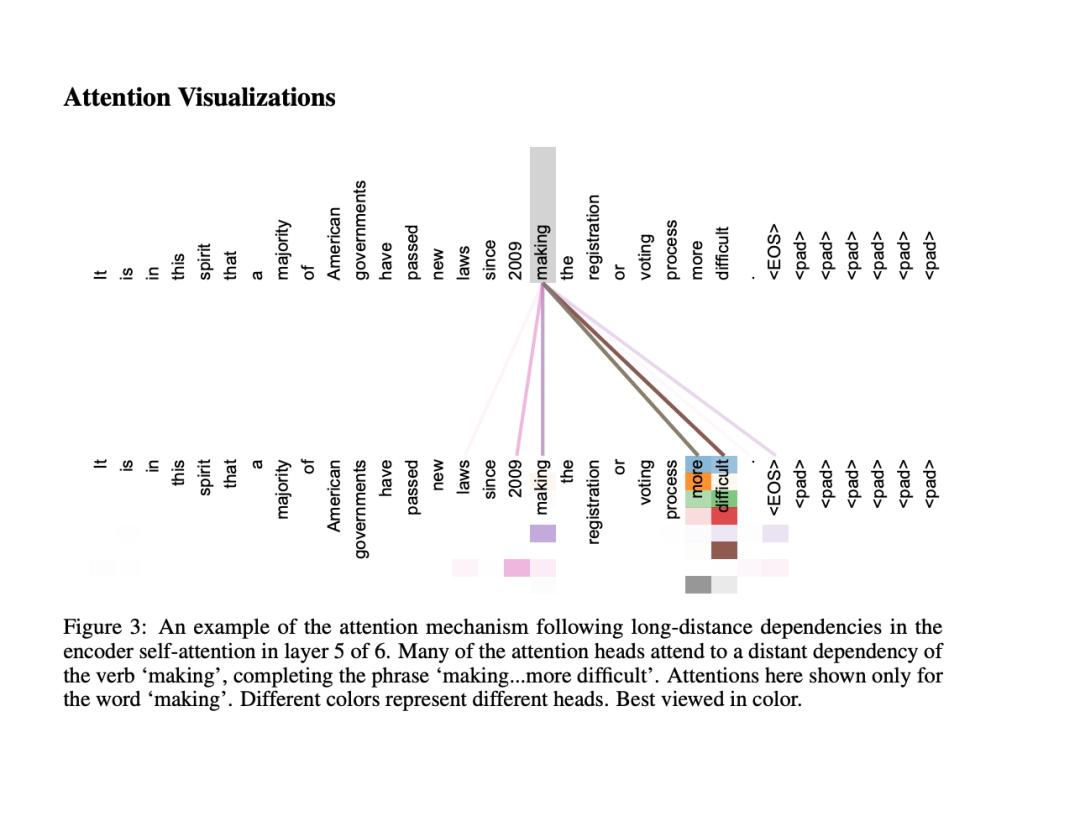
Especially those in top journals, which have passed the review of editors of major magazines and have high citations, indicating that they are truly effective technical routes, just like Google's 2017 article on Transformer.
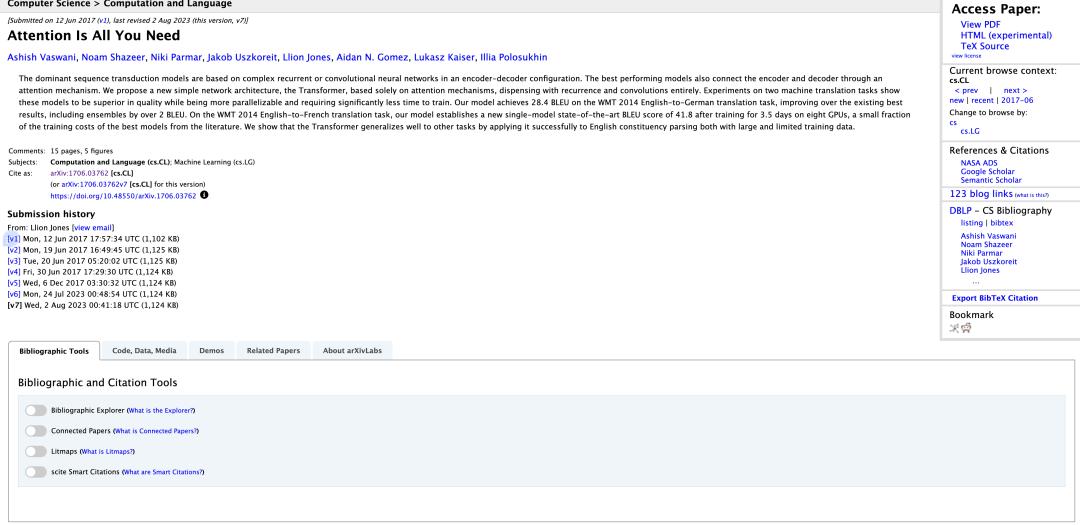
This article proposed the Transformer architecture, which reads all words concurrently through embedding and sorts them, rather than reading them sequentially one by one. This greatly improves efficiency.
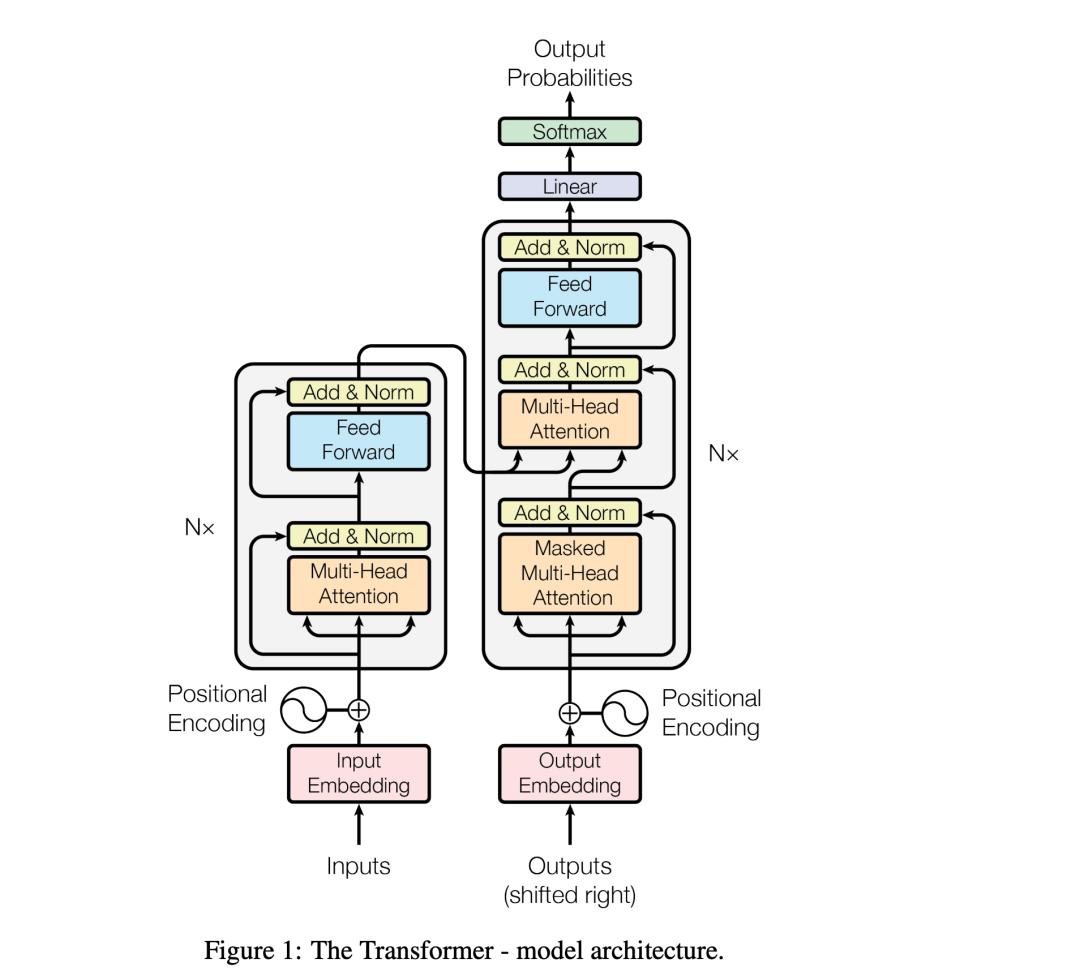
It uses sine and cosine to represent the matching degree of each vector, so there's no need to pay attention to the order to represent relative positions, without going through RNN and CNN.
The Transformer uses multi-head attention instead of starting from a single direction, which greatly increases computational efficiency, reduces response time, and achieves SOTA in various evaluations.
Extending to the current brain-computer interface field, it also outperforms traditional CNN and RNN.
In the current brain-computer interface field, it still stays at the CNN and RNN methods, processing data by sequentially processing or capturing local features of a certain signal. RNN processes data according to time, and CNN processes it according to space.
However, they both have the drawbacks of gradient vanishing and long-distance dependence.
The Transformer can simultaneously build inter-channel relationships and long-term dependencies, and directly capture long-distance temporal relationships with global attention. Attention can automatically focus on important signals and suppress noise.
So, if a product manager doesn't pursue a Ph.D., they won't know the mechanism of this article at all. The product functions they build will rely on traditional text matching or regular algorithms, or even CNN. Naturally, the product's competitiveness will be weaker.
Iteration in engineering cannot achieve the goals of the academic circle.
Engineers are specifically writing code. But if they don't break out of the engineering mindset and compare different overall thinking methods, it's difficult to reach the level of the academic circle.
Academic articles have literature reviews, which generate a lot of ideas and directions for relevant research fields. There are also different fields and technologies involved. If working in a company, first, there isn't enough time and energy; second, the company won't allocate so much money for research; finally, each person's career is restricted by their profession. To work in this direction, large companies need to invest money and allow everyone to conduct R & D.
Engineers can write code or parameters well, but it's difficult for them to change directions. This is the significance of a product manager pursuing a Ph.D.
Those who love working as product managers should pursue a Ph.D. in computer science rather than management.
Currently, many friends who have worked as product managers for a certain period think about pursuing a Ph.D. in management, shifting from science and engineering to liberal arts.
Of course, it's okay in terms of academic qualifications. But if you want to enhance the product's technical barriers and the company's valuation, a Ph.D. in computer science is definitely the choice, as it creates the need to read computer literature, not management literature.
So, for salary increase at work, a Ph.D. degree is enough, and even a degree from Malaysia can do. But for the company's valuation, technical ability, and even product barriers, a Ph.D. in computer science is indispensable.
Finally, I'd like to share this Transformer article with product managers who plan to pursue a Ph.D. After all, the key points of using Google Scholar and reading literature can only be grasped by reading more literature.
That's all for today's sharing.
This article is from the WeChat official account “Kevin's Little Things in Changing the World” (ID: Kevingbsjddd), author: Kevin's Stories. It is published by 36Kr with authorization.