A 14-gram chip changed the fate of the Croatian team
On July 3, 2026, in a just - ended match of the FIFA World Cup jointly hosted by the United States, Canada, and Mexico, Croatia scored an equalizer in the final moments of regular time. However, after VAR intervention, the goal was ruled invalid. When a Croatian attacking player headed the ball, the chip inside the football recorded a contact signal. The "pass" at the moment of the touch was re - defined, and the teammate who received the ball was in an offside position at the moment of the pass by the teammate in front. As a result, the entire goal was disallowed.
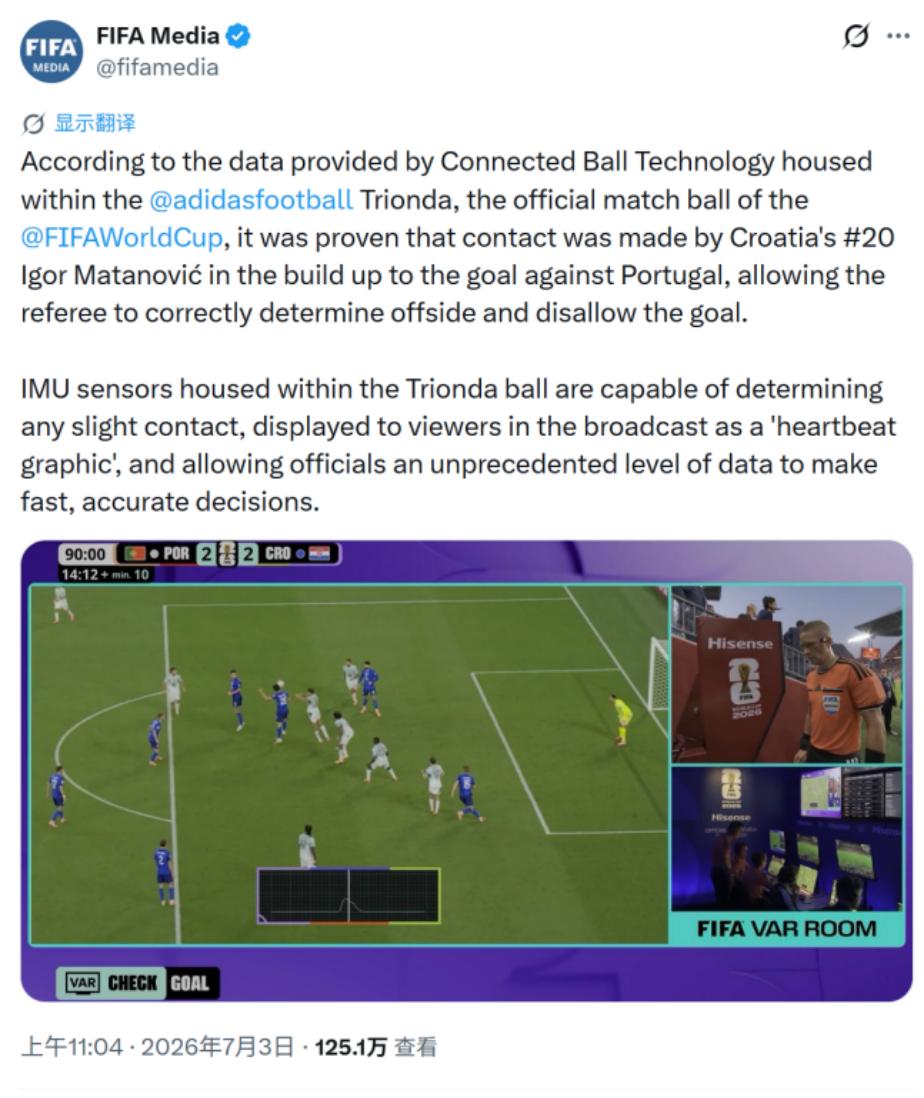
Image source: Internet
Even though many fans questioned after repeated replays that the moment of the header touch seemed invisible in the video, FIFA's explanation was that "the chip data showed a contact." The referee, based on the rules, determined that there was indeed a touch. Thus, Croatia lost 1 - 2 and was eliminated from this World Cup.
The result of the match is unchangeable, and it is a foregone conclusion. However, this penalty has opened up a problem that we must face squarely. Technologies such as chip technology, sensors, AI, and 3D body scanning, which are "non - human - eye" means, are quietly changing the results, rules, and even the nature of football matches.
01
What is this football?
The match ball for this World Cup is called Adidas Trionda. It is a product of multi - national technological cooperation jointly developed by Adidas and FIFA. Trionda is made of 4 thermally bonded panel sections, making it rounder and its flight path more predictable than traditional footballs sewn with 32 panels. At the center of the ball, there is a 14 - gram "suspension sensing system" (Adidas Suspension System). The core of this system is a 500Hz IMU (Inertial Measurement Unit), which collects 500 sets of motion data per second and wirelessly transmits them to the VAR system in real - time.
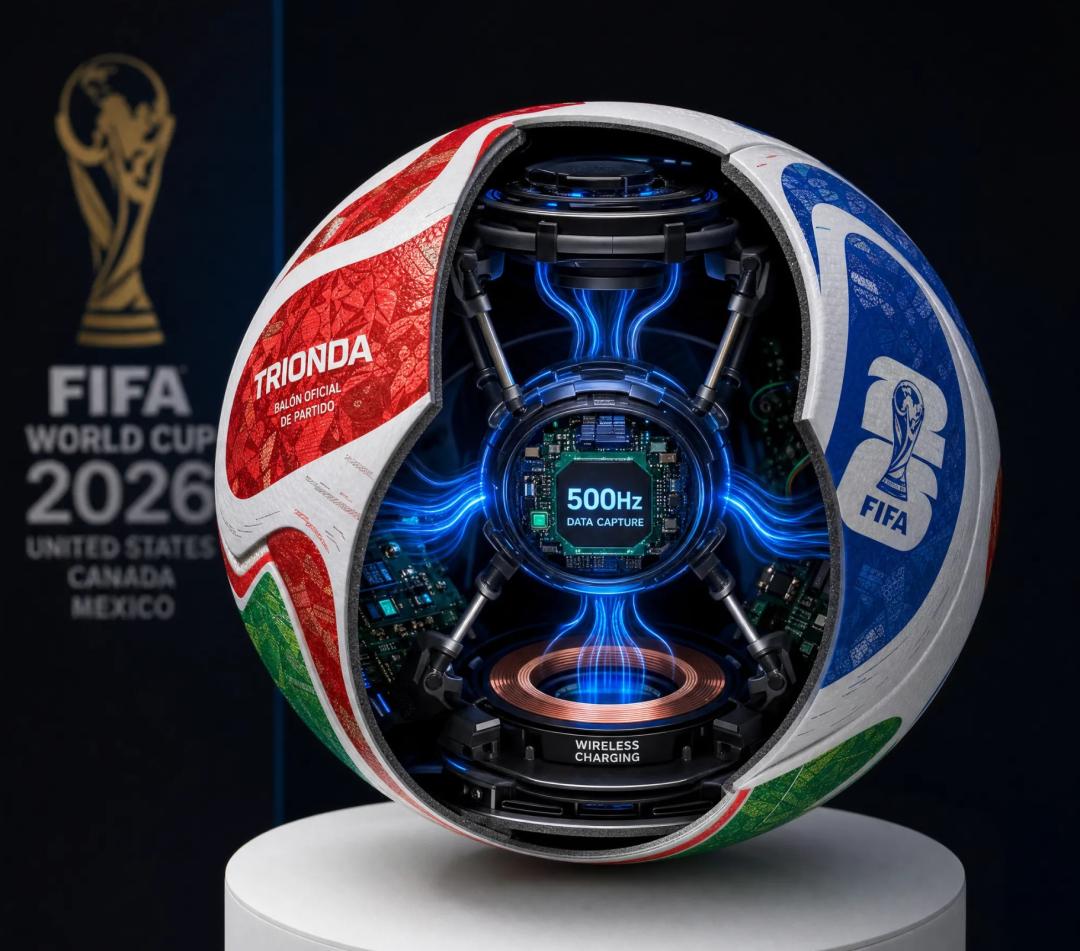
Image source: Internet
What can this chip capture? It can identify the moment of ball - touch with millisecond - level precision, including the part of the body touching the ball, the force of the touch, and the kicking point (i.e., the moment when the ball's motion state changes). It can capture flight path changes with an accuracy of 0.001 seconds and restore the complete curve of the ball's flight in the air. More importantly, it can identify extremely slight contacts, including those like a grazing touch or a brush of the ball by the corner of a shirt, which are "almost invisible to the human eye." The principle behind this accuracy is that the 500Hz IMU consists of a three - axis accelerometer, a three - axis gyroscope, and a three - axis magnetometer. Any tiny force change (even a hair - thin contact) will change the acceleration curve, and the AI algorithm can infer whether someone has touched the ball based on this curve. This level of accuracy can never be achieved by the human eye, high - speed photography, or slow - motion replay. The human eye has visual persistence, cameras have shutter speeds, and slow - motion replays have interpolation errors, while the IMU records contact as it occurs, and the record is real.
02
FIFA's "Technology Arsenal"
The technological investment in this World Cup far exceeds that of any previous one. From a commercial perspective, in essence, "technology makes the game more data - driven, more controllable, and more commercially valuable." FIFA's core technology arsenal consists of five parts:
The semi - automatic offside technology is a collaborative system composed of 12 high - speed tracking cameras (6 behind each goal, tracking 29 body points of each player 50 times per second), the Trionda chip to identify the kicking point, an AI algorithm to automatically generate offside penalties, and 3D player avatar reconstruction. The penalty delay has been reduced from 25 - 30 seconds in 2022 to 5 - 10 seconds in 2026, approaching the acceptable range for the human eye.
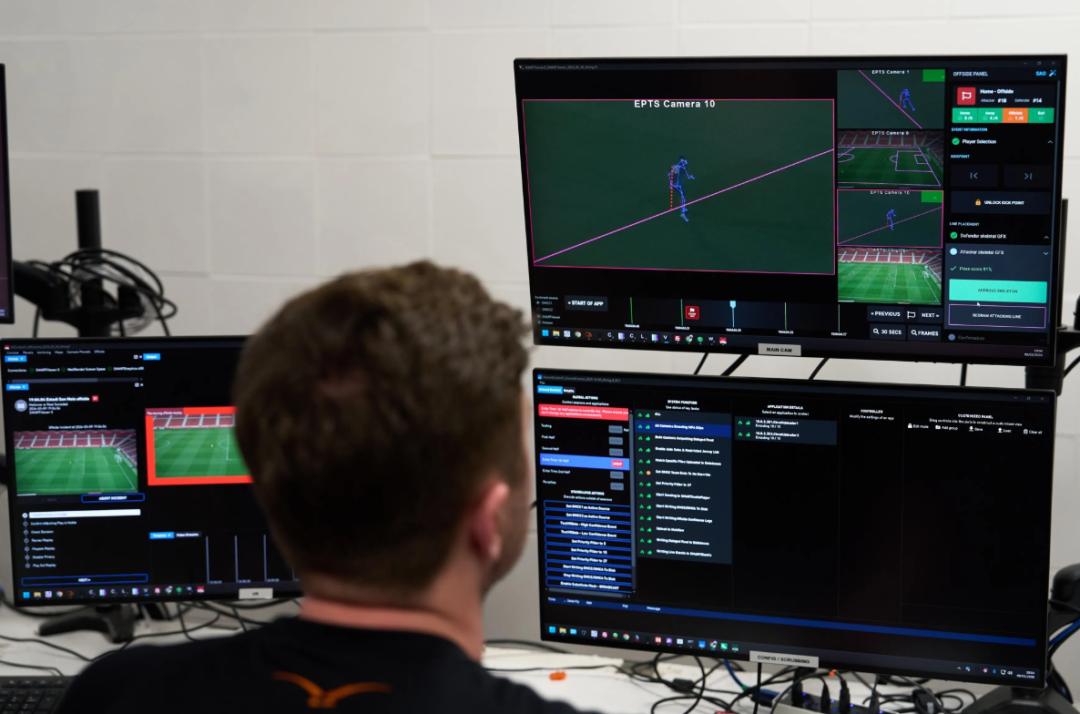
Image source: Internet
The automatic ball - out - of - bounds determination uses the chip and AI algorithm to automatically determine whether the ball is out of bounds. In the past, the manual determination by the assistant referees often led to disputes. Now, in theory, there are zero disputes. It saves 1 - 2 assistant referees per game and reduces penalty disputes. This is FIFA's "automation" path to save labor costs. This "automated refereeing" is the future trend. AI will not completely replace referees but will gradually take over "mechanical and definite" penalties, allowing referees to focus on "judgment - based and ambiguous" situations.
The 3D player avatar is supported by 360 - degree body scanning data provided by FIFA's technology partners. It is used for 3D offside replays on the VAR display, player physical fitness tracking, injury prevention, and coach review. They are visualizations of real - body data and mark the beginning of "assetizing player data."
The Sony Hawk - Eye goal - line technology has been a standard feature since 2014. In 2026, it has been upgraded to have a penalty speed within 1 second, be linked with the semi - automatic offside system, and be able to display 16 - angle pictures simultaneously.
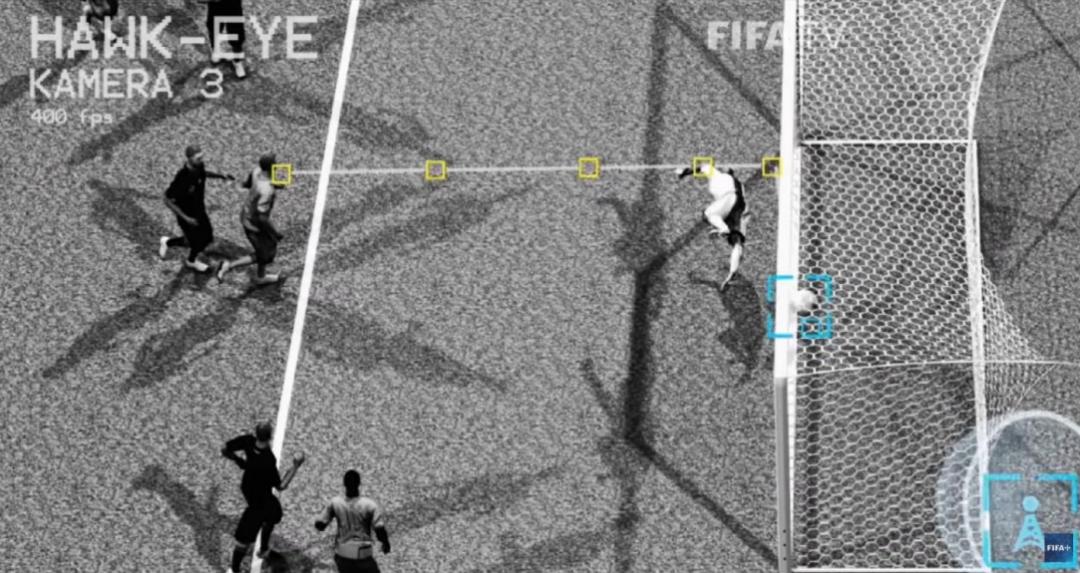
Image source: Internet
The stadium's AI computing power is provided by Lenovo, FIFA's official technology partner, with an "end - to - end AI infrastructure." At the same time, the stadium's intelligent air - conditioning system (such as full - air - conditioning coverage in MetLife Stadium and AT&T Stadium cooling from 35°C to 21°C in 30 minutes) provides a guarantee in hot weather. Behind the technological investment in this World Cup is a huge commercial network of companies such as Adidas, Lenovo, Sony, Kinemax, Hisense, and Huawei. It is not "free service." They obtain huge commercial returns through sponsorships, patents, and technology licensing. In essence, it is a commercial conspiracy between "technology companies and sports organizations."
03
Is it possible for the chip data to be wrong?
The core of the online controversy over this penalty is, "Is the chip data really irrefutable evidence? Is it possible for it to be wrong?" I will analyze this question from four aspects:
First aspect: The possibility of errors at the hardware level. The 500Hz IMU sensor is a mature industrial - grade hardware that has been widely verified in automobiles, mobile phones, and medical equipment. In theory, it has good physical stability. However, this does not mean that it "never makes mistakes." For example, the voltage drop of the battery during a long - duration game may cause signal drift, the performance of the chip may decline after a strong impact, the magnetometer may be interfered with by the stadium's magnetic field (such as from the air - conditioning system or broadcasting equipment), and data transmission loss or delay may result in incomplete data received by the VAR. Such "hardware abnormalities" are extremely rare in professional sports, but in theory, they cannot be completely ruled out. It is worth noting that during the 2022 FIFA World Cup in Qatar, the chip - equipped football experienced a data interruption due to a battery problem, and FIFA later improved the power - supply scheme. This itself shows that the hardware level is not "absolutely reliable."
Second aspect: The possibility of misjudgment at the algorithm level. The logic of the AI algorithm to determine "whether the ball has been touched" is to infer "whether an external force has been applied" based on the sudden change characteristics of the acceleration curve. However, the AI's judgment in boundary situations may have gray areas. For example, when the ball is blown by the wind, when there is a slight change in the internal air pressure of the ball, or when the ball rebounds after a slight deformation, these may all produce an acceleration curve similar to that of a "ball - touch." The AI algorithm may perform well when the training data covers the situation, but it may make mistakes in "situations beyond the training data." The premise for FIFA to announce an "accuracy rate of over 99.9%" is based on a specific test data set. No one can guarantee that the same accuracy rate will be maintained in the "unknown boundary situations" in real games.
Third aspect: The controversy in boundary situations. Croatia's penalty in this case is precisely a "boundary situation." What the human eye sees is "almost no contact," which may also be affected by the angle, while the chip records "contact." This means that the event itself may be at the critical point between "touching the ball and not touching the ball." At the critical point, the judgment of any system will have uncertainty. This applies to the human eye, the chip, and the AI algorithm. The real controversy is not "who is right and who is wrong," but "which system should have the final say in the judgment at the critical point."
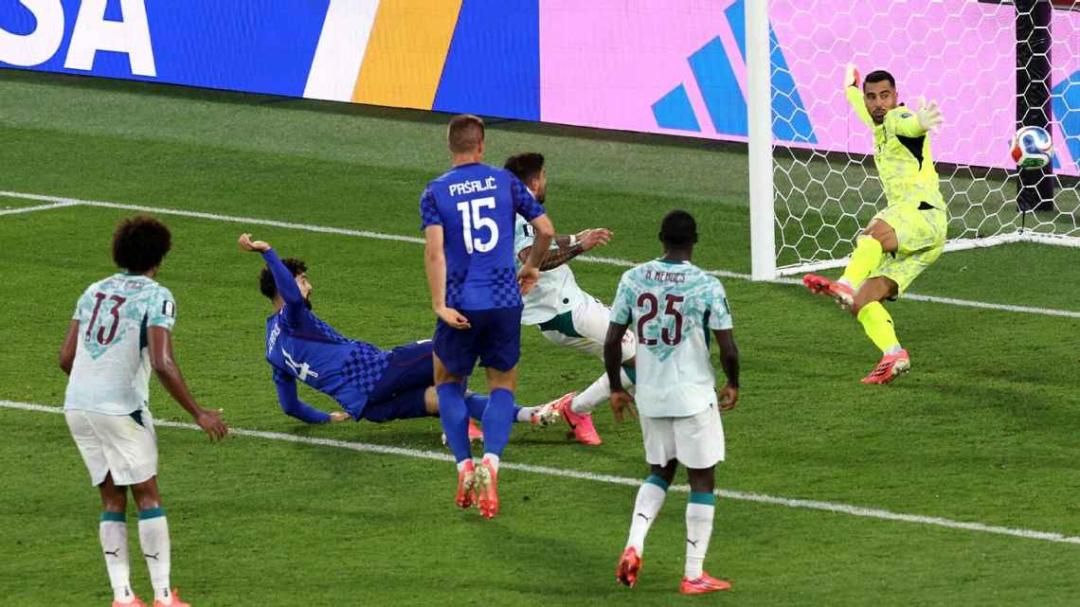
Image source: Internet
Fourth aspect: The lack of a correction mechanism. This is a more worthy - of - attention issue. Currently, there is no "appeal mechanism" for chip - based penalties. When a human - eye judgment is wrong, there is at least a "referee re - review" process. When a chip - based penalty is wrong, the referee believes that "this is objective data" and there is no "re - evaluation" procedure. When chip data becomes the basis for penalties, an error - correction system such as an "appeal mechanism, independent audit, and third - party verification" must be established. Otherwise, "science" will be placed above "fairness."
However, in reality, the game time is limited, and it is impossible for everyone to hold a discussion about this ball - touch. Therefore, the final penalty still lies with the main referee.
I have watched this goal replay many times. Personally, I think that since there is data, it is possible that the Croatian player's hair touched the football, but the force seemed relatively slight to the human eye. However, the Portuguese player No. 13 clearly touched the football later. Whether it was an active defensive mistake or a passive touch is controversial. The explanation I can think of is that the main referee should have considered that the defensive player's touch was passive (not a back - pass to the goalkeeper and not a defensive error), which did not affect the Croatian player in an offside position from gaining an advantage, thus ruling an offside. There is currently a controversy on the Internet about this part of the rules, and we will not elaborate on it here. The result is set and cannot be changed.
04
Data ownership and player authorization
Each player in this World Cup was forced to undergo a 360 - degree body scan before the game, and dozens of terabytes of data were generated after each game. Who owns these data? Did the players themselves consent? Who will use them in the future? And how?
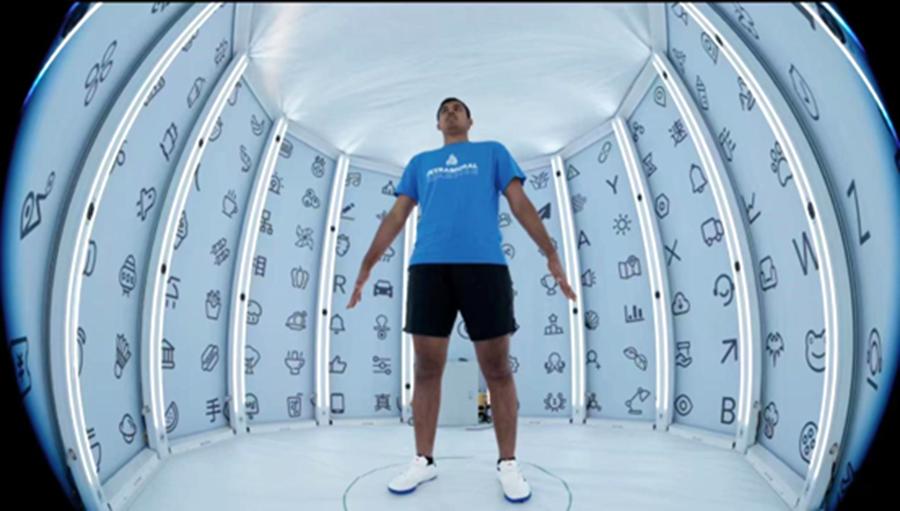
Image source: Internet
FIFA's official statement is that "player data is used for the event itself and to improve the fairness of the game." However, this statement seems increasingly flimsy in the legal environment of 2026. I will break it down into five specific questions:
Question 1: Did the players really "freely consent"? Players need to undergo a scan to participate in the game, which is a mandatory requirement of FIFA. Players who do not accept the scan cannot play. Under this "mandatory" framework, the players' "consent" is essentially "forced consent" and does not constitute "voluntary" consent in a legal sense. This "mandatory authorization" is controversial under international data laws (such as Article 6 of the EU GDPR). However, as the event organizer, FIFA has the right to make rules, which makes it difficult for data protection agencies to intervene.
Question 2: Who owns the body data? Laws vary from country to country. In the EU, it is generally considered "personal data" and the ownership belongs to the individual. In the United States, the legislation is decentralized, with some states considering it personal and some states having no clear regulations. China's "Personal Information Protection Law" in 2021 clearly states that it belongs to the individual. However, FIFA's "global unified rules" usually tend to give "priority usage rights to the event organizer," which conflicts with the individual rights of players.
Question 3: Who owns the game data such as ball - touches, running, and heart rate? Theoretically, these data belong to "event data." FIFA usually claims to have "usage rights at the event level," while clubs and players have "ownership at the individual level." However, in practice, FIFA "packages" the data usage rights to technology companies through sponsorship agreements, and players rarely have direct knowledge or control over how these data are used.
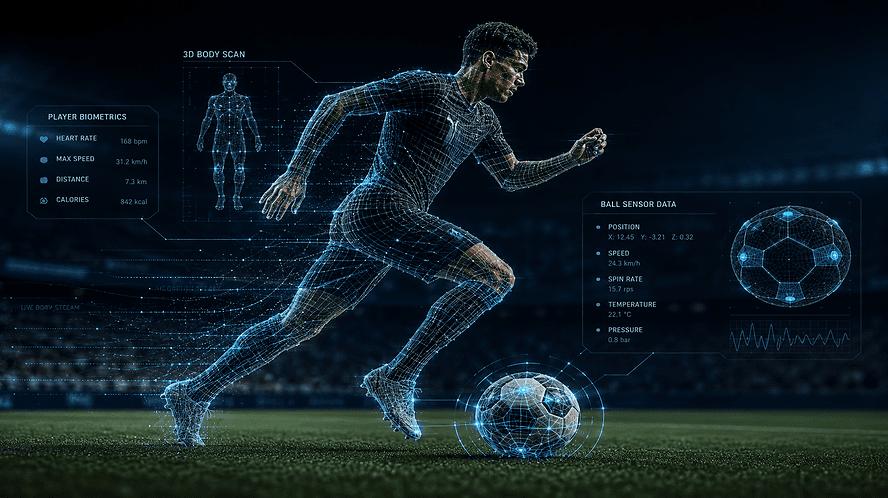
Image source: Internet
Question 4: Who will use these data in the future? Possible uses include AI training (using game data to train tactical AI), player digital twins (for e - sports and virtual training), commercialization (digital assets of star player cards and virtual events), insurance pricing (pricing athlete insurance based on physical fitness data), and medical research (studying sports medicine based on long - term physical fitness data). Some of these uses benefit the players (such as medical research and injury prevention), while others do not (such as commercialization and AI training). However, the current agreement framework cannot clearly distinguish between them.
Question 5: Can players obtain applicable rights from the data? Briefly, no. Under the current agreement framework, players cannot directly access their own raw data, decide how the data are used,