Domestic tech giants are racing to catch up with Claude Code, with Alibaba, Tencent, and ByteDance all in the fray
In the past six months, Agent products represented by Claude Code/Cowork and Codex have undoubtedly been the clearest main thread in the entire AI industry.
On June 30th, Anthropic quietly launched Claude Science, an AI workbench for scientists.
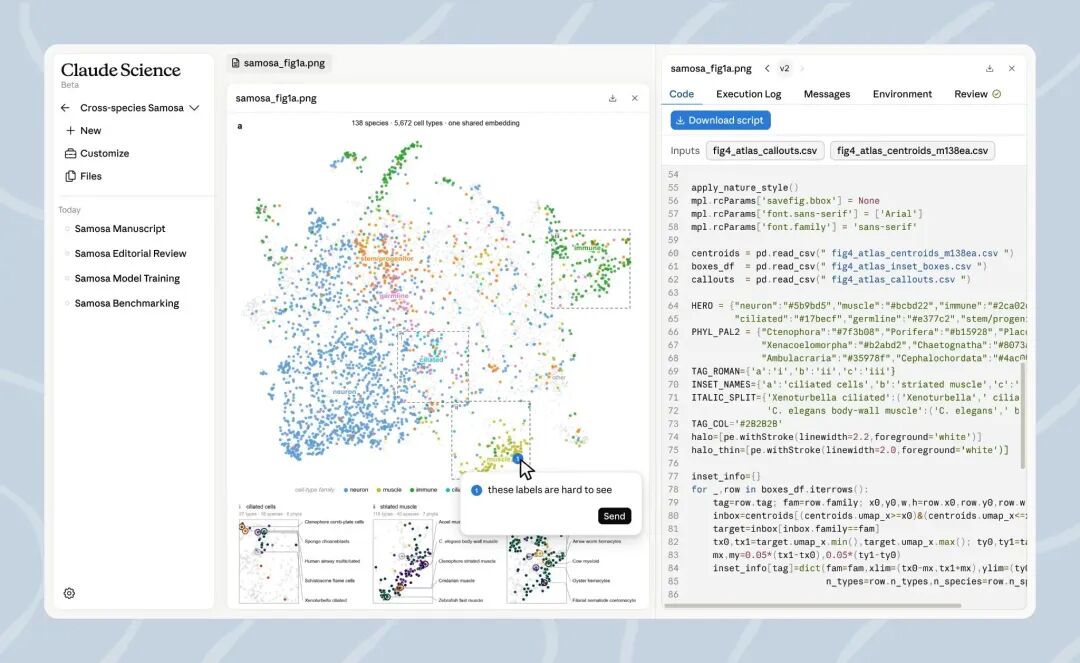
Image source: Anthropic
Anthropic's thinking is becoming clearer and clearer. First, let the Agent handle code (Claude Code), then let it handle various office tasks (Claude Cowork), and finally enter more complex professional scenarios such as scientific research (Claude Science).
In fact, Anthropic noticed that non-technical teams such as the market and data departments began to use Claude Code bypassing the chat interface, which led to the creation of Claude Cowork with a graphical interface "encapsulation".
Besides continuously iterating on the underlying models, many people may not be aware of the catch-up of domestic AI in Agent products. Alibaba, Tencent, ByteDance, Kimi, MiniMax, and Zhipu are all working on Agents. Each company basically follows Anthropic in distinguishing between Code and Work products, but with different focuses.
So, before the model capabilities of domestic AI can comprehensively surpass those of top overseas products, can domestic AI bring more domestic users to the work mode of "I command the Agent to work" by offering more affordable, more open, and more localized Agent products? Lei Keji AGI (ID: leikejiagi) conducts an inventory to try to answer this question.
Tencent WorkBuddy: Aiming to be the office entry point for more people
Tencent WorkBuddy may be the most well-known Agent product in China. After all, many people may have seen its ads on WeChat and installed and experienced it during the "lobster wave" period. In fact, besides WorkBuddy, Tencent also has CodeBuddy for developers, which basically corresponds to Claude Cowork and Code.
Tencent has already used them within its R & D and non-technical teams. According to official disclosure, CodeBuddy covers over 95% of Tencent's engineers, and WorkBuddy is used for mixed human-AI development and helps small teams iterate products more quickly.
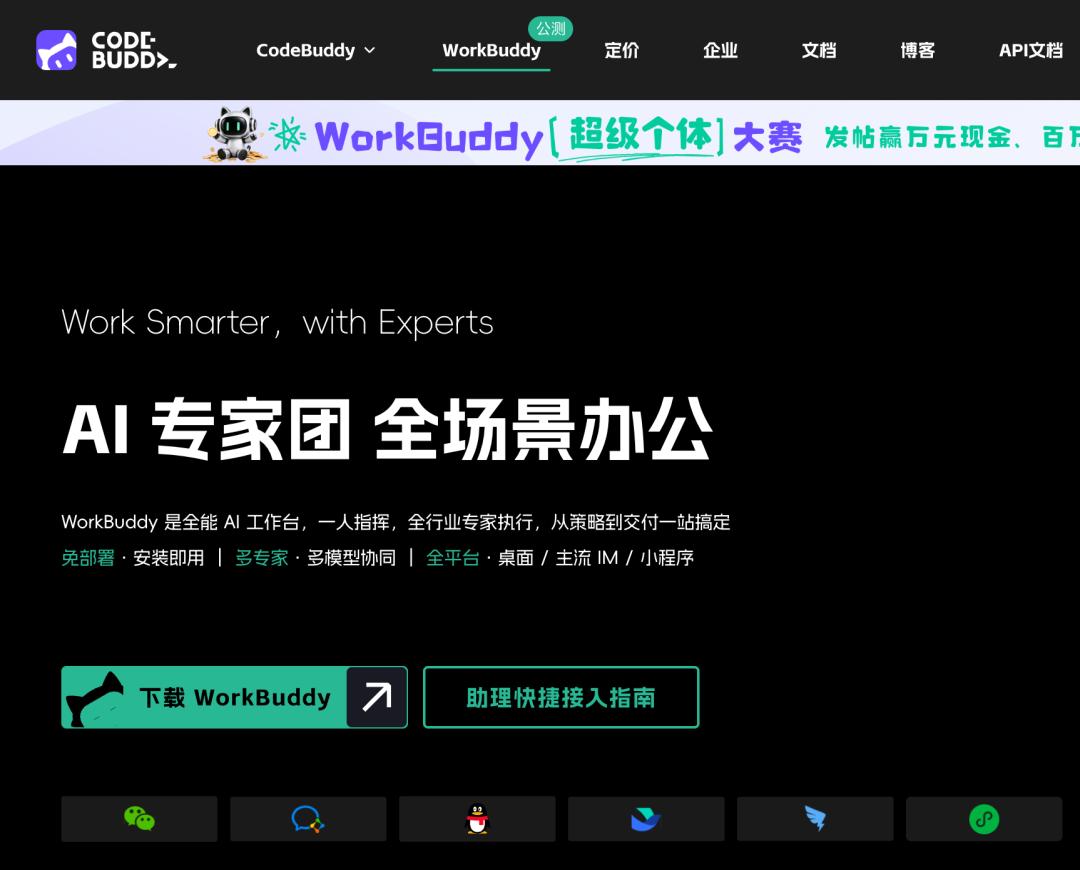
Image source: Tencent
We won't elaborate on CodeBuddy here. Compared with code development, WorkBuddy targets a broader range of productivity scenarios, responsible for document processing, content organization, collaborative tasks, and general office needs.
Tencent's advantage lies here. WorkBuddy can fully leverage the ecological advantages of Tencent Docs, Tencent Meeting, ima Knowledge Base, Tencent Lexiang, and WeChat.
Many individual users' materials, meeting minutes, to-dos, and communications are already scattered across these platforms. Therefore, an important reason for many people to use WorkBuddy is that it can directly pick up the daily "context" and then organize content, generate documents, and promote tasks within WorkBuddy.
Kimi Code/Work: Integrating long texts into the Agents workflow
Facing the wave of Agents, a group of large model companies that recently launched corresponding products have also divided their offerings into Kimi Code and Work.
Kimi Code can enter the CLI and IDE, read and write files, execute commands, search for code, obtain web content, and generate subagents for parallel tasks. Kimi Work targets local workflows, can mount local folders, browse the web through WebBridge, run Python, execute scheduled tasks, and requires user confirmation before modifying files or running code.
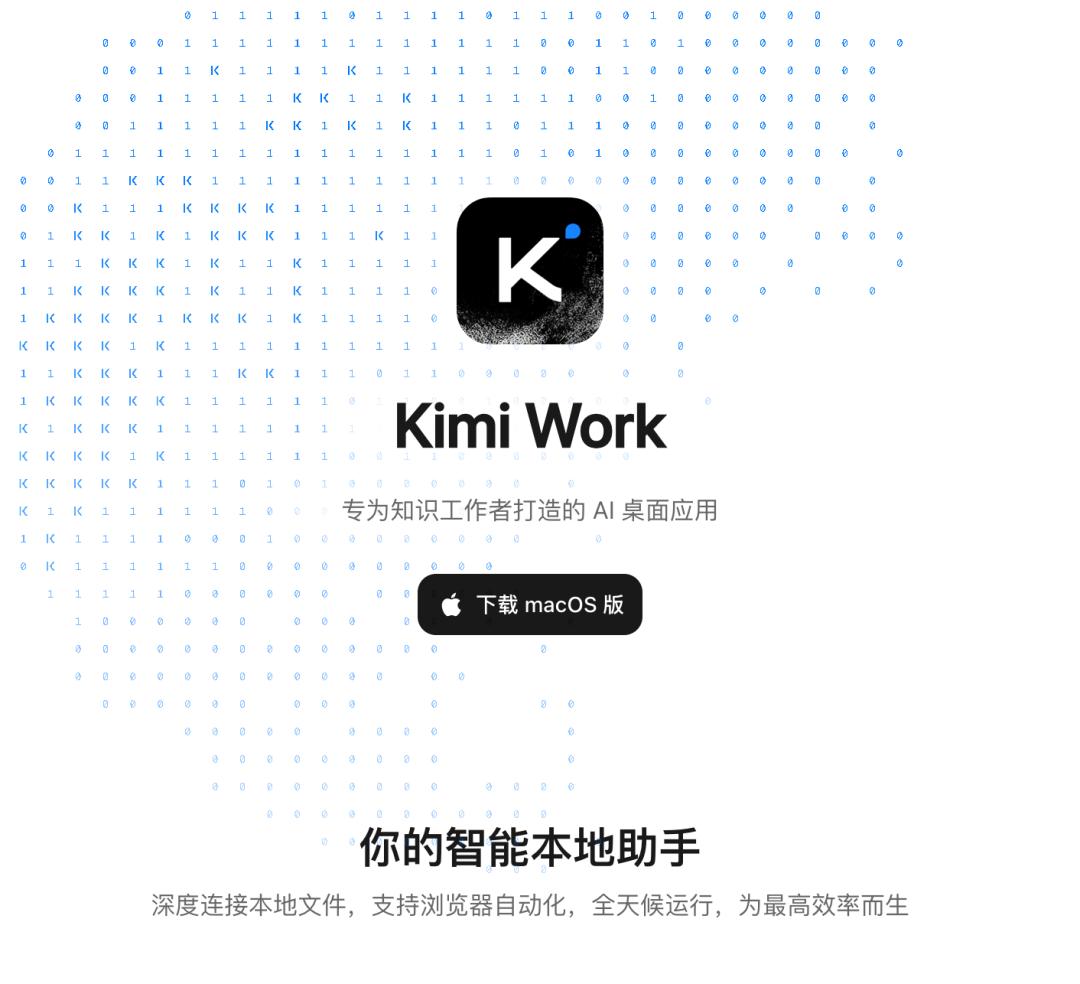
Image source: Kimi
For a long time, Kimi has been known to ordinary users for its "long text" processing ability. Reading papers, financial reports, dozens of pages of PDFs, and organizing a large amount of web materials are the most perceivable capabilities of Kimi to users. In the Agent stage, what Kimi needs to do is quite natural: not only read the materials and answer questions but also help users process files, run scripts, modify code, and generate results.
If the strength of Claude Code and Codex lies in the closed-loop of code tasks, what makes Kimi more worthy of attention is its attempt to transform the advantage of "long text reading" into an advantage in "long-range tasks". In both Kimi Code and Work, the design of an Agent cluster is also inevitable. According to the official statement, when dealing with complex problems, Kimi can automatically coordinate multiple professional agents and simultaneously decompose and solve multi-level tasks.
In addition, to attract financial users, Kimi Work also pre-integrates in-depth data sources of A-shares, Hong Kong stocks, and US stocks. All these can be said to constitute the differentiated experience of Kimi Code and Work.
Alibaba Qoder: Growing from Tongyi Lingma into a desktop Agent
Alibaba Qoder is a bit special. It is not a brand - new product that emerged from scratch. Instead, it evolved from an AI IDE product (Tongyi Lingma) through several rounds of iterations into a new Agent product, and has derived a series of products such as Qoder Desktop, QoderWork, QoderWake, Qoder CLI, and Cloud Agents.
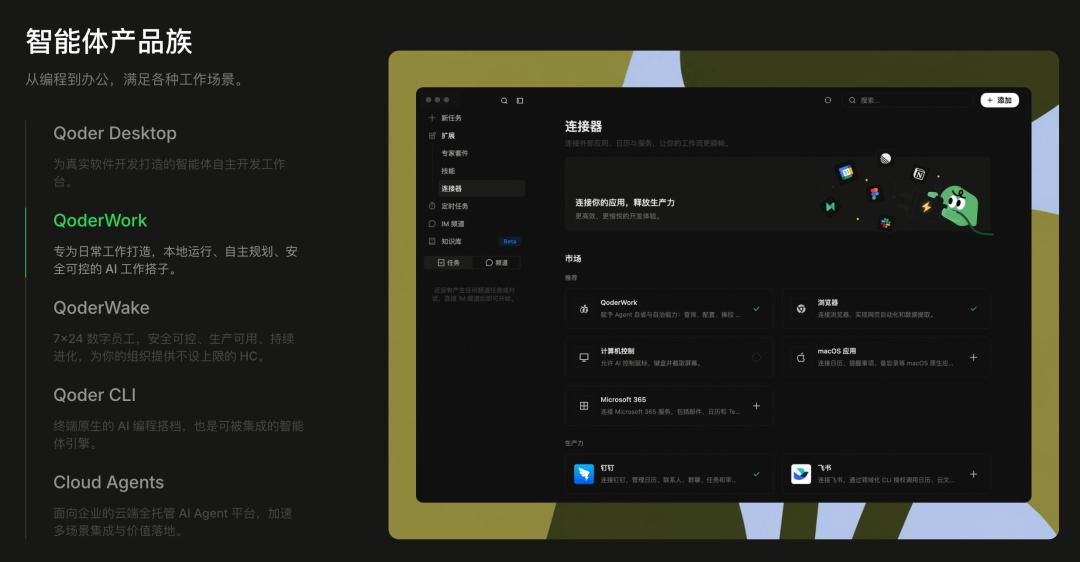
Image source: Alibaba Qoder
The core lies in two products: Qoder Desktop and QoderWork. Qoder Desktop targets software development scenarios and is closer to Claude Code. QoderWork targets daily work, handling tasks such as file organization, data processing, document generation, browser automation, desktop control, and scheduled tasks, and its positioning is similar to Claude Cowork.
QoderWork transfers Agent capabilities from code to ordinary work. As a desktop intelligent work assistant, QoderWork can complete file organization, data processing, and document generation through natural language. It can also connect to office tools, control browsers and computers, and support scheduled tasks, which is suitable for repetitive but indispensable work such as pulling data daily, writing weekly reports, and organizing monthly materials.
From a product design perspective, in addition to the "general" mode, QoderWork also provides "design", "slide", and "writing" modes, clearly emphasizing specific user scenarios. However, apart from this, not many other features and advantages can be seen.
MiniMax Code/Agent: Vertical integration of model Agents
Like the previous companies, MiniMax has launched two products, MiniMax Code and MiniMax Agent. It is worth mentioning that with the release of the new - generation large model MiniMax M3 in June, MiniMax Code also underwent a major update. According to the official statement, it is an Agent product specifically designed for M3 and trained together with M3.
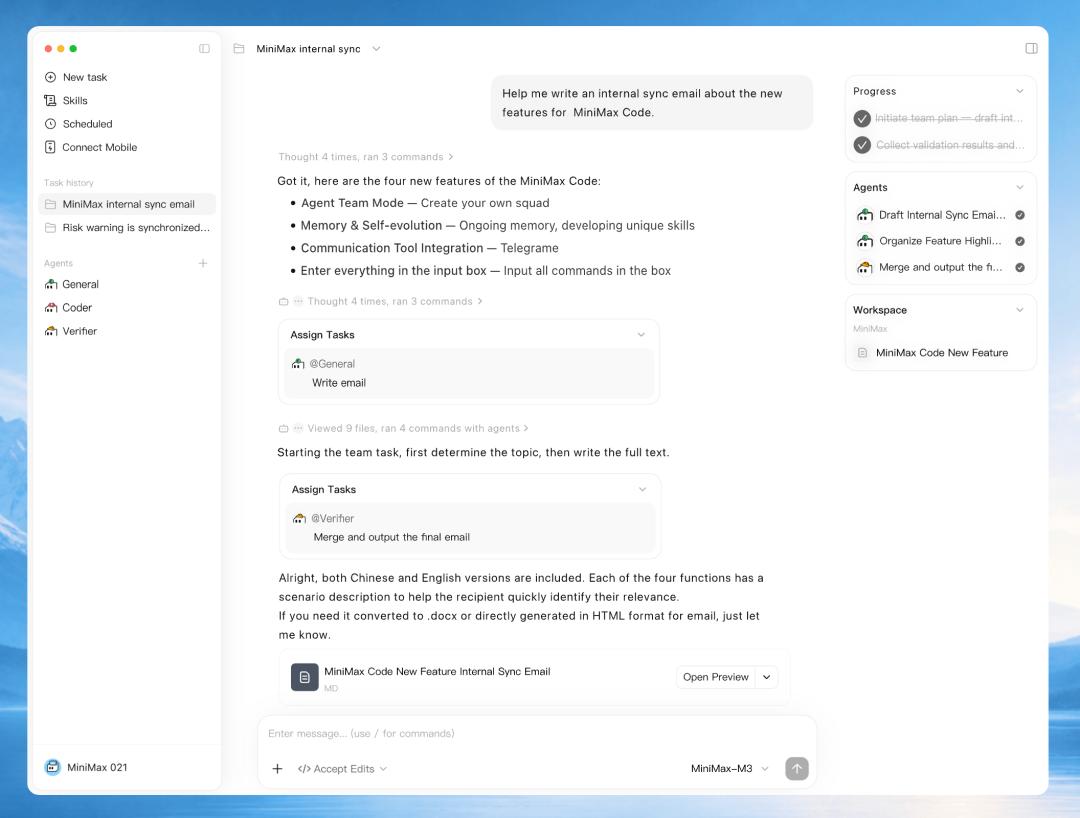
Image source: MiniMax
In simple terms, MiniMax Code can fully leverage M3's capabilities in long - context, Coding/Agentic, and native multi - modality, and is the preferred Agent to pair with MiniMax - M3. In long - range tasks, MiniMax Code will break down tasks into Workflows, and the Agent cluster will collaborate and operate autonomously through the adversarial Harness cycle of Producer + Verifier.
In fact, Claude Code has also launched Dynamic Workflows with a similar strategy, but MiniMax Code focuses more on "in - depth reflection and continuous error correction". The Agent will adjust the plan and priorities in real - time according to the task progress, and users can also intervene at any time to add requirements or correct the direction.
As for MiniMax Agent, it actually attempted to tackle long - range tasks earlier. In the May update, it launched the Mavis mode, which uses the collaboration of multiple Agents, including a design similar to Codex that allows users to intervene in the Agent's thinking and work at any time. This can be regarded as a preview before the release of MiniMax M3 and the update of MiniMax Code in June.
However, it should also be noted that this approach is most likely to result in a gap between the demonstration and the real - world experience. Long - context does not mean truly understanding the whole picture, and multi - Agent collaboration does not necessarily mean more stable results. The more roles and the longer the chain, any deviation in the middle may be magnified into an error.
ByteDance TRAE Work: Moving from an AI IDE to a general workbench
Strictly speaking, TRAE (SOLO) was initially better known as an AI IDE, competing with development tools like Cursor and Claude Code. However, the recently upgraded TRAE Work has expanded its boundaries, and its official positioning is straightforward: not just for coding.
According to the official introduction, TRAE Work provides multi - platform entrances for Web, Desktop, and Mobile, takes into account both local and cloud tasks, and does not rely on the TRAE IDE to run. After users initiate tasks on the desktop, the Agent can continue to run tasks in the cloud or locally, and multiple tasks can be advanced in parallel. After leaving the computer, users can also check the progress, review the results, and continue to adjust the direction on their mobile phones.
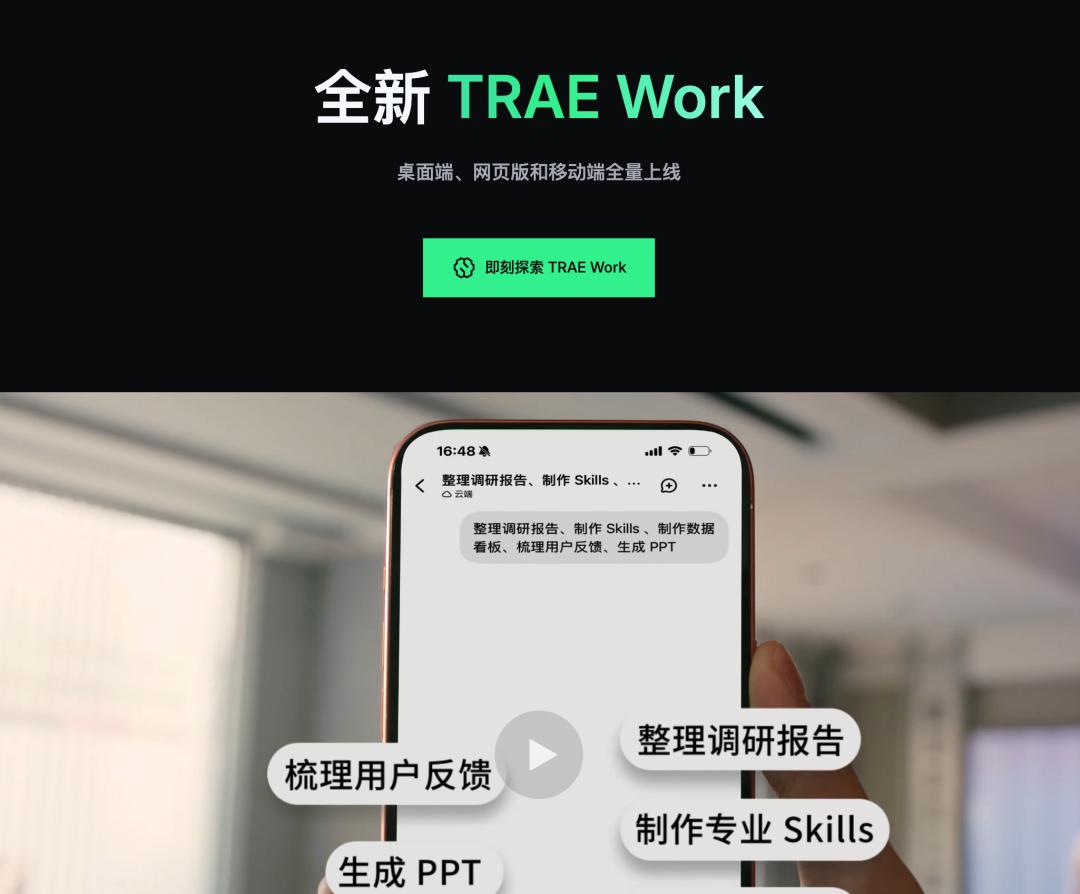
Image source: ByteDance TRAE
It is also worth mentioning that TRAE Work is divided into Work and Code modes. You can simply regard it as ByteDance's version of Codex, combining the two Agent products of Code and Work into one. The Code mode continues to handle development tasks, while the Work mode targets more general work scenarios, such as data organization, project promotion, web operations, file processing, and content generation. The difference is that Codex truly combines the two, while TRAE Work runs in two modes and users need to enter from different mode entrances.
This is very much in the style of ByteDance. Compared with Tencent WorkBuddy, which relies on the ecological context of WeChat, documents, and meetings, TRAE Work is more like an efficiency entrance for individuals and small teams. It does not necessarily require users to first enter an office ecosystem. Instead, it takes "tasks" as the core unit: as long as users hand over their requirements, it is responsible for decomposition, execution, and feedback on progress, and users can intervene at any time during the process.
Another notable move of TRAE is to open - source Trae Agent. According to the GitHub page introduction, Trae Agent is an LLM Agent toolkit for software engineering tasks, supporting file editing, bash execution, structured thinking, and task completion, and can also connect to multiple model providers.
Zhipu ZCode: Deepening the Code Agent line first
Compared with other companies, Zhipu's approach is more focused. It is not in a hurry to package itself as a general - purpose office Agent. Instead, it clearly focuses on the developer scenario and has launched Zhipu ZCode, targeting the difficulties and scenarios of long - range tasks, just like Kimi and MiniMax. This is actually different from the thinking of many domestic Agent products. Tencent, Alibaba, Kimi, and ByteDance are all working on both Code and Work lines.
It is worth mentioning that when Zhipu released the stunning GLM - 5.2 last month, it also upgraded ZCode 3.0. It fully switched to the self - developed ZCode Agent kernel and was deeply adapted to GLM - 5.2, optimizing long - range reasoning, tool invocation, and large - scale project execution links.
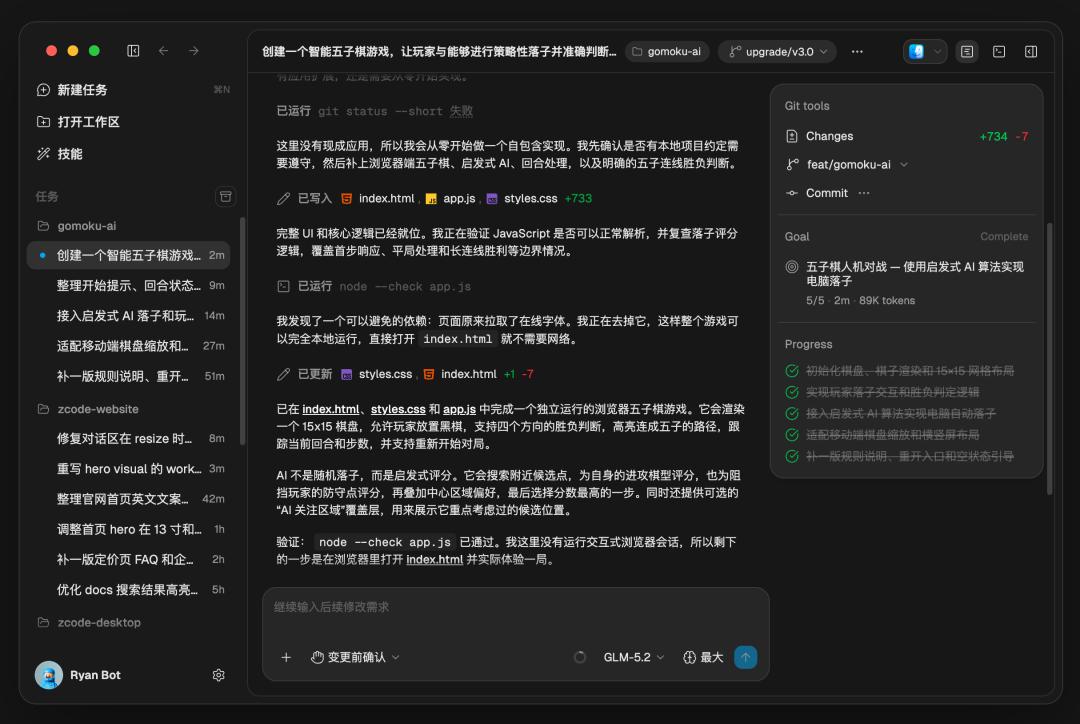
Image source: Zhipu
ZCode 3.0 also made some improvements around the actual development experience, such as features like a grouped task workspace, a Zread project knowledge base, and a visualized Git branch map. These may not sound as exciting as multi - Agent collaboration and long - context, but they are all related to the stability of the Code Agent: for an Agent to take over an engineering task, it first needs to understand the project, remember the context, and also allow users to clearly see what it has modified and where it is in the process.
The advantage of this approach is a clear goal, but the shortcoming is also obvious. The user base of ZCode will not be as large as that of WorkBuddy or TRAE Work for the time being, and its imagination space is more concentrated in the developer scenario. However, if it can truly operate stably in complex code libraries, long - range tasks, and project verification, it will be easier to build the trust of professional users.
The opportunities for domestic Agents lie in sufficient differentiation
Looking at these products together, domestic Agents are not replacing Claude Code, Claude Cowork, and Codex in the same way.
Alibaba Qoder, ByteDance TRAE, and Tencent's Buddy series from large companies all learn from Anthropic and OpenAI in the Code + Work model, but their product paths and focuses are significantly different. As large - model startup companies that survived the "hundred - model war", Kimi, MiniMax, and Zhipu all focus more on technological advantages, attempt to overcome the "long - range task" challenge that Agents must face, and emphasize the vertical integration from models to Agents.
Ultimately, what domestic Agents are pursuing is not just one specific product like Claude Code, Claude Cowork, or Codex, but a brand - new work mode: users no longer just ask AI a single question but hand over an entire task to AI and then review, correct, take over, and continue to give instructions during the process.
Compared with overseas products, the first advantage of domestic Agents is that they are closer to the local workflow.
Claude Code, Claude Cowork, and Codex have higher product completion rates and stronger developer awareness. However, they are more centered around the software ecosystem, office environment, and subscription system of overseas users. The tools and systems that domestic users use every day are often WeChat, Tencent Meeting, Tencent Docs, DingTalk,