Pan Zhuohua, a leading expert in optogenetics, has raised 125 million US dollars in financing
Recently, Ray Therapeutics, a U.S. clinical-stage biotech company (hereinafter referred to as "Ray"), successfully completed a $125 million oversubscribed Series B financing round. This financing round was led by the veteran asset management giant Janus Henderson Investors, with Adage Capital Management, Franklin Templeton, Invus, and Marshall Wace participating as follow-on investors. Old shareholders such as 4BIO Capital, Deerfield Management, MRL Ventures Fund under Merck, Norwest, Novo Holdings A/S, and Platanus all increased their investments, providing continuous support with real money.
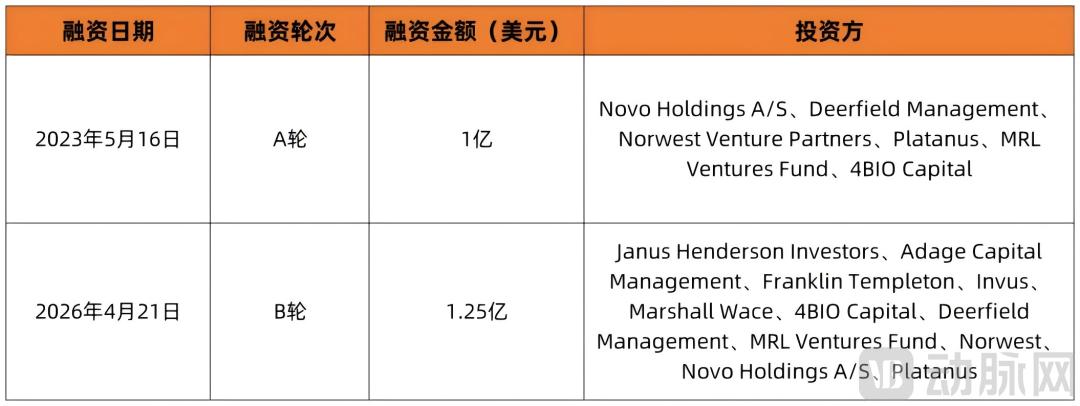
Financing history chart
This funds will be used to advance its core pipeline, RTx-015, through the late-stage clinical process for retinitis pigmentosa, paving the way for product commercialization. At the same time, it will accelerate the clinical exploration of RTx-021 in macular diseases such as Stargardt disease and geographic atrophy, and explore more application scenarios for the technology.
Nowadays, more and more players are entering the field of ophthalmic gene therapy, and different technical routes have their own focuses. In such a competitive landscape, why can Ray continuously attract capital?
Led by Zhuo-Hua Pan, Iterative Photosensitive Proteins Solve Technical Problems
Degenerative retinal diseases are highly prevalent blinding eye diseases worldwide, including retinitis pigmentosa and various macular diseases. The causes of these diseases are complex. Just for retinitis pigmentosa, there are thousands of corresponding gene mutations. Therefore, traditional gene therapies are in a dilemma: a single drug is often designed for only one mutation, and the number of patients it can cover is very limited. Currently, most mainstream treatment methods can only slow down the degeneration of retinal cells and cannot restore lost vision. Once the disease progresses to the late stage, treatment is basically impossible. At the same time, some cutting-edge solutions require the use of dedicated optical devices, further increasing the daily burden on patients.
Facing such a clinical dilemma, the scientific research community has been looking for a way out. Zhuo-Hua Pan, a Chinese-American scientist and a pioneer in the field of visual optogenetics, is a forerunner in applying optogenetic technology to vision restoration.
As early as the beginning of this century, Zhuo-Hua Pan proposed the idea of using photosensitive proteins to modify the surviving neurons in the retina, replacing the damaged photoreceptor cells and reconstructing the visual pathway. In 2006, his team completed the in vivo experiment on rodents for the first time, verifying the feasibility of optogenetics in restoring vision globally for the first time. Subsequently, he licensed the first-generation optogenetic patent to RetroSense Therapeutics, which carried out the world's first optogenetic ophthalmic human clinical trial based on this technology.
However, the ChR2 (channelrhodopsin 2) photosensitive protein used in the first generation has obvious shortcomings, including insufficient light sensitivity, the need for high-intensity light to activate, and potential phototoxicity risks. Therefore, this solution is difficult to be widely popularized. In 2016, after RetroSense was acquired by the global pharmaceutical giant Allergan, the progress of this project gradually slowed down due to technical bottlenecks.
The scientific research has not stopped there. In 2019, Zhuo-Hua Pan's team published a key study in Molecular Therapy, announcing another technical breakthrough: The team completed site-directed mutagenesis optimization of the CoChR protein (a member of the channelrhodopsin family) from Chlamydomonas ovalis and screened out two highly sensitive variants.
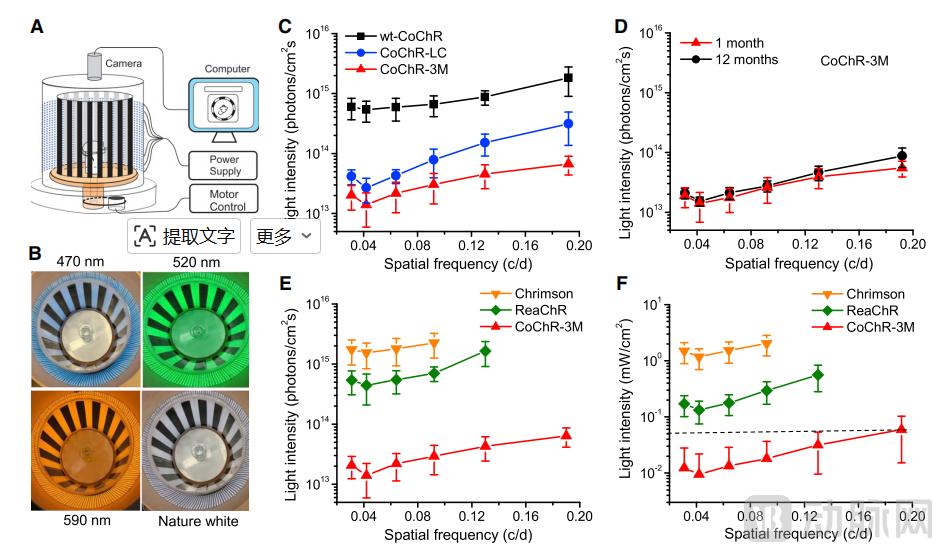
Figure F: Comparison curve of visual recovery thresholds under natural white light (Zhuo-Hua Pan's team. Molecular Therapy, 2019, Figure 6.)
Experimental data shows that the new-generation photosensitive proteins are not restricted by strong light and auxiliary equipment, can adapt to the daily light environment, and have excellent safety performance, greatly making up for the core shortcomings of the first-generation technology. Later, the patents for the relevant improved technology were licensed to Ray, which was established in 2021, and Ray promoted the clinical transformation -
Paul Bresge, the founder of Ray, has long been deeply involved in the ophthalmic field. Due to his family members suffering from retinitis pigmentosa, he has always been committed to finding solutions for blinding eye diseases. The core members of the team have witnessed the early development of optogenetics. Peter Francis, the Chief Science Officer, once led the clinical work of the first-generation therapy at RetroSense and has a thorough understanding of technology iteration and clinical pain points. This team with scientific research vision, clinical experience, and commercialization ability has become a solid force in promoting the implementation of new technologies.
Relying on this general visual optogenetic platform that has been refined twice, Ray has established a differentiated treatment system. The team uses a minimally invasive intravitreal injection method to deliver the gene encoding the improved CoChR photosensitive protein to the retinal neurons with the help of an adeno-associated virus vector. The cells that originally did not have photosensitive ability are re-engineered to be able to sense natural light and convert the light signal into an electrical signal and transmit it to the brain, thereby reconstructing a complete visual pathway.
Compared with traditional therapies, the advantages of this solution are very obvious: it is not restricted by the type of gene mutation, breaking the limitation of a single drug corresponding to a single mutation, and is applicable to a wider range of people; the treatment goal is not to delay the disease process, but to directly reconstruct the visual pathway. Even patients in the late stage with complete apoptosis of photoreceptor cells have a chance of treatment; the therapy only requires a single injection, which is expected to achieve long-term efficacy without the need for optical devices or additional drugs, greatly simplifying the treatment and maintenance process.
Two Pipelines Cover Multiple Refractory Fundus Diseases
Based on the mature optogenetic technology foundation, Ray has planned two complementary pipelines for clinical development targeting different lesion cells and types of eye diseases.
As the core pipeline, RTx-015 targets retinal ganglion cells and is administered by a single intravitreal injection. The core indication, retinitis pigmentosa, has advanced to the II/III phase development stage, and a phase I clinical exploration is being carried out simultaneously for other inherited retinal diseases such as choroideremia. With positive early clinical data, RTx-015 obtained two major regulatory qualifications, the U.S. FDA's Regenerative Medicine Advanced Therapy (RMAT) and the European EMA's Priority Medicines (PRIME), in 2026, and can enjoy benefits such as regulatory guidance and priority review, accelerating the R & D rhythm.
Pipeline RTx-021 adopts a differentiated target strategy, targeting retinal ON - bipolar cells and focusing on macular diseases such as Stargardt disease and geographic atrophy secondary to age-related macular degeneration. These diseases mainly damage the macular area of the eye, directly affecting the central vision of the human body and are an important cause of blindness in the population. The phase I clinical trial of RTx-021 for Stargardt disease has been launched, and the core goal is to verify its ability to repair central vision and make up for the treatment shortcoming in the field of macular diseases.
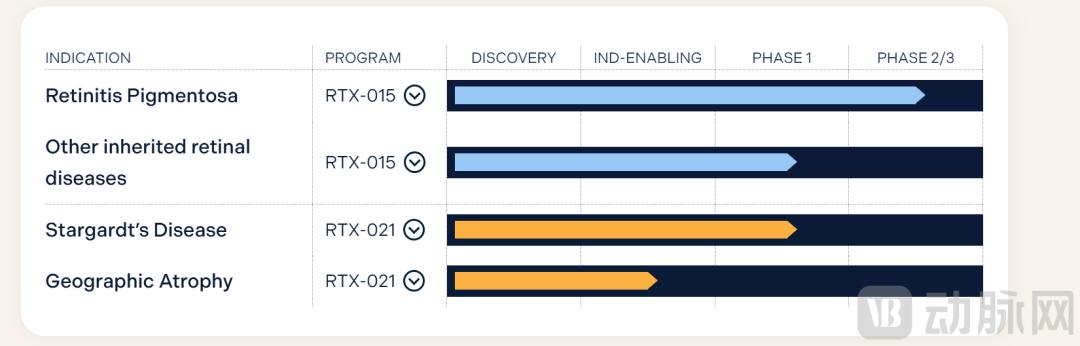
Existing pipeline chart (The figure is from Ray's official website)
The two pipelines are homologous and symbiotic, with differentiated targets, which can maximize the reuse value of the technology platform and reduce R & D risks. On the production side, Ray has joined hands with Forge Biologics to establish a cGMP production system. Forge Biologics undertakes the cGMP production of its AAV vectors and plasmid DNA, providing stable production capacity support for the clinical advancement of the pipelines and subsequent commercialization.
The Ice and Fire Song of Retinal Optogenetic Therapy
Currently, ophthalmic optogenetic therapies are at a critical window period of transition from clinical exploration to commercialization. Many global companies have laid out their strategies, and different technical solutions and R & D progress have heated up the market competition. This type of technology breaks out of the limitations of traditional gene therapies and is not bound to specific gene mutations, especially meeting the treatment needs of patients with late-stage retinal diseases. The first-mover value of this track is gradually emerging.
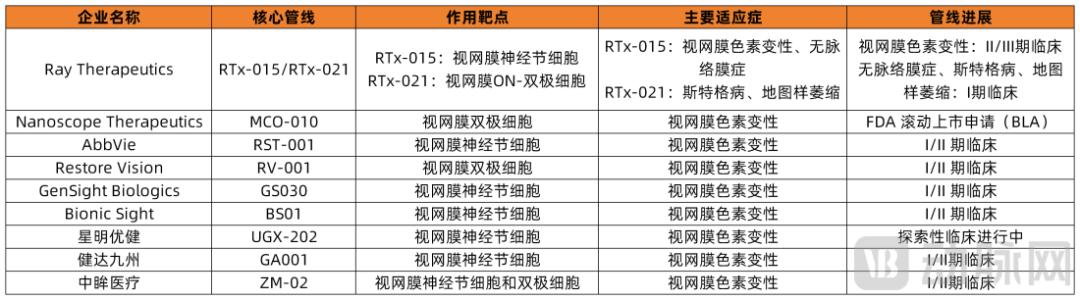
Incomplete statistics by Arterial Network, ophthalmic optogenetic therapy pipelines at home and abroad
Overall, the track shows a pattern where Europe and the United States started earlier, and China is accelerating the catch-up. European and American companies have been deeply involved in this field for many years and have a deep technical accumulation. Among them, Nanoscope's MCO-010 is leading in terms of progress and is most likely to be the first to be launched on the market. Its approval results and post - market performance may become the benchmark for the entire track. The early pipelines of companies such as AbbVie, GenSight, and Bionic Sight are restricted by the insufficient sensitivity of the first - generation photosensitive proteins and must be used with optical goggles to be effective. Restore Vision has taken a differentiated GPCR optogenetic route, using a new - generation chimeric rhodopsin protein design, which is expected to get rid of the dependence on external auxiliary devices.
Although Chinese companies entered the field later, they have a high technical starting point and a strong momentum of catch - up: The GA001 pipeline of Jianda Jiuzhou has obtained the FDA's Fast Track designation and Orphan Drug designation successively and is one of the fastest - progressing pipelines among domestic optogenetic gene therapies. Zhongmou Medical's ZM - 02 has simultaneously laid out clinical trials in China and the United States. The exploratory clinical trial led by Beijing Tongren Hospital has completed a 52 - week long - term follow - up and obtained FDA IND approval in November 2025, starting an international multi - center clinical trial. Xingming Youjian's UGX - 202 has completed the first administration in the exploratory clinical trial, and the application for phase I registration was accepted by the CDE in May 2026. At the same time, it has licensed its overseas rights to the British company AviadoBio, starting a global layout.
However, even though the industry is getting hotter, as of June 2026, no ophthalmic optogenetic drug has been launched on the market globally, and the entire track is still on the eve of commercialization. Multiple problems such as technical shortcomings, regulatory rules, and production costs have also become common challenges for all players.
Technically, the immune risk of AAV vectors and the long - term safety of exogenous photosensitive proteins still need long - term clinical verification. The global unified standard for clinical efficacy evaluation has not been formed, and the cross - field regulatory details of gene therapy and neuromodulation are still being improved, further lengthening the R & D and review cycles. At the same time, strict production standards have increased the manufacturing cost, and future commercialization problems such as product pricing and market education also need to be solved by the industry one by one.
This article is from the WeChat official account "Arterial Network" (ID: vcbeat), author: Yu Miaoxin, published by 36Kr with authorization.