Will the market still embrace Elon Musk's AI + space dream?
More than half a month after SpaceX went public, its stock price has fallen by one-third after rising 20%.
On June 12th, SpaceX was listed on the NASDAQ. With a fundraising scale of $75 billion, it broke the global IPO record set by Saudi Aramco in 2019. On the first day of listing, the stock price closed up nearly 20%, and Elon Musk's net worth reached $1.17 trillion - for the first time in the capital market, there was a "trillion - dollar man".
But the excitement didn't last long. On June 16th, after reaching a high of $229.85, SpaceX's stock price started to decline. By June 22nd, it had fallen 35.73% in four trading days, and the market value evaporated by more than $600 billion. On June 22nd alone, it lost more than $400 billion.
The trigger for the sharp decline was a bond financing. After getting $75 billion from the IPO, less than two weeks later, it announced that it would borrow $25 billion from the bond market. The market was originally willing to listen to Musk's story of AI + space, but borrowing again so soon after getting the money made many investors uncomfortable.
Projects such as Starship, Starlink, Mars colonization, and AI are all burning money. Although $75 billion in financing has arrived, there is still a gap. SpaceX can only continue to issue bonds to maintain its expansion, which also makes investors who originally pursued the myth of the space economy worried: Has this star space enterprise entered a bottomless - pit model of relying on continuous burning of money to maintain operation?
Why is SpaceX a money - guzzler?
From fiscal years 2023 to 2025, the ratio of SpaceX's capital expenditure to revenue has been rising continuously, from 44.15% to 111.63%, and then to 207.37%. In the first quarter of 2026, the company's revenue was $4.7 billion, but the capital expenditure reached $10.1 billion, 2.15 times the revenue. That is to say, SpaceX has to spend more than two dollars to earn one dollar.
Looking at the specific business, SpaceX can be divided into the following parts: the Connectivity segment (Starlink), the Space launch segment, and the AI artificial intelligence segment.
Among them, Starlink is the healthiest business on SpaceX's books and the only cash - cow of the group. In 2025, this business segment accounted for 61% of the revenue, and in the first quarter of this year, it rose to 69.4%. Many investment banks expect that Starlink's revenue share for the whole year will be close to 80%, and the revenue gap with other businesses is widening.
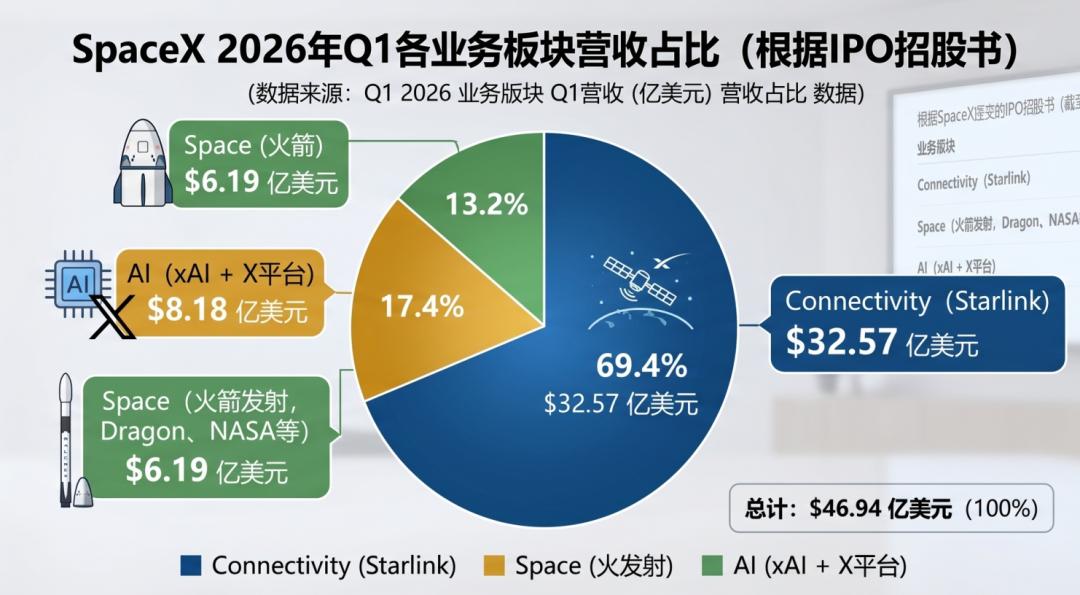
As of March this year, there were about 9,600 Starlink satellites in orbit, covering 164 countries, and the number of subscribed users exceeded 10 million. However, the ARPU (average revenue per user) of this business has been declining for three consecutive years. Although the user base is expanding, the money contributed by each user is decreasing. To maintain revenue growth, Starlink has to continuously attract new users, and the cost of attracting new users is continuous satellite launches and the construction of ground stations.
In addition, Amazon's Kuiper, OneWeb, and China's GW constellation are all accelerating. The competition in the global low - orbit satellite Internet is heating up. To maintain its lead, SpaceX has to continuously expand its constellation and upgrade its satellites. Every step requires real money.
SpaceX's space launch business is based on the Falcon 9. With 650 launches and a success rate of over 99%, the single - launch cost has been reduced from the industry average of hundreds of millions of dollars to about $67 million. The reusable rocket is the real threat of SpaceX to traditional space industry.
However, the launch business itself is not profitable. When the commercial launches of the Falcon 9 were barely breaking even, SpaceX bet on the next - generation heavy - lift rocket, Starship. Musk wants to reduce the cost of orbit insertion to less than $100 per kilogram and open up the markets for satellite deployment, space tourism, and interstellar transportation with low prices. Only in 2025, $3 billion was burned on Starship R & D, and another $930 million was invested in the first quarter of this year, which also led to an expansion of the losses in SpaceX's space launch business.
However, the real money - guzzler is AI.
Before 2025, SpaceX's capital expenditure was concentrated on rockets, satellites, and Starlink, and it could not be regarded as an AI company. But Musk has always wanted to build a vertically integrated system of "rocket + satellite + AI + data center". After fully acquiring xAI in February this year, the AI expenditure in the system began to expand rapidly. In 2025, the capital expenditure of the AI segment was $12.727 billion, accounting for 61% of the total expenditure; in the first quarter of this year, $7.7 billion was spent in a single quarter, and the proportion rose to 76%. These huge capital expenditures are mainly used to buy GPUs and build data centers.
In the current environment where the AI arms race is intensifying, Musk doesn't seem to have the intention to stop. The prospectus shows that SpaceX plans to invest $120 billion between 2026 and 2027, and the cumulative investment will reach $350 billion before 2030, most of which will be used for AI business - including orbital AI computing satellites, the Terafab chip factory, and the ongoing $60 - billion acquisition of the code platform Cursor.
It is worth noting that when Musk merged X and xAI into SpaceX, he also brought over the $12.5 - billion high - interest loan borrowed for the acquisition of X. Coupled with the loans for xAI R & D and GPU purchases, the merged SpaceX has to bear a heavy interest burden every year. To make room, Musk borrowed a $20 - billion bridge loan from Wall Street institutions such as Goldman Sachs. The original intention of this bridge loan was to temporarily take over the debt and be replaced immediately after a successful IPO.
It can be seen that the $75 - billion IPO fundraising cannot fill these holes of SpaceX for the time being.
The cost and signal behind the bond issuance
It is not uncommon for high - quality companies to issue bonds to increase leverage in the capital market. But SpaceX's bond issuance came too soon - only ten days after the IPO, and the market hadn't recovered. The wrong timing changed the meaning of the signal.
Several international rating agencies, Standard & Poor's, Moody's, and Fitch, gave ratings of BBB, Baa1, and BBB+ respectively to this bond. These ratings are on the lower side of the investment - grade, but not too bad. However, for a star technology company with a market value of $2 trillion, this rating can only be said to be average. The rating agencies are not very confident about its cash - flow sustainability.
What makes the market even more uneasy is the timing. Turning to the bond market only ten days after the IPO shows that SpaceX's financing plan has almost no buffer. After the $75 - billion IPO funds arrive, it first repays the bridge loan and then issues new bonds to fill the holes. As soon as the money comes in, it has to go out, and then it has to borrow again. The tightness of this capital chain is very serious.
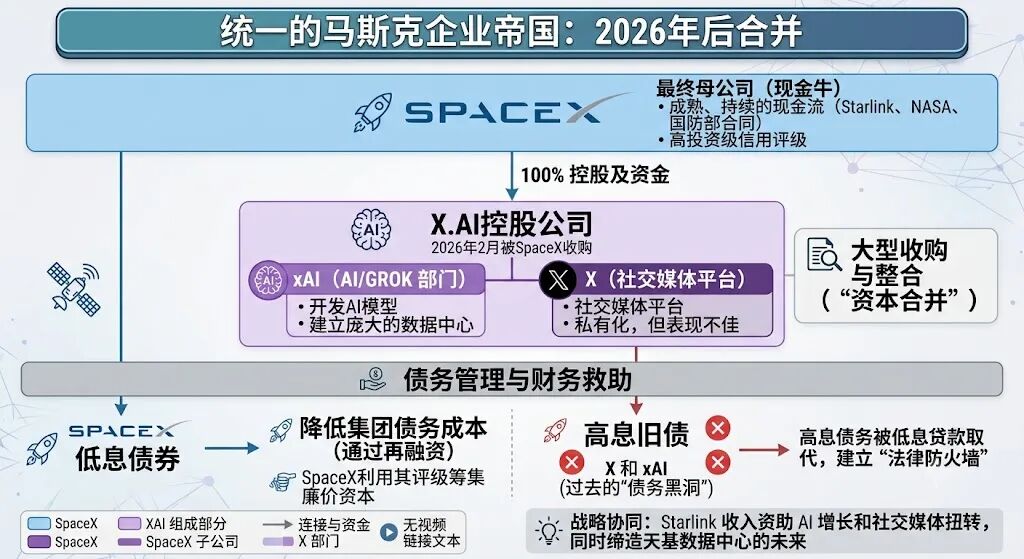
Another risk that is easily overlooked is the "promised revenue of $80 billion" in the AI business. SpaceX claims that it has signed computing - power leasing agreements with several institutions such as Anthropic and Reflection AI, with a cumulative promised revenue of more than $80 billion. This $80 - billion revenue pie has also become an important basis for supporting the valuation of the company's AI business.
However, the prospectus shows that all Colossus contracts contain a 90 - day early - termination clause. This means that the so - called "promised revenue of $80 billion" is actually just a decision to renew the contract on a quarterly rolling basis, and either party can withdraw from the agreement after a 90 - day notice. That is to say, this is not a multi - year locked - in contract, but a short - term temporary agreement, and the revenue from this business is not stable.
With the debt piling up and the revenue uncertain, this is what the market is really worried about.
Jiedian Finance believes that this snowball - style debt - borrowing model is essentially over - drawing market confidence. Once the market trend changes and investors vote with their feet, even with Elon Musk's personal brand endorsement, continuous large - scale borrowing will continuously consume the market's growth expectations for it, further shaking investors' confidence, and continuously increasing the cost and difficulty of subsequent financing. Eventually, the debt snowball will become more and more dangerous.
Especially this time, the interest - rate range of the bond issuance is set at 11% - 12%, higher than the previous rounds. The market is starting to ask a price for SpaceX's high debt. The financing cost is rising, which is a signal that the debt risk is starting to emerge. The negative impact of uncertain revenue is being transmitted to the financing end.
Short - sellers are in, but it's not easy
After SpaceX announced the issuance of a huge amount of bonds, the bearish sentiment in the market has increased. According to S3 Partners' estimate, as of June 23rd, about 5% to 7% of the outstanding shares have been short - sold. Subsequently, Ortex's model based on securities - lending data estimated that the short positions may have quickly risen to about 13%. These short - sellers are bearish not only on SpaceX's cash flow but also on its high valuation.
Since SpaceX is not yet profitable, currently only the price - to - sales ratio can be considered. As of the close on June 30th, Eastern Time, the company's market value is $2.25 trillion, and the TTM revenue (12 - month rolling revenue) is $19.864 billion, with a price - to - sales ratio of 113.27 times. Comparing with the price - to - sales ratios of some star technology stocks in the US stock market, NVIDIA's is 19 times, and Palantir's is 52 times. SpaceX is significantly more expensive.
Actually, it is difficult to classify SpaceX. It is not a pure space company, nor an Internet company or an AI company. Instead, it is more like a "holding platform" composed of multiple businesses. How to price it is also the focus of the game between the bulls and the bears.
According to traditional methods, Starlink is the easiest part to value. As the only profitable business segment, it is suitable to be valued using the EV/EBITDA method. In 2025, the EBITDA (operating profit + depreciation) of this business was $7.168 billion. The industry multiple is generally 15 to 25 times. Calculated, the EV (equity market value + interest - bearing debt - cash and cash equivalents) is between $107.5 billion and $179.2 billion.
The space launch business achieved a revenue of $4.086 billion in 2025. The price - to - sales ratio of mature US military - industrial enterprises is generally 2 to 3 times. Since SpaceX has a relatively high market share, calculated at 4 to 7 times, the valuation is roughly between $16.3 billion and $28.6 billion.
Currently, the most controversial and most elastic part of SpaceX's valuation is the AI business. The main revenue sources of xAI include the Grok subscription service, enterprise API services, model calls for developers, and integration and monetization with the social platform X. The problem is that these businesses are still a long way from covering their training and inference costs.
OpenAI has millions of paying users and corporate customers, and its API ecosystem is mature; Anthropic has stable corporate revenue and is expected to be profitable in the second quarter. But xAI has not yet proven that it can reach the same market scale. Even if xAI can catch up with OpenAI and Anthropic, and using their latest valuations of $852 billion and $965 billion respectively for comparison, plus the valuations of Starlink and the launch business, it is still difficult for SpaceX's total valuation to reach $2 trillion. SpaceX's current market value is obviously too high.
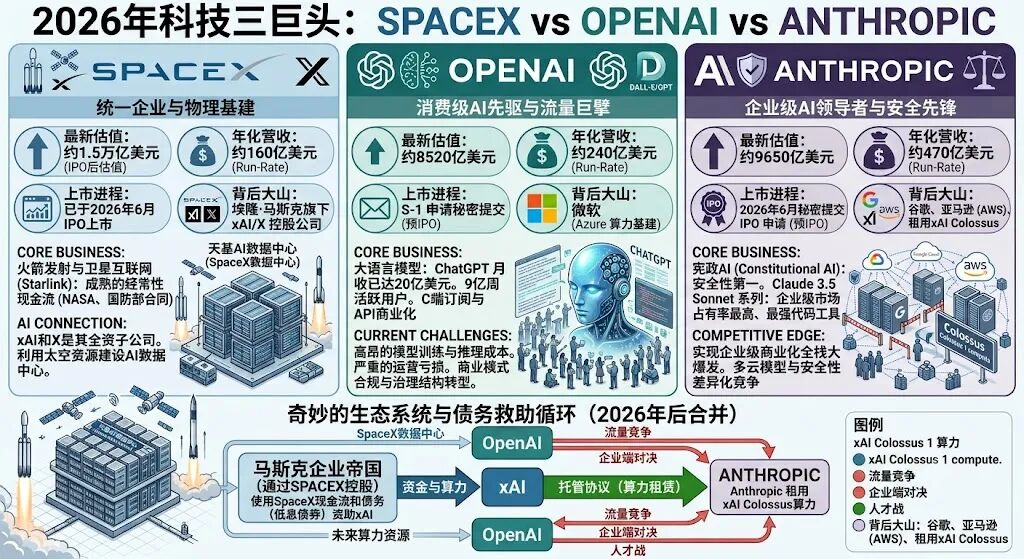
The market's pricing of SpaceX has exceeded the scope of a rocket company, a satellite operator, or an AI company. It is betting on several things at the same time: Starlink becoming the global communication infrastructure, Starship opening up the space economy, xAI entering the first echelon of AI, and Musk being able to continuously create new businesses. And these growth expectations have actually been priced into the stock price in advance.
For this kind of high - valuation growth stocks where the market discounts the cash flow of the next ten or even twenty years in advance, under the current strong expectation of the Fed's interest - rate hikes, the probability of their valuations being lowered is also increasing. The funds in the market will be more inclined to flow to high - dividend assets such as energy and public utilities with lower valuations.
It is worth mentioning that SpaceX will be included in the NASDAQ 100 index on July 7th. JPMorgan Chase estimates that about $4.3 billion in passive funds will flow in.
Jiedian Finance believes that although SpaceX may be one of the stocks most worth shorting fundamentally, it is also one of the most dangerous short - selling targets at the trading level. Currently, SpaceX's floating stock is too small, and the free - floating share ratio is about 4.2% - 4.3%. For short - sellers, the available floating shares for borrowing are limited. Once there is good news, it is easy to cause a short squeeze, and as long as there is a little new buying, the stock price may have a very large elasticity. At the same time, if the bulls betting on long - term growth continue to buy the floating shares, it will also make it more difficult for short - sellers to operate.
In addition, Elon Musk himself has a strong control over the stock price. Whether it is frequently speaking to guide market expectations or relying on personal influence to attract retail investors and core capital to hold positions, it will further compress the operating space of short - sellers. To short - sell SpaceX, one not only needs to accurately judge the fundamentals but also withstand the margin pressure caused by short - term stock - price fluctuations. A slight mistake will lead to a margin call and being forced to exit the market. The difficulty of short - selling is much higher than that of ordinary over - valued growth stocks.
This article is from the WeChat public account "Jiedian Finance" (ID: jiedian2018), author: Jiedian Finance, published by 36Kr with authorization.