A Bumper Harvest for Lithium Battery Materials
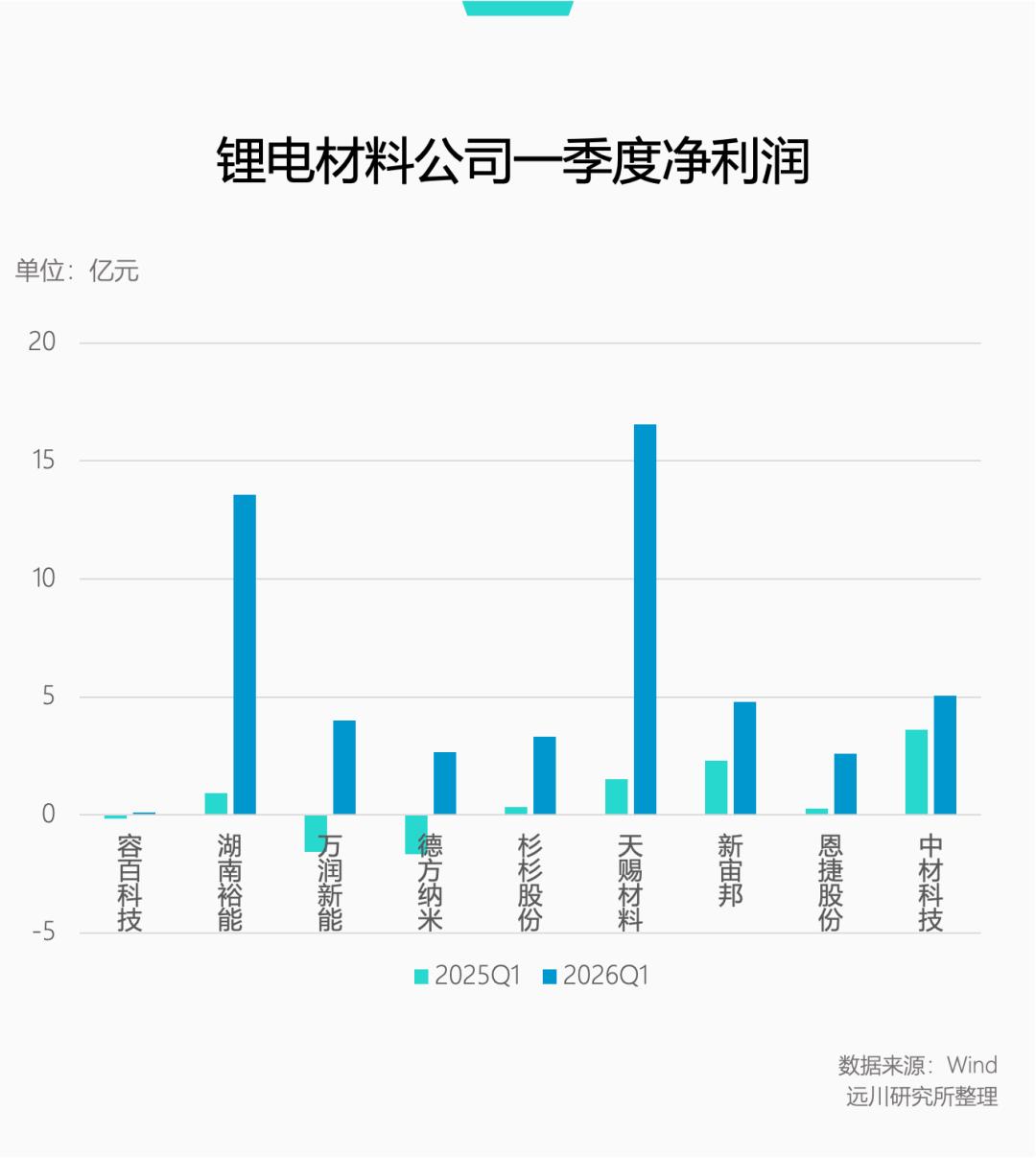
In the first quarter, the lithium battery sector achieved great success. The average net profit growth rate of 60 companies exceeded 209% [1], as remarkable as the transformation of the optical module sector.
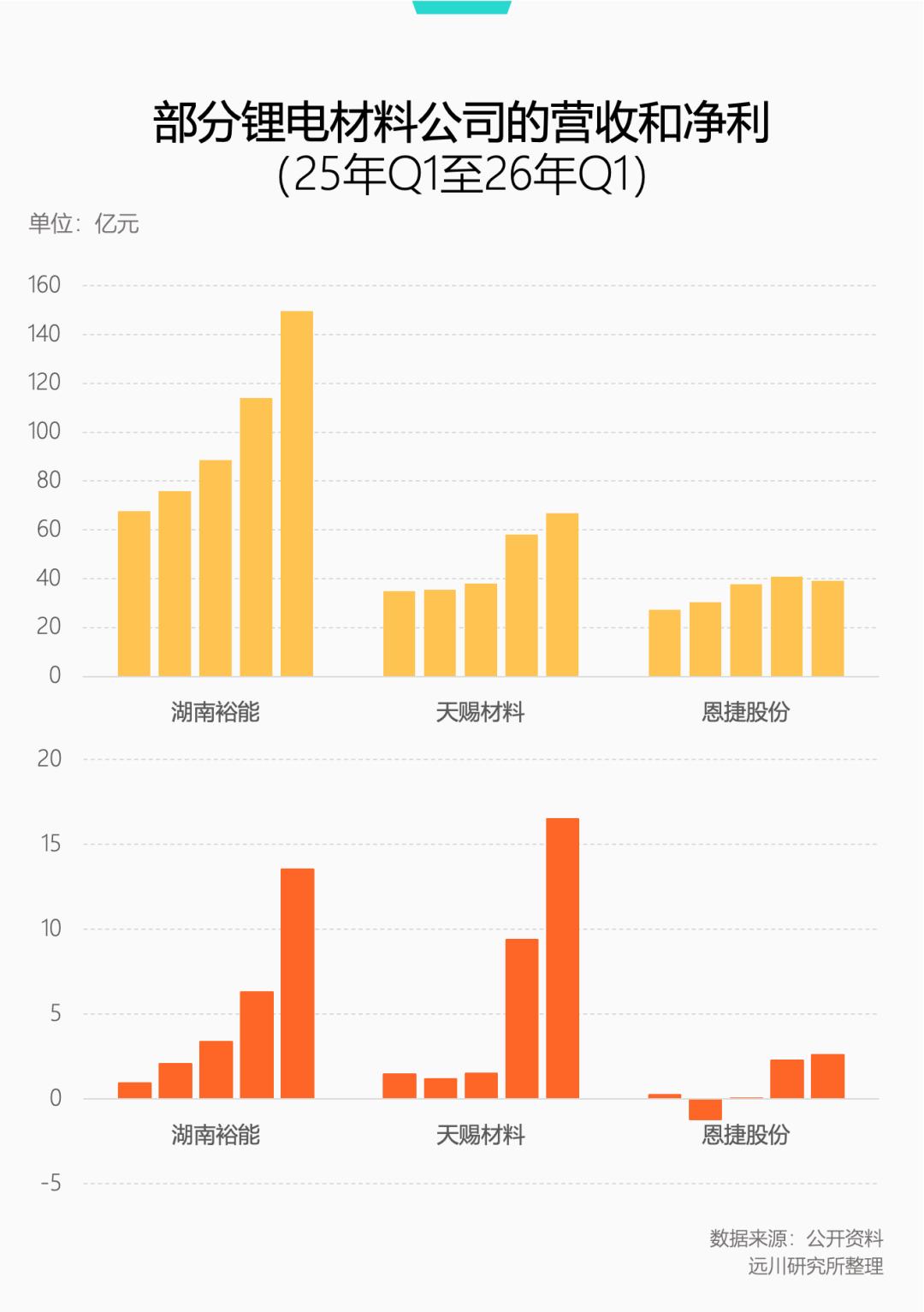
Hunan Yoneng, a company producing cathode materials, saw its net profit soar by 1338% year-on-year. Tianci Materials, whose main business is electrolyte and also has cathode materials as a side business, witnessed a 1006% increase in net profit.
Enjie Co., Ltd., a separator company, had a 902% year-on-year increase in net profit. For Shanshan Co., Ltd., its negative electrode materials and polarizers contribute equally to its main business, and its net profit growth rate was also close to 900%.
The performance of a single company may not indicate much, but when an industry climbs out of the trough, the signal of a rebound is very strong.
Turning the Tables Overnight
Before the great performance success, lithium battery material companies had endured three tough years.
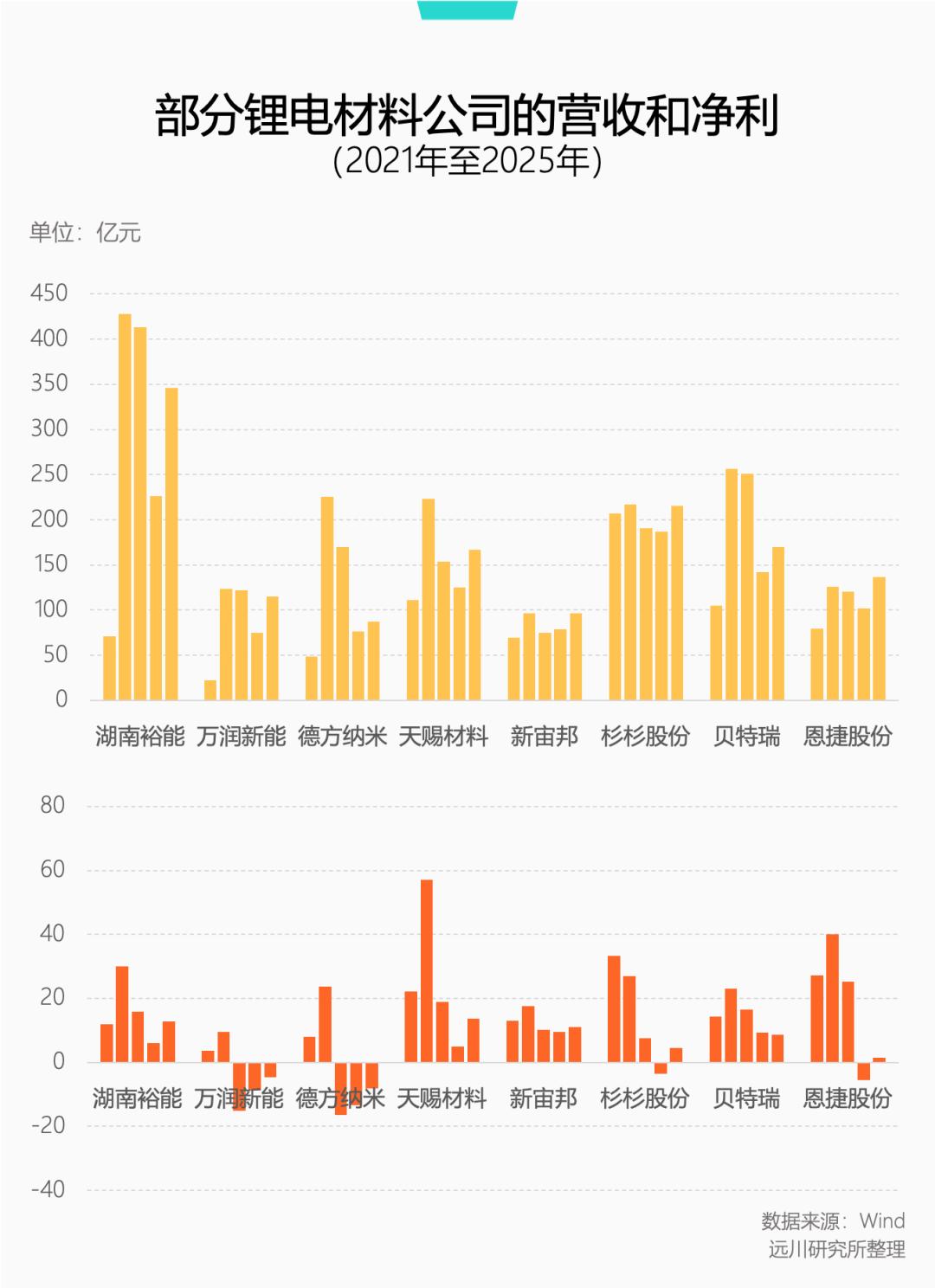
From 2022 to 2024, the revenue scale of Hunan Yoneng shrank by 47%, a reduction of a full 20 billion yuan, and its net profit volume dropped by 80%.
Tianci Materials next door also had a hard time. During the same period, its revenue decreased from 22.3 billion yuan to 12.5 billion yuan, and its net profit shrank from 5.7 billion yuan to less than 500 million yuan.
The change occurred in the fourth quarter of 2025. Lithium battery materials reversed the downward trend and started to rise.
Rongbai Technology turned a profit in a single quarter, and its annual loss narrowed. In Q4, Hunan Yoneng's revenue accounted for one-third of the whole year, and its net profit accounted for half of the annual total.
Tianci Materials' net profit in Q4 increased by more than five times year-on-year and quarter-on-quarter, contributing 60% of the annual profit. Enjie Co., Ltd.'s single-quarter net profit was 229 million yuan, a quarter-on-quarter surge of 3270%, and it single-handedly supported the annual profit.
By now, the "U" - shaped curve of the performance of lithium battery material factories has begun to take shape. The growth trend continued into the first quarter of this year, dispelling the gloom of the past three years.
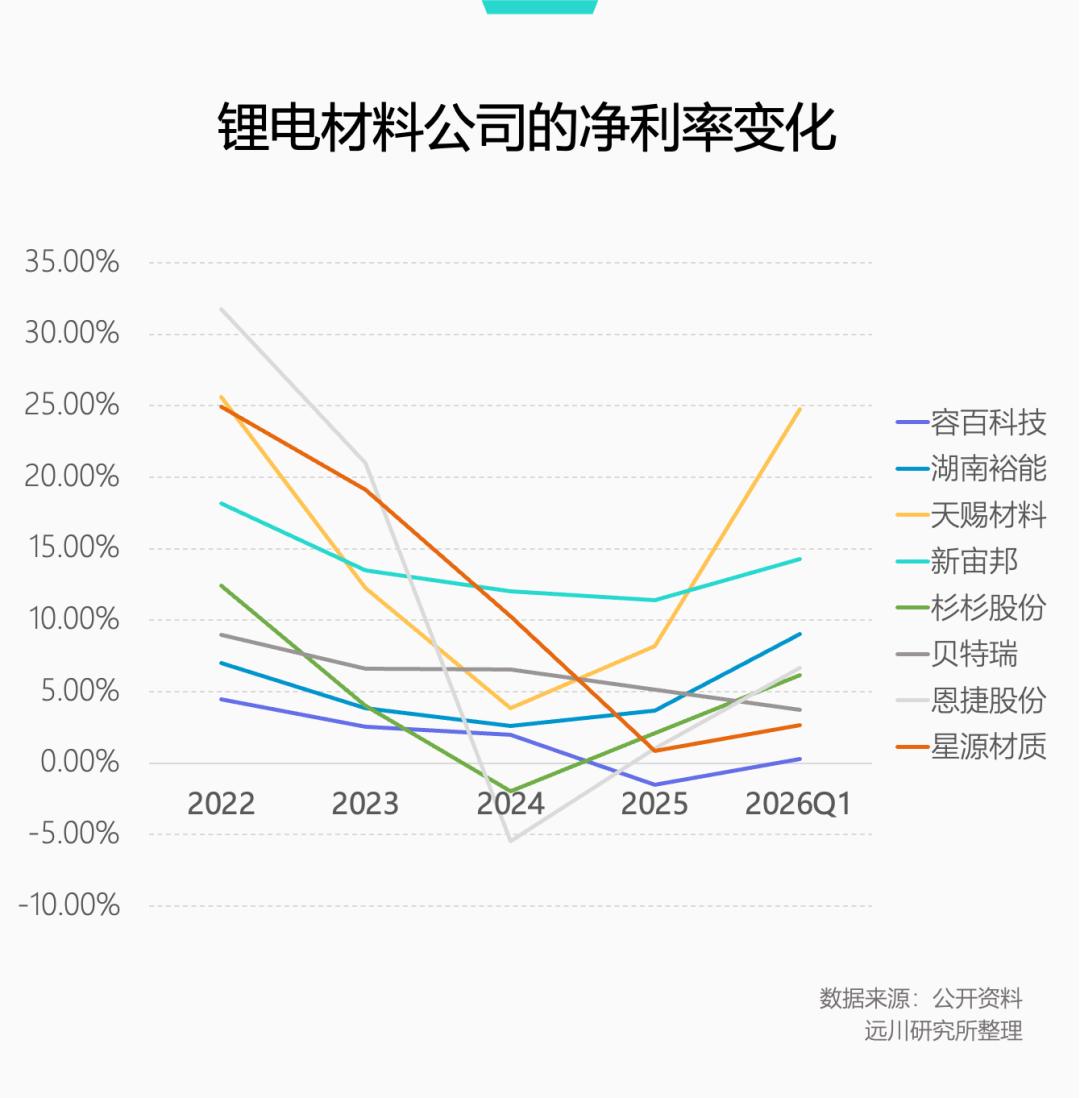
During this process, the profitability of material factories has also improved.
Taking Tianci Materials as an example, its net profit margin was 25.6% in 2022, halved to 12.3% in 2023, and further declined to 3.9% in 2024, dropping from a level comparable to TSMC to that of Foxconn.
However, in the fourth quarter of last year, Tianci Materials' net profit margin increased by 10%, returning to 16%, and reached 24.8% in the first quarter of this year, almost equal to the high point in 2022.
Tianci Materials is not an exception. The financial reports of lithium battery material factories consistently reflect the continuous improvement of profit margins.
Due to differences in industry characteristics, the net profit margin ranges of the four core materials vary.
As for how long this "U" - shaped curve can last? The answer lies in the reasons for its formation.
The Real Culprit Behind the Curve
In 2022, the new energy vehicle market suddenly exploded, catching the upstream supply chain off guard. Lithium battery material factories were inundated with orders. The revenues of major material factories generally doubled, and Hunan Yoneng's revenue quadrupled six - fold.
The upstream mining companies were even more astonishing. Tianqi Lithium's net profit in the same year was 24.1 billion yuan, with a growth rate of over 1000% and a gross profit margin of 85%, far more spectacular than today's storage factories.
However, such good times only lasted for one year. The upstream of the new energy vehicle industry soon faced all - around overcapacity.
Material factories are located in the middle of the lithium battery industry chain, and their downstream customers are battery companies. When battery companies expand their production capacity, material factories also have to follow suit.
However, the production expansion cycles of different links in the lithium battery industry chain vary. The closer to the downstream, the faster the production expansion. Therefore, material factories need to prepare production capacity in advance to win orders.
Assuming that a battery factory plans a production capacity of 1, a material factory usually needs to match a production capacity of 1.2. If battery factories expand production steadily, everyone can make money. Once the rhythm is disrupted, overcapacity is likely to occur. This concern emerged in 2023.
On the one hand, with the explosive demand for new energy vehicles, battery factories inevitably planned production capacity in advance to win orders. Every company wanted to capture the increased market share, resulting in over - capacity.
In 2022 alone, the total planned production capacity of domestic lithium batteries exceeded 1.2 TWh, four times the installed capacity of that year. There were as many as 156 production expansion projects for the four major middle - stream materials, with a planned investment of over 500 billion yuan [2]. The upstream also witnessed a wave of mineral mergers and acquisitions, scouring the world for resources.
On the other hand, the rapid expansion of the lithium battery market attracted a group of cross - border players. For example, the women's clothing brand Ribo Fashion, probably inspired by Shanshan Co., Ltd., entered the lithium battery material market with heavy investment in 2023 and even changed its name to Puyuan Materials.
No matter how fast the market grows, its scale is ultimately limited. Lithium battery material factories also realized this and slowed down their investment in unison. In 2024, the total planned investment in the industry shrank significantly, plummeting by about 70% [3].
The already - built production capacity could not be dismantled and could only be gradually digested by the new demand. In 2024, the entire lithium battery industry was gloomy. The prices of battery raw materials had nowhere to go but down, and lithium mines turned from valuable assets into useless stones taking up space.
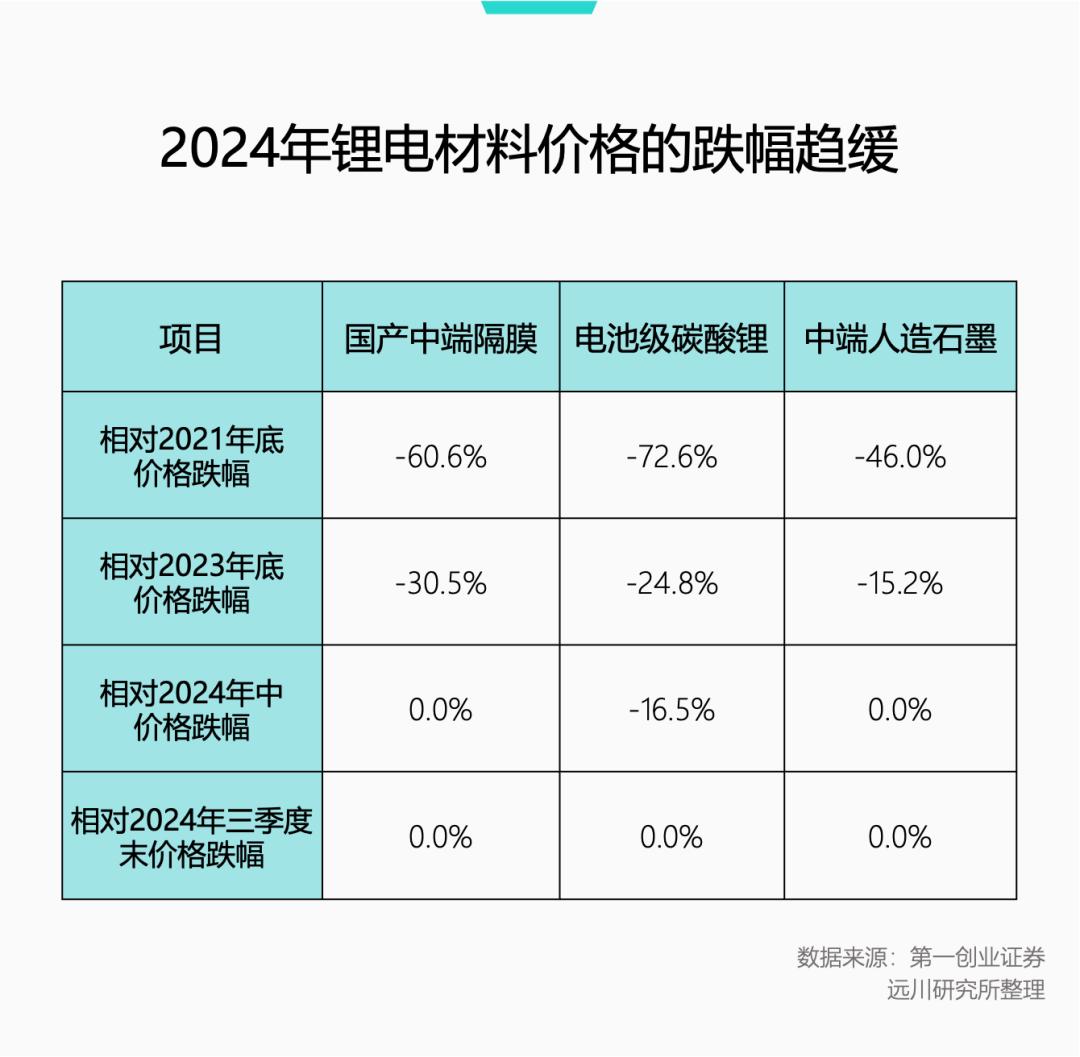
In addition to the decline in product prices, material factories also faced a problem left over from the upstream: the sharp decline in the value of raw material inventories.
Taking lithium carbonate as an example, it was similar to a financial product in the past few years. Especially from 2023 to 2024, its price hit new lows, plunging from nearly 600,000 yuan per ton to less than 100,000 yuan. All cathode material companies made large provisions for inventory impairment losses. Hunan Yoneng made provisions of 330 million yuan and 60 million yuan in these two years respectively.
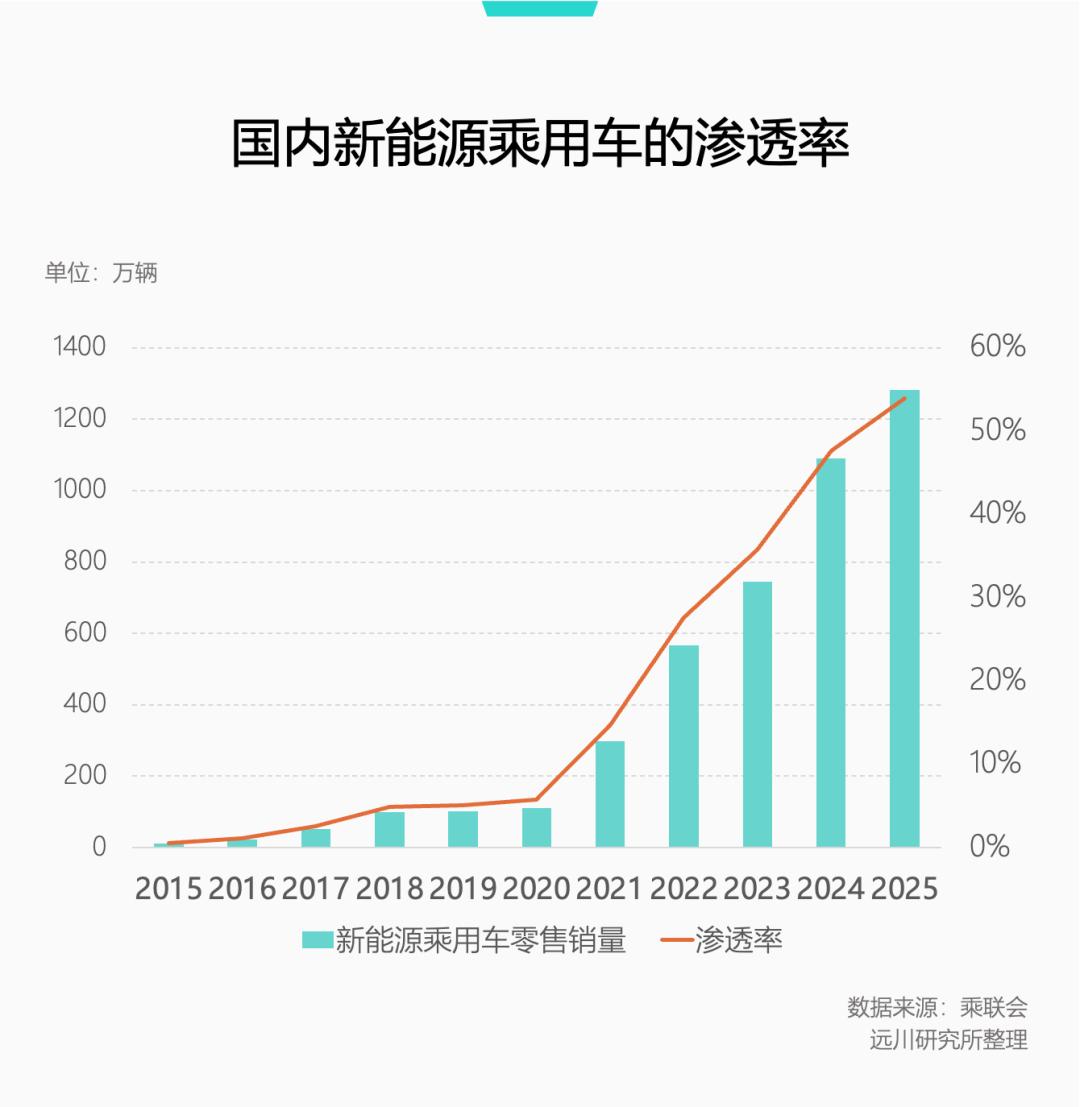
After that, a strange phenomenon occurred: the penetration rate of new energy vehicles continued to rise steadily, but lithium battery material factories could no longer make money. In 2023, Hunan Yoneng's revenue slightly decreased to 41.3 billion yuan, and in 2024, it was only 22.6 billion yuan for the whole year.
At this time, a new figure emerged in the vision of material factories: energy storage.
Energy Storage Saves Lithium Battery Materials
The current energy storage batteries are similar to the early - stage power batteries, in the initial stage with strong explosive power.
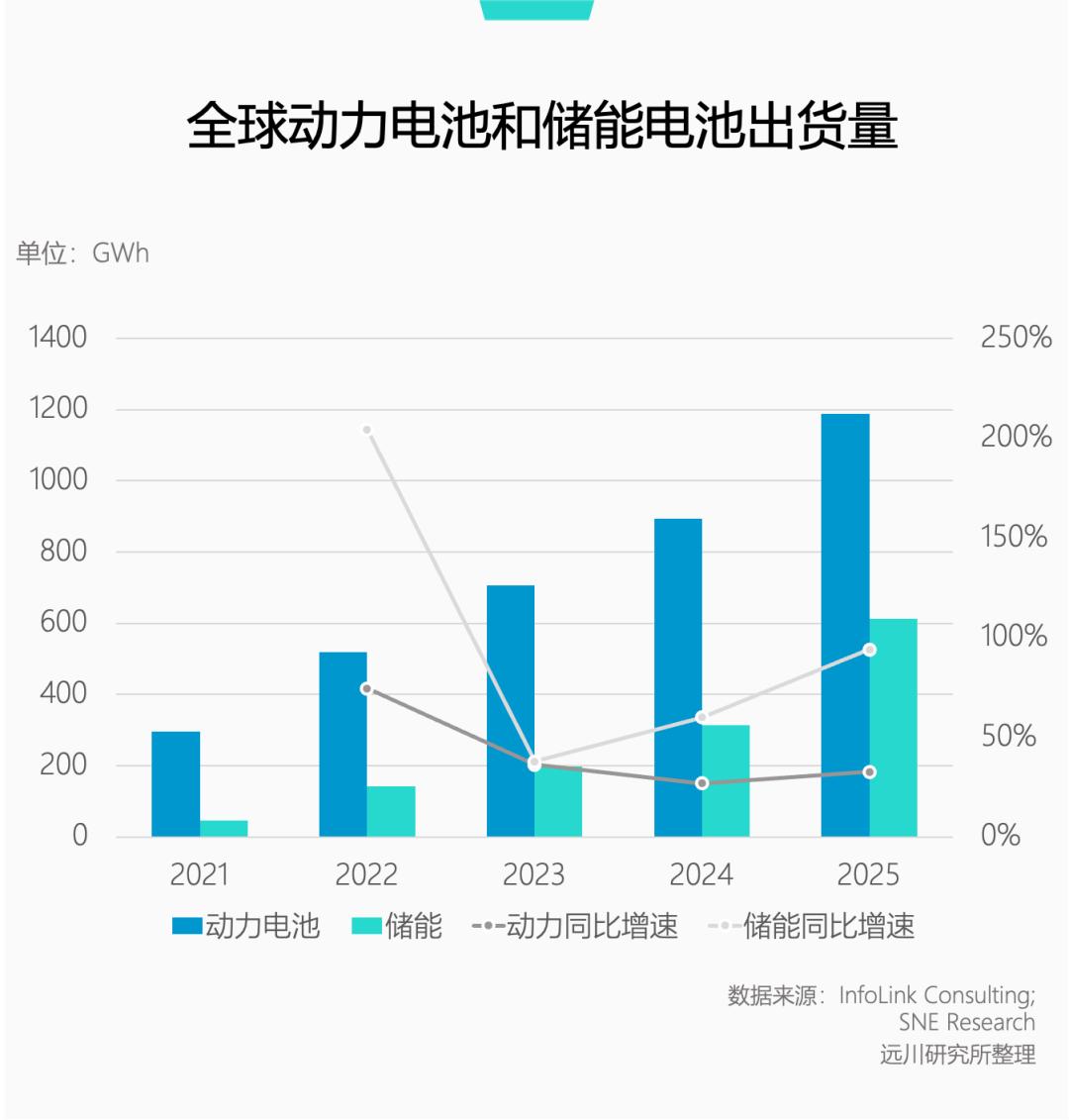
According to SNE Research data, the global energy storage battery shipments increased by 79% last year, outperforming the 31% growth of power batteries.
The statistics from another institution, InfoLink, are even more radical: the energy storage battery shipments reached 612 GWh, a year - on - year increase of 94%.
In 2025, the shipments of energy storage batteries were about half of those of power batteries, but the growth rate was more than twice as high, even higher than the fastest - growing year of power batteries in 2022. Compared with 2021, the shipments of power batteries increased by less than three times, while those of energy storage batteries increased by a full 12 times.
According to this trend, energy storage batteries will soon replace power batteries as the largest customers of material factories.
The direct change brought about by the sharp increase in downstream demand is a significant increase in capacity utilization.
Last year, the capacity utilization rate of Hunan Yoneng reached an astonishing 113.76%. Enjie Co., Ltd. was close to 95%. Although Tianci Materials did not operate at full capacity, its capacity utilization rate was 25% higher than the previous year, reaching 85%.
Most material factories have staked their fortunes on large - scale asset lists. Even if they do not start production, the depreciation of production line equipment will inevitably turn into losses in the financial statements. Only by increasing the capacity utilization rate can the depreciation cost be spread, and more sales mean more profits.
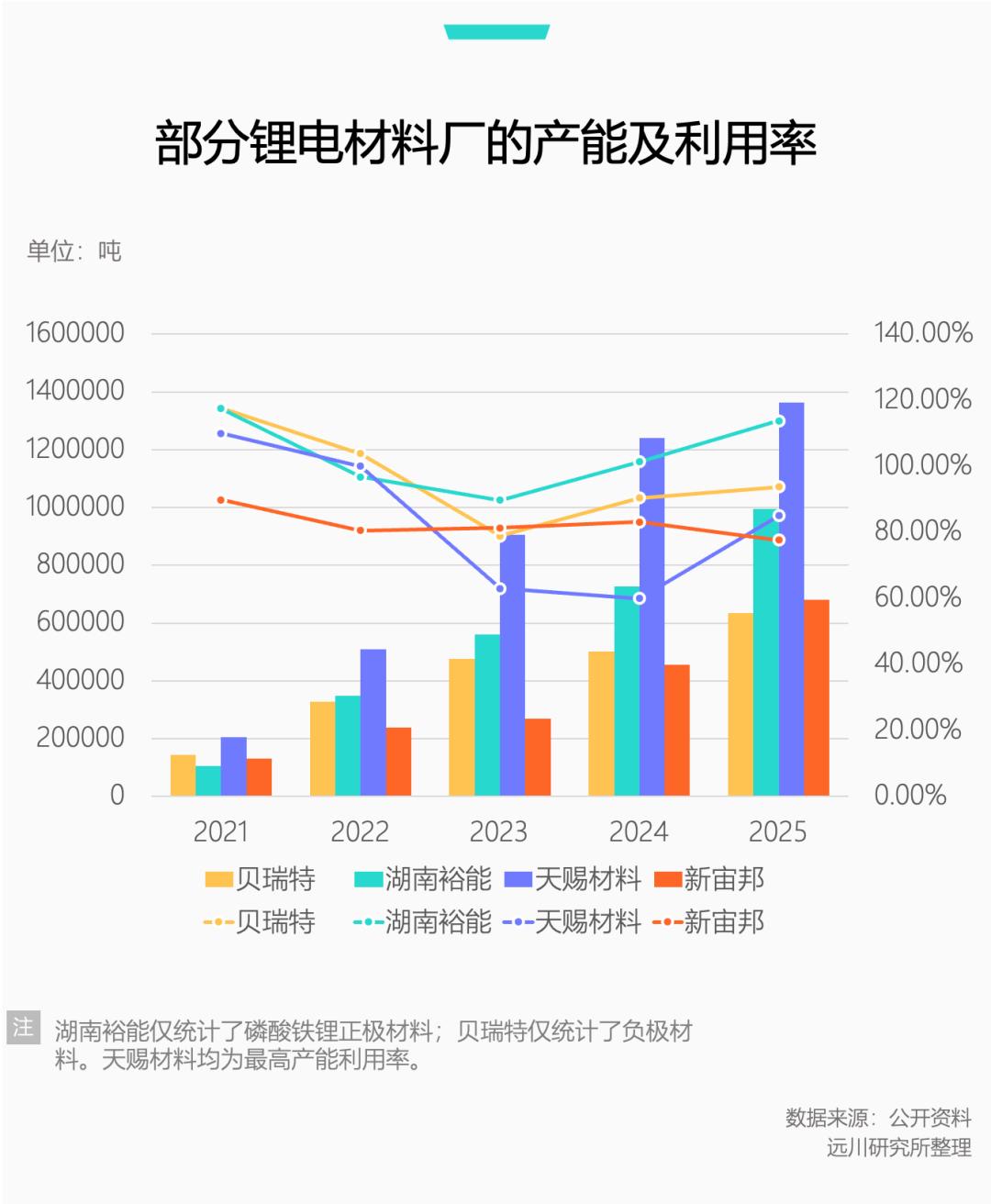
In the past few years, the rapid expansion of production capacity in material factories led to a significant decline in the operating rate, with a lot of idle production capacity, and the income statements were severely hit.
Therefore, compared with the production capacity increases of one or two times in 2022, the production expansion rhythm of lithium battery material factories has significantly slowed down in the past three years. The investment proportion of the material industry in the entire industry chain has also been continuously narrowing [5].
Production capacity planning is rigid, while demand changes are elastic. Most material factories regard power batteries as the core of their business. When faced with the explosive demand for energy storage, they will inevitably fall into a situation where production capacity cannot keep up.
The good news is that materials whose prices have collapsed finally have a reason to increase in price.
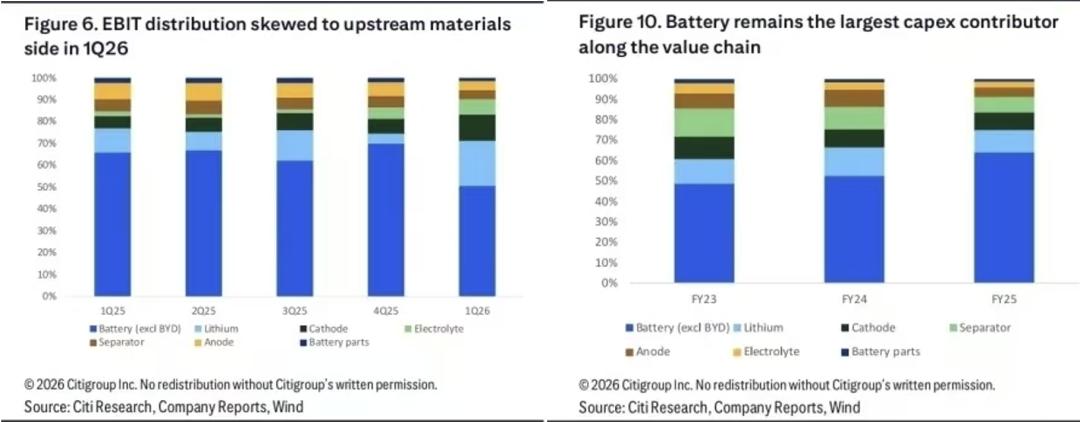
In the entire battery industry chain, the EBIT proportion of the battery industry decreased from 66% last year to 51% in the first quarter, while the upstream materials showed obvious growth.
Currently, the demand for energy storage is still growing rapidly. The global energy storage battery shipments soared by 117% in the first quarter, which means that middle - stream material factories are faced with two choices:
One is for everyone to tacitly tighten production capacity and enjoy the wealth brought by the increase in product profits.
The other is for everyone to compete fiercely by expanding production to grab market share, but the nightmare of many years ago may well reappear.
Unlike downstream batteries, which have an oligopoly structure and oligopoly - style profits, the middle - stream market structure is relatively fragmented, and the market share of leading companies is generally less than 30%. This means that even if everyone tacitly controls production, it is difficult to avoid hidden competition.
Once they choose the second path, it means that they have to return to the old path of competing on scale and cost. Chinese battery materials account for more than 90% of the global market share, but the cut - throat competition seems far from over.
Material factories can briefly enjoy the happiness brought by tight production capacity and explosive demand, but this happiness already has a price tag.
References
[1] The performance of the lithium battery sector is astonishing. The net profits of many companies have increased by more than 1000%, with the highest increase exceeding 2297%. 21st Century Business Herald.
[2] At the beginning of 2023: The alarm of overcapacity in lithium battery materials has been sounded. GGII.
[3] The prosperity of the lithium battery material industry is expected to bottom out and rebound. First Capital Securities.
[4] The investment growth rate in the lithium battery industry has declined. China Energy News.
[5] China Battery Materials, Citigroup.