The simultaneous disappearance of front-end and back-end roles: AI Coding is reshaping the division of labor for engineers in large tech companies
New adjustment signals are emerging in the R & D organizations of large companies.
According to "Big Company Daily Explosion", this week, the R & D team of Meituan's CLC grocery retail Keemart completed an organizational structure adjustment. The front - end and back - end teams were officially merged, and the new organizational structure has taken effect. It is reported that relevant front - end personnel had undergone back - end development training more than a month in advance. Meanwhile, Ant Group's MYbank also announced that it would shift the entire testing positions to R & D positions and set a six - month buffer period for relevant personnel. After the transition period, the former testers will transform into full - stack engineers.
Boris Cherny, the father of Claude Code, also posted a sharing yesterday, saying that as functions such as engineering, product, design, and data science gradually merge into a new role form, he has also been thinking recently about what the future job division might look like.
Through observing the Claude Code team, Boris didn't see the traditional functional division but rather five types of role prototypes:
- Prototyper: Responsible for putting forward brand - new ideas and quickly generating a large number of creative ideas, most of which will not be launched in the end.
- Builder: Capable of rapidly transforming a prototype or an idea into a production - level product or infrastructure.
- Sweeper: Responsible for polishing the UI, simplifying the code and systems, removing unnecessary functions, and optimizing performance.
- Grower: After the product is developed, continuously iterate to improve the product - market fit.
- Maintainer: Responsible for the long - term operation of mature systems, ensuring that they remain safe, reliable, fast, and efficient during the scaling - up process.
"Many people span two of these roles, and sometimes even three. I also noticed that these roles are not strictly bound to a specific function. For example, within Anthropic, some designers are closer to the first type, some to the second type, and some to the third type. The same goes for engineers, product managers, and data scientists." Boris said.
The days when having React skills was enough to get an interview opportunity are quickly fading away. In the current context of the rapid popularization of AI Coding, the division of technical positions is also facing a reshaping. In particular, the boundary between so - called front - end and back - end engineers is being re - integrated into "full - stack capabilities". Enterprises no longer just want a "pure front - end developer" but hope that candidates can handle back - end APIs, understand database structures, and independently complete the development, deployment, and delivery of a function from start to finish.
Signals released by ByteDance and Alibaba's recruitment
"Every company seems to be recruiting full - stack engineers," said a developer.
"The division boundary between the front - end and the back - end has disappeared. Most teams, like the one I'm in, now want people who can take end - to - end responsibility. Professional skills are still a plus, but the 'pure front - end engineers' who only do front - end work and back off when faced with back - end tasks are no longer suitable for most teams," another developer said.
Very clear signals of "job consolidation" have emerged in the recruitment market.
Google's full - stack application engineer position is more like a position focused on business applications. The front - end is just a part of it, and its responsibilities cover the entire software delivery chain. Traditional front - end positions usually focus on "user interface and front - end engineering implementation", while Google's full - stack application engineers are also responsible for the entire process from requirement collection, solution implementation, online delivery to subsequent operation support. This position requires direct understanding of internal customer needs and even undertakes some roles of BA, product managers, and solution engineers.
ByteDance's recruitment website also has a position of "AI Full - stack Engineer - Video and Edge". Although it is listed under the "front - end" category, its responsibility boundary has expanded to multiple directions such as AI product engineering, Agent service orchestration, multi - terminal SDKs, audio - video underlying capabilities, and cloud platforms.
Such job descriptions may be relatively broad, but they do release the signal that for the large front - end in the AI Native era, teams are looking for full - stack talents.
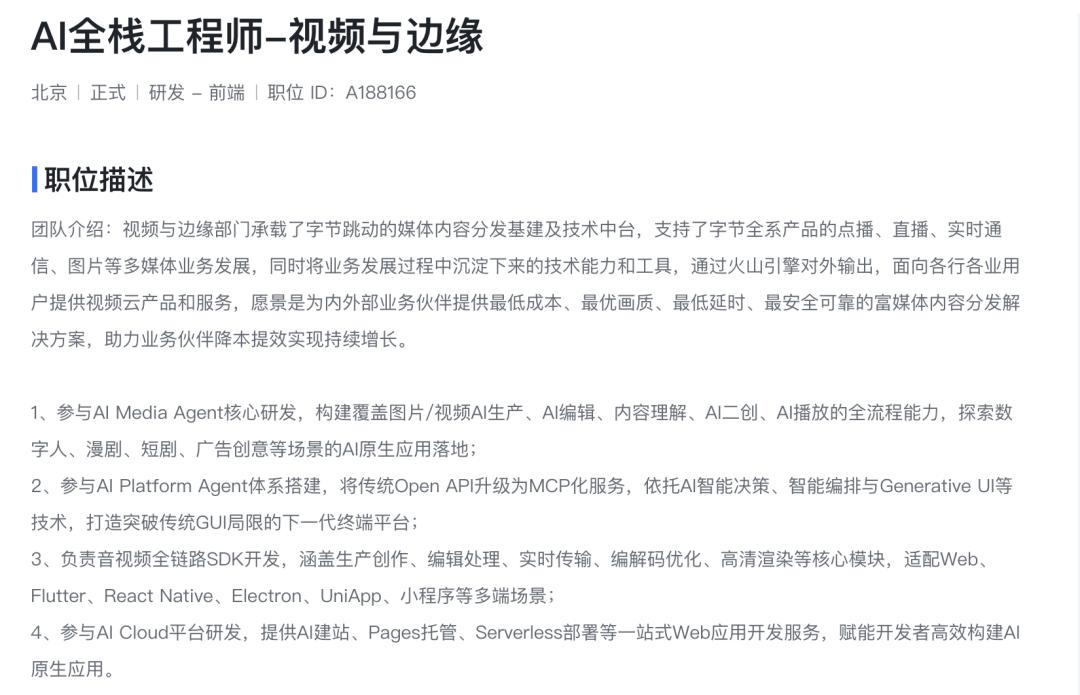
ByteDance's recruitment page
Some positions still retain the name "front - end", but their specific responsibilities are no longer just about page and interaction design. Front - end engineers increasingly need to understand back - end task systems, model call logics, and AI product experiences. Otherwise, it is difficult to turn complex AI capabilities into user - friendly products.
ByteDance's Commercial AI team is recruiting "Senior Front - end R & D Engineers". The position requires candidates to be responsible for the R & D and iteration of the Web - end business of the instant creation platform. The business scope includes the productization of creative tool chains such as digital humans, AIGC voiceovers, video generation, and Agents, and also requires participation in the exploration of AI product forms.
Tencent's latest description of the front - end engineer position shows that its requirements for front - end engineers are shifting from business page implementation to Agent engineering platform construction. This position requires candidates to be responsible for the sandbox, data, debugging, and visualization Web product systems for Agents, independently undertake the development of high - information - density pages, multi - state processes, and real - time data debugging scenarios, and promote the transformation of traditional back - end R & D tools to modern, high - quality product experiences.
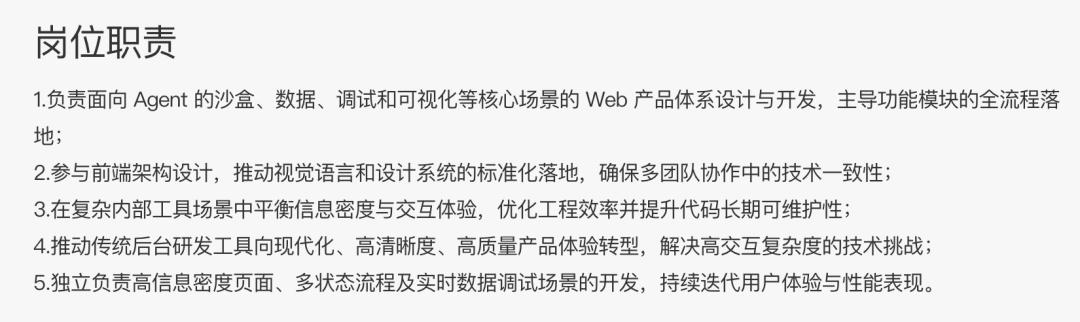
Tencent's front - end engineer recruitment page
"The competition in the front - end job market in 2026 is more intense, but it's not without opportunities. It values depth rather than breadth, problem - solving ability rather than rote memorization, and adaptability rather than dependence on specific tools," said software engineer Gawande Sakshi.
Meanwhile, back - end related positions are also breaking away from the traditional back - end scope.
Alibaba's Taotian's AI Agent application development position is responsible for building tools such as intelligent price - comparison and decision - making assistance based on large models in the e - commerce scenario, scheduling multi - domain agents based on large models to improve the efficiency of the entire merchant operation process, developing AI code generation tools, intelligent efficiency - improvement platforms for operation staff, and intelligent agent architectures for enterprise employees' office scenarios. This requires candidates to understand both server - side engineering and large - model application stacks, and be able to orchestrate models, tools, knowledge bases, and business systems into implementable AI products.
"As a back - end engineer, in order to maximize my chances of getting a job, I have to become a full - stack engineer," said a developer.
Now, some positions do not distinguish between front - end and back - end, but their job requirements have indicated the need for full - stack capabilities. For example, in Alibaba's latest recruitment, the "AI Application R & D Engineer" is described as "a system builder who crosses the boundaries of technology stacks and solves complex problems end - to - end". This position requires in - depth understanding of business scenarios and participation in the entire R & D process from requirement analysis, architecture design to online operation and maintenance.
When the large - model industry enters the stage of Agent engineering competition, training, inference, product, and engineering can no longer be clearly separated.
ByteDance's recruitment for "AI Agent Memory Infrastructure" shows this. This position is at the intersection of large models, data systems, and context engineering. Its responsibilities include building the next - generation Agent memory infrastructure, optimizing data ingestion, storage, indexing, retrieval, updating, compression, and forgetting mechanisms in large - scale, low - latency, and high - availability environments, and designing a unified memory model and processing flow for multi - modal data.
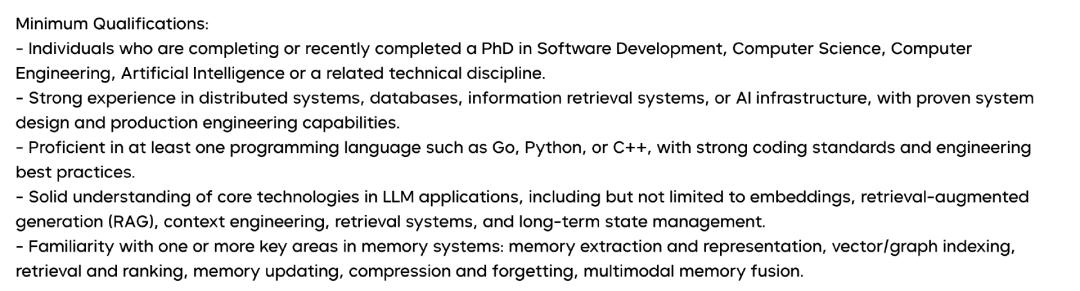
It can be seen that large companies represented by ByteDance and Alibaba are now recruiting not "people who are better at writing code" but "people who can turn models into products, agents into systems, and run AI capabilities into real - world business closed - loops". Whether it is the so - called front - end or back - end is actually not that important anymore.
Similarly, abroad, Stripe's newly opened full - stack engineer position does not split the responsibilities into front - end or back - end. Instead, it requires candidates to design, build, and maintain user - visible experiences, services, APIs, and systems, and be able to make effective trade - offs between business priorities, user experience, and sustainable technical infrastructure. Stripe also requires engineers to review and decide on technical and architectural choices in product construction, communicate directly with early - stage entrepreneurs, and troubleshoot production problems across services and technology stacks.
"Writing code is just one part of software engineering, and software engineering will not disappear. However, software engineering organizations centered around job boundaries are shifting to those centered around delivery closed - loops," Han Yu (anonymous), a R & D director of a company, told InfoQ.
Han Yu said that not only large companies are doing this, but small and medium - sized companies are also following suit. The value of positions relying solely on a certain layer of technology stack is declining, and job boundaries are gradually blurring. For companies, this can reduce overall friction costs and improve efficiency.
Based on his own experience, he summarized that in the past, companies hired "coding labor for a certain layer", while now companies need "people who can stably solve a problem with the help of AI". He also emphasized that there will still be domain experts at each end to ensure the quality of that end.
AI programming tools are eliminating boundaries
Now, the "full - stack engineers" we are talking about are more like new full - stack engineers empowered by AI: they understand both the front - end and the back - end, as well as Agent architecture, system deployment, iterative optimization, and business scenarios.
Actually, McKinsey has clearly pointed out before that AI will drive developers towards full - stack development capabilities and require them to become "AI technology stack developers". Behind the loosening of the front - end and back - end boundary is that AI programming is changing the software development process.
OpenAI's latest paper on Codex shows that Codex users have entrusted code implementation, code understanding, verification, configuration, documentation, and engineering operation and maintenance to the same set of Agentic workflow.
In the first half of 2026, the weekly active users of Codex increased by more than five times. The proportion of individual users submitting tasks equivalent to more than 8 hours of human engineer work increased by nearly 10 times compared with the beginning of the year. Inside OpenAI, Codex already accounts for 99.8% of the total output tokens of Codex and ChatGPT. More importantly, heavy users manage multiple Agents simultaneously: nearly 30% of OpenAI users have managed five or more Agents simultaneously within a week, and the top 1% of the heaviest users run about 71 hours of Agent turns in a day. AI Coding is shifting from "code completion" to "task acceptance".
Nowadays, AI programming tools have performed well in front - end page and interaction implementation, especially when component libraries, style specifications, and design patterns are relatively clear. Therefore, these capabilities are no longer the difficult points of full - stack tasks.
In terms of back - end interfaces and business logics, Claude Code and Codex can complete back - end tasks of medium - low complexity. However, when it comes to complex permissions, transaction consistency, etc., their performance becomes significantly unstable because they can hardly fully understand the implicit business constraints. Now, tools such as Claude Code, Codex, and Cursor are also gradually strengthening their back - end capabilities, such as reading repositories, modifying multiple files, executing tests, upgrading dependencies, and changing configurations.
Among them, database and state management are one of the obvious shortcomings of current coding agents. The FullStack - Agent paper specifically tests the frontend, backend, and database separately and points out that full - stack applications require real - world data processing and storage capabilities.

Researchers also point out that cross - file refactoring and dependency upgrade tasks are one of Claude Code and Codex's strengths, but they are far from reliable automation. Current Agents still have difficulty completing continuous package upgrades without destroying existing functions.
In terms of PR - level task completion, the task type has a great impact on the acceptance rate: the acceptance rate of documentation tasks is 82.1%, while that of new features is only 66.1%. Among them, Codex has a relatively high acceptance rate in all nine types of tasks, and Claude Code leads in documentation tasks and feature tasks.
Therefore, it can be said that AI programming tools already have certain back - end execution capabilities, but in terms of system boundaries, data risks, architectural trade - offs, online stability, and business correctness, senior engineers are still needed to ensure the quality.
However, it is worth noting that AI programming tools have become the "full - stack engineers" of startups.
Volodymyr Giginiak, CTO and co - founder of Wordsmith AI, said that "almost 100%" of the company's code is generated by AI. "The difference now is no longer who writes the code, but how much autonomy the AI has," Giginiak said. Currently, tasks completed completely autonomously account for about 10% of the workload, but he expects this proportion to rise rapidly. He predicts that in a year, "80% to 90% of tasks" will be completed completely autonomously.
"Engineering positions have not disappeared but are being fundamentally reshaped," Giginiak said. "In the future, the engineers with the highest leverage will be those who can design the correct operating environment and context for AI."
Of course, becoming a full - stack engineer does not guarantee job security.
"Roles often change over time and with projects," Boris said in a post replying to netizens.
Boris believes that a healthy team needs to configure different types of talent combinations according to the stage of the product: if a product is still new and has not found the product - market fit (PMF), the team needs more people who are good at the first, second, and third types of roles; if a product is growing and has found the PMF, the team needs more of the second, third, and fourth types of roles, as well as a part of the fifth - type roles; if a product already has a strong PMF, the team needs more of the third, fourth, and fifth types of roles and retain a part of the second - type roles.
"Perhaps, in the future, product roles will be more and more like this: no longer divided according to today's specific functional fields, but re - organized around product stages, creation methods, and system responsibilities," Boris concluded.
What does a full - stack developer look like in the AI Native era?
In the era of AI coding, traditional knowledge such as front - end and back - end is still important, which is the "judgment and control" of developers.
Front - end skills are still the foundation, back - end skills are equally crucial, and database skills are a must - have. Full - stack developers need to master SQL, be able to interact with relational databases, and have the ability to optimize database performance and queries. In the big - data scenario, tools such as Hadoop, Spark, and Kafka may also become important advantages.
Cloud computing and security skills are becoming new thresholds for full - stack developers. Enterprises usually require developers to understand major cloud platforms, master containerization and orchestration tools such as Docker and Kubernetes, and be familiar with Serverless computing services. At the same time, identity and access management, encryption, network security, and various compliance frameworks are also gradually included in the skill list of full - stack developers.
Infrastructure skills are