In-depth Observation Series on the Automotive Industry Chain (I): The Dilemma of European Tier 1 Suppliers and the Power Restructuring of China's Supply Chain
The dilemmas faced by European Tier 1 companies such as Continental, ZF, Faurecia, Valeo, and Schaeffler are not cyclical adjustments but may be structural collapses.
Data shows that the average EBIT margin of the five companies has dropped from 6 - 8% in the era of fuel - powered vehicles to 2 - 4% in 2025. The adjusted EBIT margin of Continental's automotive business was only 2.3% in 2024, and its automotive subsidiary, Aumovio, was independently listed on the stock market in September 2025. ZF had a net loss of 2.1 billion euros in 2025, and its net debt still reached as high as 10.2 billion euros.
Three forces are strangling simultaneously: Chinese OEMs are "de - Tier 1" through self - developed domain controllers and vertical integration; the price war is 100% transmitted to suppliers, and the 60 - day payment term policy accelerates the clearance of foreign Tier 1 suppliers; the electrification transformation has burned hundreds of billions of euros without getting a return. The BEV penetration rate in 10 European countries was only about 14% (in 2024), far lower than China's 47.9% in the same period.
The domestic substitution shows a three - layer differentiation: the domestic production rate of air suspension has reached 92.8% (a real breakthrough); the domestic production rate of EHB braking is about 30%, and domestic EMB has taken the lead (a stalemate situation); the domestic production rate of SBW steering is less than 5%, and automotive - grade MCUs are almost 100% imported (still being constrained).
The pricing power of the industrial chain is shifting from foreign Tier 1 suppliers to battery manufacturers, chip manufacturers, and platform - type suppliers. The implementation of the new national standards GB 21670 - 2025 in January 2026 and GB 17675 - 2025 in July 2026 marks the beginning of the mass production of the by - wire chassis and is also a crucial window period for domestic substitution.
01 Part One: Signals of Collapse - The Financial Truth of European Tier 1
The 2024 - 2025 Financial Panorama of Five Tier 1 Companies
During the fiscal years from 2024 to 2025, the financial data of the five major European Tier 1 suppliers showed a consistent deterioration trend. We have compiled the core financial indicators of these five companies to reveal the structural pressure they are facing with objective data.
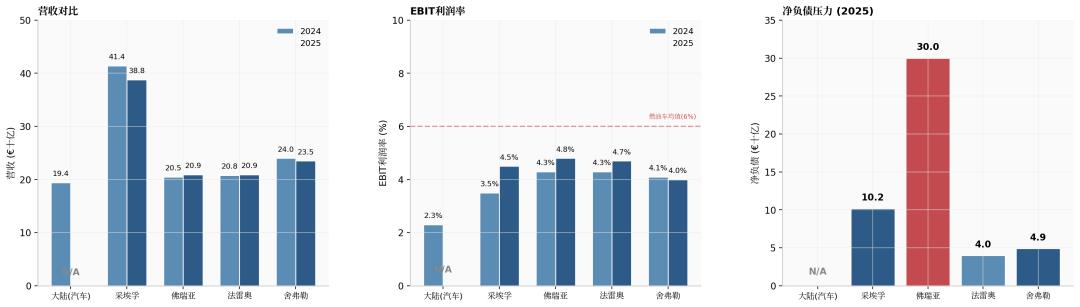
Figure 1 Comparison of the 2024 - 2025 finances of European Tier 1 suppliers: Revenue, profit margin, and debt
Three key trends can be clearly observed from Figure 1:
First, the revenue generally declined. ZF's revenue dropped from 41.4 billion euros to 38.8 billion euros (- 6.3%). Continental Group's overall sales in 2025 were 19.7 billion euros (at the group level, including tires and ContiTech). Its automotive business was independently listed on the stock market in September 2025, and the annual data for the automotive business was not separately disclosed. Schaeffler's revenue in Greater China decreased by 4.2%. The only exception was Valeo, whose revenue slightly increased by 0.5% to 20.9 billion euros, but this was achieved through a 38% increase in order volume, rather than the internal growth of the business.
Second, the EBIT margin dropped to a dangerous range. The adjusted EBIT margin of Continental's automotive business was 2.3% in 2024. In 2025, due to the spin - off, the data for the automotive business was not separately disclosed. The overall profit margin of the group was 10.2%, including the high - profit tire business with a margin of 13.6%. ZF's margin increased from 3.5% to 4.5%, but this was mainly due to cost - cutting, with more than 8,000 employees laid off, rather than business growth; Faurecia had a net loss of 2.1 billion euros in 2025 and planned to sell its interior business group to reduce debt by more than 1 billion euros; Valeo's profit margin was 4.7%, with a net profit of only 200 million euros and a net profit margin of about 1%; Schaeffler's EBIT margin was 4.0%. The average profit margin of the five companies was about 3.7%, far lower than the 6 - 8% level in the era of fuel - powered vehicles.
Third, the balance sheet continued to deteriorate. ZF's net debt was as high as 10.2 billion euros, and its equity ratio was only 13.3%. It had consecutive net losses for two years, with a net loss of about 1.06 billion euros in 2024 and 2.1 billion euros in 2025; Valeo's net debt was 4 billion euros, and its leverage ratio was 1.3 times; Schaeffler's net financial debt was 4.9 billion euros. High debt limits the reinvestment ability of these companies, forming a vicious cycle of "low profit - high debt - less investment - weaker competitiveness".
Profit Margin Collapse: A Structural Decline from 6 - 8% to 2 - 4%
The decline in the profit margin of European Tier 1 companies is not a short - term fluctuation but a structural trend that has lasted for five years. As shown in Figure 4, the net profit margin of automotive parts suppliers has continuously decreased from about 9% in 2015 to about 4% in 2025, with a cumulative decline of more than 50%.
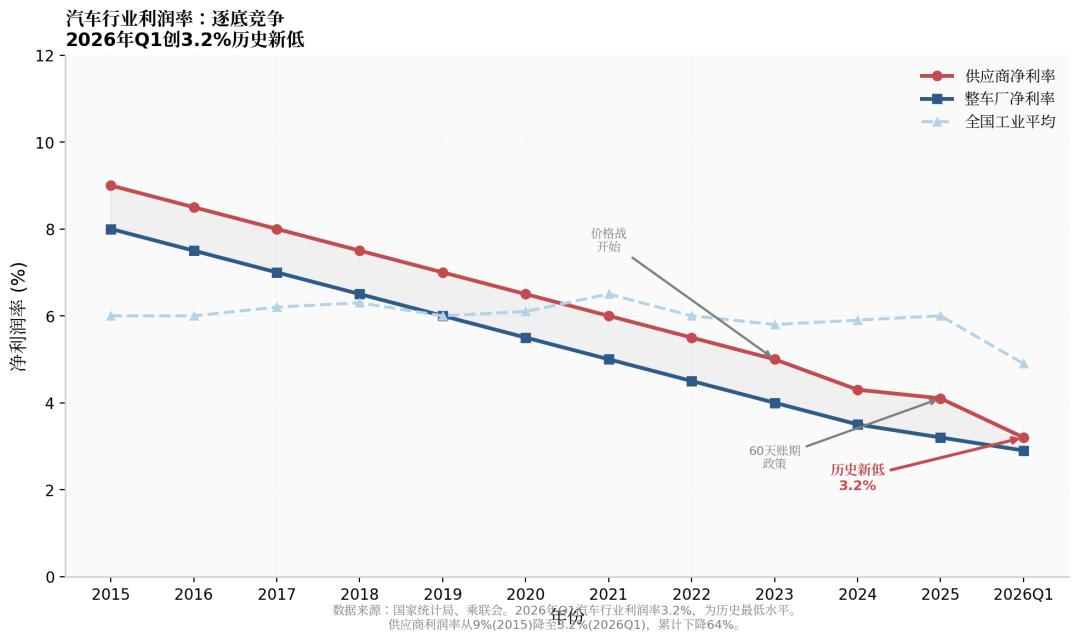
Figure 2 Profit margin trend in the automotive industry: Profit squeeze on suppliers and OEMs
This decline forms a mirror image relationship with the change in the profit margin of the Chinese automotive industry. In 2025, the profit margin of China's automotive manufacturing industry was 4.1%, with a total profit of 461.02 billion yuan and revenue of 1,1179.56 billion yuan, lower than the average level of downstream industrial enterprises. In the first quarter of 2026, it further dropped to 3.2%, with revenue of 2412.8 billion yuan, a year - on - year decrease of 0.2%; and a profit of 78.4 billion yuan, a year - on - year decrease of 18%, hitting a record low. From January to May 2026, the profit margin further dropped to 3.4%, and the profit of the automotive industry decreased by 20% year - on - year.
Key Insights
The structural decline in the profit margin means that European Tier 1 companies have lost the profit - making foundation on which they relied in the era of fuel - powered vehicles, and the transformation to new energy and intelligentization has not yet established a new source of profit. This is not a cyclical problem but a break in the business model.
Balance Sheet Deterioration: Who Is Closest to a Debt Crisis?
While the profit is declining, the balance sheets of European Tier 1 companies are under great pressure. ZF's net debt of 10.2 billion euros is the most dangerous signal - it means that even if calculated based on the improved free cash flow of 1.4 billion euros in 2025, it will take more than 7 years to fully repay the debt. More seriously, ZF recorded a one - time expense of 1.6 billion euros in 2025 due to the termination of unprofitable electrification projects, resulting in a net loss of 2.1 billion euros on the book.
Continental Group completed the spin - off of its automotive business on September 18, 2025. Its subsidiary, Aumovio SE, was independently listed on the Frankfurt Stock Exchange. In essence, this is to share risks through the capital market rather than solve the fundamental problem.
Faurecia had a net loss of 2.1 billion euros for the whole year in 2025 (after the application of IFRS 5) and planned to sell its interior business group. The transaction is expected to reduce the net debt by at least 1 billion euros.
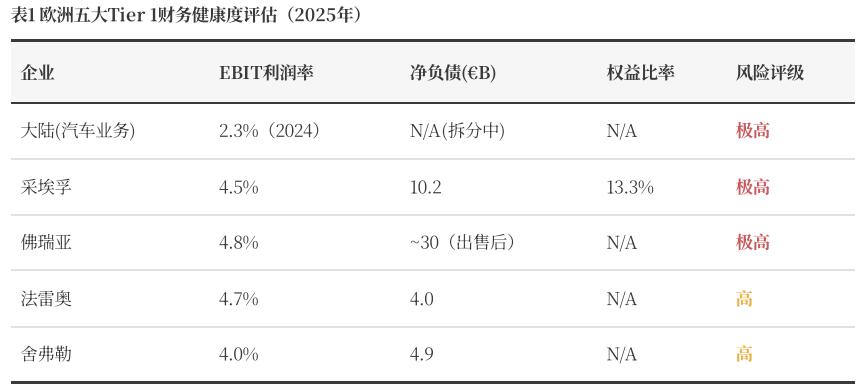
Data source: The 2024 - 2025 annual reports, quarterly financial reports, and press releases of each company. Schaeffler's net debt is the net financial debt of €4.915B.
02 Triple Strangulation - The Underlying Causes of the Dilemma
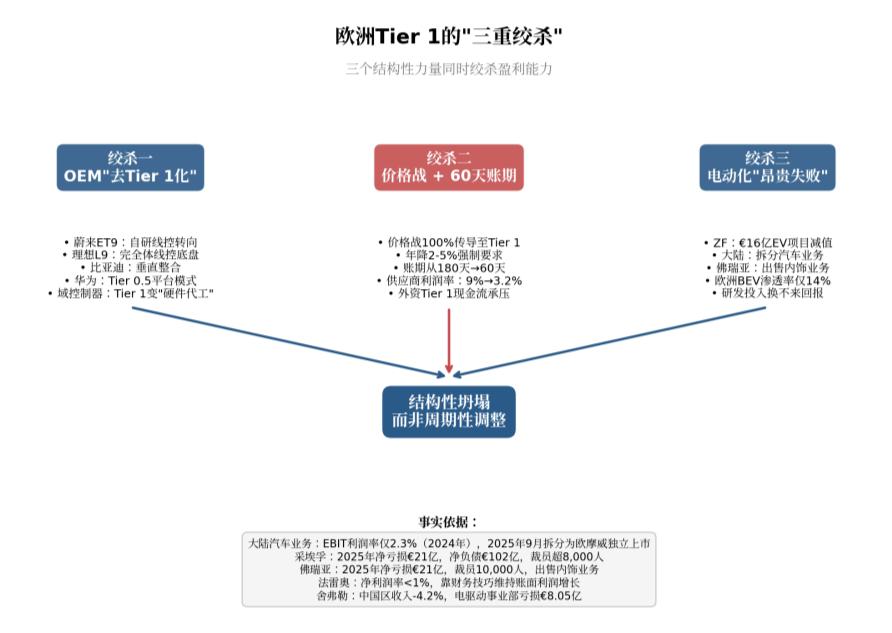
Strangulation One: Chinese OEMs' "De - Tier 1" Strategy
Chinese OEMs are systematically bypassing traditional Tier 1 suppliers and achieving "de - Tier 1" through three paths:
Path One: Self - developed core systems. NIO ET9 is equipped with a self - developed by - wire steering system and has obtained the first mass - production license for by - wire steering from the Ministry of Industry and Information Technology, becoming the world's first mass - produced vehicle without a mechanical steering column. Li L9 Livis is equipped with a "complete" by - wire chassis, including by - wire steering, by - wire mechanical braking (EMB), and rear - wheel steering. BYD takes the path of vertical integration, with the Yunlian - Z intelligent suspension body control system, self - developed One - Box by - wire braking, and self - developed SBW by - wire steering, forming a complete self - development ability for the chassis.
Path Two: Direct procurement from second - tier suppliers. Chinese OEMs are increasingly bypassing Tier 1 and directly purchasing from chip manufacturers and sensor manufacturers. The most typical case is CATL. At the 2022 World Power Battery Conference, Zeng Qinghong, the chairman of GAC Group, publicly complained that he was "working for CATL" because batteries account for 40 - 60% of the vehicle cost, and CATL has the pricing power.
Path Three: Centralization of the electronic and electrical architecture. Domain controllers centralize the functions of originally dispersed ECUs. Tier 1 suppliers are downgraded from "system integrators" to "hardware contract manufacturers". Huawei's Hongmeng Smart Mobility model is a typical Tier 0.5 - Huawei provides chips + OS + algorithms (underlying platform), and OEMs are responsible for the brand + channels + manufacturing. Traditional Tier 1 suppliers are excluded from the core software layer.
Strangulation Two: Transmission of the Price War and the 60 - Day Payment Term
The price war in the Chinese automotive industry has had a devastating impact on suppliers. From 2023 to 2025, Bethel's overall gross profit margin dropped from 19.1% to 17.6%, and the gross profit margin of its mechanical braking products dropped from 20.3% to 15.4%. The revenue of Bethel's top five customers accounted for as high as 74.4%, and the largest customer (Chery) accounted for 39%. This highly concentrated customer structure makes suppliers have almost no bargaining power in the face of annual price - cut requirements.
On June 1, 2025, the State Council's "Regulations on Ensuring the Payment of Funds to Small and Medium - Sized Enterprises" was officially implemented, requiring large enterprises to pay suppliers within 60 days. Automobile companies such as Xiaomi, BYD, GAC, Dongfeng, FAW, Seres, and XPeng have successively promised a 60 - day payment term. This policy will accelerate the capital flow in the supply chain but may also accelerate the clearance of financially vulnerable foreign Tier 1 suppliers.
Strangulation Three: The "Costly Failure" of the Electrification Transformation
European Tier 1 companies have invested huge amounts of money in the electrification transformation, but the return is far lower than expected. ZF's Electric Drive Division (Division E) is the most typical case: in 2025, it recorded a 1.6 - billion - euro expense due to the termination of unprofitable projects and laid off 7,600 employees, but still failed to achieve profitability. Continental Group chose to spin off and list its automotive business, which in essence admits that the electrification business cannot survive under the traditional architecture.
The fundamental reason lies in the slow growth of the European electric vehicle market. In 2024, the cumulative penetration rate of new energy vehicles in 10 European countries was 22.4%, among which BEV was only about 14%, far lower than China's 47.9% for the whole year in 2025. This means that while European Tier 1 companies are losing market share in China's largest EV market, they also cannot see enough growth in the European domestic market to spread the R & D investment.
03 The Real Progress of Chinese Substitution
Domestic substitution is not advancing uniformly but shows obvious three - layer differentiation. We need to distinguish the three levels of "real breakthrough", "stalemate", and "still being constrained" to avoid making overly optimistic or overly pessimistic judgments on the progress of domestic substitution.
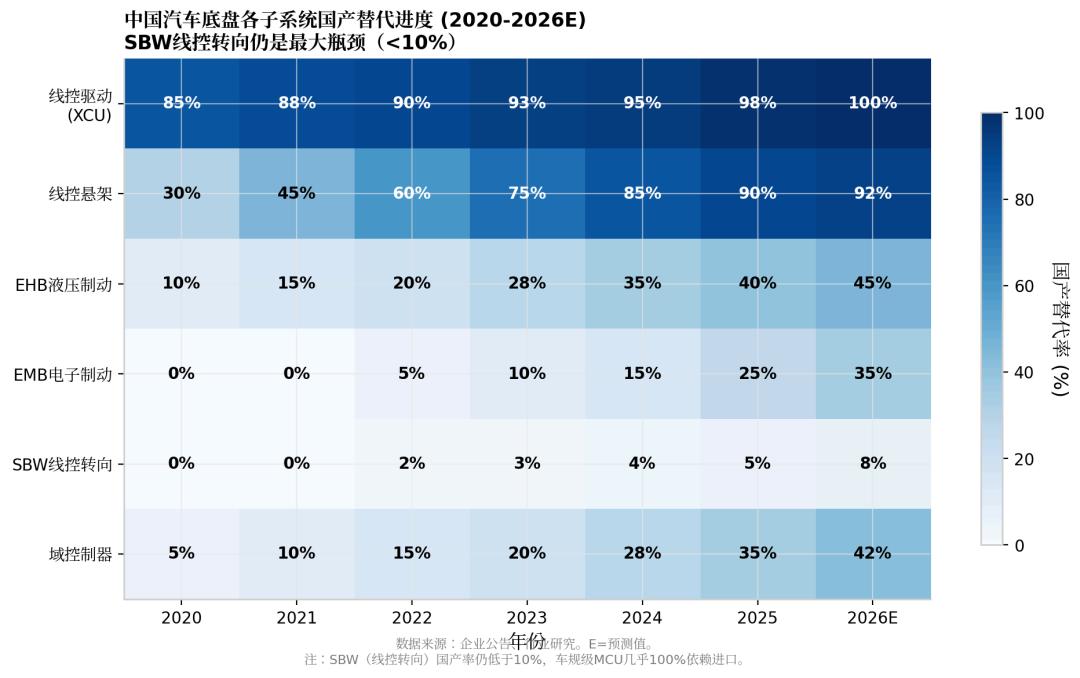
Figure 4 Heat map of the progress of domestic substitution in various subsystems of the Chinese automotive chassis (2020 - 2026E)
Real Breakthrough Areas: Suspension and Drive
Air suspension is the most successful case of domestic substitution. From January to February 2026, the total installed capacity of air suspension for domestic passenger cars was about 221,000 sets. The top three companies, Tuopu Group (34.1%), Konghui Technology (32.1%), and Baolong Technology (26.6%), are all domestic enterprises, accounting for a total of 92.8% of the market share. This forms a sharp contrast with the situation in 2020 when foreign oligarchs such as Vibracoustic and Continental had a monopoly.
