A high-stakes gamble with no way out: Decoding the all-out AI roadmap of Alibaba, Tencent and ByteDance
In the history of Internet development, there are quite a few companies that have fallen behind due to their failure to keep up with technological advancements. Today, as the clarion call of large models sounds, no one wants to see a similar story repeat itself, especially Tencent, ByteDance, and Alibaba, the three Chinese Internet companies with the highest revenues in history.
As a result, in Xixi Park in Hangzhou, Binhai Building in Shenzhen, and Dazhongsi in Beijing (the headquarters of the three companies), a long - awaited consensus has emerged. They are gathering their most core algorithmic talents and most expensive computing resources in an almost "cost - regardless" manner.
This is an unprecedented investment. The shift in logic lies in the fact that in the past, AI could only solve specific problems in well - defined fields, such as autonomous driving. In contrast, large models are a general - purpose operating system. The same set of models can write code, compose copy, and solve math problems. This means that AI is no longer just a "plug - in" for individual products but an underlying engine that can be embedded in all scenarios, including e - commerce, search, social media, payment, and transportation.
For this reason, after several years of inactivity, the top leaders of Internet giants have once again taken the stage collectively, and the competition has become even more intense this year. Qianwen, Doubao, and Yuanbao launched a long - awaited red envelope war during the Spring Festival. WeChat and Alipay are vying to be the first entry point for AI Agents. Seedance and Happyhorse are competing in the video generation field.
This is not only a technological game but also a comprehensive war about organizational agility, strategic determination, and endurance.
Three Teams, Two Talent - Employment Logics
The AI strategy is a long - awaited top - priority project for Internet giants. Undoubtedly, the leaders of Alibaba, ByteDance, and Tencent Group are Wu Yongming, Liang Rubo, and Ma Huateng respectively.
Alibaba is accustomed to having the organization serve the strategy. In 2023, after officially establishing AI as the group's major strategy, Alibaba welcomed a new CEO, Wu Yongming. As one of the youngest "Eighteen Arhats" with a technical background, he is the absolute top leader of Alibaba's large - model project.
Under Wu Yongming's leadership, Alibaba has formed a four - layer architecture consisting of the top - level, front - end, middle - end, and back - end. The Group Technology Committee, established in April this year, is at the top of this architecture. Wu Yongming serves as the team leader, and the core members are Zhou Jingren, Wu Zeming, and Li Feifei, forming a decision - making system covering the entire AI stack.
The three have different lengths of service, positions, and achievements in Alibaba. Zhou Jingren, who joined Alibaba from Microsoft in 2016 and has worked in Alibaba for 10 years, has the shortest tenure. He is the core formulator of Alibaba's large - model technical route and one of the key figures in building the Tongyi Qianwen (Qwen) series of large models from scratch.
Wu Zeming (nicknamed Fan Yu), who joined Taobao in 2004 and has worked in Alibaba for 22 years, has the longest tenure. He is the core person in charge of Alibaba's engineering system and business implementation. As the Group CTO and the convener of the Technology Committee, he is also a member of the five - person partnership committee of Alibaba's top decision - making layer. In the early days, he was the overall technical person in charge of "Double 11". Later, he led Taobao Flash Sale to break through in the instant retail market. Currently, he is leading the construction of the group's technology middle - end and AI inference platform.
Li Feifei (nicknamed Feidao), who joined Alibaba in 2018 and has worked in Alibaba for 8 years, is a world - class database expert. As the CTO of Alibaba Cloud, he is currently leading the construction of AI computing infrastructure, mainly responsible for the "foundation" of AI, that is, the computing support system including cloud computing, chips, and storage.
The three cover the three key dimensions of AI: core model capabilities, implementation efficiency, and computing costs. They are the core decision - making layer that enables the efficient operation of the four - layer AI architecture built by Wu Yongming.
The Alibaba Token Hub (ATH) business group, established on March 16th, is a first - level business group of the group, on par with Alibaba's e - commerce, cloud intelligence, and international business. It is also directly managed by Wu Yongming and serves as the resource integration center of the entire AI system.
With the core goal of "creating tokens, delivering tokens, and applying tokens", it integrates all AI - related resources previously scattered across various business lines, such as the Tongyi Laboratory, the Bailian MaaS platform, the Qianwen C - end assistant, the Wukong B - end work platform, and AI innovation businesses. It uniformly schedules the group's computing power, models, and scenario resources, allowing AI capabilities to flow efficiently within the group like water and electricity.
Among them, the MaaS platform is led by Liu Weiguang, the president of the Alibaba Cloud Public Cloud Division, who is in charge of the crucial token - delivery process. Qianwen is led by Wu Jia, the vice - president of Alibaba Group. The Wukong Division is affiliated with DingTalk, with Chen Yusen as the CEO and Shu Junliang as the product manager. Liu Weiguang, Wu Jia, and Chen Yusen all report directly to Wu Yongming.
As a subordinate department of ATH, the Token Foundry Division, established on June 8th, is responsible for front - end monetization. It is the front - end of Alibaba's large - model business and is formed by the merger of the Tongyi Large - Model Division and the Future Life Laboratory.
The main achievement of the Tongyi Large - Model Division is the Qwen series of large language models. The Future Life Laboratory was previously part of Taotian Group, and its star products are the video generation model Happy Horse and the world model Happy Oyster, with Zheng Bo as the person in charge. After the merger, Zheng is mainly responsible for multi - modality and product implementation.
It is not difficult to find that the Token Foundry is more like the main force of Alibaba's basic large models. This division is the core commercialization department directly managed by Wu Yongming. Its main function is to achieve the revenue target of the AI business and bridge the last mile from technology to commercialization.
Alibaba Cloud, led by Li Feifei as the CTO, provides the underlying computing infrastructure such as chips, storage, and cloud computing required by AI. And Wu Yongming remains the top person in charge of Alibaba Cloud Intelligence Group.
In addition, as the new brain for the group's technological exploration, the AI Future Research Institute was established in June, led by Zhou Jingren, the group's chief scientist. It focuses on cutting - edge AI exploration, mainly in areas such as AGI (General Artificial Intelligence), next - generation large - model architectures, multi - modality, and world models, paving the way for the medium - and long - term technical routes of the AI business without bearing short - term commercial KPIs.
It is not difficult to see that Wu Yongming directly manages the front - end, middle - end, and back - end without setting up separate leaders, which reflects his strategic will for AI transformation. The architecture he built forms a complete closed - loop from short - term commercial implementation, medium - term resource coordination to long - term technology reserve. The three parts have clear responsibilities and support each other, ending the internal strife situation where Alibaba's previous AI businesses were scattered across various BUs and operated independently.
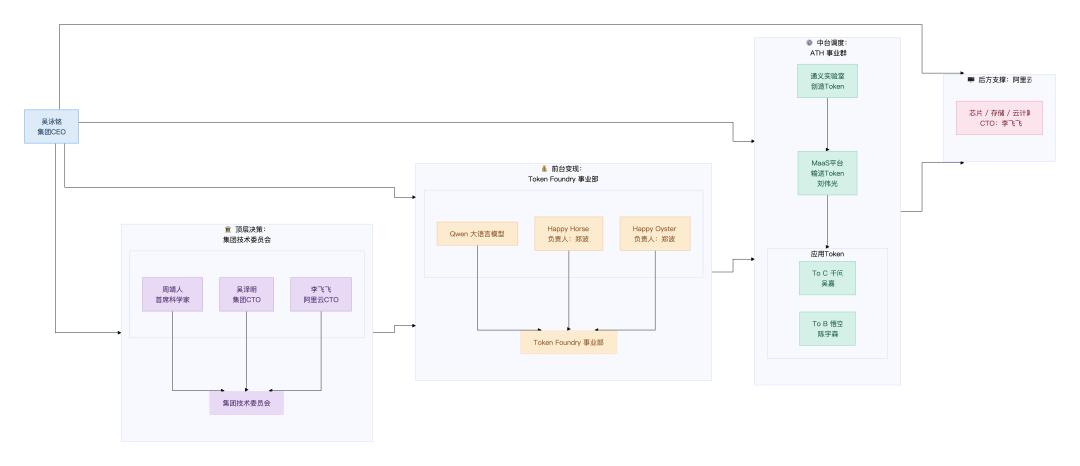
Illustration: Alibaba's AI organizational structure diagram, drawn by Tech Planet.
Compared with Alibaba's frequent organizational structure adjustments, Tencent appears more moderate, which is in line with Tencent's style of preferring to strike later. The bigger difference is that Tencent has not established a technology committee in its organizational design, and the absolute decision - maker of its AI strategy has not changed with the change of the strategy. The top decision - making layer still follows the original "twin - star" architecture, led by Ma Huateng, the chairman of the board, and Liu Chiping, the president. Ma Huateng focuses on strategy, while Liu Chiping focuses on strategy implementation.
The star figure in Tencent's AI field is Yao Shunyu, its chief AI scientist. During his time at OpenAI, he was one of the core contributors to the first - batch Agents and led two important products, the Computer - Using Agent (CUA) and Deep Research. The ReAct framework he proposed has become the most mainstream method for building language agents globally.
At the 2026 Tencent Cloud AI Industry Application Conference, the conference venue was once overcrowded because of Yao's first public appearance, which shows his influence in the AI circle.
He is one of the few employees with two reporting lines. He is the soul of Tencent's AI technology, comprehensively leading the research, infrastructure construction, and product implementation of Tencent's large models and related AI technologies. As the chief AI scientist, he reports directly to Tencent's president, Liu Chiping, which enables him to directly participate in the company's top - level AI strategic decision - making.
At the same time, as the person in charge of the AI Infra Department and the Large Language Model Department, he also reports to Lu Shan, the president of the Technology Engineering Group (TEG). This ensures that specific technical work such as AI infrastructure construction can be efficiently coordinated with the company's technology platform.
Another key figure is Tang Daosheng, the senior executive vice - president and the CEO of the Cloud and Smart Industry Group (CSIG). Tang is a long - time Tencent employee, having worked at Tencent for more than 20 years. His main responsibility is to lead the development and implementation of AI products, and his products include Tencent Yuanbao, QQ Browser, Tencent Meeting, etc. Currently, Tencent's desktop - level office assistant, WorkBuddy, comes from this business group.
Zhang Xiaolong, the father of WeChat, is considered the most important force in Tencent's AI. The upcoming WeChat Agent, "Xiaowei", is regarded as the key to Tencent's success in the AI game.
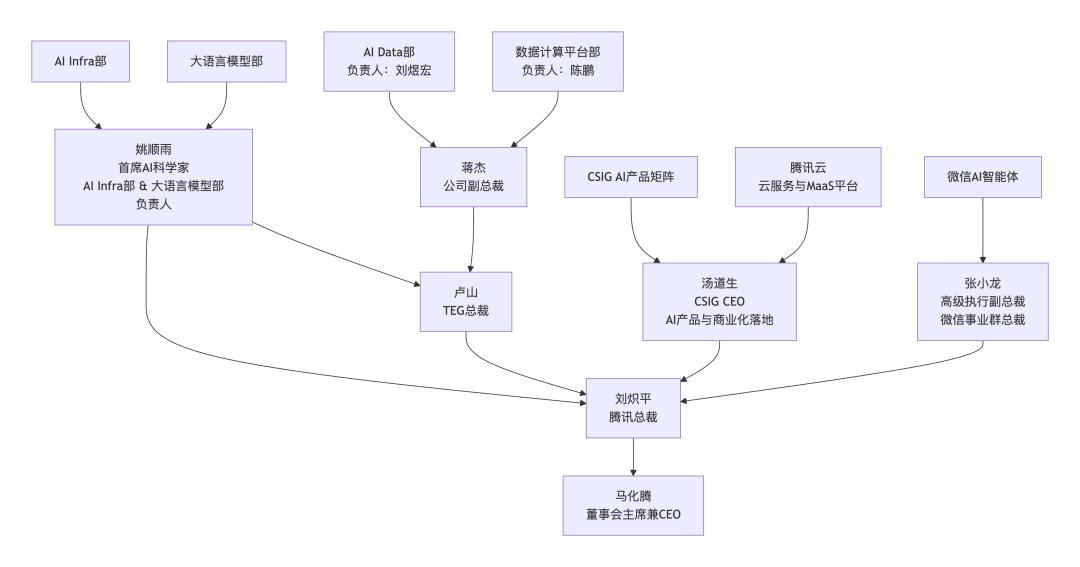
Illustration: Tencent's AI organizational structure diagram, drawn by Tech Planet.
Both Alibaba and Tencent have chosen early founding members as their absolute top leaders instead of professional managers. They all have technical backgrounds, outstanding achievements, absolute decision - making power, and sufficient prestige within the company to mobilize more resources. To some extent, ByteDance has also continued this style.
Liang Rubo, the top leader of ByteDance's large - model project, is also a founding member. What makes him more special is that he is a college alumnus of Zhang Yiming, the founder of ByteDance, and they co - founded "Jiujiu Fang" before establishing ByteDance. This 20 - year - long cooperation, from campus to the workplace, has earned Liang Rubo enough trust from Zhang Yiming. In addition, Zhang Yiming, who has stepped down as the chairman of ByteDance, will also be deeply involved in top - level decision - making.
Wu Yonghui is the technical soul of ByteDance's large - model project. Before joining ByteDance, he worked at Google for a long time. During this period, he led the development of the milestone - setting Google Neural Machine Translation system (GNMT), served as the vice - president of research at Google DeepMind, and received Google's highest technical honor, Google Fellow (rank L10). He is also one of the core contributors to the Gemini large model.
Wu Yonghui joined ByteDance in February 2025 and is the top leader of the Seed team and the overall person in charge of basic research on ByteDance's large models. He reports directly to CEO Liang Rubo.
He is mainly responsible for coordinating all basic model research of Seed, covering the general large - language base, multi - modality foundation, AI computing infrastructure, and long - term AGI cutting - edge exploration. He also leads the Top Seed global top - tier AI talent recruitment plan. The core underlying technical routes for Seedance video generation and Doubao's base model are all formulated by him.
Zhu Wenjia is the "key figure" in applying ByteDance's AI products. He has worked at ByteDance for more than 10 years, successively serving as the person in charge of Toutiao and the product technology person in charge of TikTok. He is considered by industry insiders to be the most capable manager within ByteDance of bridging the gap between technology and commercial implementation. Zhu Wenjia led the establishment of ByteDance's large - model team in the early days and now mainly manages the application side of Seed. The popular Doubao was developed under his leadership, and he reports directly to Wu Yonghui.
Tang Dai, the president of Volcengine, is the key person in charge of ByteDance's large - model To B business. He coordinates the external enterprise services and industrial implementation of Doubao and Seedance. Tang joined ByteDance in 2020, and his most important previous work experience was at Baidu, where he was particularly outstanding in the technical field and won Baidu's highest award multiple times.
In addition, there are many young and outstanding technical talents in ByteDance's AI business. Zhou Chang, the person in charge of Seed's multi - modality, manages the graphic and video generation technology teams, supporting the Seedance video large - model track. There are also young backbones like Zeng Yan, who is the core R & D person in charge of the Seedance series, representing ByteDance's talent reserve in the AIGC niche track.
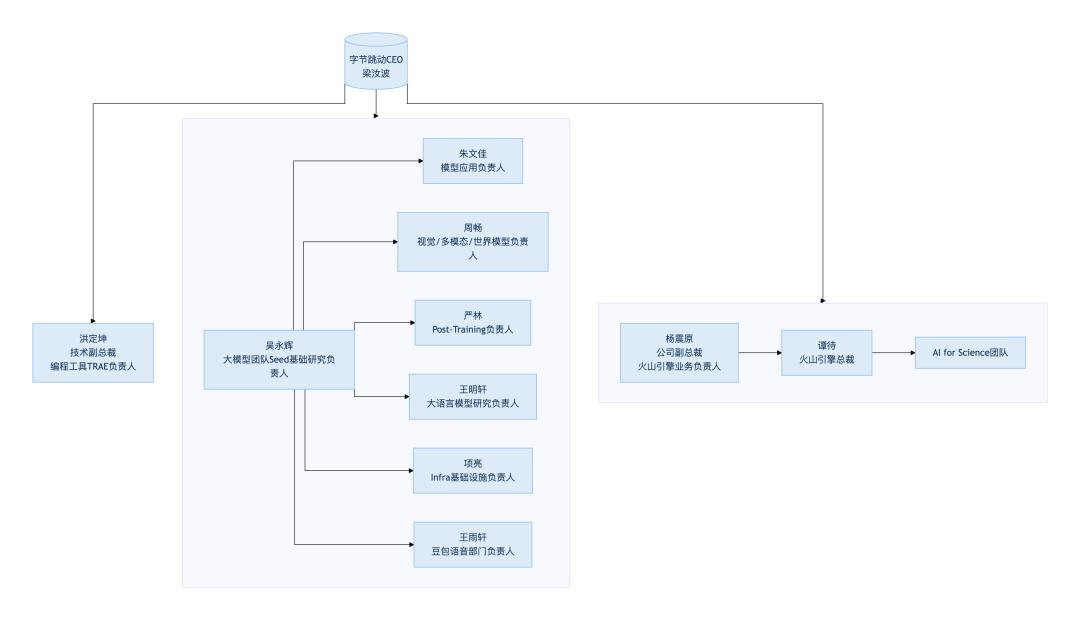
Illustration: ByteDance's AI organizational structure diagram (partial), drawn by Tech Planet.
In terms of organizational structure, Tencent and ByteDance do not have such an obvious four - layer structure. Tencent emphasizes integration, deeply integrating AI capabilities into its existing and powerful business groups, especially the TEG (Technology Engineering Group) and CSIG (Cloud and Smart Industry Group), without creating a new organizational structure. ByteDance has an independent team like Seed, directly subordinate to the top decision - making layer, charging ahead in the AI battlefield with an entrepreneurial attitude. It is worth noting that ByteDance and Tencent also have the functions of Alibaba's four - layer structure.
In terms of talent allocation, in addition to the highly similar top - leader configuration, the situations of technical talents in these three companies are completely different.
Alibaba prefers to cultivate talents internally and reuse founding members. Zhou Jingren, the "flagship" of Alibaba's AI, has worked at Alibaba for 10 years, and most of the core members of the Qwen team are internally cultivated, such as Liu Dayiheng, an early core member. This talent strategy is related to Alibaba's forward - looking layout of the DAMO Academy in 2017 to some extent.
Tencent and ByteDance have similarities. They both prefer to recruit high - level talents with high salaries and are willing to give key positions to new people. The technical cores of the two companies, Yao Shunyu and Wu Yonghui, are both recruited from outside. Born in 1998, Yao Shunyu is also the youngest among the three technical leaders, nearly 20 years younger than the other two.
ByteDance's talent recruitment was concentrated in 2024 when it launched the Top Seed plan. Zhang Yiming, who has stepped down as the CEO, personally participated in formulating the AI strategy and supervised the recruitment of AI engineers and researchers from competitors. The depth and breadth of talent reserve were also the key turning points for ByteDance to catch up in the large - model field.
However, currently, Tencent, which is slightly behind in basic models, is the most proactive. In addition to recruiting Yao Shunyu from OpenAI, it has also recruited many talents from ByteDance, including Xiao Xuefeng and Huang Qi. According to incomplete statistics, nearly 70 technical talents from ByteDance's core Seed team left in the past year, and about 30 of them went to Tencent.
Talent loss is the most pressing problem that ByteDance needs to face. In addition to being poached by competitors, ByteDance entrepreneurs have also become sought - after in the large - model field.