20 billion, the Greater Bay Area's largest embodied unicorn is born
Another unicorn in the embodied intelligence field with a valuation of 20 billion yuan has emerged.
According to investment circles, today (June 29th), Zhipingfang, a general intelligent robot hailed as "the most Tesla-like" company, has recently completed a series of new financing rounds in quick succession. The total financing amount is nearly 5 billion yuan (approximately 700 million US dollars), and its valuation has soared to over 20 billion yuan, making it the first embodied intelligence enterprise in the Guangdong-Hong Kong-Macao Greater Bay Area with a valuation exceeding 20 billion yuan.
Notably, the list of investors in Zhipingfang's current financing round covers the entire spectrum of top-tier capital, including "national teams - ministries - Greater Bay Area - local funds - insurance funds - securities firms - industrial players - financial investors", which is the only full coverage in the industry. To some extent, this also increases the certainty of its future listing.
Recalling three years ago, Guo Yandong founded Zhipingfang in Shenzhen. He led the team to skip the initial stage of "piecing together prototype machines" that was popular in the industry at that time and aimed directly at the ultimate battle of building a "general intelligent agent" from the very beginning. Now, Zhipingfang has become a new benchmark for embodied intelligence in the Greater Bay Area, and its valuation is leading the pack.
5 billion yuan in financing: The most comprehensive list of investors is revealed
This year, the financing storm in the field of embodied intelligence is obvious to all. However, what companies are competing for is no longer just the speed and rhythm of financing. "Who is investing" is more valuable - the ability to attract a diverse and luxurious group of investors has become an invisible competitive edge.
Just like this time, almost all types of leading institutions in the market have appeared behind Zhipingfang:
First of all, it has the endorsement of the national team and the support of the Guangdong-Hong Kong-Macao Greater Bay Area. National strategic capital was the first to enter the scene, including the National Small and Medium-sized Enterprises System Fund and the China Cultural Industry System Fund. At the same time, as a representative of embodied intelligence in the Greater Bay Area, Zhipingfang has received continuous investment from key regional platforms such as the Guangdong Artificial Intelligence Fund, Shenzhen Capital Group, Nanshan Strategic Emerging Industry Investment, and the Guangdong-Hong Kong-Macao Greater Bay Area Series Funds.
In terms of the industrial ecosystem, many industrial leaders such as China Biopharmaceutical (CP Group), Pharmaron, Moutai Group, China Merchants Capital, Wuzhou New Spring, Wanfeng Holdings, and Zhongbei Communication, spanning multiple pillar industries, have collectively "bet exclusively" on Zhipingfang. Coupled with previous key investments from large industrial players such as Baidu Strategic Investment and CRRC, Zhipingfang's industrial capital has fully covered core fields such as biopharmaceuticals, technology services, high-end manufacturing, and new retail.
More notably, several core enterprises in Tesla's ecological chain have also increased their investment in Zhipingfang. These industrial players, who have had in-depth cooperation with Tesla in the automotive-grade supply chain, have regarded Zhipingfang as the "most Tesla-like" strategic anchor in the robot field by "voting with their feet".
In addition to capital support, various industrial players have also opened up their core pharmaceutical production lines, consumer scenarios, port construction, and high-end manufacturing processes, and have deeply integrated and co-evolved with Zhipingfang's embodied intelligence brain.
Furthermore, the latest series of financing has also attracted the layout of several insurance companies, as well as the in-depth participation of market-oriented financial investment institutions and leading securities firm capital such as CICC Capital, CITIC Construction Investment, Hongtai Capital, GSR Ventures, Bohua Capital, and Avic Trust Capital.
Old shareholders such as Fortune Capital, Dunhong Asset Management, Daode Investment, Wuxi Venture Capital, Liang Venture Capital, Guangyuan Investment, and Junli Capital have continued to increase their investment beyond the quota and have accompanied the company with long-term heavy investment.
This lineup is a microcosm of Zhipingfang's rapid progress in the venture capital circle in the past two years.
Founder Guo Yandong graduated with a doctorate from the School of Electrical and Computer Engineering at Purdue University in the United States. He is a national innovation leader and a part-time professor at the Hong Kong University of Science and Technology (Guangzhou). Before starting his business, Guo Yandong worked as a researcher at Microsoft's Seattle headquarters. After returning to China, he served as the chief scientist and R & D executive at XPeng Motors and OPPO. He is good at both technological innovation and industrial implementation and is a rare "AI + intelligent hardware" expert in the industry.
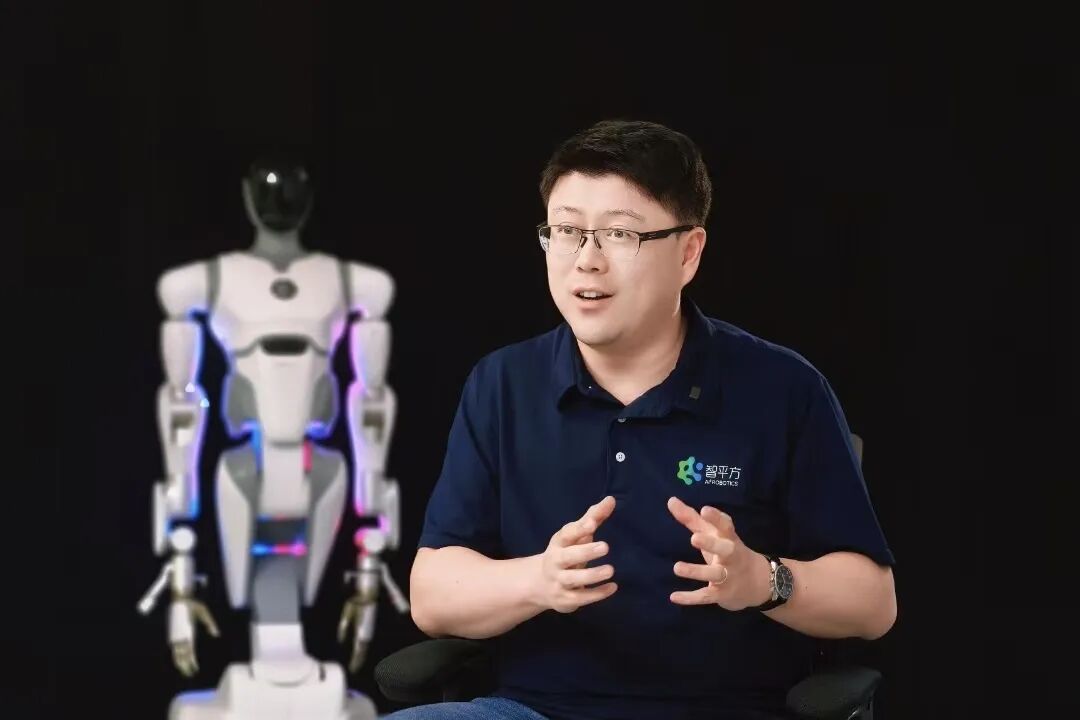
Back in early 2023, Guo Yandong founded Zhipingfang in the Shenzhen Robot Valley, setting off a storm in the venture capital circle.
Three months after its establishment, the company received joint investment from SEE Fund, Qingzhi Capital, and SDIC Venture Capital. In 2025, Zhipingfang entered a period of explosive financing, completing several rounds of financing in the hundreds of millions within the year. Its valuation increased more than tenfold, and it successively introduced financial and industrial funds such as Fortune Capital, Dunhong Asset Management, Shenzhen Capital Group, Cornerstone Capital, Nanshan Strategic Emerging Industry Investment, Guozhong Capital, Puhua Capital, Yunqi Capital, Guangyuan Investment, Bloomage Biotechnology, and a large retail enterprise. Many old shareholders have continuously increased their investment beyond the quota for several consecutive rounds.
Since then, a representative of embodied intelligence in the Guangdong-Hong Kong-Macao Greater Bay Area has emerged. The financing path of Zhipingfang is undoubtedly the most vivid portrayal of the explosion of embodied intelligence in China. From a spark to a more profound historical stage, the battle among the giants has begun.
Winning with the "brain": They are building the next-generation robot brain
After communicating with investors, they all mentioned their deepest impression of Zhipingfang: it is the most Tesla-like Chinese embodied intelligence company.
Back in 2023, the mainstream in the embodied intelligence industry was "modular assembly", where the visual model, language model, and motion control were independent of each other. The end-to-end VLA was considered a "too difficult and too early" route. Zhipingfang and Tesla were the only two companies daring to go all-in on this route. When Guo Yandong founded Zhipingfang, he focused on "full-stack self-research and algorithm-driven hardware" and adopted the end-to-end VLA as the only technical route.
That is to say, before the American embodied intelligence company PI (Physical Intelligence) triggered an industry revolution and made "end-to-end VLA" a consensus, Zhipingfang had already accumulated nearly a year of experience in model training and iteration. This time difference constituted an early technological gap.
The iteration speed is extremely rapid. In the past three years, Zhipingfang has continuously promoted the evolution of VLA technology. In 2024, it launched the first end-to-end VLA embodied large model among Chinese startups. In 2025, it released the world's first VLA model with a "heterogeneous input + asynchronous frequency" dual-system, and in the same year, it became the only startup in the world (and the only one in China) to open-source a robot model.
In response to the industry's discussion on the technical routes of VLA and the world model, Zhipingfang was the first to propose the judgment that "the world model is a core component of the VLA system, and the two should be integrated". Subsequently, Zhipingfang collaborated with Peking University to launch a new-generation VLA architecture (Video2Act) that integrates the world model, achieving for the first time the robot model paradigm of "predict first, then execute" and improving the generalization ability and task success rate in complex scenarios.
Always adhering to the principle of "brain first", in June this year, Zhipingfang officially released the world's first open-source brain-like VLA model, NeuroVLA. This is currently the only embodied intelligence system that simultaneously possesses three major biological movement capabilities: active perception, fault self-recovery, and sequential memory. It is regarded by the industry as an important evolutionary direction for the next-generation robot brain.
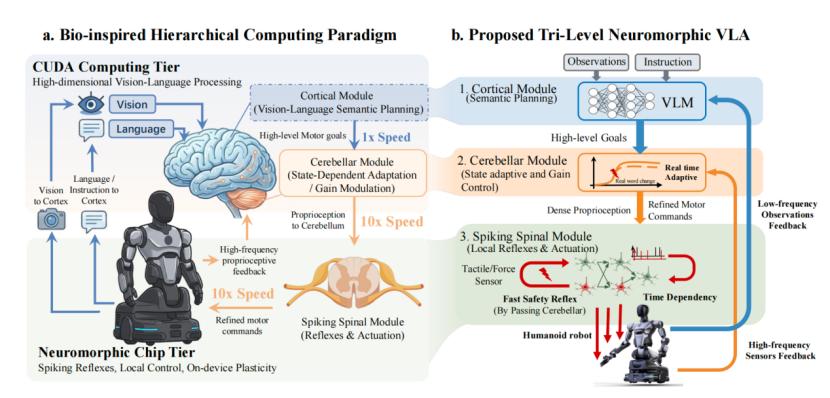
Specifically, NeuroVLA introduces the "cortex - cerebellum - spinal cord" collaborative mechanism into the robot control system for the first time.
Among them, the cortex is responsible for semantic understanding and task planning; the cerebellum is responsible for high-frequency motion coordination and dynamic correction; and the spinal cord is responsible for millisecond-level motion execution and safety reflex. This design enables the robot to obtain movement stability close to that of living organisms and millisecond-level "instinctive reactions" for the first time.
It can be understood in a simple way: In the traditional VLA model, one "brain" has to do three things at the same time, like a person having to understand the boss's instructions, plan every step, and retract his hand instantly when encountering danger. The "brain-like" model has a three-layer division of labor, where each layer has its own responsibilities, making the robot faster, more stable, more energy-efficient, and safer in the real physical world from an architectural perspective.
Zhipingfang's practice fully verifies the point that instead of making the model bigger, it is better to make the architecture smarter.
For a long time, the mainstream belief in the AI industry has been that the larger the model, the more data, and the more powerful the computing power, the stronger the intelligence. In the embodied intelligence field, many companies are also replicating this logic, piling up larger VLA models, feeding more training data, and using more powerful GPUs. Therefore, the breakthrough of NeuroVLA lies not in being "bigger" but in being "smarter".
When this system was deployed on a robot for testing, the changes were obvious and profound:
The shaking disappeared. Quantitative data shows that the "jerk" (an indicator for measuring shaking) of the robotic arm during movement has been reduced by more than 75% on average.
It has millisecond-level "instinctive reactions". The robot deployed with NeuroVLA demonstrated continuous survival behaviors: it first retracted quickly with a reflex of less than 50 milliseconds to avoid a hard collision. Then, its "cerebellum" module used the contact information to re-plan a detour path on the spot, and the success rate of completing the task finally reached 54.8%.
It has "time series memory" for the first time. When performing repetitive tasks such as "shaking a beaker", NeuroVLA reads the force peaks at a speed of 200 times per second through the "spinal cord" layer's pulsed spinal cord module, enabling the robot to complete periodic movement patterns autonomously without relying on visual counting and showing a "sense of rhythm".
The energy consumption has been significantly reduced. Due to the characteristic of the pulsed neural network that it does not consume power when not working, the average power consumption of the entire spinal cord-like execution layer during operation is only 0.4 watts, showing an order-of-magnitude advantage compared with traditional solutions, making it possible to develop mobile robots with long-term battery life in the future.
It abandons data involution. NeuroVLA does not blindly rely on a large amount of robot data. The team used the pre-trained Qwen-VL and hundreds of downstream samples for fine-tuning and achieved end-to-end training of the SNN through surrogate gradients, significantly reducing the training threshold of the brain-like architecture and making it feasible in practical engineering.
The birth of NeuroVLA is the latest result of Zhipingfang's continuous high-intensity investment in the research and development of embodied large models. It proves that to achieve truly robust and practical embodied intelligence, it is not necessary to pursue larger-scale data and models. Rethinking and designing the underlying architecture is equally important, if not more fundamental.
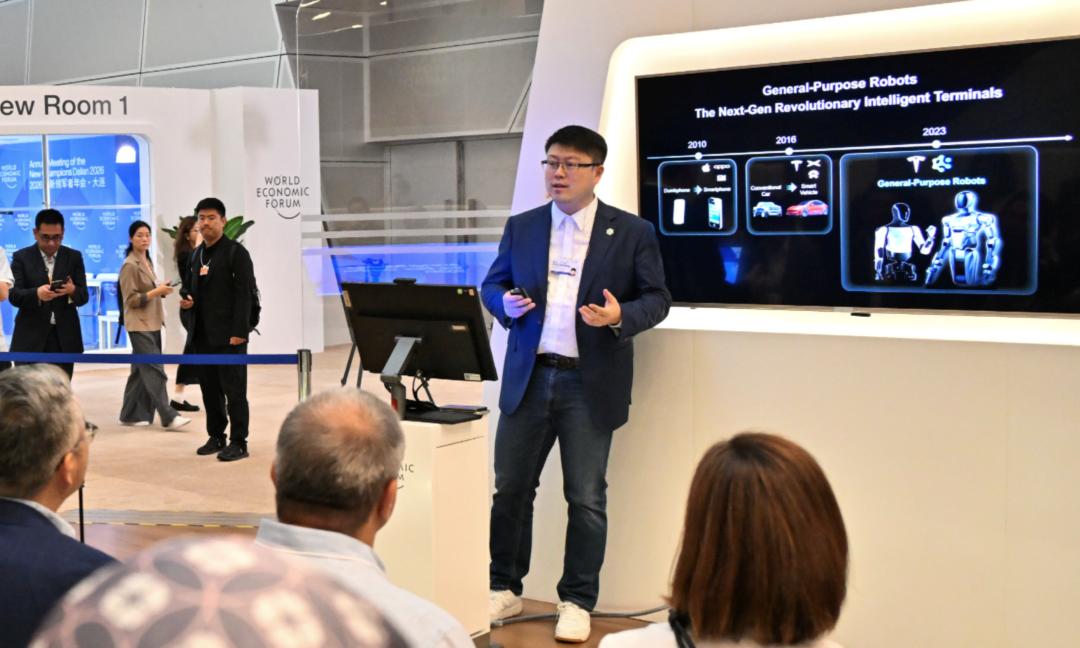
It is worth mentioning that at the just-concluded Summer Davos Forum, Guo Yandong, as a representative entrepreneur rooted in the Shenzhen Robot Valley, was the only invited speaker in the field of Chinese embodied humanoid robots at this year's Davos Forum. In his speech, he proposed that the next-generation robot brain should not be just a competition of computing power and data but should explore more efficient and sustainable development paths.
The era of robots taking up jobs has begun, and the reshuffle is underway
After the industry's hype, it's time to return to this simple common sense: Robots are for working, not for performing.
Just as Zhipingfang has focused on "productivity-oriented general intelligent robots" from the very beginning. To pave the way for large-scale mass production, it built its own production line in September 2025 and started production. In December of the same year, it achieved real delivery of hundreds of units per month. Currently, Zhipingfang has built a semi-automated production line with an annual output of more than 2,000 units and has achieved regular batch delivery. In the second half of 2026, it will start the construction of the first production line for tens of thousands of productivity-oriented embodied humanoid robots in China.
The mass production ability is undoubtedly the key dividing line for measuring whether a robot enterprise can cross from technology verification to a productivity tool.
More importantly, Zhipingfang's production line ability is deeply integrated with its hardware and large model design. It achieves the collaborative optimization of the "body" and the "brain" from the bottom, fully releasing the model's capabilities in the physical world. The trinity collaborative system of "model × hardware × scenario" constitutes Zhipingfang's deepest moat.
In the battle of the hundred embodied intelligence companies, continuously winning real commercial orders is the only touchstone for testing whether a robot can cross the "from 1 to 10" scale-up window.
Although many companies are "entering the factory", Zhipingfang's uniqueness lies in that it chooses high-end manufacturing "tough nut" scenarios (semiconductor, panel, and sterile workshops). These scenarios have extremely high requirements for precision, reliability, and cleanliness. Once they are successfully implemented, the technical barriers and customer stickiness will be stronger.
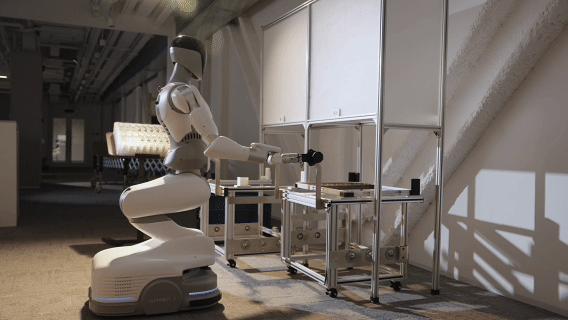
Currently, in the semiconductor display field, Zhipingfang has crossed from single-point verification to large-scale implementation. Last year, it took the lead in implementing a three-year cooperation project with Huike for the delivery of 1,000 units, achieving a breakthrough in a single-point scenario in the industry. This year, it has achieved multiple customer repurchases in a single scenario and won more landmark customers in the semiconductor field.
In the biopharmaceutical field, it has completed the deployment on Bloomage Biotechnology's production line and started in-depth cooperation with several other biopharmaceutical companies this year. In addition, Zhipingfang has implemented several real commercial projects in tracks close to people's livelihoods, such as public services and new retail. In the new retail field, the company's Aibao "Intelligent Cube" has achieved regular operation in more than a dozen provinces and cities across the country. The robot clerks work 10 hours a day on average, independently making hundreds of cups of coffee and ice cream every day without any mistakes, and have further expanded to categories such as matcha, beer, and cocktails.
In the next three years, Zhipingfang plans to deploy 1,000 Aibao Intelligent Cubes across the country. Currently,