The iPhone 18 features a bizarre "9GB" RAM configuration, earning Apple the title of "master of precise cost-cutting"?
On June 25th, Apple raised the prices of many Mac and iPad models. For example, the price of the 128GB iPad Air increased from $599 to $749, with an average price increase of up to 20%. Strangely enough, the iPhone doesn't seem to be on this price - increase list.
Has Apple suddenly had a conscience? Don't be in a hurry. The real move is still in the works.
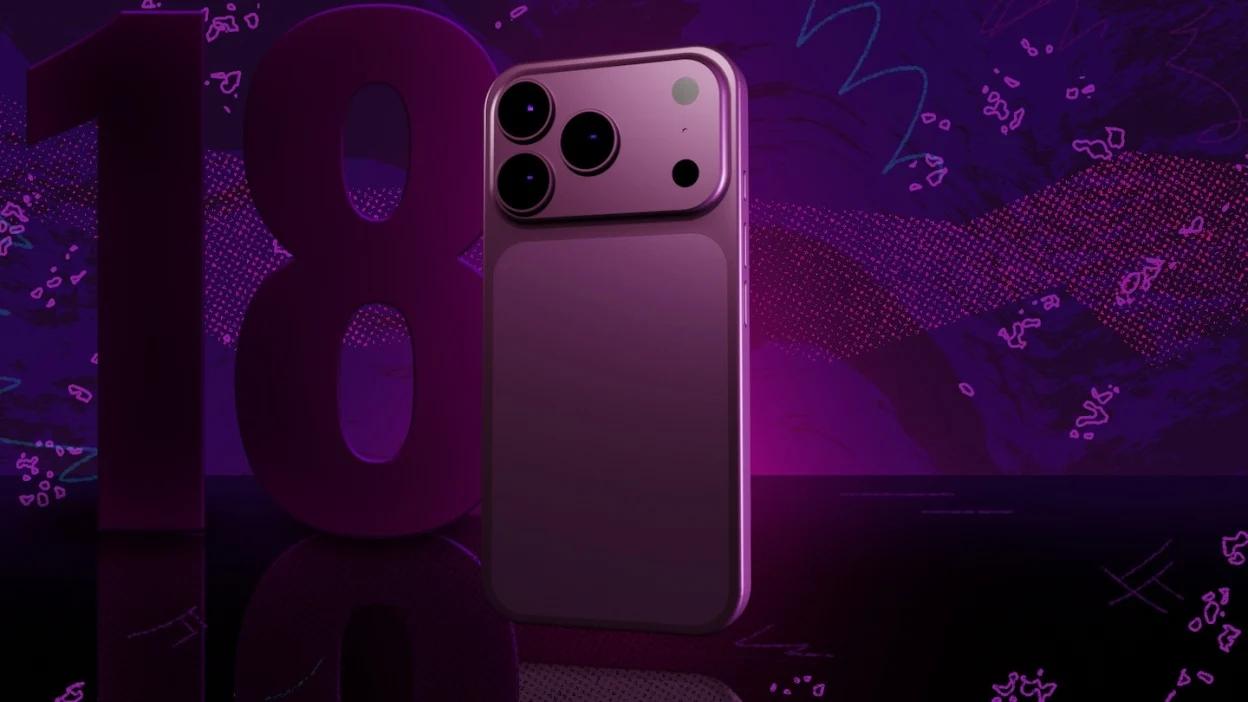
According to IDC, after the price increases of Mac and iPad, the price of the standard - version iPhone 18 may increase by $50, and the price increases of the iPhone 18 Pro and Pro Max may reach $200. Based on this speculation, the starting price of the iPhone 18 Pro may reach around $1,299, and the Pro Max may even reach $1,399. That is to say, the price of the iPhone 18 Pro in the Chinese market is very likely to start at 10,000 yuan.
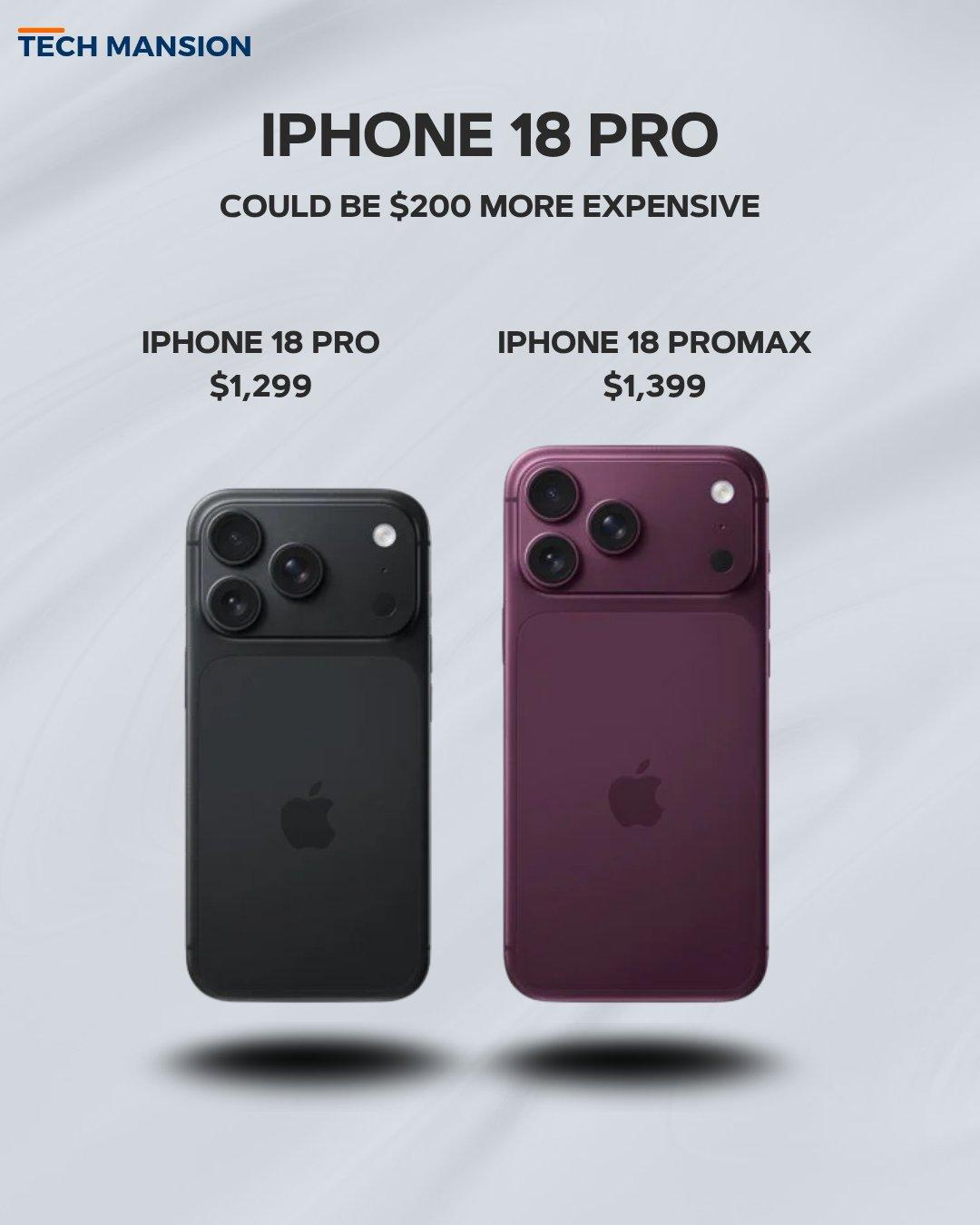
(Image source: TechMansion)
The reason Apple gives for this price increase is that the AI boom is taking away a large amount of storage production capacity, and the procurement costs of DRAM (RAM) and NAND (flash memory) are rising rapidly, making it difficult for the company to continue to absorb these costs.
While Apple was busy explaining how exaggerated the costs were, Micron also came out to complain. Micron executives hinted that during the last trough in the storage industry, some large customers used their procurement advantages to push prices to the bottom, worsening the manufacturers' profits and forcing them to cut production - capacity investments. Although Micron didn't directly name names, the outside world naturally blamed Apple.
Apple thinks the storage manufacturers are raising prices too much, while Micron thinks the large customers pushed prices down too hard back then. The two sides are arguing heatedly about who should be responsible, but they have a tacit agreement on the solution: transfer the costs to consumers. Micron and other companies that sell storage more expensively than gold are making huge profits, and Apple's gross profit will also increase significantly.
Consumers ultimately bear the storage costs
Apple's control over the supply chain has long been difficult for its competitors to replicate. Its large procurement volume allows Apple to contact multiple suppliers simultaneously and then use order allocation to get lower procurement prices.
When the storage market has an oversupply, Apple can lock in long - term contracts at low prices, and suppliers are willing to make concessions to keep this large customer. Did the low prices ultimately benefit consumers? Obviously not.
It is understood that Sumit Sadana, the Chief Commercial Officer of Micron, said that when the storage industry's profits hit rock bottom in 2023, some customers were still aggressively pushing down prices. Micron had already warned them at that time that such practices would dampen investment willingness. Now, with large - scale procurement of high - bandwidth memory by AI data centers and the time required to expand the production capacity of ordinary DRAM, the lack of production capacity built back then has quickly become a shortfall today.
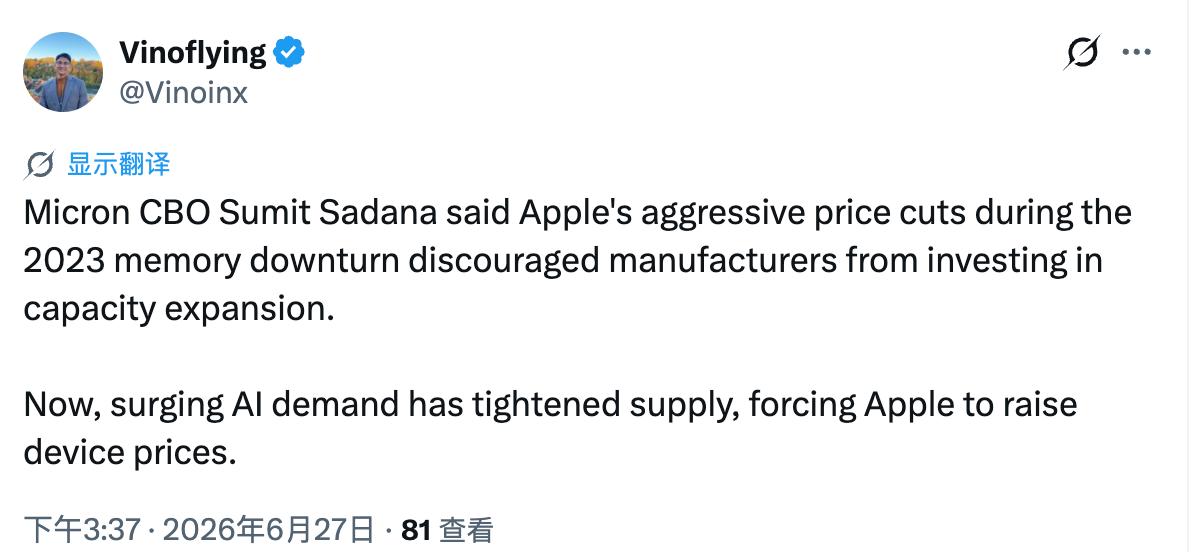
(Image source: X)
Xiaolei thinks there is a bit of sarcasm in these words. Apple used to be good at taking advantage of the industry cycle to buy cheap goods, but now it's being bitten by the same cycle. However, it seems that this bite didn't first erode Apple's profits but instead targeted consumers' wallets.
Micron doesn't deserve consumers' sympathy. Its latest quarterly gross profit margin is close to 85%. The storage price increase is giving Apple a headache, but it's also making upstream manufacturers rich. This whole thing is more like a debate between two high - profit players about who should make less money, and consumers unfortunately don't have the right to participate in the negotiation.
The cost pressure Apple is facing is also real. According to TechInsights' calculations, the memory and storage cost of the iPhone 17 Pro is about $50, and for the same parts in the iPhone 18 Pro, it may approach $200. An increase of about $150 per unit is enough to explain why Apple is considering a price increase.

(Image source: X)
The latest news is that Apple is seeking permission from the US government to purchase chips from Yangtze Memory Technologies Co., Ltd. Yangtze Memory's core product is DRAM. If this move is implemented, it can increase the number of RAM suppliers and put some price pressure on Samsung, SK Hynix, and Micron. As for the NAND capacity cost of the iPhone, Apple still needs to find other solutions.
This actually exposes Apple's real choice: when the supply chain is favorable, it keeps the accumulated profits for itself; when the supply chain is unfavorable, it transfers the increased pressure to the market. Apple could make less profit or offset some of the price increases by optimizing the costs of other components, but it ultimately chooses to raise the price, apparently believing that high - end users will still pay.
But a bigger problem arises: although the price is increasing, the upgrade points of the iPhone 18 series are very unclear.
With 9GB of memory, Apple truly lives up to the title of "Master of the Knife"
It is understood that the iPhone 18 Pro, Pro Max, and foldable models to be released in the fall of 2026 will still be equipped with 12GB of memory. It won't be until the spring of 2027 that the standard - version iPhone 18 and iPhone 18e will be launched, with the memory increasing from the current 8GB to 9GB.
9GB is indeed a bit novel in today's mobile phone market. Android flagships commonly have 12GB and 16GB of memory, but Apple has chosen the most peculiar number between 8GB and 12GB, just a little more than the previous generation and just not reaching the configuration level of the Pro series. If it's said that this was completely decided by engineers, Xiaolei is a bit skeptical. It seems more likely that the finance department and product managers were involved.
The 9GB of memory in the standard - version iPhone 18 may use a combination of 1.5GB×6 dies, while the current 8GB solution is 2GB×4 dies. A die refers to the DRAM die inside the package, and six dies don't mean there are six independent memories on the motherboard.
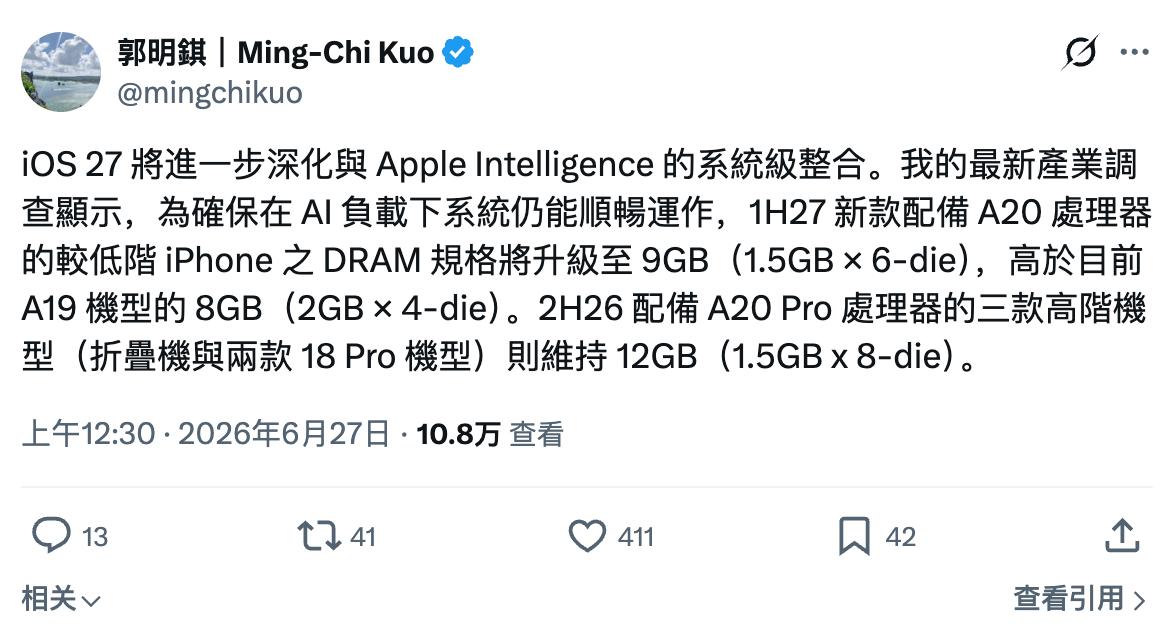
(Image source: X)
Is the extra 1GB useful? Actually, it is. Compared with 8GB, 9GB is a 12.5% increase, which can leave more space for the system and edge - side models and may also reduce the frequency of background app closures. It is a real upgrade in capacity, but the increase is still meager. If the price of the standard version only increases by $50, users can at least console themselves that they've got an extra 1GB; however, if the Pro series maintains 12GB but may charge an extra $200, it's hard for people to accept with a smile.
This also leads to a more crucial question: Can edge - side AI really work?
Xiaolei believes that edge - side AI has practical value. Offline summarization, photo organization, and personal information processing involving privacy are all suitable to be done on the phone, and the response speed is more stable. However, the phone's memory, heat dissipation, and battery all have clear limits. It's still not very feasible for the phone to handle complex inferences and long - term Agent tasks on its own. If only small - scale models of this kind are running on the phone's edge side, Apple actually doesn't need to forcefully add 1GB of memory.
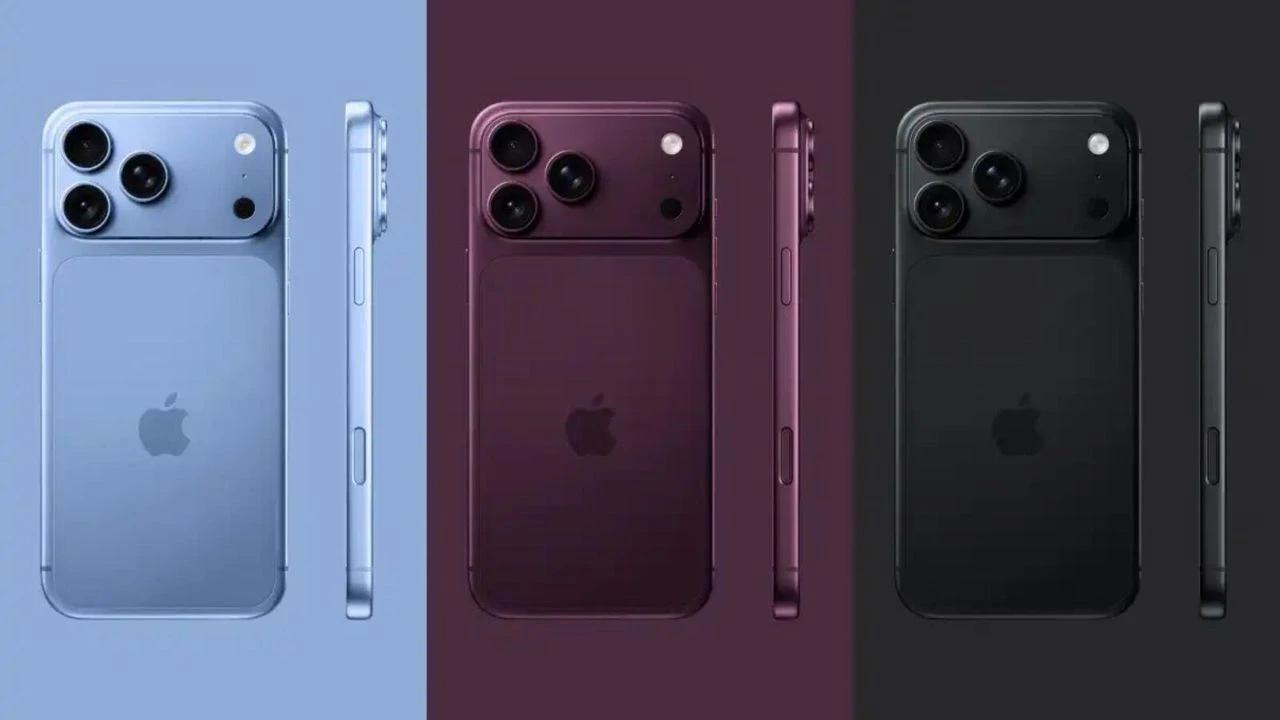
(Image source: X)
Therefore, it is reported that the A20 Pro to be installed on the iPhone 18 Pro will use a 2nm process and WMCM packaging, moving the DRAM from the top of the chip to the side to improve heat dissipation and communication efficiency. The rumored 96 - bit wide LPDDR6 and the expanded neural network engine are also making room for edge - side AI. But as for when Chinese consumers can use Apple's AI, it's still unclear for now.
AI that can't run on the phone is more suitable for the cloud
Apple has always adopted a hybrid approach towards AI, that is, simple tasks are processed on the device, and complex inferences are handed over to Private Cloud Compute. In the new plan in 2026, some high - load tasks are even extended to the NVIDIA GPUs on Google Cloud. Although Apple emphasizes edge - side AI, it is actually building a system that coordinates the edge and the cloud.
Although everyone knows that AI on the phone, whether it's edge - side, cloud - side, or a hybrid of the two, can only be considered a small - scale attempt and can't be compared with enterprise - level Agents. Recently, people have been discussing cloud computers, cloud operating systems, AI browsers, and AI assistants. In fact, future terminals may be more like entrances, and the real - working Agents open browsers, run software on the cloud, and retain the state of the previous task. When users log in on a thin device, the task can continue to be executed. This idea is indeed attractive for Agents that need to run all day.
Alibaba Cloud's Wuying is trying this direction. Its AgentBay puts the cloud browser, code environment, desktop, and mobile device operations into an isolated running space. Agents can perform web operations or process files on the cloud, and enterprises can create and recycle environments according to tasks. Compared with buying a Mac mini for each employee, this method is more convenient for unified permission management and elastic expansion, and it can also prevent Agents from directly accessing employees' personal computer files.
(Image source: Alibaba)
This makes people question the reason Apple gives for the price increase. When more and more AI capabilities need to be completed on the cloud, why should consumers pay such a high premium for edge - side hardware in advance? They have to pay once when buying the phone, and may have to pay again when using cloud services in the future. This "double - charging" is what users really need to be vigilant about.
IDC predicts that in 2026, the global smartphone shipments may decline by 13.9% year - on - year, but the average selling price will continue to rise. It's not difficult to use an old iPhone with surplus performance for another year. When the core selling points of new phones are concentrated on the currently invisible AI potential, consumers' most direct response is to extend the phone - replacement cycle.
Going back to the original question, who will ultimately pay for the $200 price increase of the iPhone 18 Pro?
Xiaolei doesn't deny that AI is driving up the hardware costs of phones, and advanced processes and new packaging also require a lot of money. What consumers care about is how much real experience they can get in return for the money they pay. Especially for Chinese users, it's a bit unreasonable to ask them to pay the AI hardware premium in advance when the core AI functions haven't been fully implemented.
(Image source: X)
Edge - side AI has its place, and cloud - side AI will also take on more and more complex tasks. Apple can continue to optimize the division of labor between the two, and cloud computers like Alibaba Cloud's Wuying will also find a market for enterprise - level Agents. However, these grand technological routes can't automatically become reasons for the iPhone to increase in price.
If Apple doesn't have enough "strength" to prove that the iPhone price increase is reasonable, then Apple fans will probably just respond with "not buying".