After losing over 9 billion yuan in three years, Momenta needs a stronger sense of security.
"The competition in automotive assisted driving will end in 2026, and only three participants will ultimately emerge victorious in the domestic market."
In October 2025, at the World Intelligent Connected Vehicles Conference, Cao Xudong, the founder and CEO of Momenta, made this judgment. At that time, the competition in the intelligent driving industry was accelerating from the stage of "boasting and showing off" to the in - depth stage centered around cost, reliability, and delivery capabilities.
At the same time, Momenta's business progress was remarkable, and it had entered the top camp of intelligent driving suppliers. As of September 2025, it had cooperated on more than 160 mass - produced models, and its partners covered global automakers such as Mercedes - Benz, BMW, Toyota, and Honda.
This might be the source of Cao Xudong's confidence when he judged that this year would be the decisive battle in intelligent driving, implying that Momenta would surely be one of the three winners.
Picture/Momenta's official WeChat account
As of mid - 2026, the competitive landscape of the intelligent driving track was still unclear, and the pattern differentiation had not yet fully formed. However, a distinct trend was that the industry elimination competition had intensified.
Even for the top players, the pressure had not eased.
The most direct challenge comes from the business model itself. Intelligent driving features high R & D costs, high trial - and - error costs, and high engineering delivery costs. At the current stage, it is almost an industry consensus that "high - end solutions do not have large sales volumes, and low - end solutions do not make money": high - end solutions have not entered the popularization stage, and the delivery cycle is long; the prices of basic functions are constantly being compressed, and the contribution per vehicle is limited.
The second pressure comes from the vulnerability of the moat.
For example, on the surface, Horizon's hardware - software integration and Momenta's data - driven approach have both established short - term barriers. However, in essence, both models still rely heavily on the "choices" of automakers. Against the backdrop of the increasing trend of automakers' self - research, "you may be a partner today and an alternative tomorrow." Unless suppliers can form irreplaceability in terms of data, large - scale delivery, or ecological binding, long - term stickiness and bargaining power are difficult to guarantee.
On June 23, the Hong Kong Stock Exchange released Momenta's post - hearing listing application materials. From its prospectus, Momenta's long - term challenges are focused on these two points.
01. A Loss of 9.234 Billion in Three Years, Unrealized Self - Sustenance
From the revenue perspective, Momenta has achieved high - speed growth in the past three years.
From 2023 to 2025, its revenue increased from 743 million yuan to 1.325 billion yuan and then to 2.413 billion yuan, tripling in three years, with a compound annual growth rate of over 80%.
Although there was growth in both 2024 and 2025, the driving forces behind Momenta's high - speed growth were not the same.
Let's first briefly analyze Momenta's revenue structure. Among the company's two major business segments, the mass - produced vehicle solutions, which provide intelligent driving software systems for automakers, contribute the core revenue. In its prospectus, Momenta claims to be the first Tier - 1 supplier to provide a complete system - level intelligent driving software.
The revenue from this segment is further divided into pre - mass - production technology development services and post - mass - production licensing fees based on sales volume. The former involves custom - developing intelligent driving systems for automakers and charging development fees on a project basis, while the latter charges software licensing fees based on the actual sales volume of vehicles equipped with the intelligent driving system, which is a licensing system.
In 2024, Momenta's revenue growth was mainly due to the increase in technology development service revenue and the increase in licensing revenue driven by more projects entering the formal mass - production stage. However, in 2025, licensing revenue contributed more to the revenue growth.
Behind this, the evolution of Momenta's revenue structure in the past three years is worthy of attention.
In 2023, technology development services accounted for 96.8% of the revenue, while licensing services accounted for only 3.1%. By 2025, the proportion of technology development services had dropped to 59.9%, and the proportion of licensing services had risen to 40.1%.
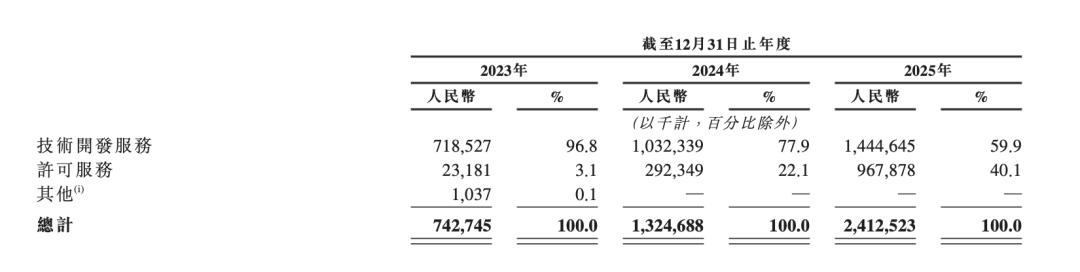
Picture/Momenta's prospectus
This structural evolution is also the key factor for Momenta's continuously increasing gross profit margin. From 2023 to 2025, Momenta's gross profit margin jumped from 17.5% to 49.0% and then to 71.6%.
The company mentioned in its financial report that the gross profit margin of licensing service revenue is usually higher. The reason is that a significant portion of the costs involved in delivering the solution are incurred during the development stage. Therefore, once the solution is deployed in mass - produced models, the incremental costs related to licensing services are extremely small.
As for the autonomous taxi (Robotaxi) service solution, Momenta cooperates with travel platforms to operate Robotaxi fleets, and the revenue comes from the share of actual operating fares. This is one of Momenta's core narratives about the future and the second leg of CEO Cao Xudong's "one flywheel, two legs" strategy. However, at the current stage, it has not contributed more to the revenue growth.
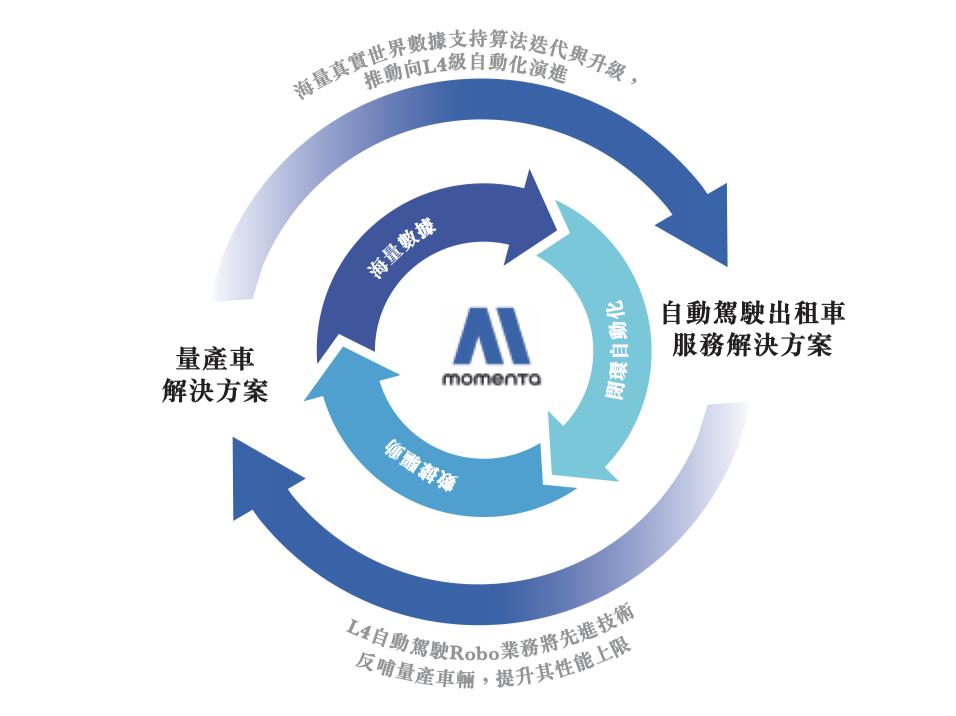
Cover image/Momenta's prospectus
However, in addition to the high - speed growth in revenue, Momenta's losses have remained high, and it has not yet achieved self - sustenance.
From 2023 to 2025, Momenta's net losses were 2.57 billion yuan, 3.206 billion yuan, and 3.458 billion yuan respectively, with a cumulative loss of 9.234 billion yuan in three years, and the loss amount increased year by year. After excluding non - cash items such as share - based compensation and changes in the fair value of preferred shares, the adjusted net loss has been continuously narrowing, with 1.093 billion yuan, 959 million yuan, and 303 million yuan in the past three years respectively.
The long - term high R & D investment is one of the core reasons for its losses.
From 2023 to 2025, Momenta's R & D investment has been continuously increasing, reaching 1.281 billion yuan, 1.508 billion yuan, and 1.869 billion yuan respectively. In 2025, R & D expenses accounted for 77.5% of the revenue.
In terms of operating cash flow, Momenta is also under pressure. In 2025, Momenta had a net operating cash outflow of 280 million yuan, and its self - sustenance ability has not yet been formed.
Based on this reality, before achieving full self - sustenance, Momenta needs more funds to support its high - level R & D investment.
This is why, when Momenta goes to the Hong Kong Stock Exchange for an IPO this time, some outside views believe that this is not the best time for listing. However, it is obvious that after missing the wave of listings in 2024, Momenta must seize this rather urgent time window.
02. Behind the High Market Share, Momenta Also Faces "Vulnerability"
In its prospectus, Momenta cited data from CIC Consulting, stating that based on the sales volume in the 12 months ending February 2026, its market share in the global urban NOA segment was 64.5%, and its market share in the broader highway and urban NOA segment was 27.4%.
Objectively speaking, these two sets of data have firmly placed Momenta in the top camp, especially the former.
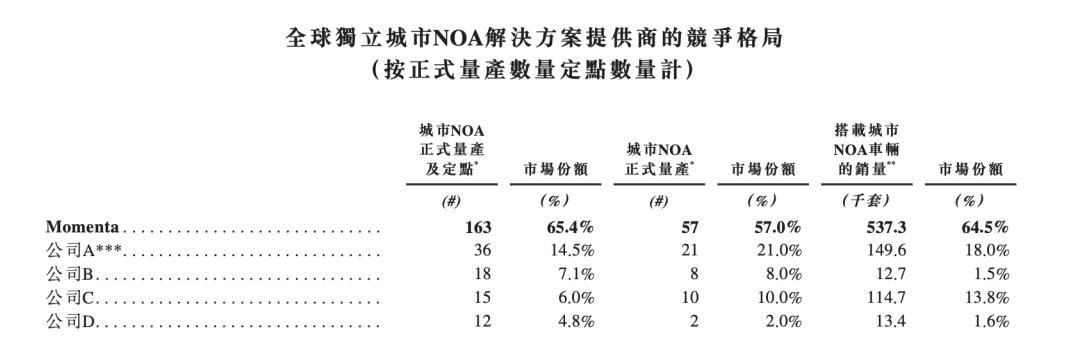
Picture/Momenta's prospectus
However, from another perspective, CIC Consulting's statistical scope is "third - party independent intelligent driving solution suppliers", excluding Huawei's Hongmeng Smart Mobility (Five - Realm Model) and automakers' self - developed solutions. In this narrow track, Momenta's share is far ahead.
However, once the scope is expanded to the entire market, the pattern changes immediately. Huawei's Qiankun ADS has an overall share of 27.9%, and Momenta's share drops to 13.3%. According to media reports, in January this year, Huawei's (including the Five - Realm Model) market share soared to 67.9%, while Momenta's dropped to 14%.
The competitive pattern also shows significant differentiation in different price segments. In the 100,000 - 200,000 yuan market, Horizon leads with the scale advantage of its Journey series chips; in the 200,000 - 400,000 yuan market, Huawei's Qiankun ADS dominates strongly; in the high - end market above 400,000 yuan, Momenta still has a relative advantage.
This means that Momenta's main market is more concentrated in high - end models, and it still needs to break through in the penetration of large - scale volume models. Although the company has mentioned in its prospectus that it is accelerating its penetration from the high - end market downwards.
Looking back, in the most enthusiastic years of the intelligent driving industry, a large amount of capital poured into the L4 - level Robotaxi track, creating one valuation bubble after another. Momenta is one of the few companies that has always adhered to the path of "mass production first, data feedback" - not talking about L4 in vain, starting from the mass production of L2+/L3, using large - scale vehicle installations to obtain data, and then using data to drive algorithm evolution.
This path did not seem very attractive at that time, but after the industry entered the in - depth stage, its advantages began to be continuously demonstrated.
In addition, Momenta only focuses on algorithms, does not bind to hardware, and does not compete with automakers for the dominant right in intelligent driving. This positioning was once regarded as a "weakness" during the most intense debate on the "soul theory" in the industry - only doing software and not doing chips, without the right to hardware access.
However, this "not touching hardware, not seizing the soul" attitude has helped Momenta gain the trust of automakers. For example, although Huawei's full - stack solution is powerful, its strong - handed cooperation model makes many automakers wary; Horizon's chip solution has a wide coverage, but its in - depth customization ability at the algorithm level is limited. Momenta has found a niche between the two.
However, the current stage - by - stage lead never means safety. Since it has not been transformed into a real competitive barrier, it has instead become a new constraint for Momenta.
On the one hand, as the market space for third - party independent suppliers is gradually compressed, Momenta's past advantages are starting to fade.
The self - research of intelligent driving by automakers is the biggest structural threat that Momenta faces. In fact, this is not a problem of being chased by a certain competitor, but a major trend in the reconstruction of the entire industry value chain.
On the other hand, the high concentration of customers has also become another challenge for Momenta.
In 2025, the top five customers contributed 62.6% of Momenta's revenue, with BYD being the largest customer, contributing 21.6% of the revenue. However, the problem is that BYD is accelerating the self - research of chips. Once its self - developed solution is installed in large - scale vehicles, Momenta may face a direct impact.
Looking back, Momenta has indeed been accelerating its layout in the past period.
One is self - research on chips. The BMC 7X chip has a computing power of 272 TOPS and was delivered for installation in December 2025, aiming to make up for the shortcoming of hardware - software integration. However, the large - scale mass production of chips still takes time. NVIDIA's Orin - X has a deep ecological barrier, and Horizon's Journey 6 series is quickly seizing market share with its local advantage. Momenta is in a catching - up position in terms of time and ecology.
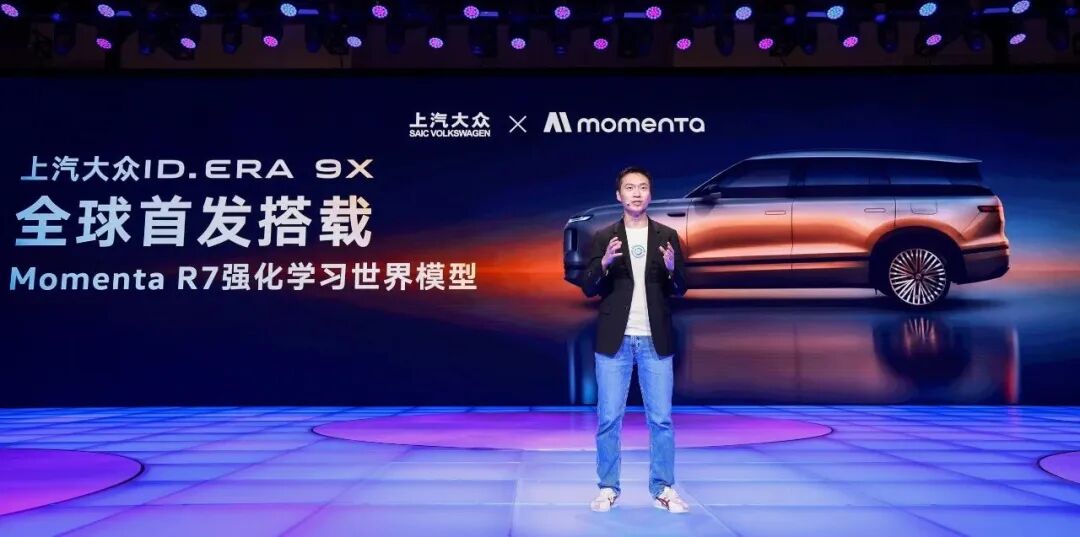
The second is the upgrade of the narrative - from an "intelligent driving supplier" to a "physical AI platform". The R7 world model was mass - produced and launched in April 2026, and is installed in SAIC Volkswagen's ID.ERA 9X, aiming to upgrade the valuation anchor from a "software company" to an "AI base for the physical world". However, the revenue from Robotaxi is still small, the issuance of L4 licenses is still slowing down, and the implementation of physical AI requires a huge amount of funds. The grand narrative can support the IPO valuation, but it cannot support a sustainable business model.
Picture/Momenta's official WeChat account
However, at the current stage, the situation Momenta faces is that the BMC chip is more of a remedial measure rather than a strategic initiative, and physical AI is still far from entering the verification path.
In other words, Momenta's responses are real but limited.
Now, looking back at Cao Xudong's "end - game theory", it is not difficult to find that Cao Xudong's judgment a year ago might have been too optimistic. A more accurate description is that 2026 is not the end, but the room for trial and error is indeed approaching zero. This is true for Momenta and for any company in the intelligent driving track.
When the living space of third - party suppliers is squeezed from both ends - on one end by systematic competitors like Huawei, and on the other end by the wave of "eliminating suppliers" in automakers' self - research, how to make more money in the limited space and realize greater ambitions is becoming the most realistic challenge for companies like Momenta.
Cover image/Momenta's official WeChat account