Selling tokens has become as cutthroat as the food delivery business, while those selling mining tools are essentially "printing money".
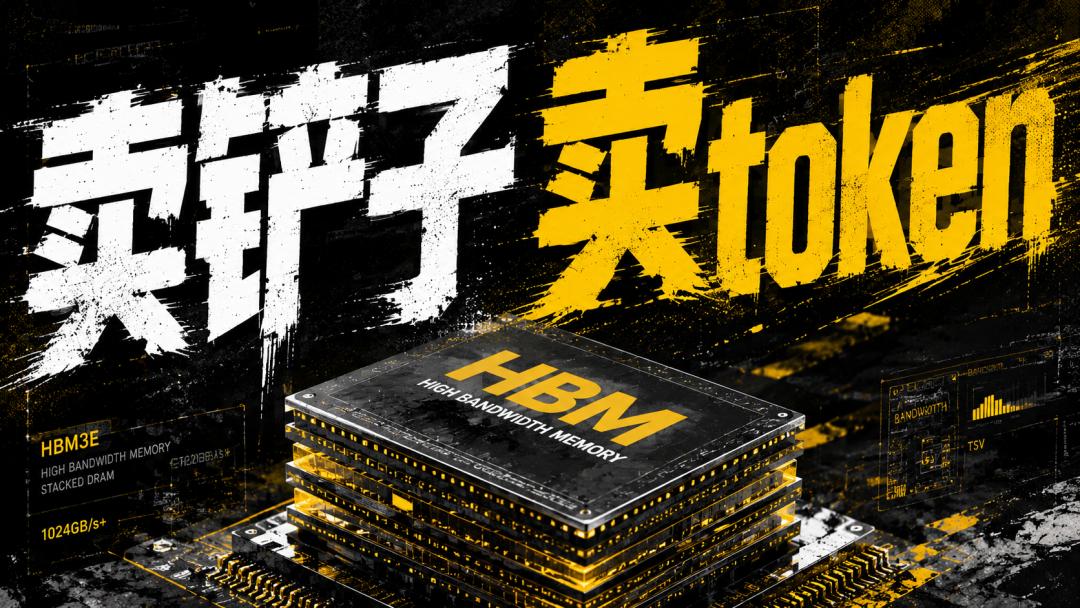
In this round of AI development, profits are still concentrating in the most critical segments.
Put simply, the upstream of the AI industry has almost absorbed all the money invested in the entire industrial chain.
Let's first look at a few sets of figures.
In Micron's latest quarter, its revenue reached $41.456 billion, operating profit was $33.318 billion, and the operating profit margin was 80.4%. The company's guidance for the next quarter is even more impressive, with expected revenue of about $50 billion and a gross profit margin of about 86%.
In the first quarter of 2026, SK Hynix's operating profit was 37.61 trillion won.
In the first quarter of 2026, Samsung's semiconductor DS division had an operating profit of 53.7 trillion won. Although this figure doesn't solely represent storage, the official statement clearly indicates that the core driving forces are AI demand, record - high Memory performance, and industry price increases.
If we look at Hynix, Samsung DS, and Micron together, the combined single - quarter operating profit of these three companies is roughly close to $100 billion.
Let's make a comparison.
Nvidia's single - quarter operating profit during the same period was approximately $53.5 billion.
That is to say, the combined single - quarter operating profit of these three companies is significantly higher than that of Nvidia.
Industry giants like Tencent and Apple have to bow to the large storage manufacturers.
Let's change the reference.
The combined net profit attributable to shareholders of 608 companies on the Science and Technology Innovation Board in 2025 was 58.624 billion yuan.
The combined single - quarter operating profit of Hynix, Samsung DS, and Micron, when converted into RMB, is more than 10 times this figure.
This is the most straightforward situation in the current AI industrial chain:
The model layer is reducing costs, and it is a forced reduction.
On the OpenAI side, the API prices have become extremely detailed: different models, different context lengths, cached inputs, and batch - processing discounts are all sold separately. In essence, it is constantly reducing the cost per token while increasing utilization.
Prices are becoming more and more transparent, and competition is becoming more and more direct.
Google Gemini follows the same logic, with tiered pricing where different capabilities correspond to different prices. It even offers continuous package discounts on the enterprise side. In essence, it is still competing for volume and calls.
Microsoft is even more direct. While developing its own models, it integrates third - party models (including DeepSeek) into Azure AI Foundry, allowing customers to make horizontal comparisons and switch at any time.
This "model supermarket" model essentially further compresses the bargaining power of a single model.
The situation is the same in China.
ByteDance's Doubao, which previously emphasized low prices or even near - free services, has now started to charge step by step and adopt tiered pricing. The reason is simple: the cost calculation doesn't work out.
Once the call volume increases, the cost explodes. In the end, it is found that most of the money is spent on GPUs and storage, and the model itself has become a business of "small profits but large sales".
In other words, model companies are competing on price and capabilities in the front - end, but the cost structure in the back - end is becoming more and more rigid.
On the other hand, the storage layer is reaping profits.
HBM, server DRAM, eSSD - these things can't be expanded immediately as you wish. The supply release is slow, and the verification cycle is long, but the demand is being driven up by AI data centers, training, inference, and Agents.
The result is that prices rise, and profits are directly reflected in the financial statements.
Model companies are competing on price, while storage companies are collecting cash.
So when looking at AI now, we can't just focus on which model is the strongest. We also need to see which part is the most bottleneck.
Selling tokens is becoming more and more like "takeout": the order volume can keep increasing, but the prices are becoming more and more transparent, competition is becoming more and more intense, and both platforms and merchants are constantly offering discounts.
Selling "shovels" is more like a "toll booth": if you want to build a data center, conduct inference, or implement an Agent, you have to pay the money first, and it's hard to save this cost.
At least in this stage, the most exaggerated profits in the AI industrial chain are not in the front - end where intelligence is sold, but in the back - end where memory and storage are sold.
In the face of storage and semiconductor hardware, all companies seem to be at a disadvantage.
This article is from the WeChat official account "Wu Duidui" (ID: esnql520), written by Wu Duidui, and is published by 36Kr with authorization.