A Visit to Guangzhou Electric Appliance City: "E-waste" Unloaded from Japanese Containers Has Become a Hard Currency Here
Exit A of Gongyuanqian Subway Station. Going upstairs leads to Animation Star City, and on the right - hand side are Fengjia Hardware and Electrical Appliance City and Jiangjundong Electrical Appliance City. Originally, there was no connection between these two places. One is a pilgrimage site for the second - dimension community, and the other is a stronghold for old Guangzhou residents to buy light bulbs and repair rice cookers. However, in the past two years, they have been linked by the same group of people.

(Image source: Shot by Lei Technology)
Hearing that this place is the base camp of “electronic waste”, Lei Technology (ID: leitech) decided to go on - site to find out.
I arrived on a weekday afternoon. The first floor of the electrical appliance city was still the same as before. Most of the stalls were selling power strips and LED light strips. But when I went to the basement floor, a different smell began to permeate the air: old plastic, lithium batteries, and a musty smell similar to that in a warehouse. Dozens of stalls had second - hand digital products polished brightly and placed above the glass cabinets, looking like some newly discovered cultural relics.
Undoubtedly, the top - selling item among them is the CCD camera. There were people around almost every stall. The bosses skillfully reported the models: “This Canon A620, the same model as Ouyang Nana's, is 90% new. It comes with a battery and a charger. It's 680 yuan, no bargaining.” The girl standing next to the stall took the camera, took a photo of her companion, and then leaned over to the two - inch LCD screen to check the result. I saw this action N times within three hours.
The CCD camera, a sensor technology that has long been replaced by CMOS, has now become a hard currency here. An old digital camera that might only be worth a few dozen yuan on Xianyu usually costs four or five hundred yuan here, and it's not uncommon for popular models to cost over a thousand yuan. Strangely enough, buyers don't think it's expensive, and sellers don't worry about sales.
A stall owner told me that on weekends, he can sell more than a dozen cameras a day. “They all come after seeing it on Xiaohongshu,” he said. “What they want is that sense of authenticity.”
I heard the word “authenticity” too many times that afternoon.
Xiaohongshu accidentally revived the dying old electrical appliance city
The transformation of Fengjia Hardware and Electrical Appliance City probably took place around 2023. At first, only a few stalls sold second - hand cameras as a side business, and the sources of goods were from recycling channels in Hong Kong, China, and Japan. At that time, CCD cameras hadn't been hyped up yet. These old cameras were bought by weight, costing only a few dozen yuan each, and were sold to some students with limited budgets or boarding students who weren't allowed to bring mobile phones to school.
The turning point was Xiaohongshu. With the resurgence of the Y2K trend, vintage filters became the key to getting traffic. Celebrities started showing off their old CCD cameras. Ouyang Nana, Yi Yangqianxi, and Song Yanfei all had one.
The recommendation mechanism of the algorithm quickly sensed this popularity. Tags like “CCD atmosphere”, “film substitute”, and “old - fashioned charm” began to generate a large amount of content. A once niche second - hand trading category was promoted to a hit by the platform.
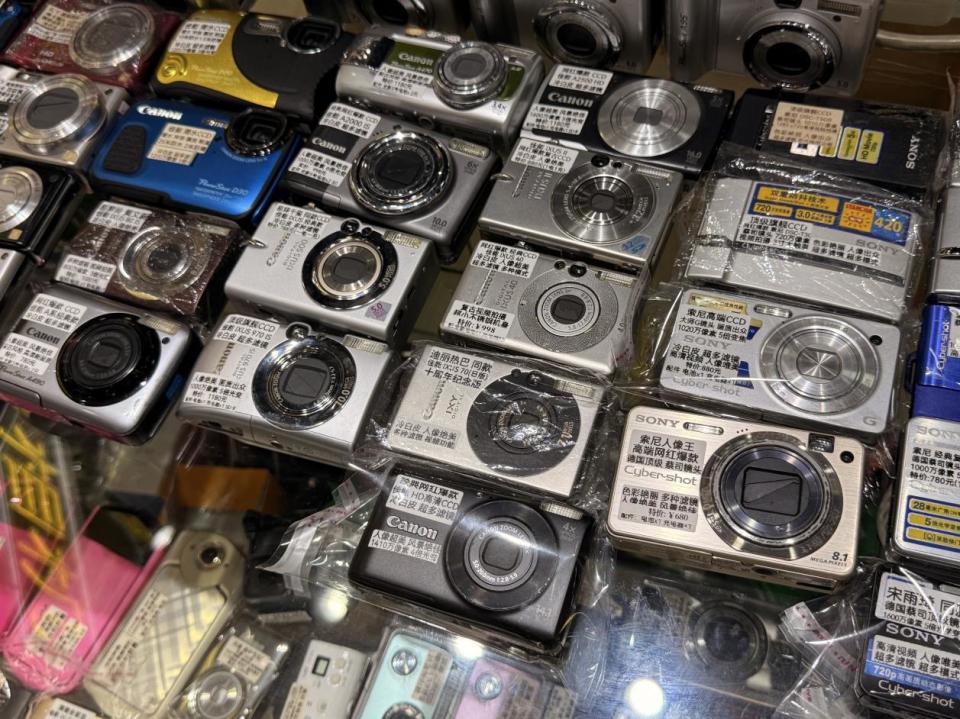
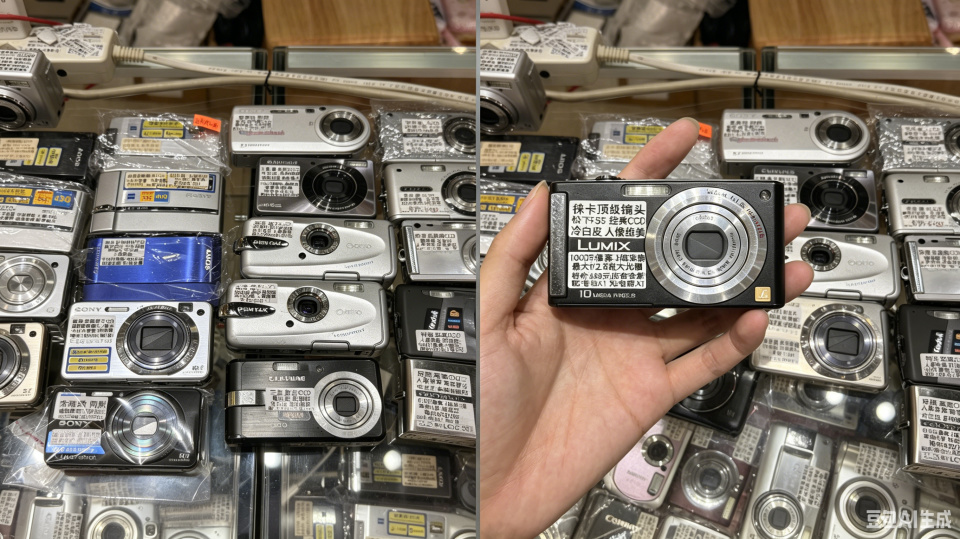
The bosses in the electrical appliance city are very sensitive. Many of them have been in this business for more than a decade, from selling MP3s and MP4s to selling mobile phone accessories, and now CCD cameras. They sell whatever is popular. A boss told me that 70% of his current sources of goods are from Japan. “There are specialized recycling companies there, which ship them to China in containers. When we get them, we have to select, test, repair the broken ones, and disassemble the ones that can't be repaired for parts.” His stall isn't big, but there are more than 200 cameras on the shelves, ranging from Canon to Casio, from Fuji to Olympus, sorted by brand and condition.
(Image source: Shot by Lei Technology)
The price system has also been rebuilt in the past two years. The boss gave me a set of figures: In 2022, a Canon IXUS 95 IS was sold for about 150 yuan; in 2024, the same model can be sold for more than 600 yuan. If it's a model with the “portrait king” attribute, such as the Canon A620 or Sony T30, the price can directly exceed a thousand yuan. This is no longer the depreciation logic of second - hand electronic products, but the pricing logic of trendy toys and social currency.
The profile of the customers who come to buy is very clear: aged 18 to 25, mainly women, college students or those who have just started working. Most of them already have an iPhone with a powerful enough camera function, but they still come to buy CCD cameras.
There was a girl on - site who was choosing a Sony T7, a ultra - thin model from 2005. Its design is still amazing today. She said she had read guides on Xiaohongshu for three months. “The color tones of each model are different. Some are colder, and some are warmer. I have to find the one that suits me best.”
This selection process itself has become part of the consumption experience. Just like shaking a blind box when buying one, when buying a CCD camera, you also need to take test shots, make comparisons, and have some hesitations. Finally, you find the “destined” one among a pile of old cameras.
The corridor on the second floor of the electrical appliance city is very narrow, and the stalls are very close to each other. On the left, people are bargaining; on the right, someone is teaching how to adjust the ISO; in front, a girl has just found that the battery cover is loose and is asking for a replacement. This kind of noise and crowding actually creates a sense of ritual for treasure - hunting.
There are many news stories about people being deceived when buying CCD cameras online, such as fake models, modified machines, and dash - cams in camera shells. Here, at least you can touch the camera with your own hands and take test shots on - site. A boss told me, “They're not afraid of paying a little more, but they're afraid of fakes. A real old camera can capture that feeling, which a fake one can't.”
Young people are tired of the perfect photos taken by mobile phones
CCD, short for Charge - Coupled Device, was once the mainstream image sensor in digital cameras. Its working principle isn't very complicated: light enters through the lens, hits the CCD, is converted into an electrical signal, and then becomes a digital image. However, CCD has a characteristic: high power consumption, high cost, and poor performance in high - sensitivity situations. The noise is extremely obvious in low - light environments. After 2008, CMOS sensor technology matured. With low power consumption, low cost, and high speed, it quickly pushed CCD out of the market.
From a technical perspective, the elimination of CCD is a reasonable progress. However, consumer behavior is never determined only by technical parameters.
The photos taken by CCD cameras have several obvious defects: low resolution, full of mosaics when magnified; high color saturation, with red looking like painted and green looking like oiled; obvious noise in the dark areas, with a rough grainy texture; highlights are prone to overexposure. When taking pictures of people in the sun, the skin will look extremely white.
These are serious flaws in the eyes of photography enthusiasts, but in the eyes of today's young people, they are exactly the source of the atmosphere.
(Image source: Shot by Lei Technology)
In contrast, mobile phone photography has taken a different path in the past decade. With multi - camera modules, computational photography, AI algorithms, night - mode, and portrait blurring, the photos taken by mobile phones are becoming more and more “correct”.
However, this “correctness” is based on the intervention of a large number of algorithms. When you press the shutter, the mobile phone simultaneously performs HDR synthesis, skin - tone optimization, scene recognition, and edge sharpening, and finally outputs an image that looks better than reality.
The problem is that when all photos are good - looking, the concept of “good - looking” itself loses its value.
On social platforms, beauty filters, AI photo - editing, and template color - adjustment have formed a new visual standard. The skin must be flawless, the legs must be long, and the sky must be Klein blue. This industrialized aesthetic is mass - producing visual fatigue. Young people are exposed to such images every day, and they are longing for unprocessed original images instead.
The revival of CCD is a rebellion against algorithms. The low pixelation blurs the skin flaws, the high - saturation colors create a nostalgic feeling like a memory filter, and the noise and overexposure make the photos look like they were taken in the past rather than now. The stall owner summed it up very well: “What a mobile phone takes is a photo, and what a CCD takes is a feeling.”
This feeling is precisely named “authenticity”.
However, the “authenticity” here needs to be in quotation marks. The photos taken by CCD cameras are also digital signals and can also be post - processed. Its authenticity isn't physical authenticity but perceptual authenticity, an illusion without algorithmic intervention. What young people are buying isn't an objective documentary - style record but a subjective, emotionally authentic experience with a vintage filter.
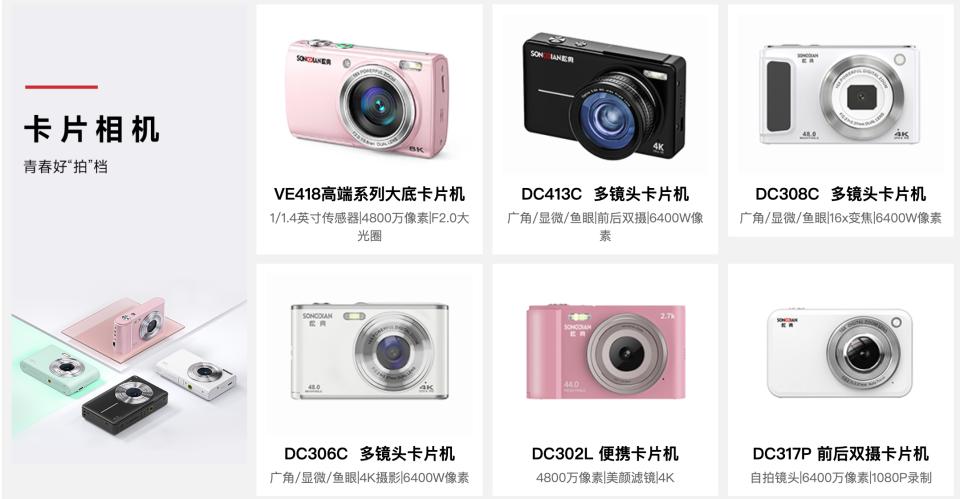
This demand has also given rise to a new business ecosystem. In addition to second - hand trading, the domestic camera brand Songdian has risen by taking advantage of the trend. It specializes in producing digital cameras in the CCD style, with a price of two or three hundred yuan. Their appearance replicates the design of the millennium era, and they have multiple built - in filter modes.
(Image source: Songdian official website)
The resurgence of old digital devices isn't limited to CCD cameras. I also saw a large number of old MacBooks, PSPs, Nintendo DSs, and BlackBerry phones in the electrical appliance city. Their functions have long been integrated into smartphones, but as objects, the sense of time they carry can't be replaced.
In fact, the more technology advances, the stronger people's rebellion against technology becomes.
Young people would rather take blurry photos to regain the sense of control over photography
I talked to three stall owners, and when describing the customers' needs, they all used the same expression: “What they want is blurriness.”
What exactly does this “blurriness” refer to?
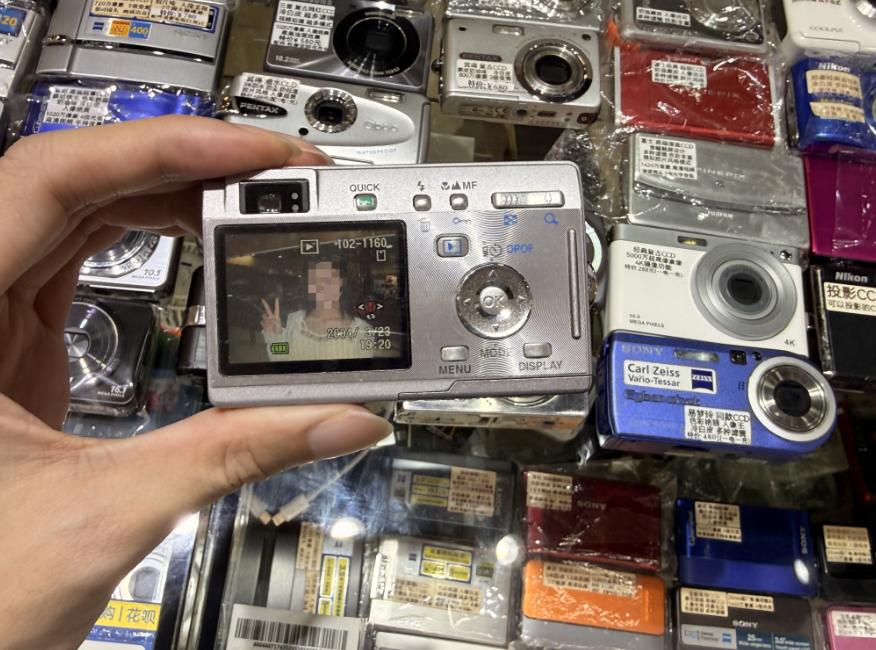
A girl gave me the answer. She opened her mobile phone photo album and compared two photos: one was taken by an iPhone 15 Pro Max, with even lighting, delicate skin, and natural background blurring; the other was taken by a CCD camera, with a yellowish skin tone and a blurred background, with a millennium - era texture. She pointed to the CCD photo and said, “This one looks like me, and that one doesn't.”
(Image source: Shot by Lei Technology)
The algorithmic optimization of mobile phone photography is essentially a set of aesthetic hegemony. What is good - looking skin? What is a good - looking scenery? The answers to these questions are written into the code and become the default settings. Users only need to press the shutter to get the “correct” result.
However, “correct” doesn't equal “authentic”, let alone “self”.
When everyone produces images within the same algorithmic framework, differences are smoothed out. The same filter on Xiaohongshu, the same beauty parameters on Douyin, and the same composition template on Moments. Visual homogenization has reached an unprecedented level.
Young people are beginning to realize that their faces, their lives, and their travels are all being formatted by algorithms.
And CCD provides an inexpensive way to escape.
Its technical defects happen to be the opposite of algorithms: no AI beauty, no HDR synthesis, no scene recognition. When you press the shutter at a person, you get what that person looks like under that lighting condition. You may not look good, the background may be messy, or the exposure may be wrong, but it's what you took yourself, not what the algorithm decided for you.
This “manual feeling” is crucial. Adjusting the ISO, choosing the white balance, turning the flash on or off. These operations that are silently done by AI on mobile phones need to be judged by the user themselves on a CCD camera. Photography has changed from a passive behavior back to an active one.
Even if these choices are rough and the results are not as good as those taken by mobile phones, the sense of participation in the process allows young people to regain a certain sense of control.

(Image source: Xiaohongshu @Jialunbujia)
A stall owner told me that many girls will buy a portable printer after buying a CCD camera, or go to a photo - printing shop to print out the photos. They say that the photos stored on the mobile phone will be lost sooner or later, and only when they are printed out and put in an album are they real. This obsession with physicalization is also an escape from cloud storage, algorithmic recommendation, and information - flow bombing.
Of course, this rebellion has limitations. CCD itself is also a digital technology, and its vintage feeling is also a product of technical parameters. Moreover, when CCD becomes a trend, it is also captured by new algorithms. The notes about “CCD direct output” on Xiaohongshu are themselves a form of content production.
Young people think they are escaping from algorithms, but in fact, they may just be jumping from one algorithm pool to another. However, even so, this attempt to escape is still meaningful. It at least proves that when technology makes everything too convenient, too perfect, and too correct, people will have a longing for the inconvenient, imperfect, and incorrect.