Unlimited servings for only 9.9 yuan, why are hot pot restaurants all scrambling to offer self-service vegetables?
The soup base costs 18.8 yuan separately. It's 26.8 yuan per table, and 9.9 yuan for unlimited vegetable consumption... The words "vegetable buffet" are increasingly appearing on the menus, signboards, and walls of hot pot restaurants. Self - service vegetables are becoming a standard feature in more and more hot pot restaurants.
Meituan data shows that the search volume for "Guizhou wild vegetables" has skyrocketed 23 times in a year, and "wild vegetable buffet" has become a hot search term. From the all - you - can - eat wild vegetables for just a dozen yuan in Guizhou street - stall hot pots to leading brands competing to launch self - service stations, a silent battle around "vegetables" has begun.
From the mountains of Guizhou to dining tables across the country, the vegetable buffet craze is in full swing
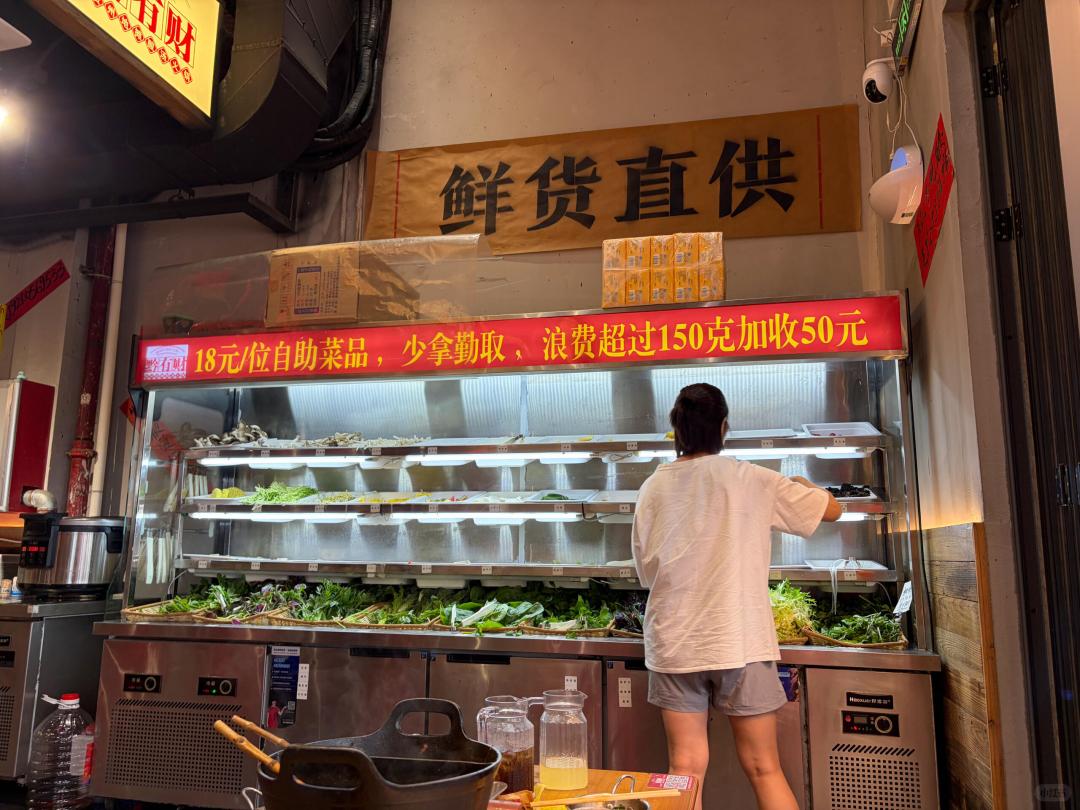
The origin of the vegetable buffet is in Guizhou. For just a dozen yuan, you can enjoy a hot pot meal with a soup base, dipping sauce, rice, and dozens of seasonal vegetables to eat as much as you like. For example, at Bumei Sister's Street - stall Hot Pot, the signboard at the entrance directly reads "Soup base stir - fry + self - service vegetables + rice + dipping sauce = 12 yuan per person". At Guichu Sour Beef Hot Pot, for 16 yuan per person, you can have unlimited fruits, vegetables, and condiments.
After this model went viral, topics like "Guizhou people are so tight - lipped" exploded on social networks, pre - heating the wave for its replication across the country.
First to emerge were the chain brands with Yunnan - Guizhou flavors. Wang Fendou's Guizhou Sour Beef Hot Pot put up a sign saying "18 yuan for unlimited refills of wild vegetables", and Chen's Family Guizhou Bean - rice Hot Pot opened nearly 60 stores with a 12.9 - yuan - per - person vegetable buffet.
△Photo source: Taken by Hongcan.com
Leading and mid - tier brands also quickly followed suit. Haidilao upgraded the condiment station to a vegetable buffet area in some stores. For 11 to 19 yuan, you can enjoy fresh vegetables like bok choy, romaine lettuce, and oilseed rape. Zuoting Youyuan launched a "Longevity Village" vegetable buffet at 26.8 yuan per table. The new brand "Xiabu Xiabu Ranch" under Xiabu Xiabu has a 15.91 - yuan all - you - can - eat area for seasonal vegetables, offering more than 30 kinds of vegetables without limit. Small hot pot brands like Shanmiaomiao even offer an 18.8 - yuan single - person weekday meal (including the soup base and vegetable buffet).
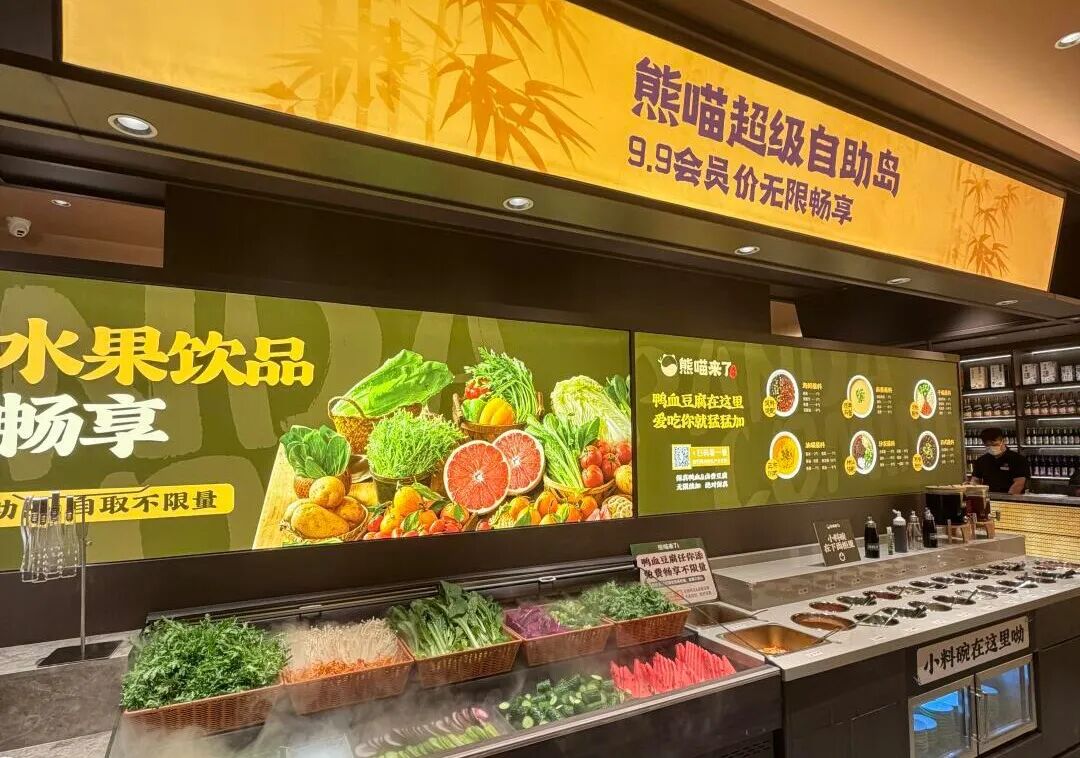
Xiongmao Laile took a different approach. On the basis of the original 12 free desserts, it added a 9.9 - yuan self - service island with more than 30 products including vegetables and fruits.
For a while, "eating vegetables" almost became a standard feature in hot pot restaurants. The playback volume of topics related to "wild vegetable buffet hot pot" on Douyin is close to 50 million.
Vegetable buffets don't make money, but hot pot restaurants still rush to offer them
Actually, behind the full - screen "vegetable buffets" lies a more complex accounting than expected.
If you think that the vegetable buffet is just a simple concession by the merchants, you're underestimating it. Hot pot restaurants that offer vegetable buffets have different business strategies: some take the "all - inclusive" route, settling the soup base and vegetables in one go; others separate the vegetable buffet from other parts for settlement, and customers must order the soup base and meat to unlock the self - service qualification. But in either form, the core logic is the same - vegetables are low - cost traffic - attracting items, while the soup base and meat are the core sources of profit.
Take the 9.9 - yuan self - service island model tested by Xiongmao Laile as an example. Founder Wu Hongtao told Hongcan.com: "Just looking at the self - service island itself, since it includes vegetables, fruits, DIY desserts, fried chicken, sauces, etc., 9.9 yuan can't cover the cost."
But the brand is calculating another account: the original 12 free desserts required two full - time store employees for production. After the self - service island model was launched, the model of having two full - time employees make 12 free desserts was cancelled. Some desserts were included in the self - service island, and customers can pick them up by themselves. Only a few employees need to be allocated to replenish and maintain the self - service station.
Through this increase and decrease, the labor cost has actually decreased. At the same time, customer satisfaction and the number of visitors have significantly increased, and the repurchase rate is also rising. "The ingredient cost has increased by two percentage points compared to before, but the labor cost has decreased by two percentage points, basically achieving a balance."
△Photo source: Screenshot from Xiaohongshu
Another hot pot brand that tried the vegetable buffet earlier went through a more tortuous accounting process. This brand has its own vegetable base, which gives it an innate advantage in the supply chain. But after launching the buffet, it still found that the cost of a single module was not cost - effective. Because the average customer spending decreased significantly and the dining time was prolonged, the financial model of a single store was under pressure. The person in charge of the brand said: "Customer satisfaction has increased, but there are problems with the financial model of a single module. We still need to wait and make adjustments."
Why do merchants do it even though they know that "a single module is not cost - effective"? Because the essence of the vegetable buffet is a "hook product". In the increasingly competitive hot pot market, only with customer flow can there be a chance to generate profit. Use low - margin vegetables to attract customers into the store to support the table - turnover rate, and then earn back the profit through high - margin meat, soup bases, and beverages.
An industry insider told Hongcan.com that the value of the vegetable buffet doesn't lie in the dishes themselves. "The vegetable buffet uses low - cost traffic - attracting items to drive customer flow, relies on customer flow to support the table - turnover rate, and then uses the high table - turnover rate to spread the fixed costs such as store rent and utilities, ultimately achieving a profit balance overall. "
The business data of Chen's Family is quite representative. According to industry media reports, Chen's Family, which launched a 12.9 - yuan wild vegetable buffet package, relies more on customers' additional consumption for profit. Statistics show that more than 50% of customers will order additional special dishes like cured meat and crispy pork. After being paired with high - margin products, the comprehensive gross profit margin can reach over 55%.
△Photo source: Screenshot from Xiaohongshu
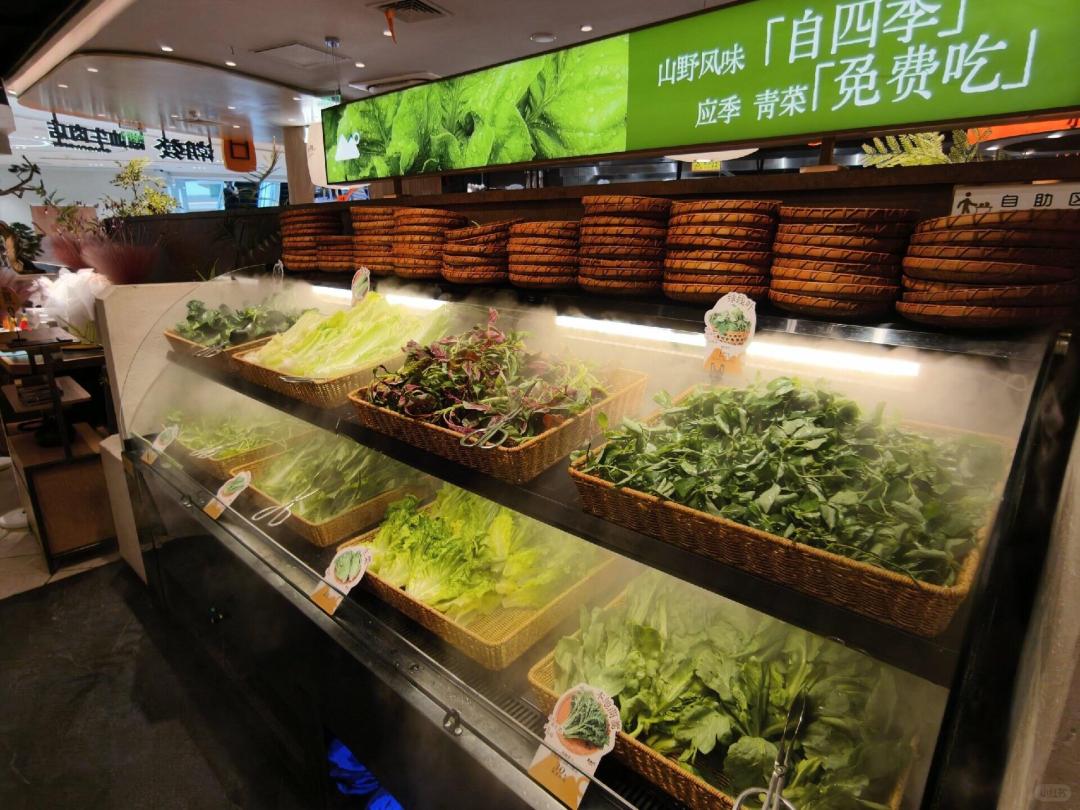
Driven by this factor, some brands are no longer satisfied with simply offering a low - cost buffet and have started to add value in terms of experience and content. Some stores have launched a "wild vegetable science - popularization wall" to mark the health - preserving effects of each wild vegetable, strengthening customers' awareness of health. Some regularly release fresh - picking videos to interact with users. Others use "wild vegetable blind boxes" to create a sense of surprise and stimulate customers to visit the store. These "tricks" have turned the vegetable buffet from a simple cost - effective tool into a content carrier that can be spread and discussed.
Not everyone can set up that vegetable buffet
But when this model is replicated on a large scale, problems arise. The rapid spread of the Guizhou model in first - tier cities is dragging the hot pot industry into a new round of involution.
1. Reduced differentiation, accelerated standardization, and the peak of the dividend period
From the popularity of the Guizhou model in 2024 to the full - scale follow - up of leading brands today, the window period for the differentiation dividend of the vegetable buffet is less than two years.
The person in charge of a hot pot brand that tried value - added services earlier told Hongcan.com: "After we launched it, everyone imitated. But gradually, they stopped imitating because they were reluctant to 'give' after reaching a certain level." He judged that the vegetable buffet will go through a similar process - the threshold is not high, but the cost pressure of continuous operation will make many followers drop out.
The problem is that when everyone has the "standard feature", it is no longer a traffic - attracting weapon, and the feature is no longer a feature. Consumers won't come specifically because of the vegetable buffet, but they may give a bad review because of "few varieties and unfresh vegetables".
2. Invisible thresholds in the supply chain are eliminating some entrants
Guizhou has the advantage of direct vegetable procurement, so the dozen - yuan buffet works. But in first - tier cities, direct delivery from the origin, cold - chain transportation, and manual replenishment in stores all compress the profit. Fewer vegetables are not attractive, but more varieties will lead to small single - item procurement volumes and the problem of difficulty in forming procurement advantages.
A more direct challenge comes from seasonality. The supply of wild vegetables and seasonal vegetables is greatly restricted by the season. Brands that can maintain a rich variety and control costs often have a well - established origin cooperation system behind them. Leading chain brands can supply through their own farms, while small and medium - sized brands may have to rely on the wholesale market, facing the dilemma of high costs and unstable quality.
Wastage is also a tricky problem. In the self - service model, damage caused by customers' picking and waste from taking more than they can eat will lead to an uncontrollable loss rate. The person in charge of a brand that has tried the vegetable buffet told Hongcan.com that after the launch of the vegetable buffet, the vegetable consumption in the store has tripled. The configuration of the original rough - processing area and the labor demand need to be adjusted accordingly, which actually increases the operating cost.
Conclusion
The rise of the vegetable buffet craze is essentially a true reflection of the current hot pot market. Everyone is adding value because no one dares to cut back. Consumers enter the store with an expectation of spending 18.8 yuan and end up spending seventy or eighty yuan when they leave. Although they may say "I've been tricked again", they may still can't help but click on the posts about "vegetable buffets" next time.
After all, low - cost vegetables are just the key to attract customers. The real profit of a store ultimately depends on customers' additional purchases, stable repurchase, and comprehensive word - of - mouth. Everyone can easily set up a self - service vegetable table, but to go the long - run, it's all about the strength of the supply chain, cost - control ability, and refined operation level. If you only see the traffic dividend but don't sort out the supply chain, calculate the costs, and optimize the operation, you may eventually have to remove that "vegetable table" in a hurry.
This article is from the WeChat official account "Hongcan.com". Author: Qiu Hong; Editor: Wang Xiuqing. Republished by 36Kr with permission.