Trying to choke China's supply chains, US auto giants are the first to panic
The United States has taken another action. A Connected Vehicle Security Act aims to choke Chinese automakers.
Now, the situation has reversed. It's actually American automakers who are the first to seek "accommodation". What's going on?
Waving the "National Security" Flag
According to a report on the "Voice of America" website, at the end of April, two U.S. senators, Bernie Moreno and Elissa Slotkin, from different parties introduced the so - called "Connected Vehicle Security Act of 2026". The act prohibits the import, sale, and operation of vehicles produced in China or any country of concern, and bans the use of connected vehicle technologies developed in China on U.S. roads.
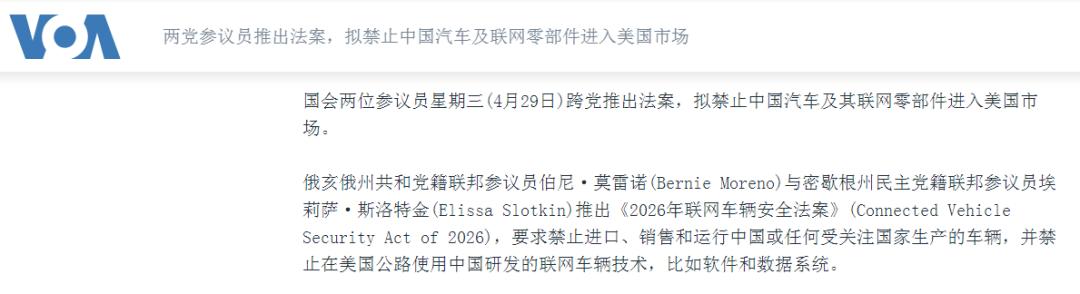
Screenshot of the report on the "Voice of America" website
The act requires that vehicle and software restrictions take effect in 2027, and hardware restrictions take effect in 2030. The phased implementation is to give the U.S. industry time to ensure domestic supply.
The act also clearly states that if a connected vehicle manufacturer has at least 15% of its equity held by entities from countries identified as "restricted countries" by the United States, the company will be prohibited from producing or selling cars in the United States.
Regarding violations, the act proposes a minimum fine of $1.5 million or five times the transaction amount. Continued violations will lead to a daily increase in the fine amount.
On May 27, two lawmakers, including Elissa Slotkin, introduced another bill to ban Chinese connected cars from entering the United States, including those entering through its neighboring countries, Mexico and Canada.
This is the fourth bill proposed by bipartisan lawmakers in the U.S. Congress this year to protect U.S. national security and the auto industry from the "threat" of Chinese cars.
Elissa Slotkin said that the new bill is based on the bipartisan "Connected Vehicle Security Act of 2026" she previously proposed. "It prohibits any form of Chinese - made complete vehicles from entering the United States, not even for a single day," she emphasized.
Slotkin quoted Oren Cass, the chief economist of the U.S. think - tank American Compass, saying, "The United States needs to urgently decouple from China to restore our economic sovereignty. Among all sectors, the auto industry is particularly urgent."
In the United States, a bill needs to be passed in identical versions by both the Senate and the House of Representatives and then signed by the president to become law.
Who Is Being Choked?
It should be clarified that the origin of the above "ban" is the new regulations on connected vehicles introduced by the Biden administration in 2025, which focus on the import of complete vehicles and the market access of on - board software and hardware from Russia and China.
Behind these seemingly tough bills, who is actually being restricted?
Ford confirmed to Reuters that it has applied to the U.S. Department of Commerce for authorization to continue importing the Lincoln Nautilus SUV produced in China. This model is one of the few Chinese - imported models that were already on sale in the United States before the implementation of the U.S. government's restrictive measures.
Ford said that the software of the Nautilus was developed in the United States and installed on the vehicles in China. Therefore, it needs the approval of the U.S. government to continue selling in the United States.
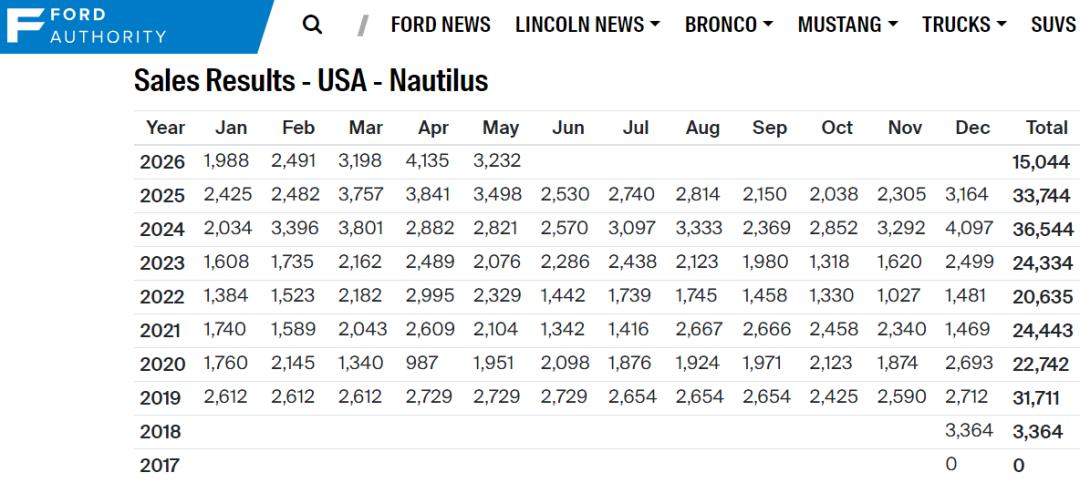
Sales volume of the Lincoln Nautilus
From January to May 2026, 15,044 Nautilus vehicles were sold in the United States, taking an absolute lead as the top - selling model of the brand. During the same period, 8,458 Lincoln Navigators, 10,901 Lincoln Aviators, and 7,535 Lincoln Corsairs were sold in the United States.
Ford is likely to start importing the 2027 - model Nautilus in January 2027. Therefore, Ford only has a few months left to obtain the authorization.
The situation is a bit comical. U.S. politicians are shouting "national security" and busy building walls against the Chinese auto industry. Before the walls are even built, U.S. automakers are already lying on the wall, shouting "Let me through".
Volvo Cars said in May that it has obtained an exemption, but all its models sold in the United States still need to fully comply with the regulatory details. The company confirmed that due to its ownership structure, it needs specific authorization.
Other automakers that may need to apply for licenses include Polestar, a high - end electric vehicle brand jointly created by Geely and Volvo. The company said it is working with the U.S. government to comply with the new regulations.
In addition to the impact on the sales side, after the implementation of hardware control, the entire supply chain of U.S. automakers faces a more arduous task.
General Motors has set a deadline, requiring some suppliers to remove Chinese - made parts from their supply chains by 2027. Earlier this year, General Motors announced that it will move the production of the Buick Envision to a factory in Kansas, the United States, starting in 2028.
Data from the global consulting firm AlixPartners shows that Chinese companies hold about 5% of the shares in approximately 10,000 U.S. auto suppliers, and more than 60 U.S. - based auto suppliers are controlled by Chinese companies. These suppliers include manufacturers of axles, airbags, windshields, and steering systems.
Researchers at the Rodium Group said bluntly in a study, "Hardware restrictions may be more cumbersome, and automakers need more time to adapt."
Reuters put it straightforwardly: This exposes the degree of the close connection between the U.S. auto industry's supply chain and China.
The Global Industrial Chain Is Not One's Backyard
CNBC quoted data from Kelley Blue Book, stating that the average price of new cars in the United States in April was $49,461. According to the auto information trading platform DCar, in China, consumers can choose from more than 200 battery - powered models, including hybrid models, all priced below $25,000.
U.S. consumers are facing heavy pressure from the cost of buying cars, while the U.S. government is taking a tough stance on the Chinese auto industry chain.
"The reality is that we are lagging behind Chinese cars in the U.S. market, but we hope that automakers can respond through innovation," Stephen Ezell, the vice - president of the U.S. think - tank Information Technology and Innovation Foundation, told CNBC. "Ultimately, if the auto industry wants to thrive in the United States, it must compete through innovation."
The Motor & Equipment Manufacturers Association (MEMA) in the United States once admitted, "Almost all parts manufacturers have reported that software and hardware are jointly developed by global teams. There is no clear answer as to whether regulatory measures can precisely restrict single lines of code."
Even the industry association is "confused". They are asked to strip out Chinese technology, but they can't even distinguish the ownership of the technology. How can they strip it out?
Data from AlixPartners shows that in 2012, there was only one Chinese company among the world's top 100 auto parts manufacturers. By 2024, this number had increased to 13, and it is expected to reach 22 by 2030.
In 18 years, the number has increased from 1 to 22. This is not achieved through policy subsidies but through real - world manufacturing capabilities, cost control, and delivery efficiency.
The global auto industry is already intertwined. It cannot be cut off by a single bill. Forcing a "decoupling" will only lead to the bitter consequences of rising domestic production costs and a significantly extended delivery cycle.
The views in this article are for reference only and do not constitute investment advice. Investment is risky, and you should be cautious when entering the market.
This article is from the WeChat official account "China New Finance" (ID: jwview), written by Zhang Shunan, and is published by 36Kr with authorization.