Future Tech|Who will become the next AI giant? These 175 early-stage projects are showcased at WAIC 2026


Above the hustle and bustle of each technological wave, there is always a group of people who see the light earlier.
While most people are still chasing well - defined tracks, they have already lit torches in directions that no one is optimistic about - a team in their twenties, a solution yet to be verified, and a piece of code that has just been made to work. Their technology is often on par with that of industry giants, but they fall short in one aspect: they are not seen, not empowered, and not invested in.
What WAIC Future Tech aims to solve is precisely this problem. It is the venture capital ecosystem of the World Artificial Intelligence Conference, consistently identifying these young teams overshadowed by the influence of industry giants and presenting them to capital, market scenarios, and technology.
Industry giants determine the present of AI, while young startups define its future.
In 2025, Future Tech selected over 200 projects from more than 600 early - stage projects globally. Seventy percent of these startups were established less than three years ago, and over forty percent of their founders were born in the 1990s. During the four - day exhibition, 100 investment institutions and 200 investors participated in one - on - one discussions, effectively connecting with startups 2000 times. They reached over 1200 potential customers on - site, and finally secured 268 million yuan in intended orders.
This year, 22 OPC projects and 153 startups were carefully selected from 1200 innovative projects and entered the WAIC venture capital ecosystem exhibition area. These startups are mainly distributed across four tracks: industry applications, embodied and terminal technologies, infrastructure, and cutting - edge technologies. Industry applications and embodied technologies are the two most crowded tracks this year, and these young teams have already immersed themselves in real - world scenarios.
Those Who Are Seen
Among these 153 startups, there are many such teams.

Lu Dingshun, the founder of Quantum Kun Technology, once challenged Google's "quantum supremacy" narrative. He founded Quantum Kun Technology in early 2026, and within five months of its establishment, the company secured hundreds of millions of yuan in early - stage financing. Since quantum hardware is not yet mature, they chose to "prioritize software" - integrating quantum high - precision solvers with large models to create scientific intelligent agents for AI4S, injecting underlying data that adheres to physical laws into AI, and deeply penetrating into R & D fields such as materials and biomedicine.
Wang Yuxin, the founder of Xingjie Zhiwei, was rated by overseas expert Simon Willison as one of the top six large - model teams in China in 2025. In the first month of its establishment, the company received tens of millions of yuan in financing. Their "streaming video generation" technology integrates large - model inference, video generation, and agents, enabling real - time video generation and continuous writing, similar to chatting. Their research results, Stream - R1 and Stream - T1, once topped the daily list on Hugging Face.
Yuanchen Taichu focuses on the "data foundation" of embodied intelligence. While others rely on cameras to collect data, issues such as occlusion and force - sense perception have always been difficult to solve. They independently developed a new generation of data collection paradigm, NeuroScale, with a non - invasive motor nerve interface as the core collection entry. Based on a fully self - developed software and hardware architecture, they extract surface electromyography (sEMG) signals from the skin. Through the neural electromyography basic large model PULSE, they reconstruct multi - modal continuous information such as hand posture, force, and tactile feedback. The cost of a single set of collection equipment is less than 20,000 yuan. In less than half a year of formal operation, they have received over 500 million yuan in financing support from leading institutions.
RoboParty is a high - tech team of post - 2000 engineers full of vigor, focusing on the full - stack open - source bipedal humanoid robot track. They have built a robot platform that is reproducible, verifiable, and allows for secondary development, providing a solid foundation for developers, research institutions, and industry partners in the field of embodied intelligence. In just over a year since its establishment, the company has received nearly 100 million US dollars in financing. Relying on its self - developed physical robot body and BFM whole - body motion control core technology, it explores a self - developed technology closed - loop of "hardware body + motion cerebellum + Wholebody_VLA whole - body visual language action model".
There are many such teams.
Truly disruptive innovations are often in the hands of young people who have not yet been recognized by the world. What Future Tech does is to dig them out ahead of time.
One Person Can Make an Army
If the startup exhibition area is a stage for small teams, OPC takes the concept of "small" to the extreme - one person can make an army.
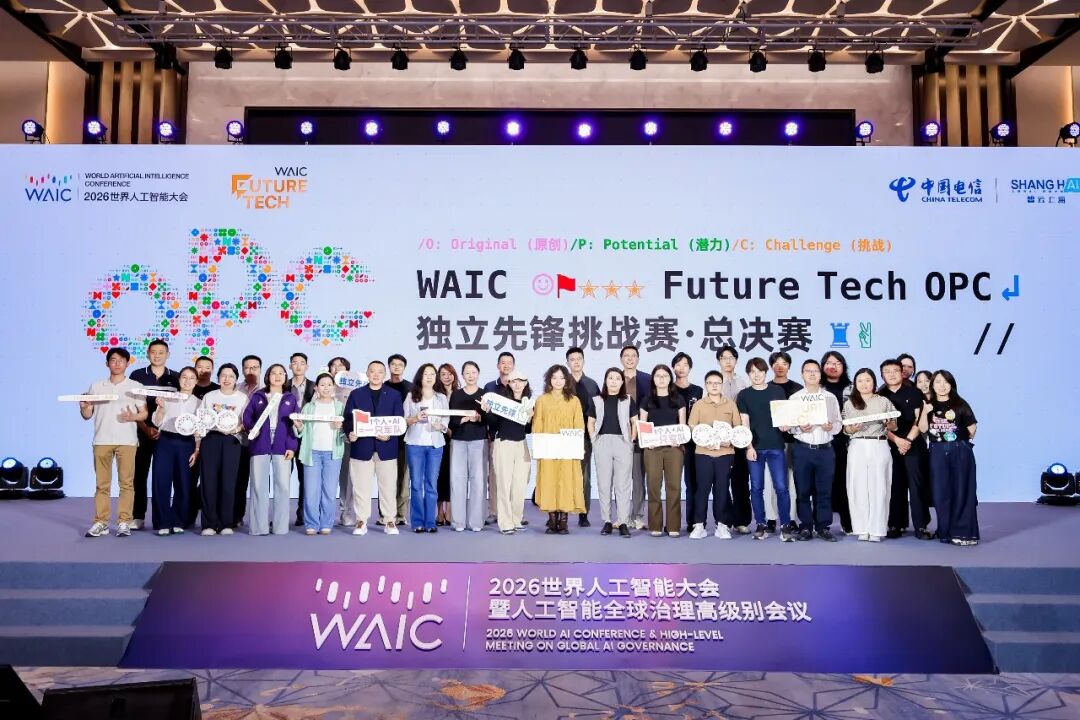
This year, Future Tech launched the OPC Independent Pioneer Challenge, with Originality, Open - source, and Individuality (Original / Open / One) as the core concepts. At the national finals that just ended on June 17th, 8 teams emerged from 8 national regions and over 600 projects and reached the final PK stage. In his speech at the finals, Wu Laijun, the deputy general manager of the Cloud Capability Center of Shanghai Telecom, said, "The golden age of innovation for ordinary people and small teams has arrived." With the support of inclusive computing power and large models, even a small studio can create disruptive AI products.
The 8 projects are distributed in fields such as gaming, sleep, education, finance, office work, and healthcare. Chang Nan's Lumoverse, with a team of two or three people in three months, built a game world with digital lives, making the 3A game pipeline, which originally required hundreds or thousands of people, accessible to ordinary people. Niu Jun's team focuses on "real employees, not fake AI", helping a multinational juice supplier find customers. AI found over a thousand accurate leads in five hours, increasing efficiency by ten times. Ren Qiuhan's GitStudy is a student team that breaks down complex code repositories into a clear learning path and distills it into Skills documents for people. The remaining five projects, from AI sleep decision - making, gentle and healing digital avatars, to real - time in - meeting decision - making advisors, overseas family health services, and REITs investment research that can answer questions about financial reports, each have their own unique approaches.
In July, these 8 teams will all directly participate in WAIC and showcase their products at their respective booths for face - to - face competition. The gathering of these tiny innovation glimmers will illuminate the future of the digital industry.
Real Capital and Eyes That See Earlier
Selecting projects is just the first step. Future Tech aims to provide real capital connections.

WAIC 2026 has coordinated multiple capital and investment institutions for its venture capital ecosystem, specifically inviting over 200 professional AI investors and setting up a dedicated capital connection area. In previous sessions, more than 100 institutions, including BlueRun Ventures, Futeng Capital, Monolith, SoftBank China, Matrix Partners, and Shenzhen Capital Group, have been attracted to evaluate projects. The goal of WAIC is to combine market - oriented funds, local governments, and industrial capital to turn Future Tech into a regular incubation platform and cultivate real explosive unicorns.
In July, They Will Be at the Same Venue
Last year, FutureTech brought roadshows, project connections, technology open - mics, and workshops to the exhibition site. Young entrepreneurs, independent developers, and investors no longer just looked at each other across the booths. Instead, through continuous questions, roadshows, and exchanges, they directly tested ideas, refined products, and sought cooperation.
This year, such open exchanges have continued to heat up - the Flash Stage features technology open - mics, leader sharing sessions, and innovation roadshows; in the Cross - boundary Activities, the AI tennis ranking competition and the hand - operated World Cup penalty shoot - out are equally exciting.
In July, at the Expo Center, these young people who are lighting torches in uncharted areas will meet those who see the light earlier at the same venue.
This is never just a four - day exhibition. For entrepreneurs, it is a ticket to enter the industry's vision ahead of time; for investors, it is a one - stop window to find the next new species. FutureTech brings projects, capital, and market scenarios to the same venue. The rest is to ensure that truly valuable innovations are heard, verified, and supported.
The registration channel is now open. See you in Shanghai in July.