Karpathy invested in an AI memory company, which shares the same name as DeepSeek Engram memory architecture
While large model companies are still competing for longer context windows, stronger reasoning abilities, and more complex Agent workflows, a new company named Engram has chosen to bet on another question: Can AI learn continuously from the materials, conversations, and experiences it encounters every day, just like a human being?
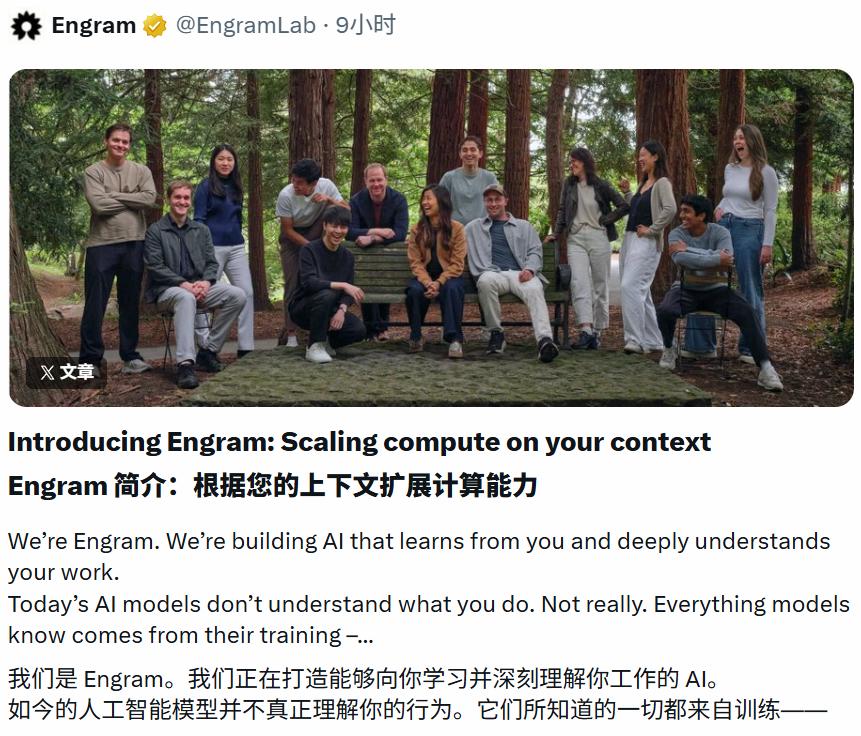
This company has just made its public debut and has completed a $98 million financing round. The investors include a group of top venture capital firms such as General Catalyst, Kleiner Perkins, and Sequoia. The list of its investors and advisors also includes Assaf Rappaport, Andrej Karpathy, and Pieter Abbeel.
Andrej Karpathy and Jason Wei have also sent their congratulations.


The problem Engram wants to solve is: The model understands the Internet, but it doesn't understand your company.
Today's AI can answer questions, read code, and write documents, but it is not familiar with the key knowledge within an organization - project decisions, historical choices, team discussions, etc., are mostly not in the training data. Therefore, enterprises have to repeatedly provide context, and the model has to understand it from scratch each time, which is costly and error-prone, and the model will forget after the conversation ends.
Engram believes that AI should not just read the context temporarily, but truly learn it.
Turn "Context" into Model Capability
Engram's core positioning is to build a "memory layer" for AI that can learn continuously.
The problem it wants to solve is not whether the model can temporarily read more materials, but whether the model can truly absorb the knowledge within an organization and naturally call it in subsequent tasks. Compared with common RAG or long-context solutions, Engram tries to move the computation forward: Let the model learn the information in GitHub, Slack, Notion, documents, and project records in advance, instead of retrieving and reading again before answering each question.
This is also the difference between Engram and many AI application companies. It is not betting on a longer chat window, but a new scaling direction: Starting from a powerful pre-trained model, invest the training computation into the private context that users and enterprises really care about.
According to the company's introduction, Engram has already let the model learn the company's data every day internally. In the future, it hopes to increase the update frequency to every hour and finally reach every minute. Its goal is to find a unified training algorithm that can absorb data of any scale and form, so that the model can continuously improve in continuous use.
Engram's first product is a set of APIs for Agents, serving large shared knowledge workspaces. Currently, the company has announced early collaborations with Notion, Harvey, and Microsoft: Notion is used to build Custom Agents that understand large Notion workspaces, the Harvey scenario focuses on law firms and enterprise knowledge, and the Microsoft direction is to pilot more efficient customized Agents in M365.
The three scenarios of Notion, Harvey, and Microsoft have one thing in common: high knowledge density, complex context, and it is difficult to solve the problem with a single retrieval. Engram is betting on this type of enterprise scenario - the model should not only be able to call tools, but also be able to digest the information flow within the organization in the long term.
A Research Team Focused on Continuous Learning
Engram's team background is highly concentrated on the issues of continuous learning and model memory.
Judging from the public materials, this company is more like an AI team assembled around research propositions. The team members have long been concerned about directions such as continuous learning, context compression, retrieval enhancement, LoRA, synthetic data, long context, and memory architecture. The core issue always revolves around one point: How to make the model learn from continuously changing data while avoiding forgetting and losing control.
The company's founders and core members include Dan Biderman, Sabri Eyuboglu, Jessy Lin, Jack Morris, etc. The team members have studied the issues of memory and forgetting from multiple perspectives, including how humans remember, how machines forget, and how the model can retain old abilities while learning new knowledge.
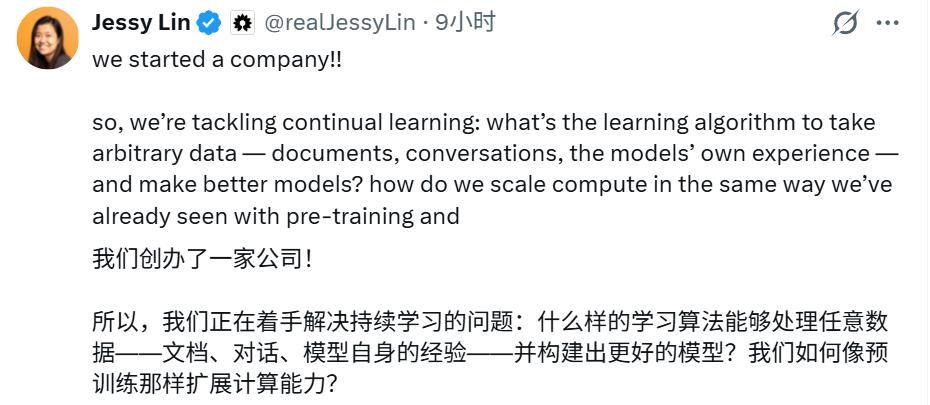
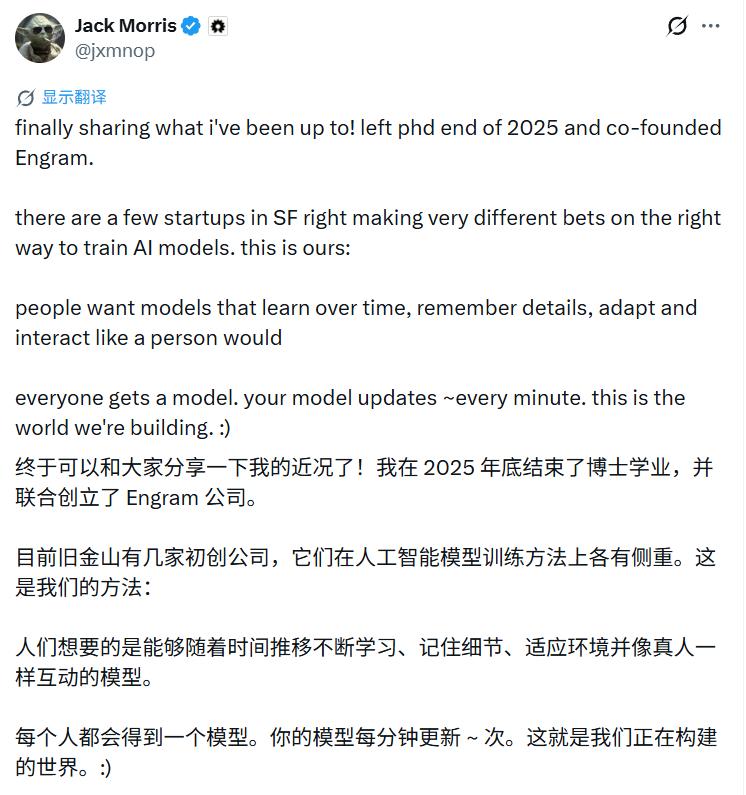
This also explains why Engram puts "continuous learning" at the center of its corporate strategy. What it wants to do is not an add-on memory function, but a set of infrastructure designed around long-term learning from the training algorithm, system architecture to product experience.
For Engram, the real challenge lies in proving that continuous learning can move from a research problem to a stable product. The model should be able to learn enterprise data, and also be reliable, controllable, auditable, and continuously generate value after multiple rounds of updates.
This article is from the WeChat public account "Machine Intelligence" (ID: almosthuman2014). The author is someone who focuses on entrepreneurship. It is published by 36Kr with authorization.