Unified Search and Recommendation: A New Exploration of Information Access in the Era of Large Language Models
With the continuous deepening of applications in information retrieval and recommendation systems, Large Language Models (LLMs) provide new possibilities for unified modeling of the two main information acquisition paths: search and recommendation.
Search characterizes users' immediate information needs actively expressed, while recommendation reflects users' long - term interest preferences accumulated in historical behaviors. Although their interaction forms are different, they essentially serve to understand and meet users' information needs.
If these two types of signals can be unified and modeled within the same large language model framework, the model is expected to understand users' intentions more comprehensively and provide a more personalized information acquisition experience.
In this work, the team from Leiden University explored the use of a large language model with billions of parameters for unified search and recommendation modeling without full - parameter fine - tuning, and proposed the GEMS framework: on the one hand, it alleviates cross - task gradient conflicts through multi - subspace gradient decomposition; on the other hand, it reduces the perturbation of fine - tuning on the general knowledge space of the large language model through null - space projection.
The relevant research paper has been accepted by the top AI conference SIGIR 2026.
Paper link: https://arxiv.org/abs/2601.09496
GitHub address: https://github.com/Polaris-JZ/GEMS
Experiments show that GEMS can achieve overall improvements in search and recommendation tasks and provide a new implementation path for a more stable, deployment - friendly, unified search and recommendation system based on large language models.
Research Background
Search and recommendation are the two most core services in modern information platforms. Search usually involves users actively inputting queries, reflecting immediate information needs; recommendation models long - term interest preferences based on users' historical behaviors. Although their interaction forms are different, their goals are highly consistent: to understand and meet users' information needs.
In recent years, the development of generative recommendation and large language models has provided new possibilities for unifying search and recommendation. Existing methods usually transform both search ranking and recommendation ranking into conditional generation problems: the model directly generates the target item identifiers based on users' queries, historical interactions, or a combination of both. Such a unified generation paradigm has good flexibility and can also utilize the semantic understanding ability of pre - trained language models.
However, when this idea is extended to large language models, the problem becomes more complex. Full - parameter fine - tuning has high training and storage costs and is difficult to scale to larger large language models. Although parameter - efficient fine - tuning methods such as LoRA reduce costs, they do not really solve the task conflict problem in unified search and recommendation.
Specifically, the search task focuses more on the semantic relevance between the current query and candidate items, while the recommendation task emphasizes more on the long - term preferences and collaborative filtering signals in users' historical behaviors. Their optimization goals are not completely consistent. When sharing the same model parameters, the gradient update of one task may damage the performance of the other task, resulting in unstable joint training.
Meanwhile, fine - tuning on search and recommendation data may also perturb the original general semantic knowledge of the large language model, causing the model to have an offset in understanding users' intentions: queries or preferences that could be correctly understood before fine - tuning may generate results inconsistent with the real intentions after fine - tuning.
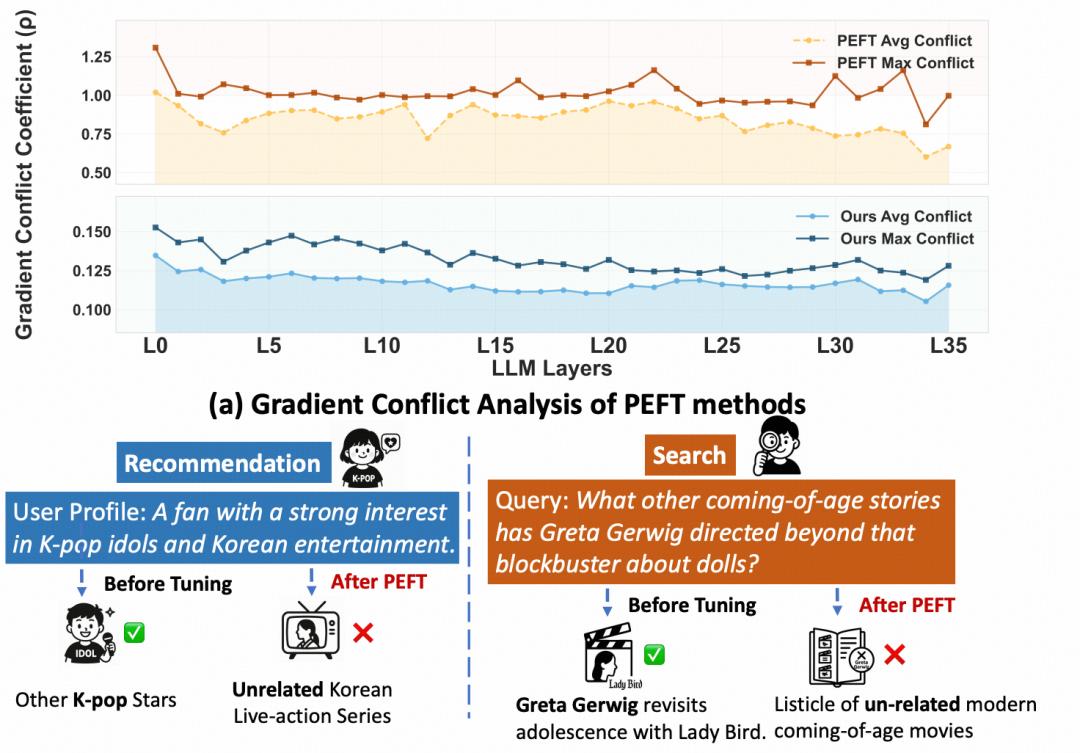
Figure | Two key challenges in unifying search and recommendation in large language models. Figure (a) shows that there are obvious gradient conflicts between the search task and the recommendation task in different large language model layers under the PEFT setting; Figure (b) shows the possible offset in understanding users' intentions caused by fine - tuning, that is, the model can correctly understand users' needs before fine - tuning, but may be affected by overfitting of task data after fine - tuning, generating results inconsistent with the real intentions.
Therefore, unifying search and recommendation is not just a matter of "how to put two tasks into one model" or "how to reduce fine - tuning parameters". The more critical issue is: how to alleviate the gradient conflict between search and recommendation and protect the original general semantic understanding ability of the large language model while avoiding the high cost of full - parameter fine - tuning.
Research Method
To solve the above problems, the paper proposes GEMS. Its basic idea is to organize gradient updates in a low - dimensional gradient subspace and further decompose the optimization signals of search and recommendation into different subspaces.
GEMS consists of two core modules: Multi - Subspace Decomposition and Null - Space Projection.
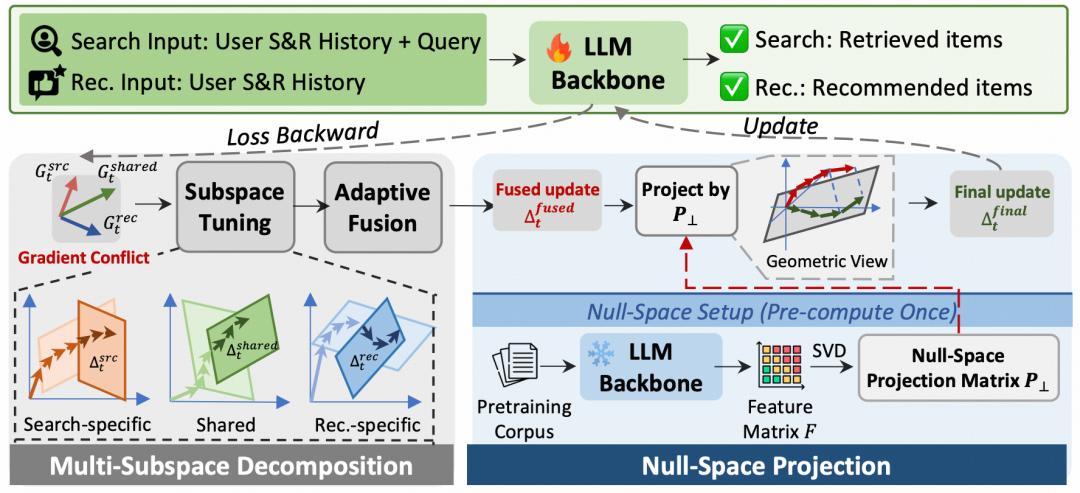
Figure | Overview of the GEMS framework. During the unified search and recommendation training process, GEMS first calculates the gradients of the search and recommendation tasks respectively, and divides them into a shared subspace, a search - specific subspace, and a recommendation - specific subspace through multi - subspace decomposition; then it integrates the updates of different subspaces using an adaptive fusion mechanism; finally, it constrains the update direction through null - space projection to reduce the perturbation of the general knowledge space of the large language model.
1. Multi - Subspace Decomposition: Alleviating Gradient Conflicts between Search and Recommendation
GEMS first divides the optimization space into three complementary subspaces: a shared subspace, a search - specific subspace, and a recommendation - specific subspace.
The shared subspace is used to capture the signals commonly required by search and recommendation, such as user interests, item semantics, and the general matching patterns between them. The search - specific subspace is used to model query semantics and query - item relevance. The recommendation - specific subspace is responsible for capturing long - term user preferences, behavior sequence patterns, and collaborative filtering signals.
The advantage of this design is that the consistent optimization directions in search and recommendation can enter the shared subspace, while the potentially conflicting task - specific signals are restricted to their respective subspaces. In other words, GEMS does not simply mix the gradients of the two tasks, but explicitly distinguishes "commonly useful signals" from "task - specific signals", thereby reducing destructive interference.
In addition, GEMS also designs an adaptive gating mechanism to automatically adjust the contributions of the search - specific subspace and the recommendation - specific subspace according to training dynamics such as task loss, gradient norm, and the sample proportion in the batch. This enables the model to dynamically balance the two tasks during training, rather than relying on fixed weights for simple addition.
2. Null - Space Projection: Protecting the General Knowledge of the Large Language Model
In addition to alleviating task conflicts, GEMS also focuses on another important issue: whether fine - tuning will damage the original general semantic ability of the large language model.
To this end, the paper proposes Null - Space Projection. This module first estimates the dominant knowledge space in the pre - trained representation of the large language model using general corpora, and then projects the updates generated by task fine - tuning to the orthogonal complement space of this knowledge space. Intuitively, it is to avoid excessive changes in the model along the "main directions carrying general knowledge".
In this way, GEMS allows the model to learn new information required for search and recommendation tasks while reducing the risk of damage to the original language understanding and reasoning abilities. This is particularly important for unified search and recommendation, as understanding users' intentions often highly depends on the general semantic ability of the large language model.
Research Results
The paper conducted experiments on two datasets containing search and recommendation behaviors, including Qilin and Amazon. The experiments covered both recommendation and search tasks and were systematically compared with traditional search/recommendation models, generative unified search and recommendation methods, and parameter - efficient fine - tuning methods such as LoRA and LoRA - MoE.
The experimental results show that GEMS achieved the best or near - best performance on different datasets and different tasks. Especially under the two backbone settings of T5 - base and Qwen2.5 - 3B - Instruct, GEMS maintained a stable advantage, indicating that this method is not only applicable to medium - scale pre - trained models but also scalable to large language models with billions of parameters.
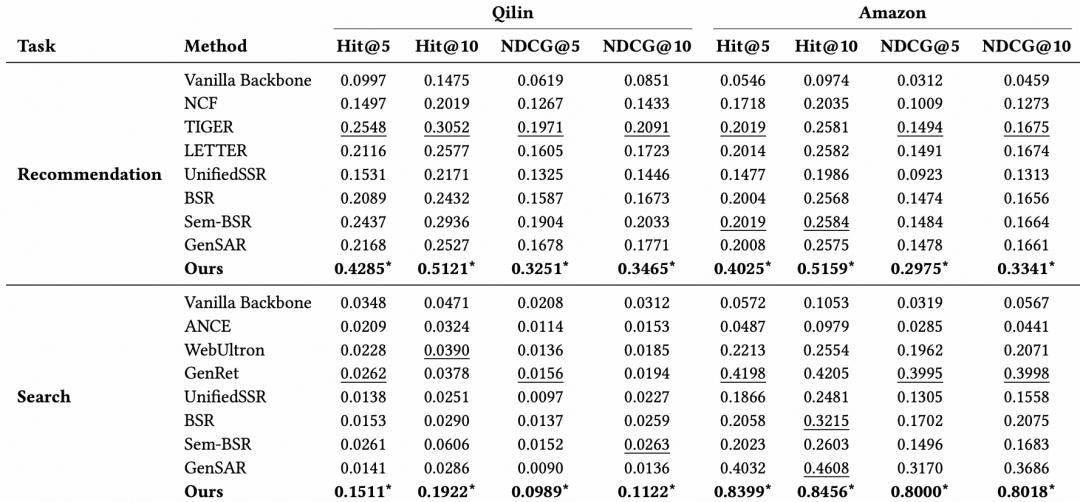
Figure | Search and recommendation results of GEMS on T5 - base.
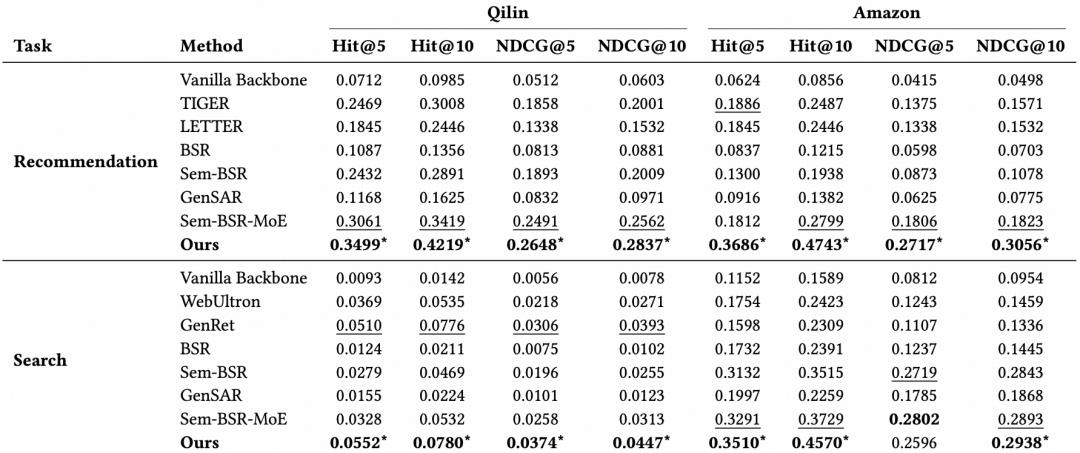
Figure | Search and recommendation results of GEMS on Qwen - 3B.
Ablation experiments further verified the necessity of the two core modules. After removing Multi - Subspace Decomposition, the model performance significantly decreased, indicating that explicitly distinguishing shared signals from task - specific signals is crucial for alleviating the interference between search and recommendation. After removing Null - Space Projection, although the model could still achieve certain improvements, its overall performance was weaker than that of the complete GEMS, indicating that protecting pre - trained knowledge is also critical for stable intention understanding.
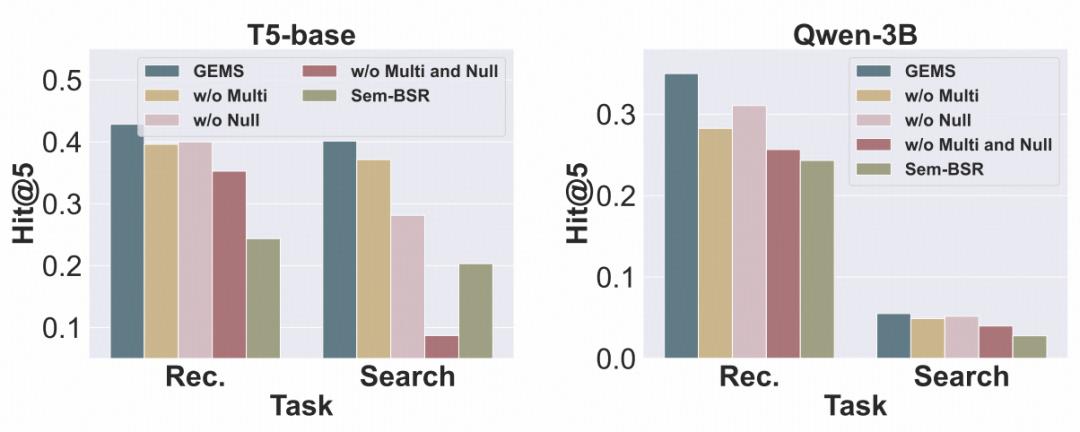
Figure | Ablation experiments of the core modules of GEMS.
The paper also conducted gradient conflict analysis. The results show that compared with ordinary PEFT methods, GEMS can significantly reduce the gradient conflict between search and recommendation in each layer of the large language model, especially in the attention - related layers, where it performs more stably. This indicates that the advantages of GEMS are not only reflected in the final metrics but also in the optimization process itself.
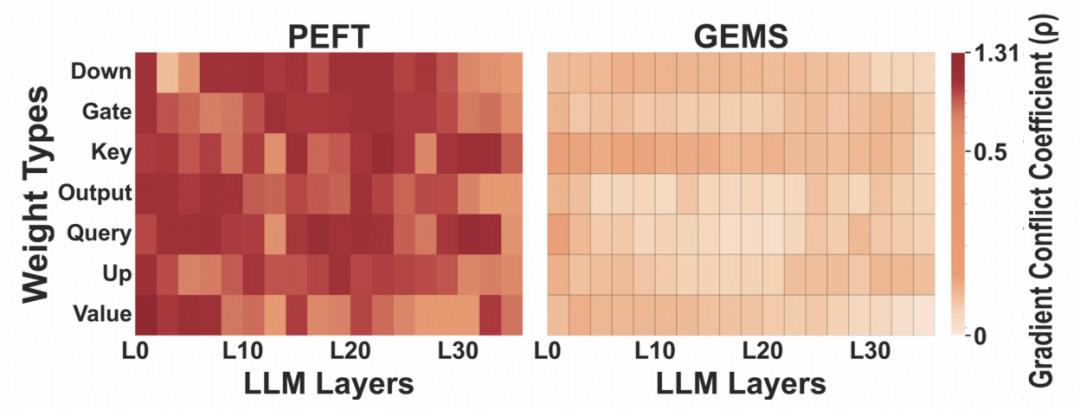
Figure | Comparison of gradient conflicts between GEMS and PEFT.
In addition, the user intention retention experiment shows that ordinary PEFT methods are more likely to have the situation of "correct prediction before fine - tuning and wrong prediction after fine - tuning", while GEMS can significantly reduce such degradation. This indicates that its null - space projection mechanism indeed helps to alleviate the semantic drift and intention understanding offset caused by fine - tuning.
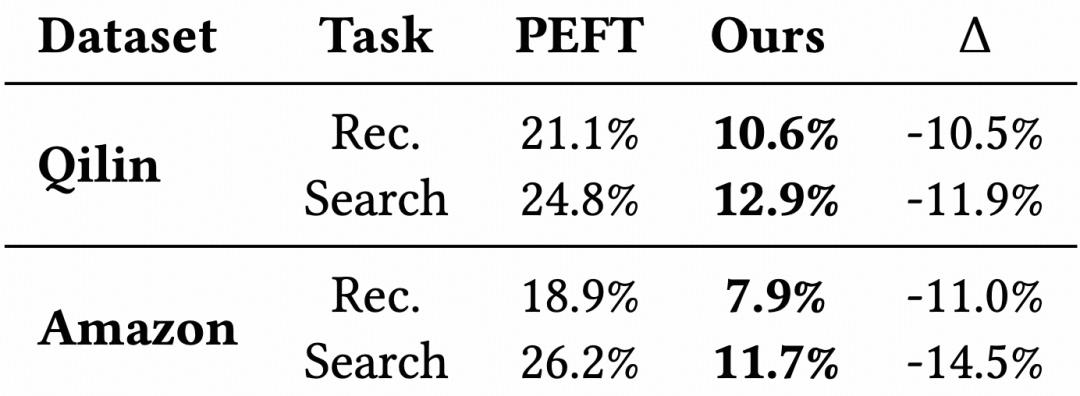
Figure | Analysis of the ability to maintain the understanding of users' intentions.
An important advantage of GEMS is that it does not need to retain additional adapter parameters in the model for a long time. Different from LoRA or LoRA - MoE, GEMS directly performs subspace optimization in the original parameter space, updates parameters through a low - dimensional gradient subspace during training, and avoids introducing additional adapter modules during the inference stage.
This makes GEMS more deployment - friendly. For real - world search and recommendation systems, the model storage, inference latency, and system maintenance costs during the online service stage are also crucial. GEMS not only focuses on avoiding the high cost of full - parameter fine - tuning but also considers the practical availability of large models in the unified search and recommendation scenario.
More importantly, GEMS addresses the two core issues in unified search and recommendation, namely task conflict and knowledge retention, within the same optimization framework. Compared with simply increasing the model capacity or introducing more expert modules, GEMS provides a more direct and interpretable solution from the perspective of gradient geometric structure.
Future Directions
This work explores a new direction for unified search and recommendation in the era of large language models. The research team believes that search queries and recommendation behaviors can be regarded as two complementary expressions of users' information needs: the former reflects immediate intentions, and the latter characterizes long - term preferences. To truly unify the two, the model not only needs to share representations but also needs to handle the optimization conflicts between different tasks and retain the original semantic understanding ability of the large language model while adapting to the tasks.
GEMS provides a new solution to this problem through gradient multi - subspace tuning and null - space projection. The experimental results show that this method can achieve overall stable improvements in search and recommendation tasks, alleviate gradient conflicts, reduce the offset in understanding users' intentions, and has good deployment - friendliness.
Overall, GEMS demonstrates a feasible path for unifying search and recommendation within the large language model framework: instead of simply sharing model parameters, it starts from the optimization process itself, explicitly handles the task differences between search and recommendation, and strikes a balance between task adaptation and knowledge retention.
In the future, with the further integration of user behavior signals, search queries, dialogue interactions, and context information, information acquisition systems may no longer be clearly divided into "search" or "recommendation" but will move towards a more unified, continuous, and personalized intelligent service form. How to stably model short - term intentions, long - term preferences, and dynamic context in the same base model while maintaining the model's general understanding ability and deployment efficiency will become an important research direction for information retrieval and recommendation systems based on large language models. GEMS takes a step in this direction and hopes to provide new ideas for subsequent research on unified information acquisition models.
This article is from the WeChat official account "Academic Headlines" (ID: SciT