Shenzhen, Suzhou, Xi'an, Hefei, take off right now
Chinese cities are now experiencing a stark contrast.
Recently, the General Administration of Customs released the foreign trade data for the first five months of 2026. The results are quite interesting: on one hand, cities like Shenzhen, Suzhou, Xi'an, and Hefei are making rapid progress. On the other hand, traditional foreign trade powerhouses such as Guangzhou, Tianjin, Nanjing, Chengdu, and Qingdao are facing sluggish growth.
It can be said that a major reshuffle is taking place in this year's foreign trade landscape.
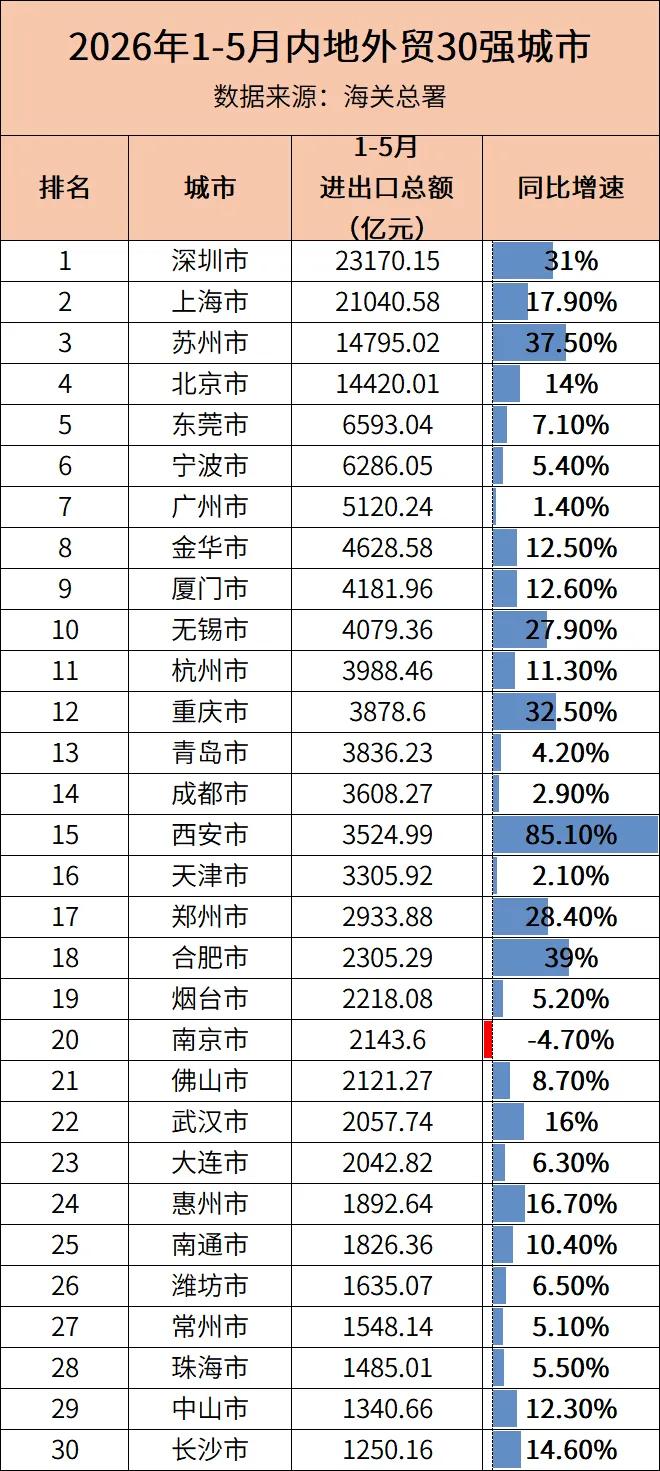
Let's first look at the ranking changes.
Beijing, which has long ranked third in the country, has been overtaken by Suzhou. In the first five months of this year, Suzhou's total foreign trade imports and exports reached 1.479502 trillion yuan, while Beijing's was 1.442001 trillion yuan. Suzhou has officially taken the position of the "third city in foreign trade on the Chinese mainland."
Meanwhile, Wuxi has successfully entered the top ten in the country. Three central and western cities, Chongqing, Xi'an, and Hefei, have also moved up simultaneously. Among them: Chongqing's ranking has risen by 3 places; Xi'an's by 4 places; and Hefei's by 3 places.
Next, let's look at the growth rates.
Among the top 30 foreign trade cities, the five cities with the highest growth rates are: Xi'an, 85.1%; Hefei, 39%; Suzhou, 37.5%; Chongqing, 32.5%; and Shenzhen, 31%. All of them have exceeded 30%, which can be described as a collective surge. However, what's more worthy of attention is that among the top 30 foreign trade cities, 20 cities have growth rates lower than the national average (15.3%).
Let's look at the changes in the top ten foreign trade cities. Shenzhen, Shanghai, Suzhou, and Beijing remain in the top four. Shenzhen still leads by a large margin. In the first five months, its total imports and exports reached 2.32 trillion yuan, a year-on-year increase of 31%. It continues to firmly hold the position of the first city in Chinese foreign trade.
Meanwhile, Wuxi, with a high growth rate of 27.9%, has successfully squeezed into the top ten in the country. The rapid rise of inland cities such as Xi'an, Hefei, and Chongqing has also become the biggest highlight of this round of foreign trade data.
In the past, many people thought that foreign trade was surely the domain of coastal cities. Now it seems that this logic is being rewritten.
If we were to ask which city has the most explosive foreign trade growth this year? Unexpectedly, it's Xi'an.
In the first five months, Xi'an's total imports and exports reached 352.499 billion yuan, a year-on-year surge of 85.1%. Its growth rate is 69.8 percentage points higher than the national average, leading by a large margin. Why is Xi'an so strong?
The answer lies in two words: chips. With the global explosion of AI computing power demand, the market for memory chips has been continuously rising, and Xi'an happens to be one of the most important memory chip bases in China. In the first five months of this year, Xi'an's exports of mechanical and electrical products reached 263.61 billion yuan, a 123.5% increase, accounting for as high as 95.1% of the city's total exports. Processing trade has even skyrocketed by 176.9%.
Behind Xi'an stand two world-class chip giants: Samsung and Micron. The Samsung Xi'an base is one of the most important NAND flash memory production bases in the world, with a production capacity accounting for more than 40% of Samsung's global total. Micron Xi'an has ranked first among Shaanxi's import and export enterprises for 19 consecutive years. Coupled with local enterprises such as Huatian Technology and Yisiview, the entire industrial chain has formed a closed loop.
Xi'an is the first to reap big benefits from this round of memory chip price increase brought about by AI.
If Xi'an is the biggest dark horse, then Suzhou is one of the biggest winners. In the first five months of this year, Suzhou's total foreign trade reached 1.48 trillion yuan, a year-on-year increase of 37.5%. The growth rate in May alone reached an astonishing 59.4%. Among the trillion-level foreign trade cities in the country, it hardly has any rivals.
Even more exaggerated is that Suzhou's foreign trade volume accounts for 52.2% of the total in Jiangsu Province. Specifically: exports reached 890.09 billion yuan, a 31% increase; imports reached 589.41 billion yuan, a 48.7% increase.
Why is Suzhou's growth so rapid? The answer is still AI. Servers, optical modules, PCBs, and computing power equipment are all industries that Suzhou excels in. Meanwhile: Suzhou's exports of lithium batteries have increased by more than 85%, and exports of photovoltaic products have increased by more than 85%. It can be said that there are multiple areas of success.
In addition to Xi'an and Suzhou, there is another city that has to be mentioned: Hefei. In the first five months of this year, Hefei's total imports and exports reached 230.529 billion yuan, a year-on-year increase of 39%, ranking second in the country in terms of growth rate.
Why is Hefei also so strong? It has bet on two sectors: chips and display panels.
Currently, Hefei has a globally leading new display industry cluster and an integrated circuit industry cluster. A number of leading enterprises such as BOE, Jinghe Integrated, and Changxin Storage are concentrated here. From materials to manufacturing, from chips to terminals, a complete closed loop has been formed. In the first five months of this year, exports of high-tech products such as liquid crystal panels, vehicle-mounted displays, and chips exceeded 70 billion yuan, with an increase of more than 70%, becoming the biggest driving force for Hefei's foreign trade growth.
After looking at this list, we can find a common pattern.
The cities with the fastest growth have almost all caught the same wave: AI, chips, computing power, PCBs, optical modules, display panels, etc.
In a nutshell: The golden touch of AI hits wherever it points. It can be seen that the cities selected by AI may not be coastal, may not have a high administrative level, may not be commercially developed, and may not have a large population...
Of course, this round of AI revolution is far from over. If the first half of AI was about those who "sold shovels" getting rich first, then the second half will be a competition of real scenario implementation and commercialization.
This article is from the WeChat official account "Urban Warfare", written by the Sun Bushu team and published by 36Kr with authorization.