1.2 trillion, Tsinghua professor, challenging the most powerful AI in the US, achieving instant legendary status with one battle
On June 22, the stock price of Zhipu AI continued to soar, and its market value soared to HK$1.2 trillion at one point during the trading session.
Why do investors go crazy about a company with an annual revenue of only 700 million?
The answer lies in an AI paradigm revolution.
01 Explosion
On June 12, 2026, the US government issued a ban, and Fable 5 was gone. It was taken off the shelves globally just three days after its launch. The official reason given was:
National security.
Different from previous large models, Fable 5 can do more than just chat.
It is more like a digital employee. It can operate your computer, plan tasks on its own, write code, run tests, and fix bugs. Even more terrifying is that it can finish the work that a professional team takes two months to do in just one day.
This is not a fantasy.
According to a test by the University of Pennsylvania in the United States, Fable 5 replicated the famous game "Minecraft" in just 20 minutes.
The battlefield of large models is shifting from being able to chat to being able to do work. Whoever can make AI truly do work will get the next ticket. And the Americans seem to be one step ahead again.
There is an air of anxiety on the Internet, and many people are asking: Has China's large models been left behind again?
At a critical moment, a Tsinghua professor stepped in!
Just a few days after Fable 5 went offline, on June 17, a Chinese large model company called Zhipu announced the full - scale release of GLM - 5.2.
How powerful is GLM - 5.2? Can it withstand Fable 5? Let's look at a set of data first:
On the globally authoritative AI programming ability evaluation list Code Arena, GLM - 5.2 ranked second in the world with 1595 points. The first was Fable 5, which has been taken off the shelves.
In other words, among the available large models, it ranks first.
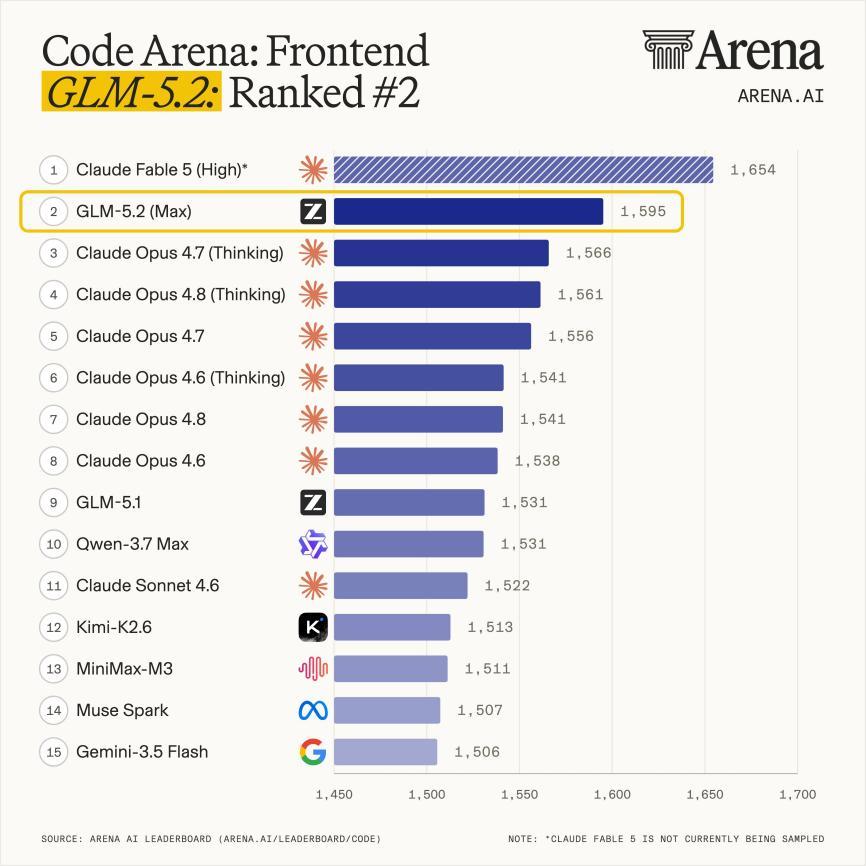
Netizens exclaimed in amazement, and the Arena official said, "This is an incredible milestone."
This means that the domestic open - source large model has for the first time entered the global top three in coding: Claude, OpenAI, and Zhipu.
Before this, this position was always held by Google's Gemini.
GLM - 5.2 did not achieve a sudden turnaround overnight. Behind it is a Tsinghua professor who has been working quietly for 13 years.
His name is Tang Jie.
02 A Bold Gamble
At the end of 2024, DeepSeek R1 made a splash, and the whole world was shouting: It's China's AI DeepSeek moment. The large model industry changed overnight.
While many people were still competing in terms of parameters, prices, and download volumes, Tang Jie, a professor in the Department of Computer Science at Tsinghua University and the chief scientist of Zhipu, made an astonishing judgment:
"The battle of chat is basically over!"
In his view, the chat paradigm is coming to an end, and the marginal return is dropping sharply. What remains are mostly engineering and technical problems, rather than disruptive paradigm innovation.
The next paradigm may be to enable everyone to use AI to do something. "Chatting is not the end; doing work is!"
So what exactly counts as doing work? The most natural and logical direction is coding.
Understanding code libraries, tracking bugs across files, and running tests. If a model can write code on its own, it can plan, execute, and correct errors on its own.
In a sense, it is an intelligent agent that can do work.
Tang Jie was very determined, but there were countless nights of debate within the team. Finally, Tang Jie made the decision to invest all their energy in the coding field.
This is not his first bet. Earlier, when GPT - 3 made a splash, Zhipu had to make a decision: Should they develop a large model with hundreds of billions of parameters?
Tang Jie was well aware that if they did and failed, it might send the company to its grave.
But even though he knew there were risks, he still decided to persevere.
At the company's internal decision - making meeting, his statement was decisive: "If we succeed, it will at least prove that Chinese large model companies can also reach the world - class level in terms of technical capabilities."
He wasn't without hesitation, but after hesitating, he still chose to keep persevering.
In 2021, Zhipu rented 1000 A100 graphics cards from the Jinan Supercomputing Center and reconstructed the operators from the bottom up. The training lasted for 8 months.
At that time, as one of the incubators of Zhipu AI, the entire Beijing Academy of Artificial Intelligence only had 480 A100 cards. Zhipu's investment was quite substantial.
By July 2022, Zhipu had trained GLM - 130B, with a total investment of 6 million yuan.
When OpenAI burned nearly 30 million yuan and finally opened the first door to the large model with hundreds of billions of parameters for humanity, Tang Jie's team, through extreme engineering optimization, created China's first open - source large model with hundreds of billions of parameters at a much lower cost than the opponent.
This kind of judgment is not innate.
In 2006, Tang Jie graduated with a doctorate from Tsinghua University. Big companies offered him several times his salary, and foreign universities gave him offers, but he still chose to stay at the university for scientific research.
The person who prompted him to make this decision was Academician Wang Xuan.
He wanted to follow in Wang Xuan's footsteps and promote technological innovation and industrialization as a professor.
Just before Tang Jie graduated, in February 2006, Mr. Wang Xuan passed away. Tang Jie's choice became a kind of inheritance in a mysterious way.
At that time, the number of global papers had reached hundreds of millions, but no one had summarized the laws behind the papers.
Tang Jie tried to develop a tool called AMiner to use AI to mine the papers and cooperation relationships of global scholars and create a map of the academic world.
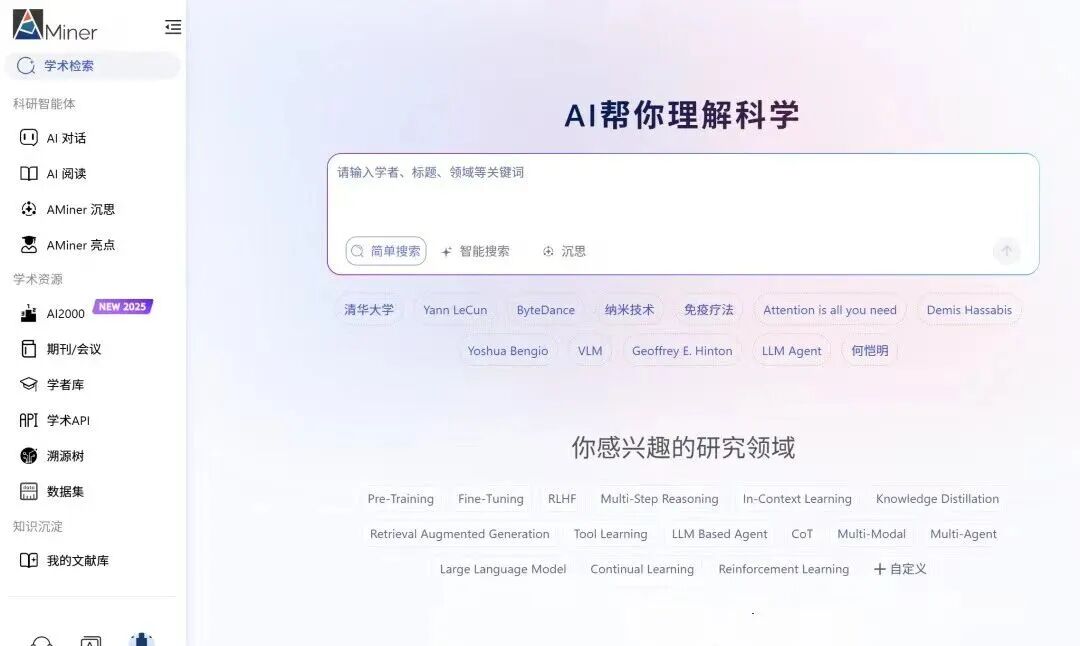
In those days, no one cared about academic tools. Hot money flowed into e - commerce and games. "He worked on it for 13 years."
Over the 13 years, the richest people in the Internet industry changed several times. Tang Jie, in his office at Tsinghua University, pored over papers one by one with his students.
This ascetic - like experience didn't bring Tang Jie wealth, but it honed his judgment on large - scale data and AI.
This kind of judgment "can't be bought with money, can't be rushed out, and can only be developed over time."
In 2019, when Tang Jie founded Zhipu with the team from the KEG Laboratory of Tsinghua University, the foundation accumulated over more than a decade by AMiner directly became its technological foundation.
It was also thanks to this kind of judgment that he dared to invest real money and train China's earliest large model with hundreds of billions of parameters when the company was just starting and its future was uncertain.
Later, when the entire industry was caught in the involution of competing in parameters and prices, he withdrew again and concentrated the next - generation R & D resources on the more difficult but also closer - to - AGI direction of coding.
03 Cracks
Many AI companies have a clear goal from the very beginning: to develop products, applications, and acquire users.
But Tang Jie is different.
When he founded Zhipu, he never regarded the large model as a chat tool. In his eyes, the end - game of the large model is not dialogue, but AGI, an intelligent agent that can replace humans in doing work.
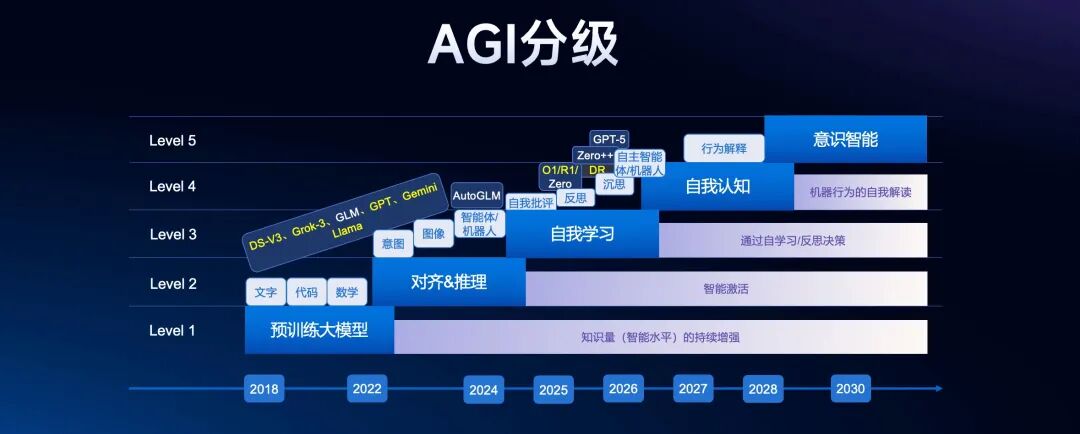
▲ Source: Tencent Technology
This path is not easy from the start because it means: not developing popular applications, not competing for traffic entrances, and not pursuing short - term growth. Just do one thing:
"Push intelligence forward."
The core team structure of Zhipu was also shaped by this choice from the very beginning.
Tang Jie serves as the chief scientist, responsible for the technical direction; Zhang Peng serves as the CEO, responsible for business implementation; Liu Debing serves as the chairman, responsible for strategy and capital.
This is not a one - man show, nor is it a purely commercial company. It is more like a compromise structure: running the company in an academic way and surviving in a corporate way.
But this structure is prone to hit a wall between ideal and reality.
To B is the first crack in reality.
Zhipu could have targeted the C - end, competed for traffic entrances, and pursued short - term growth. This is also the choice of most AI companies. But Tang Jie focused on the To B market.
Dealing with the government, banks, and schools, the high unit price and sufficient budget seem attractive.
But the price is also clear: the payment cycle has been extended from 21 days to 112 days, large customers change frequently, most transactions are one - time, and there are even strange cases where the procurement amount is higher than the sales amount.
This is not the growth curve of a typical technology company. It is more like an engineering - type business: not glamorous, but stable; not explosive, but hard to fail.
Zhang Peng later summarized it straightforwardly: "The C - end is not for making money, but for showing capabilities to the B - end."
In February 2026, the crack was magnified for the first time.
After the release of GLM - 5, problems emerged. It was not a technical failure, but a loss of control in the product mechanism: insufficient rule transparency, slow gray - scale rhythm, and chaotic upgrade experiences for old users.
After a series of problems were superimposed, the reaction was immediate: "In one day, HK$70 billion in market value evaporated."
The numbers themselves are not the most fatal. What's more fatal is the chain reaction: investors questioned, the team wavered internally, and onlookers outside said that scholars can't do business after all.
But Tang Jie didn't explain much. He just sent a letter, offered a compensation plan, and then continued to move forward. This is very much in his style:
"Don't make excuses, don't haggle, don't confront emotions, just keep doing technology."
But the greater pressure actually comes from the right to tell the story.
Zhipu has led the domestic large model industry many times, but time doesn't reward those who start first.
At the end of 2024, DeepSeek became popular, and the industry narrative began to change. China's AI moment was re - defined. Those who started first did not become the center of the story.
When evaluating DeepSeek, Tang Jie said three words: "Very shocking."
He didn't elaborate on what was behind those three words. But for someone who had been working on it for more than a decade to be overtaken in the narrative by a latecomer, it's impossible not to feel disappointed.
04 Sprint
But this disappointment probably only lasted for a few seconds.
On January 8, 2026, Zhipu went public on the Hong Kong Stock Exchange. When the bell rang, standing beside the big gong were Chairman Liu Debing and CEO Zhang Peng.
Tang Jie, the founder and chief scientist, was hidden in the team, so quiet that he was almost invisible.
This is not surprising.
Academician Wang Xuan once said: "If a scientist appears on TV too often, it means that his scientific career is basically over."
Tang Jie took this as a rule.
He hardly manages his personal image. His Weibo nickname is Tang Jie THU, and his profile only has two lines: Professor at Tsinghua University, Founder of AMiner.
The topics he talks about always revolve around technology, and the most frequently heard sentence is: "I hope it will be useful to everyone."
After the bell - ringing ceremony, Tang Jie wrote an internal letter titled "Do AGI with the Spirit of 'Coffee'". The first sentence of the letter was not a celebration of victory, but:
"At the beginning of the year, everything was so difficult."
He told a story. When he was visiting the Hong Kong University of Science and Technology, he was chatting with Professor Yang Qiang in a coffee shop. He said that he had drunk too much coffee these days and was a bit addicted, so he needed to quit.
Yang Qiang asked him back: Why quit?
This sentence later became a metaphor for him. Doing AGI is not a sprint but a long - term and stable output. This also explains his other hobby, triathlon: swimming, cycling, and running.
He believes that this is the same as scientific research: it's not about who runs fast, but about who can persevere.
AMiner took 13 years to develop, the large model with hundreds of billions of parameters took 8 months of perseverance, and the coding route has gone through five generations of iteration. All are slow - paced things. But when you persevere with slow - paced things for a long time, they become structural barriers.
On June 12, 2026, the US banned Fable 5, which shocked global developers, and there was an air of anxiety in the domestic AI industry.
Elon Musk asserted on social media that China's large models are catching up quickly in terms of benchmarks, but it may take until the first quarter of 2027 to reach the level of Fable.
Tang Jie replied with six words: "It won't take that long."
A person who usually avoids the spotlight will still jump out when pushed to the limit, not for himself, but for China's large models.
Many years ago, a student sighed in the laboratory, saying that doing academic research was too difficult. Tang Jie replied: "Doing academic research should be like a real man, standing upright."
Standing upright means having advanced concepts and daring to tackle world - class problems. Standing firmly on the ground means basing oneself in China and applying research results to the real world.
He said this to his students and also to himself. He has gambled on this one thing in his life.
References
[1] Official website of the Department of Computer Science at Tsinghua University
[2] "Tang Jie of Zhipu: The 'Real Big Shot' Hiding Outside the Hype" by Titanium Media
[