Chinese companies are placing diverse "bets" on the World Cup
The second round of the group stage of the 2026 FIFA World Cup in the United States, Canada, and Mexico is in full swing.
Many popular star players are in excellent form. Lionel Messi scored a hat - trick in Argentina's first match; French star Kylian Mbappé and Norwegian star Erling Haaland both scored two goals.
In addition, there are also scenes of strong teams being blocked and underdogs snatching points.
After Cape Verde held Spain to a 0 - 0 draw in the first round, they also drew 2 - 2 with Uruguay in the second round, remaining undefeated against two World Cup champions. Another new team, Curaçao, held Ecuador to a 0 - 0 draw and earned their first World Cup points in the team's history. There was also Congo (Kinshasa) drawing 1 - 1 with Portugal, and Japan twice coming from behind to draw with the Netherlands...
If we trace the root cause, the first - ever reform of this World Cup is one of the key factors contributing to these upset moments.
This year's World Cup has increased the number of teams from the previous 32 to 48. Not only have four new teams that have never qualified before, such as Uzbekistan, Jordan, Cape Verde, and Curaçao, appeared on the field, but also teams like Iraq, Norway, and Scotland have returned to the World Cup.
The increase in the number of teams, the adjustment of the tournament system, the longer schedule, and the fact that the game venues are spread across 16 cities in three countries all contribute to the sharp increase in the uncertain factors of this competition. This also adds a lot of difficulty to brand marketing choices.
Nevertheless, in an era of extremely fragmented attention, the World Cup is still one of the very few super - nodes that can simultaneously achieve global reach, emotional resonance, technology display, and channel endorsement.
Chinese companies are still looking for ways to increase their popularity in this competition, which can be compared to a "high - stakes gamble".
Some brands have become global sponsors of the World Cup; some companies have sponsored top - tier teams such as Spain, Portugal, and Argentina; star players like Messi and Cristiano Ronaldo have also been "snatched" by companies; the only Chinese head referee, Ma Ning, has become the traffic code for many brands and platforms.
There are many cooperation methods for Chinese companies. For example, Xiaohongshu has obtained the broadcasting rights of the event, achieving a breakthrough in the community's positioning; Cotti Coffee has become the official authorized product retailer of the 2026 World Cup.
There are also endless creative marketing events.
For example, Mengniu and Hisense put up a joint billboard on the sidelines - "Hisense and Mengniu are trustworthy, Hisense and Mengniu are really great", becoming the first joint - cooperation case of Chinese sponsors in the recent history of the World Cup. Kimi announced before the start of the game that it would dispatch 300 sub - Agents to publicly predict all 104 matches and set up a 1 - trillion - Token prize pool, leading a wave of "model prediction" in a lightweight way.
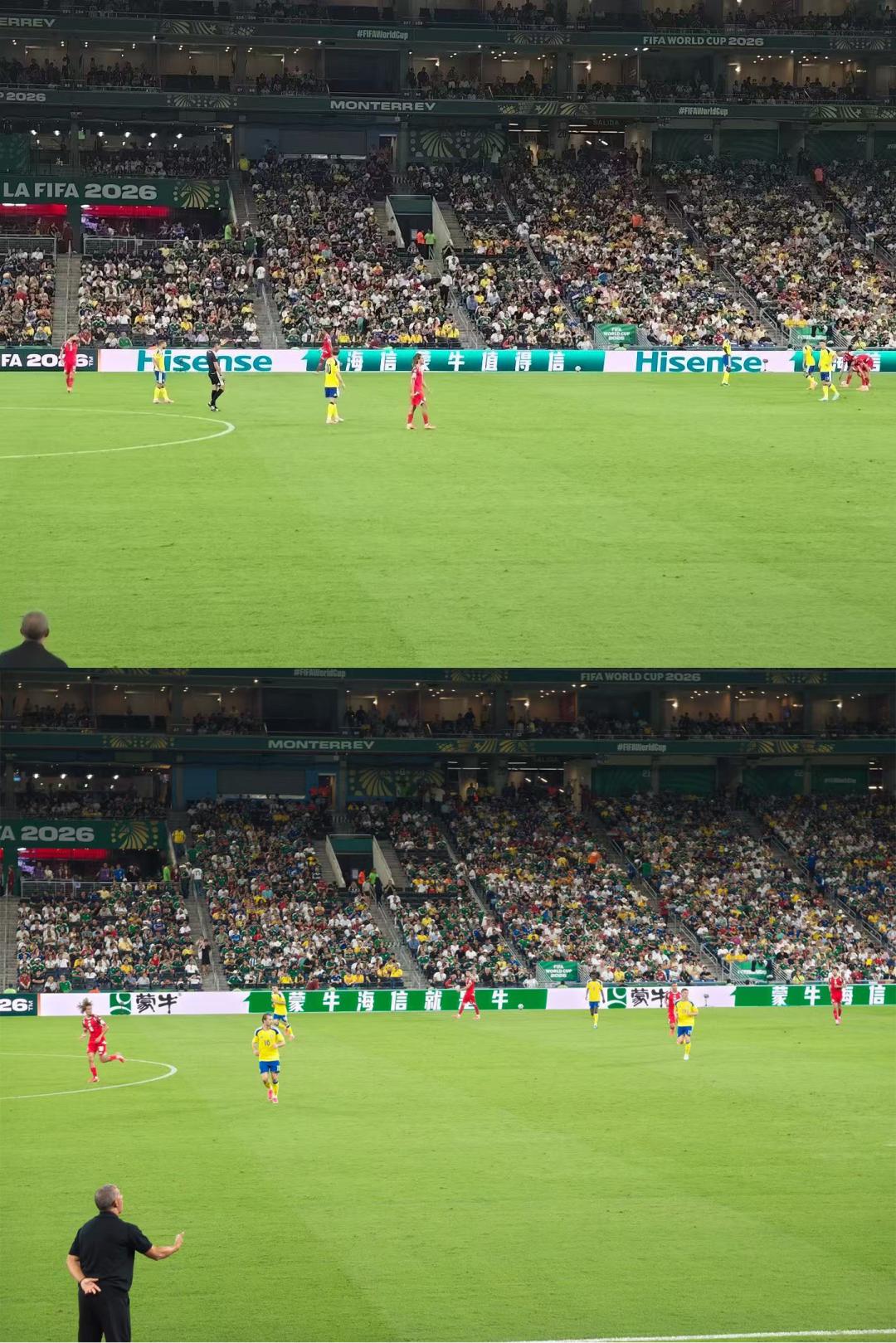
Image source: Hisense's official Weibo
It can be said that the interaction between Chinese companies and the World Cup is still full of highlights.
Chinese companies bet on the World Cup with different focuses
For brands, the best way to complete the marketing of a sports event is to bet on the champion or dark - horse players in advance. However, in the World Cup, which has only one event and one champion, the probability of betting on the champion is not high, and there are many dark - horses and upsets.
Therefore, more Chinese companies are betting on more certain options. These methods can be roughly divided into four categories: becoming an official sponsor of the World Cup, choosing to sponsor a team, signing star players, and finding a differentiated breakthrough.
First of all, becoming a global official sponsor of FIFA and betting on the overall traffic of the World Cup is the safest but also the most difficult way.
Among the global official sponsors of FIFA in this World Cup, Chinese companies occupy three seats: Hisense, Lenovo, and Mengniu.
Different from previous years, the cooperation between these three companies and the World Cup is no longer limited to shooting promotional videos, making advertising slogans, and exposing brand logos, but has carried out more in - depth cooperation.
Among them, Hisense and Lenovo have both become official technology partners of FIFA, and the technologies of Hisense and Lenovo can be seen in many aspects of the World Cup.
Hisense mainly showcases RGB - Mini LED display technology, VAR (Video Assistant Referee) display enabling technology, and AI intelligent viewing technology. These three technologies have been deeply embedded in the core systems of event broadcasting and penalty judgment.
Among them, the RGB - Mini LED display device independently developed by Hisense has the characteristics of high color accuracy and can also perform precise real - time color and light control, making the picture color purer and the details clearer, effectively avoiding traditional problems such as halos and color deviation, and making the penalty judgment of the event more accurate.
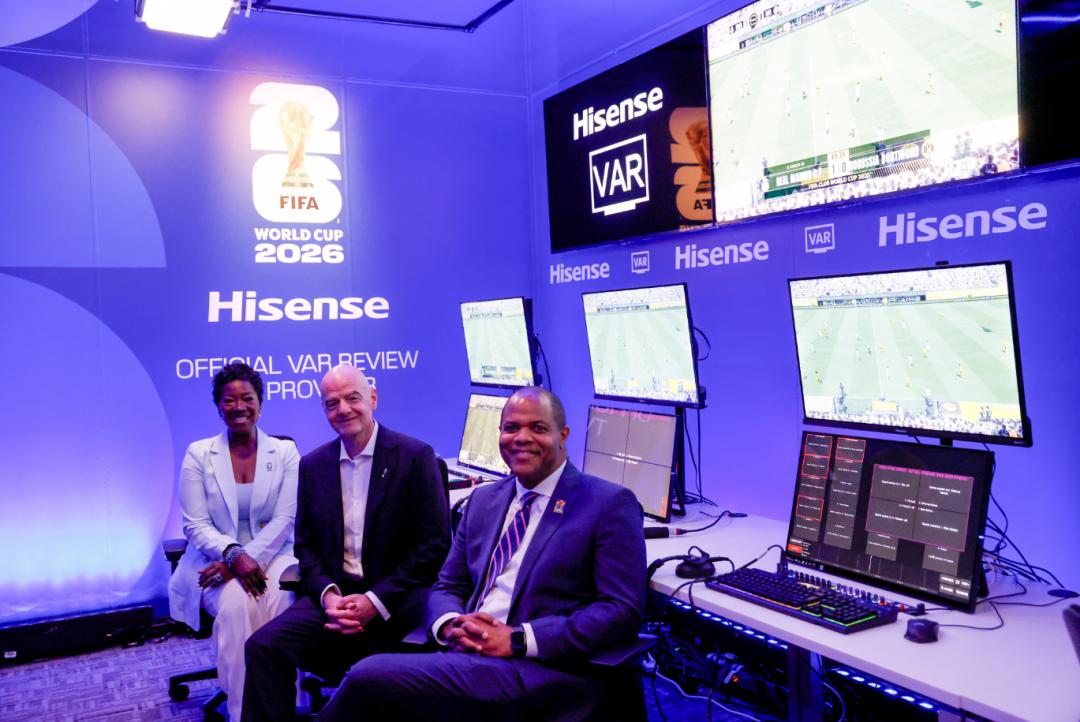
Image source: Hisense's official WeChat public account
This device has been installed in the VAR referee center and the international broadcasting center, and is called by netizens the "fourth Chinese referee of the World Cup" besides the three Chinese referees, Ma Ning, Fu Ming, and Zhou Fei, who are officiating this World Cup.
Like Hisense, many technologies developed by Lenovo, such as the AI video enhancement system from the referee's perspective, the 3D digital human visualization solution, and the football AI super - intelligent agent, are also reflected in the World Cup.
Another brand, Mengniu, has brought its products to the field. Mengniu ice cream has officially become the official ice cream of this World Cup, and its subsidiary brand, Miaokelando, has also officially announced that it has become the global official cheese of the 2026 FIFA World Cup.
Besides official sponsorship, more brands choose to enter the World Cup indirectly by betting on popular championship - winning teams and players.
In the past, brands usually bet on only one team, but this year, many brands have chosen to bet on multiple teams. For example, Yili has sponsored five national teams at once, including Argentina, France, Portugal, Spain, and Germany; TCL has signed contracts with three strong teams, Spain, Germany, and Argentina; Luckin Coffee has signed contracts with two European powerhouses, Spain and Portugal, within a month before the start of the game.
This "multi - point layout" strategy can, to some extent, hedge the risk of a single - bet team being eliminated early.
Among the many brands betting on teams, it is worth mentioning that Cotti Coffee, although it has only sponsored one team and become the global sponsor of the Argentine national football team, has also become the official authorized product retailer of the 2026 World Cup. It can launch authorized peripheral products such as FIFA official commemorative tickets and official team jersey - themed fridge magnets in its stores.
This way of being both a sponsor and an official "ticket - buyer" is equivalent to adding a stable traffic entrance for the brand that can run through the entire tournament.
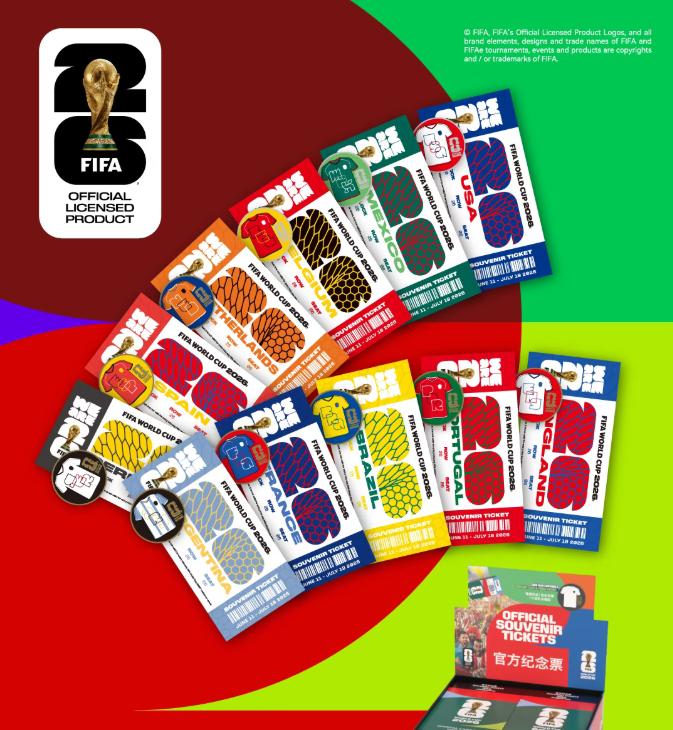
Image source: Cotti Coffee's official WeChat public account
In terms of players, this World Cup is generally considered to be the last World Cup for "Messi and Ronaldo", so Messi and Ronaldo have become regulars for brands to sign contracts with.
For example, brands that have signed contracts with Messi personally or through the Argentine national team include Mengniu, Wahaha, Pulse, and Du Xiaoman; brands that have signed contracts with Ronaldo personally or through the Portuguese national team include Dreame Technology and Changan Qiyuan.
Besides Messi and Ronaldo, other star players have also attracted attention. For example, Wanglaoji has signed Norwegian star Erling Haaland as the global brand ambassador for its international English brand, WALOVI; Bubbly, a subsidiary of Dongpeng Beverage, has signed Kylian Mbappé as its brand ambassador.
Of course, a few brands choose to create topics through differentiated methods.
For example, Meituan Waimai has sponsored the Ghanaian team from Africa for two consecutive World Cups. This time, Meituan has continued its previous strategy, making the players wear training uniforms similar to those of food - delivery riders with the slogan "Meituan Waimai, fast as goals", and the related videos have once again gone viral on social platforms.
As Ma Ning, the only Chinese head referee in the World Cup, has become popular on the Internet, many brands have announced their cooperation with him, such as Mengniu, Lengsuanling, Meituan, and Hisense.
It can be said that brands have gone all out to ride on the popularity of the once - every - four - year World Cup.
Content battle among platforms
Besides brand marketing, another battlefield is among content platforms.
For world - class events, obtaining the broadcasting rights of the event is one of the key ways for platforms to acquire traffic, enrich the content ecosystem, and create commercial realization.
In this World Cup, China Media Group holds the exclusive all - media broadcasting rights and sub - licensing rights, and has authorized China Mobile Migu and Xiaohongshu to be the official rights - holding broadcasting partners.
Among the three rights - holding platforms, CCTV and Migu are both "old faces", and what really attracts attention is the entry of Xiaohongshu.
All along, Xiaohongshu has been centered around tags such as product recommendations, fashion, travel, and food. For a lifestyle - oriented community to obtain the World Cup copyright is in itself a signal of breaking through the circle.
After obtaining the broadcasting rights, Xiaohongshu has made updates in both product and content.
In terms of the product, Xiaohongshu has set the "World Cup" section as a first - level entrance, parallel to the two core tabs, "Following" and "Discovery". It has also launched the "Fans' Circle" function, allowing users to join the circles supporting their favorite teams or players and post and interact.
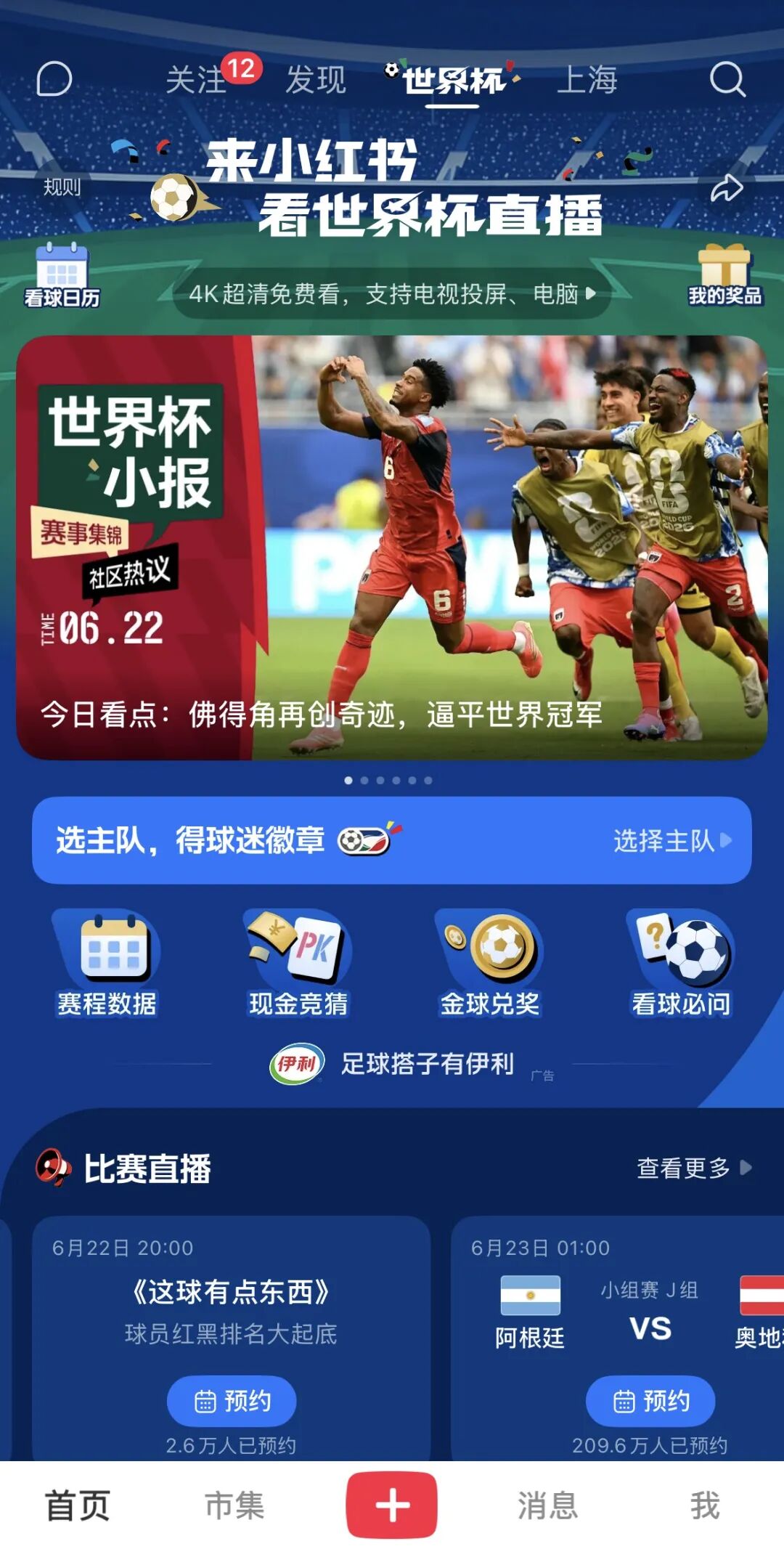
Screenshot of Xiaohongshu's "World Cup" page, image source: Xiaohongshu APP
In terms of content, Xiaohongshu has formed a dedicated commentary team of 42 people, and the platform has also launched self - produced programs such as "Fan Zhiyi, the Fan" and "This Ball is Something".
Xiaohongshu's real advantage does not lie in the commentary lineup and professional level, but in the native UGC community atmosphere.
In the past, the main platforms for fans to watch and discuss football were vertical sports platforms like Hupu and Dongqiudi, and the discussion methods were more inclined to professional analysis and competitive debates. On Xiaohongshu, watching football is more like a lifestyle.
For example, on Xiaohongshu, some users have shared their first - hand perspectives at the stadium; some netizens have viewed the World Cup from the perspectives of "Empresses in the Palace", K - POP, and anime.
Some hot memes have also emerged. For example, the confused look of South African players trying to understand the referee's thick - accented penalty in the opening game was ridiculed by netizens as a "Level 100 English listening test" and has been widely discussed on the platform. A lot of "lightweight" content has also stimulated ordinary passers - by to join the discussion of World - Cup - related topics.
From a strategic perspective, Xiaohongshu has been strengthening the commercial path of being the "first search entry for users" recently. Obtaining the World Cup broadcasting rights this time has also allowed Xiaohongshu to enter a wider circle.
According to the data released by Xiaohongshu, within the first three days after the start of the game, the cumulative number of interactions of fans in the live - broadcast rooms reached 90 million, indicating a high willingness of users to interact in real - time while watching the games. It is understood that male users account for more than 60% of the viewers.
Another platform, Migu, which has obtained the World Cup broadcasting rights, does not have a strong advantage in the content ecosystem and focuses more on technology empowerment in its approach.
Its core approach is to improve users' viewing experience through AI capabilities in terms of commentary, vision, companionship, and data. For example, it has introduced AI intelligent commentaries in multiple styles, covering Mandarin and various dialects; it presents complex tactics clearly through AI stadium intelligent overview and visual running radar maps; the AI intelligent agent supports "asking while watching" to provide instant interpretations and trend judgments; the AI football large model can predict the probabilities of wins, draws, and losses of matches, etc.
Douyin and Bilibili, which have not obtained the World Cup broadcasting rights, mainly focus on the secondary creation of World - Cup - related content.
Both platforms have launched many related programs. For example, Douyin has launched "The Football Knowledge Conference", covering 35 match days and inviting 51 well - known football commentators, industry experts, and Douyin influencers to participate in debate - style football reviews; Bilibili has invited Ma Ning to join and carried out content cooperation, and encouraged UP - owners to conduct secondary creation and professional analysis around the World Cup.
As a short - video platform, Douyin has taken more actions in lightweight content. For example, Liu Jianhong's "Watch Football Together Now" is more of a companion - style viewing, emphasizing offline gatherings and a real football - watching atmosphere; Huang Jianxiang's cooperation with Deyun Society, "Huang's Football Class", packages football content in the form of storytelling and cross - talk.
In addition, Douyin has also invited active star players like Erling Haaland to join, and the official accounts of some popular championship - winning teams such as Argentina, Portugal, France, Germany, and Spain will also release event content on Douyin.
Actually, since the World Cup is held in the North American time zone, it means that a large number of matches will be held in the early morning in China. Only a few fans can watch the full 90 - minute games, and most users will learn about the games through short videos, hot memes, and secondary creations.
Therefore, content platforms can only have the opportunity to become users' "long - term entry" in the future after becoming the "supplementary channels" for the event first.
AI companies ride on the World Cup traffic in a more lightweight way
Besides brands and platforms, a group of AI companies have ridden on the World Cup traffic in a more lightweight way.
For a long time, "prediction" has been a high - frequency scenario for AI large models to reach users. In the list of "Top 10 AI Prompts in 2025" previously released by Alibaba Qianwen, "stocks" ranked first, followed by "eight - character horoscopes", "emotional counseling", "insomnia", etc.
In the World Cup, users generally care about the outcome of each match and which team will be the champion, and AI large models