"Another Spring" for Cross-border E-commerce Independent Sites: Value Reassessment in the AI Era
For the first time, the single - quarter GMV exceeded the $100 billion mark. This is a new high set by Shopify in the first quarter of this year.
This SaaS player, which once used the slogan of "arming Amazon rebels" and provided e - commerce infrastructure for millions of merchants globally, once pushed the concept of decentralized e - commerce to the peak and made the independent website business extremely popular. Now, it is fully telling the story of AI e - commerce, and judging from the financial report data, the initial results are showing.
Among the single - quarter GMV that increased by 35% year - on - year to $100 billion, the new growth is closely related to Shopify's comprehensive upgrade of the AI tool matrix and its heavy investment in Agentic Commerce (also known as "intelligent agent business").
At the earnings conference call, Shopify's management pointed out that the penetration rate of its merchant - side AI assistant, Sidekick, has increased rapidly, with significant efficiency improvement in operations. The number of weekly active stores has increased fourfold year - on - year. In just the first quarter of this year, merchants created more than 12,000 custom applications through Sidekick. At the same time, Shopify Catalog, the product data infrastructure, has the ability to serve AI agent business at scale. As of the first quarter, it has completed the structured processing of more than 1 billion product information, providing standardized and directly callable product data for AI agents. The AI search traffic driven by this has a conversion rate twice that of general AI search traffic.
Whether it is providing AI assistance on the operation side for merchants or introducing AI traffic on the sales side for them, it has made running an independent website attractive again. At least, when facing future business, independent websites are embracing AI at a fast pace. And as the driving force behind the independent website business, Shopify also has a new growth driver.
Of course, not only Shopify, but also many well - known independent website SaaS platforms in the cross - border e - commerce industry, such as Shoptop and SHOPILNE, are all placing bets when facing the new variable of AI. Transforming from "e - commerce SaaS" to an "AI - native business operating system" and building a business infrastructure for the AI era seems to be the common way forward for everyone to break through the bottleneck.
What has Shopify done to "pave the way" for AI e - commerce?
"Shopify has entered the AI era with a clear leading edge - strong and continuous growth, and 20 years of e - commerce data accumulation. These two points make us stand out in the industry. By 2026, this advantage will be magnified exponentially." Regarding the first - quarter performance, Shopify President Harley Finkelstein said.
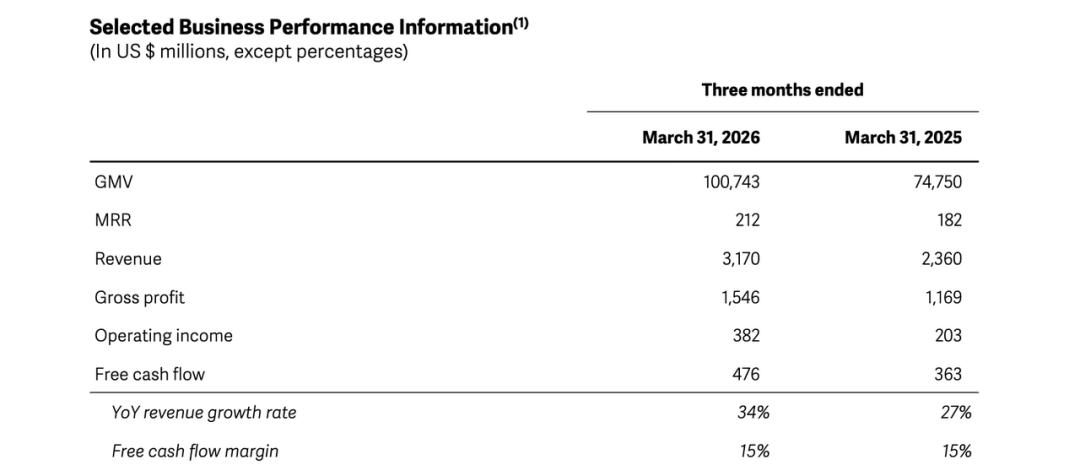
Figure: Key data from Shopify's first - quarter financial report this year
He also once said, "2026 will be the year of builders, and we will fully empower them - from the first order to full - scale expansion." What Shopify is currently doing is "paving the way for the new era of AI e - commerce" - providing AI and full - stack e - commerce infrastructure for merchants, developers, and partners.
Currently, Shopify has taken a series of actions around its AI strategy and product innovation. They can be roughly divided into the following three aspects:
1 Fully layout Agentic Commerce (also known as intelligent agent business, which means that AI agents replace consumers to shop and complete the whole process from demand identification, product search, price comparison, negotiation to order placement and payment) to enable independent website merchants to sell products on the AI platform.
Shopify believes that AI chat is the next frontier in e - commerce. The place where consumers discover products is shifting from traditional search engines to various AI dialogue interfaces, and Shopify wants to enable merchants to access the latest AI channels "out of the box". For this reason, in December 2025, Shopify officially launched "Agentic Storefronts". It can help merchants on the Shopify platform be accurately and quickly discovered on AI platforms such as ChatGPT, Perplexity, and Microsoft Copilot.
This is supported by three links: Shopify Catalog (i.e., the Shopify product library), UCP (Universal Commerce Protocol), and the unified management backend. Shopify Catalog uses real signals from millions of merchants and products to process data in a structured way, enabling AI to discover and understand products. UCP is an open - standard protocol jointly launched by Google, Shopify, Walmart, Etsy and other e - commerce platforms to solve the interaction problem between AI agents and e - commerce platforms/merchants. The unified management backend allows merchants to sell products to all AI dialogue "scenes" with just one configuration, manage orders across platforms, and attribute independently according to AI channels.
2 Systematically upgrade AI tools to transform AI from a "passively responsive assistant" to an "actively decision - making partner".
In terms of using AI to help merchants improve operational efficiency, Shopify has two core products - Magic and Sidekick. Magic is a series of integrated free AI functions that can generate product descriptions, create marketing images, conduct email marketing, edit social media copywriting, and provide intelligent customer service responses. This year, new functions such as "brand tone cloning" were also launched. Sidekick is a conversational agent. When merchants open the chat sidebar on any page in the backend and describe what they want to do in natural language, it will plan, execute, and report the results.
When Sidekick was launched a few years ago, it was just a simple chatbot. However, after Shopify released a major version update (Shopify Edition Winter ’26, including more than 150 function upgrades) at the end of 2025, Sidekick was transformed from a passively responsive assistant to an actively decision - making support. For example, Sidekick Pulse can actively monitor and analyze data and push suggestions for adjusting operational actions in the backend. With conversational editing, merchants can change the store design just by speaking. Custom App generation can build customized small apps in the management backend to handle specific internal workflows.
3 Open up externally, allowing merchants to introduce "talented people" in the AI field to take over operational work.
In April this year, Shopify announced the launch of the AI Toolkit for merchants and developers, allowing mainstream AI tools such as Claude Code, Cursor, Gemini CLI, Visual Studio Code, and Codex to access the Shopify ecosystem through plugins, Agent Skills, or MCP (Model Context Protocol).
In other words, Shopify allows merchants to introduce external AI agents into their independent website backends to take over various store operation tasks. In the past, merchants had to pay for Shopify plugins or outsource and allocate corresponding operational personnel to complete these tasks. Now, they only need to issue simple instructions or access corresponding skills to complete the tasks.
This series of "AI transformations" is obviously effective. Data shows that since 2025, the AI - driven traffic of Shopify stores has increased eightfold year - on - year, and the order volume from AI search has increased by about 13 times. Various AI tools make independent website operation simpler, more efficient, and lower - cost, further reducing the entry threshold for merchants. And opening up AI channels has enabled independent websites to obtain unprecedented and currently low - cost new traffic. Reflected in Shopify's own performance, more merchants entering the market and more merchants becoming active have naturally driven up core indicators such as its MRR (Monthly Recurring Revenue, the core revenue indicator of SaaS subscription - based enterprises, which measures the predictable recurring revenue per month).
The SaaS platform evolves into an "AI - native e - commerce operating system"
Shopify is quite representative, but in this wave of AI, no one wants to fall behind. As an industry insider said, currently, globally, SaaS is being underestimated, and only AI remains. It's not a one - or two - year thing, but a matter of the next five to ten years, so one has to stay in the game.
In addition to Shopify, taking SHOPILINE and Shoptop, two mainstream players in the cross - border e - commerce independent website ecosystem, as examples, it is a consensus to increase investment in the AI strategy and redefine their own value.
In November last year, SHOPILINE officially released the theme of SHOPLINE's new OS 3.0 at the "2025 SHOPLINE Global Ecosystem Symbiosis Conference". The core message is to provide a systematic growth foundation for brand expansion overseas with stronger performance, a more open ecosystem, and full - link AI capabilities.
According to SHOPLINE's official introduction, in terms of AI empowerment, relying on the large - model capabilities of private deployment, it has implemented multiple intelligent products such as online intelligent customer service and website - building coding assistants, with an adoption rate of over 90%. Relying on AI - built intelligent plugin functions such as search, recommendation, and advertising, it brings over tens of millions of dollars in natural conversion transactions for merchants every week. At the same time, it is also promoting a conversational shopping experience for consumers to improve the user interaction mode of independent websites in a result - oriented manner.
Regarding the new traffic introduced by AI channels for independent websites, the actual measurement data of the SHOPLINE platform shows that the number of visitors and traffic from AI channels have increased by about 775% and 675% year - on - year respectively, and the average conversion rate has increased by 53.9% year - on - year. The low base and low proportion behind the high growth rate indicate the huge incremental space for AI e - commerce channels. "We have rich tools and AI - friendly structured data to support the large model in collecting multi - modal data, enabling merchants to obtain more GEO/AEO traffic," said a relevant person in charge of SHOPLINE.
In addition, in May this year, SHOPLINE also cooperated with Accio Work, the cross - border business AI Agent workbench under Alibaba, to launch the "SHOPLINE Store Builder" plugin. Through three AI agents, it helps merchants complete business processes such as website building, product listing, and development more simply and quickly in a conversational way.
Shoptop officially released an AI - native e - commerce operating system (AI - native e - commerce OS) in April this year and simultaneously implemented an AI Agent intelligent product matrix, such as the website - building intelligent agent Shoplazza AI, the visual creation intelligent agent LazzaStudio, the advertising placement intelligent agent AdValet, and the operation management intelligent agent Athena, forming an agent - collaboration system to break data silos and process fragmentation.
Its relevant person in charge explained that in the past, Shoptop served over 650,000 merchants globally as a professional SaaS platform. Now, relying on the AI - native architecture and intelligent agent technology, it integrates the originally fragmented and decentralized cross - border services into an integrated intelligent system. AI capabilities are deeply embedded in the entire business scenarios of cross - border e - commerce independent websites from construction to growth, achieving a closed - loop of "demand input - intelligent generation - automatic execution - continuous optimization".
Perhaps the expression methods and implementation rhythms of each company are different, but their attitudes towards the variable of AI are the same - seize it to get the ticket to the next season. Everyone also clearly knows that to truly build the 'e - commerce infrastructure for the AI era' is by no means simply adding AI functions to existing businesses.
"Although no one can currently clarify what the final form will be, it is certain that everything from the underlying architecture, product logic to the interaction mode needs to be reconstructed with AI as the 'water, electricity, and gas' to be called a real AI - native e - commerce operating system or an AI - native business ecosystem," an industry insider pointed out.
Re - evaluating the value of independent websites, who can catch the new trend?
Undoubtedly, many SaaS platforms have significantly lowered the threshold for independent websites. In the early days, if a merchant wanted to build an independent website, they had to deploy it themselves and write code. The emergence of Shopify and others has almost made "website building" an "out - of - the - box" thing.
From about 2020 to 2022, independent websites were the most - concerned by Chinese overseas - going merchants. At that time, influenced by some leading players, more people saw the potential of independent websites, while the disadvantages of third - party platforms were magnified. Various SaaS platforms emerged, jointly promoting the rapid development of the cross - border e - commerce independent website business.
Behind this is the DTC model carried by independent websites, which is exactly suitable for the current environment of overseas - going merchants - upgrading from over - production and rapid circulation to a more controllable supply chain and a more private - domain - based operation model.
However, soon people began to disillusion with independent websites. A practitioner said bluntly, "Although the entry threshold for independent websites has been lowered, the threshold for truly making it successful is still high. Considering the operational difficulty and cost comprehensively, many small and medium - sized sellers realized that this is not something that can be easily achieved." After 2023, with the rise of new platforms such as TikTok, Temu, and SHEIN providing more options for merchants, independent websites gradually cooled down.
But now, new changes are occurring.
From the perspective of the rise of AI - agent commerce, the question that merchants need to answer is: When consumers no longer open search engines or e - commerce platforms but directly ask AI for shopping advice, can their brands and products appear in the dialogue? And the question that "Shopify and others" need to answer is: Can their value to merchants change from helping them open stores to ensuring that they can be seen, understood, and traded by AI?
In other words, if the previous - generation SaaS platforms lowered the threshold for building independent websites, then the new - generation independent website service providers driven by AI, or the 'AI - native e - commerce operating system', aim to lower the threshold for independent website operation to almost zero and help merchants gain an advantage in terms of new traffic introduction.
Currently, independent websites are indeed the first to enjoy the dividends of AI traffic. For example, the e - commerce checkout function of ChatGPT was first connected to Shopify. Merchants running independent websites not only have free new traffic but also can directly complete sales conversions.
According to public data, as of December 2025, the monthly active users of ChatGPT had reached 880 million, and relevant calculations showed that 2.1% of ChatGPT conversations in 2025 involved product purchases. Based on this calculation, the total volume of product transactions that just the ChatGPT AI platform can bring is quite considerable. And the numbers are still growing. As of May this year, the global monthly active users of ChatGPT have exceeded the 1 - billion mark.
In addition, in the AI era, independent websites will also undertake more tasks in brand building. According to the analysis of multiple digital marketing service providers, brand independent websites have a relatively high weight in AI information sources. Generally, AI will first search for information on the brand's official website and then look for verification information across the network. The content assets of independent websites are independently controlled by merchants, and product introduction pages, FAQs, brand stories, etc., can all be understood and quoted by AI.
Of course, this will also be a reshuffle. When AI brings technological equality for independent websites and the migration of traffic entrances, in a sense, both large companies, small teams, and even "one - person companies" are on the same starting line. The same is true for their service providers - the "Shopify and others" that are undergoing transformation.
This article is from the WeChat official account "Yibang Power", author: He Yang. Republished by 36Kr with permission.