AI Payment: WeChat and Alipay are Busy Laying the Groundwork, While Agents Are Still Finding Their Feet
Recently, "AI payment" has suddenly changed from a concept to a head - on competition among industry giants.
First, JD.com released the first domestic autonomous payment protocol for intelligent agents, the A2P2 protocol, on June 11th, writing rules for issues such as "how agents are authorized" and "how the payment link is audited". Immediately afterwards, Alipay made its "biggest - ever overhaul" on June 16th. The AI - version of Alipay started an internal test with invitation codes. Functions like registering for medical appointments, using the medical insurance card, placing orders, and comparing prices can all be driven through conversations with Abao. Less than a day later, WeChat Pay launched an "AI - exclusive card". Users can express their consumption needs in conversations with agents, and the intelligent agents will complete the recommendation, order - placing, and payment processes. This function is already supported in Tencent's desktop intelligent agent product, WorkBuddy.
The three giants are all betting on "AI payment" at the same time. However, don't get too excited just yet. Based on the actual tests by 「AIX Finance」 and the analysis of industry insiders, AI payment is still stuck in the middle ground between auxiliary decision - making and proxy execution, and is still far from true agent - autonomous payment. Alipay has completed the payment process, but still requires users to manually confirm the payment. WeChat has achieved a closed - loop payment system, but at the cost of restricting the main account's permissions and locking funds within a "quota".
So, the question is, where are the different AI payment routes in China and abroad currently? Since AI payment is far from mature, why are Alipay and WeChat in such a hurry to enter the market now?
01. Four Forms of AI Payment at Home and Abroad
The idea of "letting AI agents trigger transactions" first emerged overseas. In November 2024, payment giant Stripe released the Stripe Agent Toolkit, a payment plug - in for agent workflows, which proved the feasibility of a closed - loop AI payment system. However, it was Alipay in China that truly introduced this process into consumer scenarios. At the Bund Summit in 2025, Alipay officially launched "AI Payment" and was the first to implement it in Luckin Coffee's AI order - placing assistant, Lucky AI, achieving a full - link connection from order - placing to payment by the intelligent agent.
In the past two years, a large number of domestic "AI payment" - related products have emerged, which can be roughly divided into four forms.
Type 1: AI Controls the Entire Payment Link
This is currently the only form recognized as "AI payment" in the industry. Representative products include the Lucky AI of Alipay × Luckin and the AI - exclusive card of WeChat Pay.
Its characteristic is that when users reach the order - placing and settlement step, they will not be redirected to a separate "go to settlement" page. The settlement process is smoothly integrated into the existing in - page conversation, and in some cases, this step can even be skipped, with AI handling the operation.
For example, users can have a conversation with Lucky AI in the Luckin Alipay mini - program to select products and place orders without leaving the existing conversation page or reopening the Alipay app to make payments. However, users still need to manually confirm the payment password at the end.
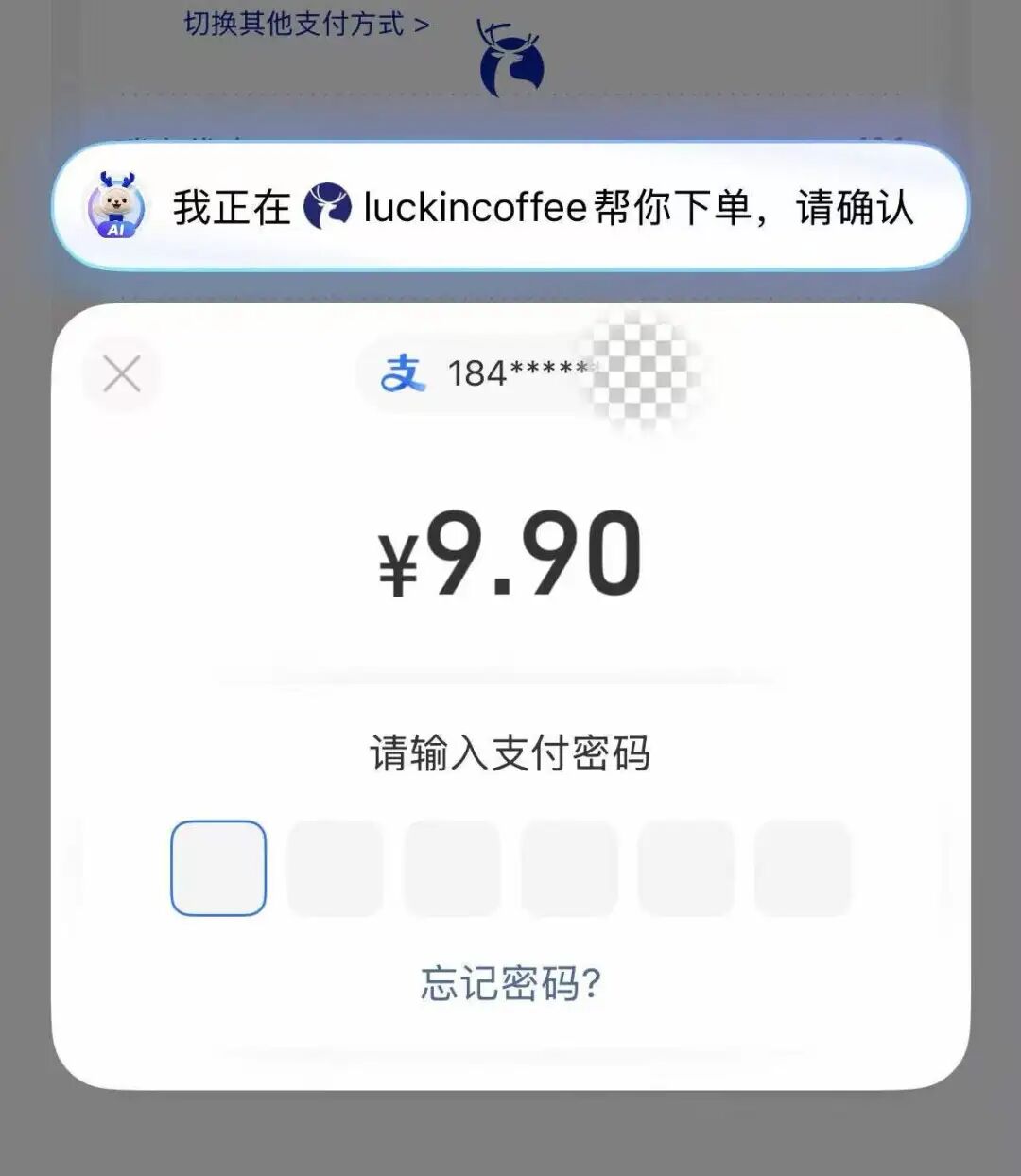
Users can let AI place orders in the Luckin Alipay mini - program
This kind of closed - loop operation calls the original functions of the Internet cashier, such as fund deduction and reconciliation, through a dedicated controlled entrance for agents.
Type 2: AI Handles the "Shopping Guide" Task, and the Final Fund Deduction is Operated by the User
Doubao's cross - platform price comparison on mobile assistants, Meituan's "Xiaomei" for order - bundling and address filling, and the 「Instant Checkout」 experience once launched by ChatGPT all belong to this type.
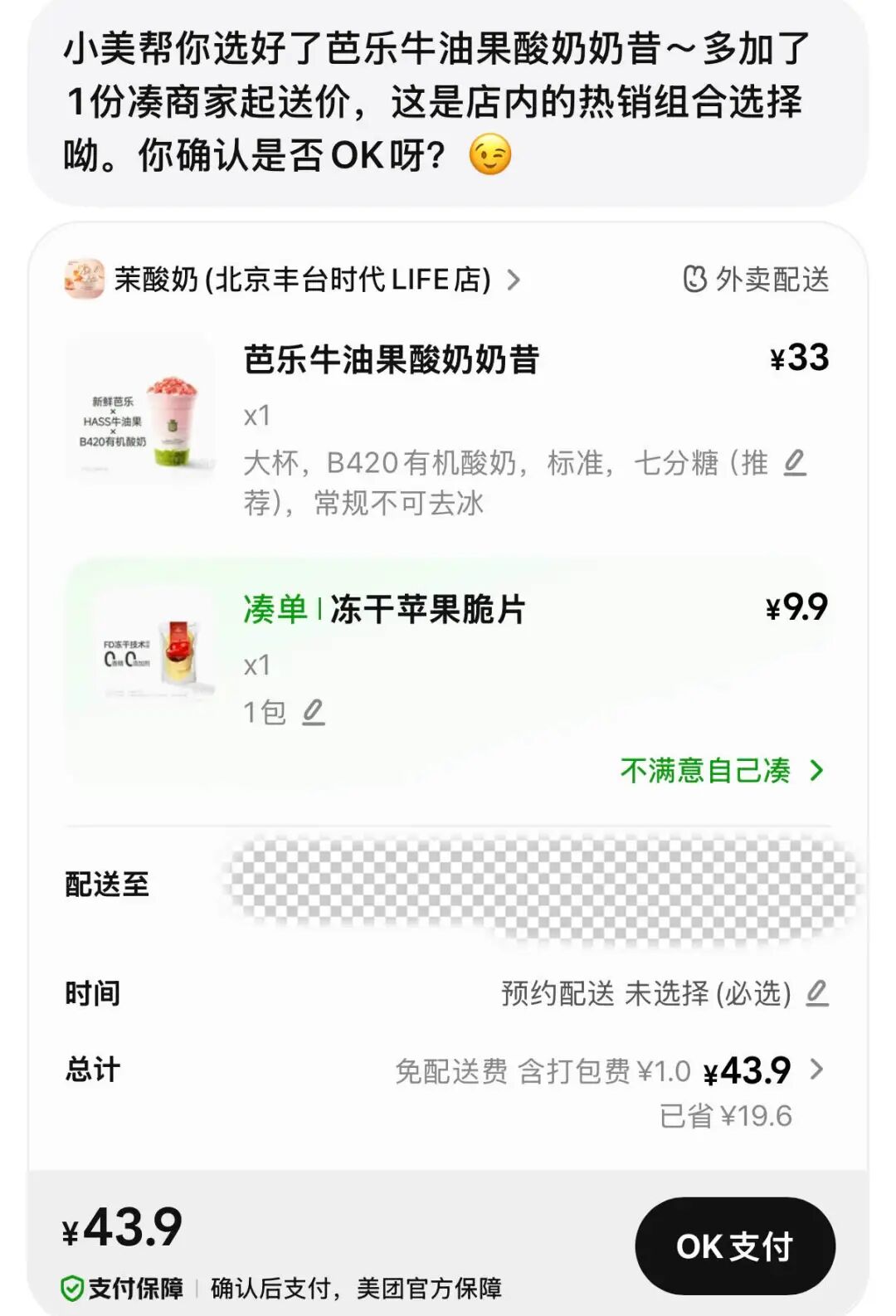
Meituan's Xiaomei can help recommend products and bundle orders
The user experience is similar to that of the first type. AI completes most of the process, but the final payment must be manually confirmed by the user. The difference lies in the underlying technology. Fund deduction still relies on the general cashier, and the platform has not created a new AI payment channel.
Zhao Jiangjie, a senior agent industry insider, told 「AIX Finance」 that if a complete AI shopping process is broken down, agents can mainly participate in the first four steps: understanding the user's intention, searching for products, adding items to the cart and bundling orders, and generating an order and initiating a payment request. However, the final step of authorizing fund deduction still requires human intervention.
Therefore, the industry is more inclined to call this type AI shopping or AI shopping guide rather than strict AI payment.
Type 3: "Underlying Infrastructure"
JD.com's ClawTip (a micro - payment infrastructure for the agent ecosystem), Du Xiaoman's ClawPay (encapsulating payment capabilities for Skill access), UnionPay's APOP (an open protocol framework for intelligent agent payment), and overseas products like Visa TAP and Mastercard AP4M all belong to this type. They are not direct - to - consumer payment products.
Zhao Jiangjie said that this type is more like abstracting the AI payment models already in use by themselves and their competitors into a set of standards. However, the problem is that if no one adopts the protocol, it will become an ignored PDF.
Type 4: Completely Jumps out of the Human Account System and is Native Settlement between Machines
For example, the x402 protocol launched overseas allows AIs to pay each other with stablecoins to buy computing power and data. The entire process has nothing to do with human accounts. This is the most advanced form at present, and there is no domestic involvement for now.
It is not difficult to see that although there are many players involved in AI payment at home and abroad, most are still at the shopping guide or infrastructure level, and only a few can achieve autonomous payment. Moreover, the routes of the few players who have achieved a closed - loop system are different. Overall, AI payment is still in a very early stage.
02. For AI Payment: Alipay Chooses to Open Up, While WeChat Chooses Isolation
Among the many domestic "AI payment" participants, Alipay and WeChat Pay are the rare players that simultaneously possess a national - level entry point and licensed payment qualifications, which makes them the real focus of this competition.
The two have the same general direction, which is to minimize manual operations, but they have different solutions for "AI handling money".
Alipay chooses to open up, integrating product selection and payment into the same conversation. It allows agents to directly access real - money accounts through rules and embedded verification. WeChat chooses isolation, using an AI - exclusive card to "lock" the available funds separately, preventing it from touching the main account. In essence, it sacrifices some flexibility for security.
This results in different positioning of their AI payment products.
Let's first look at Alipay. Since the second half of last year, its core move has been to open up its AI payment capabilities as much as possible.
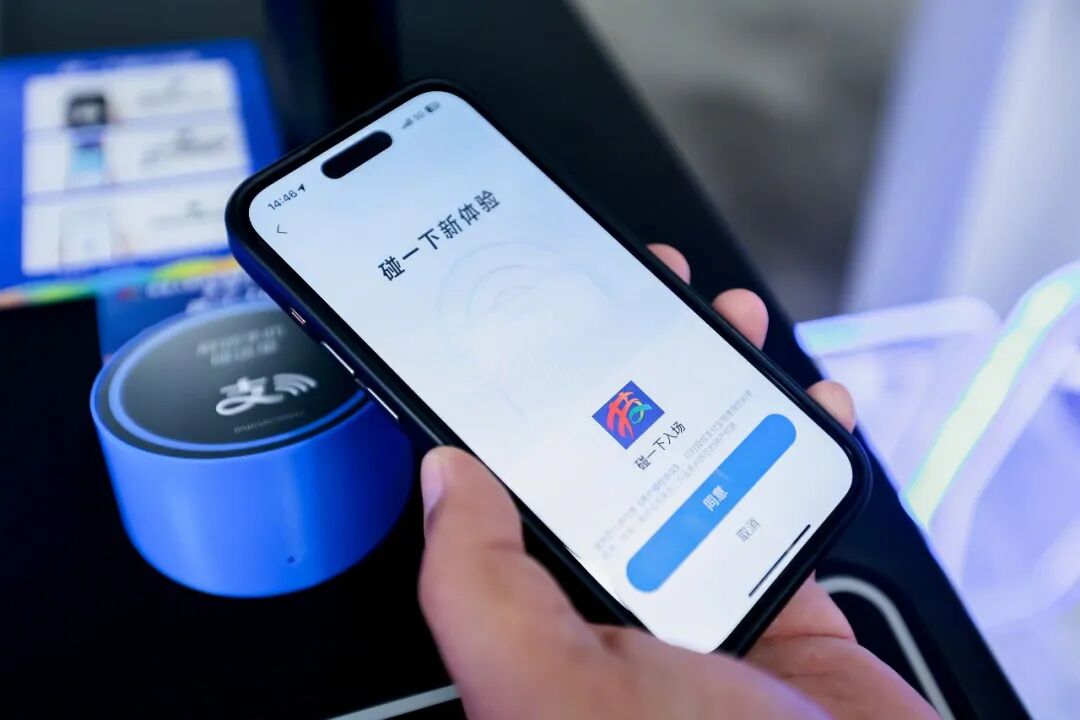
Image source / Alipay's official Weibo
In July 2025, Ant Group opened the MCP (Model Context Protocol) interface. Third - party intelligent agents can directly access Alipay's fund - deduction capabilities, connecting the complete link of intelligent agent invocation, service quotation, user confirmation, and automatic payment. This means that not only Alipay's own products can use AI payment, but in theory, any third - party AI application that accesses MCP can also use this channel.
However, after opening the channel, how to ensure fund security? At the beginning of the year, Alipay jointly launched the ACT protocol with Qianwen, Taobao Flash Sale, Damai, and Alibaba Cloud's Bailian, trying to solve the most difficult security and trust issues in AI payment. According to Alipay's official statement, the currently supported scope includes general intelligent agents such as Qianwen, Claude Code, and Hermes Agent, as well as hardware scenarios such as smart glasses and smart cockpits.
Alipay's ambition is not just to "help Luckin sell more coffee". It wants to become an AI payment channel that can be repeatedly used. No matter which AI assistant users use or which application they open, as long as it involves payment, they can use Alipay.
Zhao Jiangjie pointed out that in Alipay's AI payment, agents can access users' real - money accounts. This includes not only daily consumption such as taking a taxi, ordering takeout, and paying bills but also transferring money, buying funds, and managing investment accounts. This means that Alipay is giving agents a key to an account with higher permissions, but currently, the boundaries are still restricted by rules and not fully opened.
In contrast, WeChat's "isolation route" is more cautious.
Currently, the implementation entry point for WeChat's AI payment is its desktop intelligent agent, WorkBuddy. The scenarios running inside are mainly vertical agents such as the Meituan Life Assistant, and the ecological coverage is relatively limited.
In terms of funds, WeChat has opened an AI - exclusive virtual card for users, which is isolated from the main account and the bound bank card. The maximum amount that agents can spend is equal to the amount users deposit into the card, and the funds are used for specific purposes.
Zhao Jiangjie summarized the technical route differences between the two as follows: WeChat allocates a certain amount of money for agents to spend, while Alipay gives agents the key to the account within a certain boundary. The former is safer but more restricted, while the latter is more radical but is considered closer to the ultimate state of agent - native payment.
However, it should be noted that there is still a gap between Alipay's current actual user experience and its described open - ended vision. In most scenarios, the final confirmation step is still left to the user. Some netizens even said that when using Abao to order takeout or buy clothes, the conversation part is novel, but they are still required to enter the password at the end, and the experience is even worse than directly searching on Taobao. Currently, it gives the impression of being more like a "shortcut with a voice" rather than an agent that can complete tasks for users.
03. AI Payment is Far from Mature, but the Payment Entry Point Waits for No One
Currently, AI payment is still far from becoming an infrastructure. Even within Alipay's own system, AI mainly replaces search and selection with conversation and redirection, and cannot truly operate on behalf of users.
「AIX Finance」 conducted actual tests on multiple tasks of the AI - version of Alipay, such as service retrieval, shopping order - placing, and government - related services. It was found that when completing tasks like "finding the entry point and opening the page", it can instantly access Taobao Flash Sale, the mobile phone service hall, the electronic medical insurance card, and even the medical appointment registration page. However, it often gets stuck when going further.
For example, although the appointment registration page can be opened, users still need to select the department and available appointment slots by themselves. It can open the Taobao page, but the recommended products do not match the user's instructions, and it cannot add products to the shopping cart autonomously. When asked to place a takeout order, it pops up a page waiting for the user to manually confirm the payment instead of showing "payment completed".
Abao can enter the Alipay ecosystem and identify user instructions to open the correct service entry points. However, once it crosses the entry point and enters third - party mini - programs, the executable permissions of the agent sharply decrease. It cannot read the data of the third - party platform, has difficulty legally controlling its state, and cannot obtain authorization from the third - party platform.
The root cause of this problem is related to the APP ecological architecture. It was originally designed for "human finger operation" rather than for agents. That is to say, Abao's current ability ceiling is limited by interfaces and permissions.
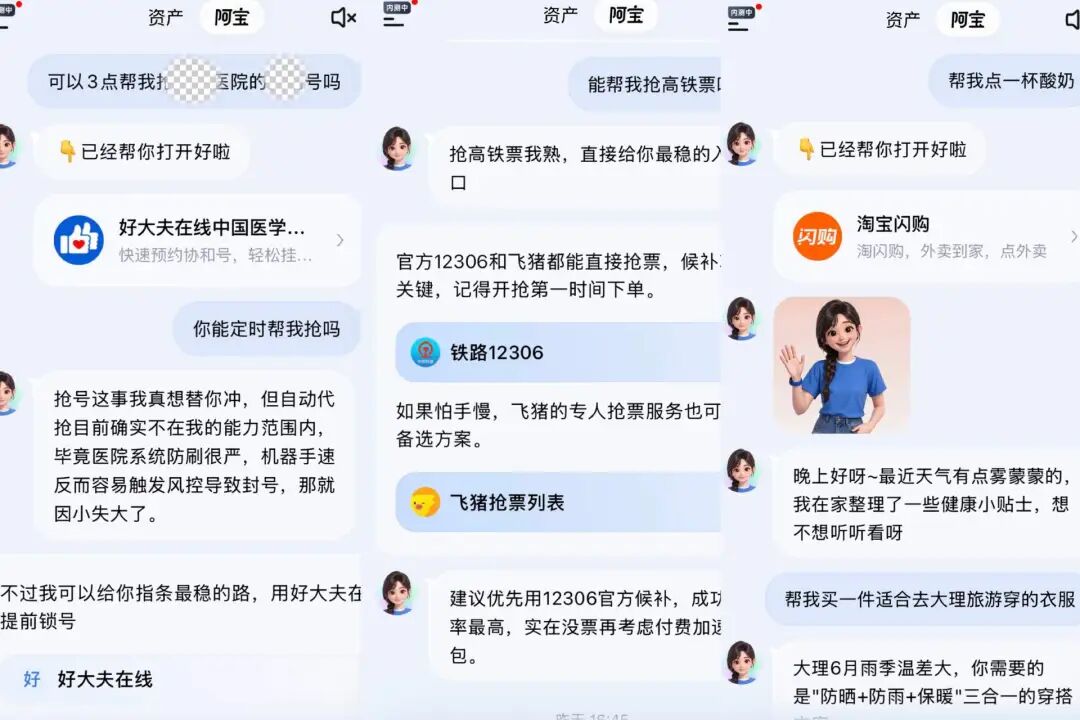
Abao can instantly activate the entry points for appointment registration, ticket - grabbing, and takeout ordering, but cannot directly complete further operations with a single click
The above - mentioned problems are, on the one hand, due to technology. Agents still have obvious shortcomings in intention understanding and memory support.
Zhao Jiangjie said that agents are not yet mature in intention understanding and memory support. For example, when a user asks it to buy a piece of clothing suitable for traveling, the difficulty lies not in "buying" but in "suitable". This word involves comprehensive factors such as the climate of the travel destination, personal preferences, and budget. Currently, agents do not have a stable way to understand this and do not have enough context to define it.
Therefore, currently, AI can barely handle low - value, high - frequency, and highly standardized scenarios, such as paying phone bills and buying coffee. Once it encounters decisions that require comprehensive judgment, the error rate increases sharply.
In addition to technology, there are two other higher barriers restricting AI payment.
One is cross - platform restrictions.
A complete AI payment chain often needs to span multiple different types of platforms. For example, an agent may need to compare prices on Taobao, place an order on JD.com, and make a payment through Alipay at the same time. This means that each involved platform needs to actively open its payment interface, which involves the commercial interests of each platform, such as traffic, data, and commission distribution. No one will easily give up these interests.
The other is supervision.
In case of disputes over AI - autonomous payment, such as wrong purchases, over - priced purchases, or malicious instructions, there are no clear regulations on how to determine responsibility and who should be responsible under the existing legal framework. Moreover, even if supervision allows it, whether users are willing to truly hand over the payment authorization to AI is still unknown.
Given the immature technology, non - interoperable platforms, and incomplete supervision, why are Alipay and WeChat still entering the market now?
Because payment is a track that is extremely difficult to replace once established. Whoever lays the channel first and sets the rules will gain an advantage. WeChat Pay and Alipay must launch their AI payment products now. If they enter the market after it matures, the cost will be several times higher.
An Internet observer compared Alipay's current AI payment protocol to the birth of the escrow payment system back then. "When Taobao was launched in 2003, no one dared to transfer money directly to strangers. The escrow payment system acted as an intermediary. Today's AI payment protocol is doing the same thing, using rules and standards to lock in the foundation of the next - generation payment entry point. If you are one step late, you may not even have the chance to participate in the game."
Meanwhile, a more fundamental migration is taking place. Agents are replacing APPs. When agents become powerful enough, more and more consumption decisions will be made in AI dialog boxes. The dialog box itself will become a new payment entry point. On that day, the one whose payment channel is default - called by AI will hold the key to the next - generation settlement entry point.
AI payment has not