36Kr Exclusive | Lenovo Star and Shunwei Capital Co-Lead the Round, AI Computing Power Center Perception and Efficiency Management Solution Provider Completes Angel Round Financing
Author | Qiao Yujie
Editor | Yuan Silai
Yingke learned that XinGantong Technology Co., Ltd. (hereinafter referred to as "XinGantong") recently completed an angel - round financing of tens of millions of yuan, co - led by Lenovo Star and Xianfeng. This round of financing will be mainly used for chip R & D iteration, product verification, and market expansion.
As the scale of large - model training continues to expand and commercial services are launched, the construction of AI computing power infrastructure urgently needs efficient operation. Meanwhile, high - performance GPUs have also pushed computing power into an era of high energy density and high power consumption.
From dozens of GPUs in a single cabinet to a cluster of ten thousand cards, power supply, heat dissipation, and energy consumption management inside data centers are becoming new technological bottlenecks. At the same time, emerging directions such as space computing power and orbital data centers have also put forward higher requirements for system stability and precise sensing capabilities. Against this background, XinGantong chose to enter from an increasingly crucial link in the computing power infrastructure - current and spatial magnetic field sensing.
In the field of current and power sensing, traditional Hall sensors have problems such as high noise and large temperature drift. In high - density and high - current scenarios, it is difficult to balance the range and resolution, and they cannot meet the requirements of AI servers for refined power management. Traditional fluxgate sensors use a winding structure, which is large in size and low in integration, and it is also difficult to meet the requirements of high - frequency applications.
Zhang Naichuan, the co - founder of the company, introduced to Yingke that currently, the industry generally adopts a hierarchical monitoring scheme: voltage - dividing resistors are used at the board level for coarse - grained detection, Hall sensors are used at the module level, and traditional fluxgate sensors are used at the bus level. Due to the large differences in the range, accuracy, and output characteristics of the three types of sensors, the data cannot be unified, and it is difficult to form real - time monitoring and scheduling capabilities throughout the entire system.
For today's AI data centers, simply "seeing" the system status is no longer enough. It is necessary to establish a unified, real - time, and predictable sensing system to support energy - efficiency optimization and intelligent operation and maintenance.
Based on this idea, the company has developed a chip - level solution that can achieve semiconductor integration through technologies such as MEMS comb - tooth structure, 3D stacked packaging, CMOS analog front - end, high - speed ADC, and on - chip calibration algorithms. It compresses the originally large - scale fluxgate technology to the chip scale, achieving digitization and high integration while maintaining high accuracy. It is understood that the company's core fluxgate chip has completed its first tape - out, reaching an accuracy of 1nT and a linearity of 0.5‰.
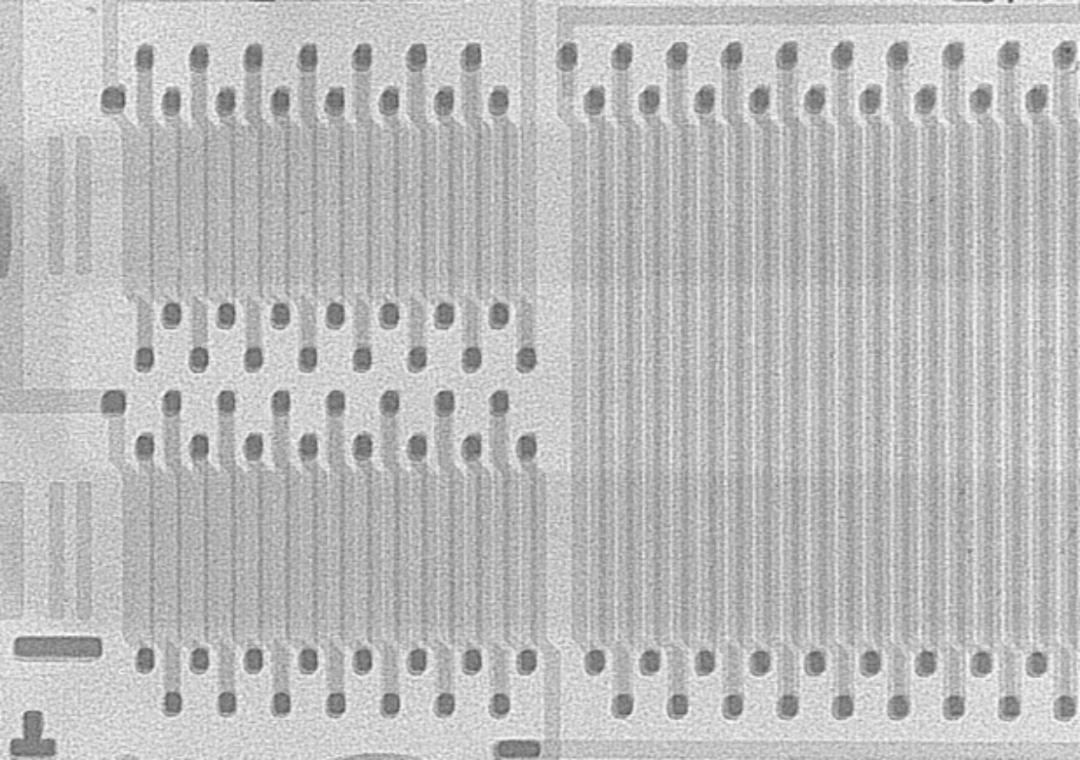
The successful tape - out of XinGantong's PerMAG3001 with a comb - tooth structure (Source: Company)
Different from traditional single - point sensors, XinGantong emphasizes the ability of "multi - technology stack integration". It has built a four - layer technology system from chips, ASICs, systems to the AIDC computing power and efficiency intelligent allocation platform. The same set of technical architecture can cover three scenarios: board - level, cabinet - level (Rack), and system - level (Inlet), realizing the unified collection and management of sensing data at different levels in the data center.
Once these data are connected, the system can predict the status of cabinet load, module power consumption, etc. in real - time and dynamically adjust power supply, liquid cooling, and GPU resources to achieve closed - loop optimization.
In addition to the current AI computing power centers, this solution is also applicable to the field of space computing power and simultaneously meets the key requirements for volume, weight, power consumption, and real - time response in space.
The chip - level fluxgate solution naturally has the advantages of high integration, miniaturization, and high reliability, which can meet the special requirements of the space environment for the sensing system. Currently, the company has cooperated with satellite enterprises, and the performance of relevant products has passed the preliminary verification. According to the plan, the formal module products are expected to be launched in the second half of 2026 and enter the customer testing stage.
In terms of the team, the core members of XinGantong have rich experience in the chip and intelligent sensing industries.
Niu Yuling, the founder, once served as the chief engineer of Qualcomm Snapdragon chip packaging and testing in the United States, and later served as the general manager of the US R & D center of Yijing Technology and the director of chip R & D, packaging, and testing. Zhang Naichuan, the co - founder, was responsible for the R & D and mass production of the Tudatong Robin905 lidar platform and once served as the general manager of the chip R & D and technology management department of Yijing Technology and the person in charge of the silicon - photonics chip technology of Xifeng Optoelectronics.
The following is an excerpt from the communication between Yingke and the founding team of XinGantong:
Yingke: Why emphasize the "platform" attribute of the "chip - level fluxgate platform"?
Zhang Naichuan: In traditional solutions, different types of sensors are used at different levels. Although the measurement objects are both current and power, the output data formats, accuracy characteristics, and stability are not consistent. Therefore, it is difficult to form a unified data system, let alone support system - level optimization and AI training. In addition, most traditional sensors are analog devices, which are difficult to deeply integrate with modern digital communication protocols, and the integration cost is relatively high. Therefore, there is still a strong information island phenomenon among different levels inside the data center, lacking unified scheduling capabilities.
The core value of our proposed "chip - level fluxgate platform" lies in covering three levels: board - level, module - level, and cabinet - level with the same set of technical architecture. That is: the same technical route; the same parameter system; the same data characteristics; through different product forms, realizing the full - link monitoring of the entire AIDC (AI Data Center) power system. Once the data at the board - level, module - level, and cabinet - level are collected uniformly, the data center will have system - level scheduling capabilities.
For large - model training, especially basic model training, it has a long cycle, large investment, and high requirements for system stability. In the past, many abnormalities could only be discovered after serious failures occurred. If real - time monitoring can be achieved at the board - level, intervention can be made in advance when current fluctuations first appear, such as reducing the load and optimizing power consumption, thus avoiding the spread of failures and ensuring the stability of model training.
Yingke: Why is such a sensor solution also needed in the space computing power scenario?
Zhang Naichuan: The company's initial target market was actually AI data centers. However, with the rise of concepts such as space computing and orbital data centers, we found that the demand for refined power management in the space scenario is also very urgent.
There are mainly four reasons. First, the heat dissipation conditions are extremely limited. Ground data centers can use air convection, air - cooling, or even liquid - cooling systems for heat dissipation, while there is no air convection in the space environment, and heat can only be dissipated through heat conduction and radiation. Therefore, the system has almost no excessive heat dissipation redundancy, and the requirements for power consumption management are extremely high. Second, the system is non - maintainable. Ground equipment can be replaced and repaired when it fails, but once a satellite enters orbit, the maintenance cost is extremely high or even impossible to achieve. Therefore, it must rely on a higher level of online monitoring and predictive maintenance capabilities. Third, it is highly sensitive to weight. Any additional weight will directly increase the launch cost. Therefore, space computing equipment requires sensors to be as miniaturized and highly integrated as possible. Fourth, it needs to balance radiation resistance and long - term reliability. Traditional sensors are not designed for the space environment and have natural limitations in terms of reliability, integration, and environmental adaptability.
In the space computing scenario, this type of sensor solution has become the infrastructure to ensure the normal operation of the system and is a rigid demand. Therefore, we are also gradually extending our core technical capabilities to the space computing direction.
Yingke: What is the current progress of product implementation?
Zhang Naichuan: In the aerospace field, the company's first test chip has completed tape - out and passed module verification, and its performance meets the requirements of the cooperation partner. According to the plan, formal product samples will be launched in the second half of this year and sent to customers for testing. If the test results meet the expectations, the first batch of cooperative satellites are expected to carry the company's sensor chips for in - orbit verification.
In the data center field, the company is currently focusing on promoting current detection products. Since the introduction cycle of servers and cabinets is relatively long, this year will mainly focus on customer verification and solution introduction. It is expected to start small - batch delivery next year and gradually form a business scale. Once the data center market enters the large - scale stage, the potential market space will be larger.
Investors' views:
Lenovo Star: XinGantong has entered a key link after the AI computing power infrastructure has shifted from "construction scale" to "operation efficiency". With the popularization of ten - thousand - card clusters and high - power - consumption servers, refined current and power sensing will become the underlying ability for energy - efficiency management, fault early warning, and stable training. We are optimistic about the team's reconstruction of the sensing system of the computing power center with a chip - level fluxgate solution and its extension to high - reliability scenarios such as space computing power.
Xianfeng Changqing: Whether it is current monitoring and energy - efficiency optimization in AI data centers or environmental sensing in future space computing, ocean exploration, and geomagnetic navigation, high - precision, high - reliability, and large - scale deployable sensing capabilities are required. High - performance magnetic sensing is expected to become a new key infrastructure.
XinGantong has promoted the capabilities originally limited to high - end scientific research and aerospace fields to industrial applications through chip - level fluxgate technology, greatly expanding the application boundaries of the fluxgate technology path. Currently, the company has successfully completed chip tape - out verification and achieved verification and introduction in several scenarios. The team has experience in chip design, advanced packaging, intelligent sensing, and mass production of complex systems, and has strong cross - disciplinary technology integration capabilities. We look forward to XinGantong growing into a new - generation intelligent sensing platform enterprise for key fields such as computing power, aerospace, and the ocean.